AquaShield
The cold one, and the one that lives underwater. A pure polyurea that still sprays at twenty below, skins over in seconds, and is rated for constant immersion — ponds and water features, tanks and canals, dairy barns, cold storage, wastewater and the inside of things that never dry out.
- 100% solids pure polyurea
- Zero VOC
- Sprays down to −20°F
- Made by ArmorThane
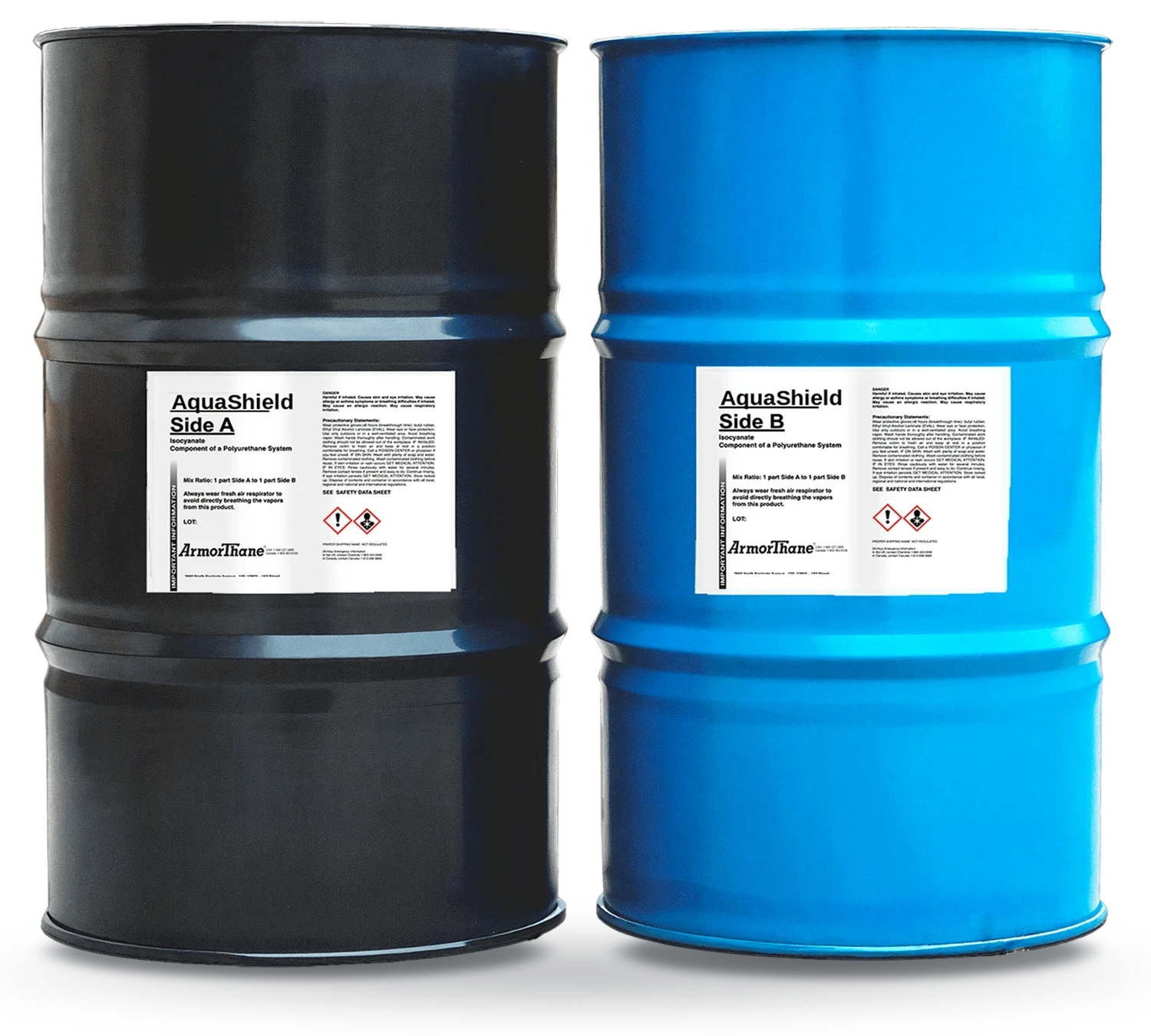
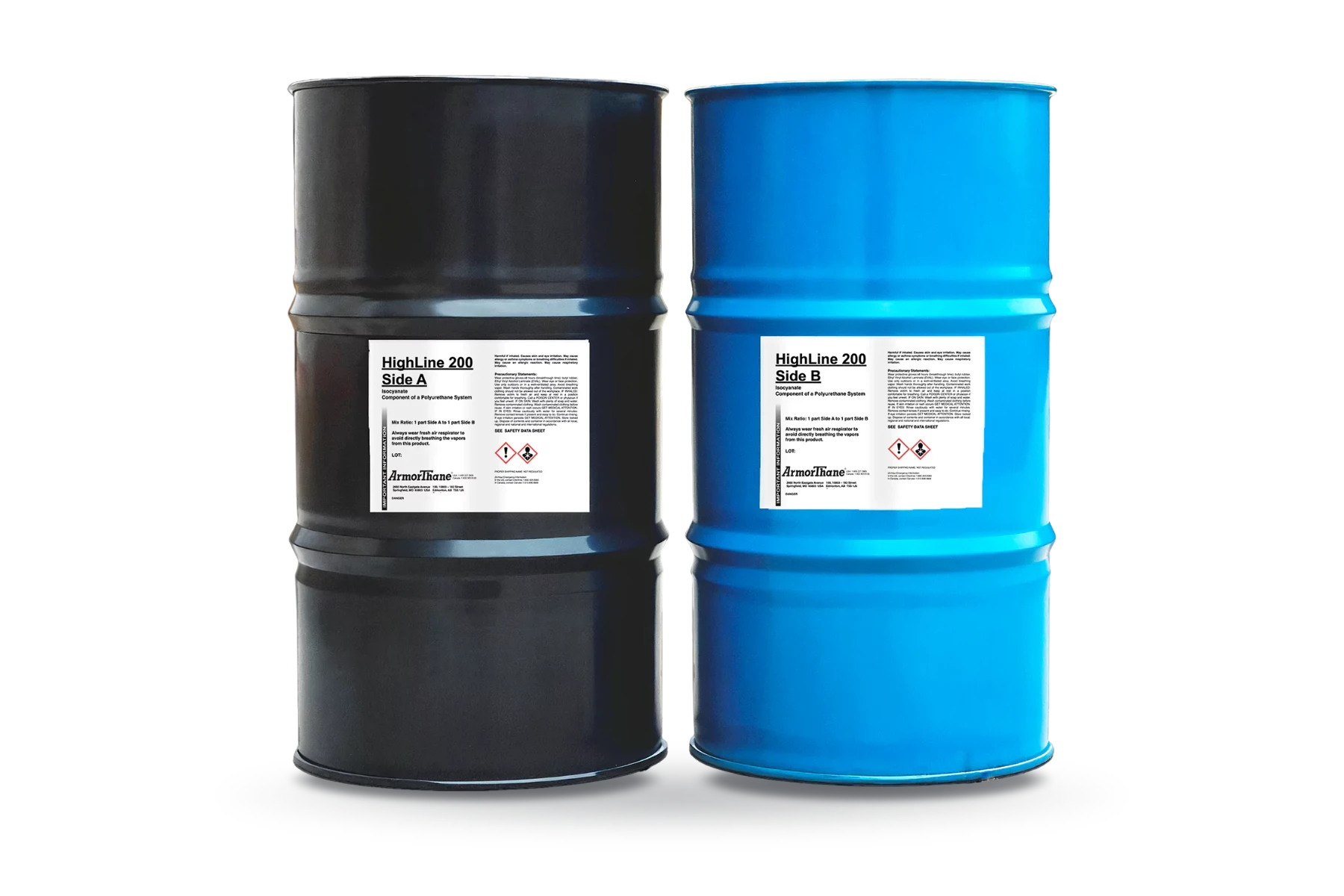
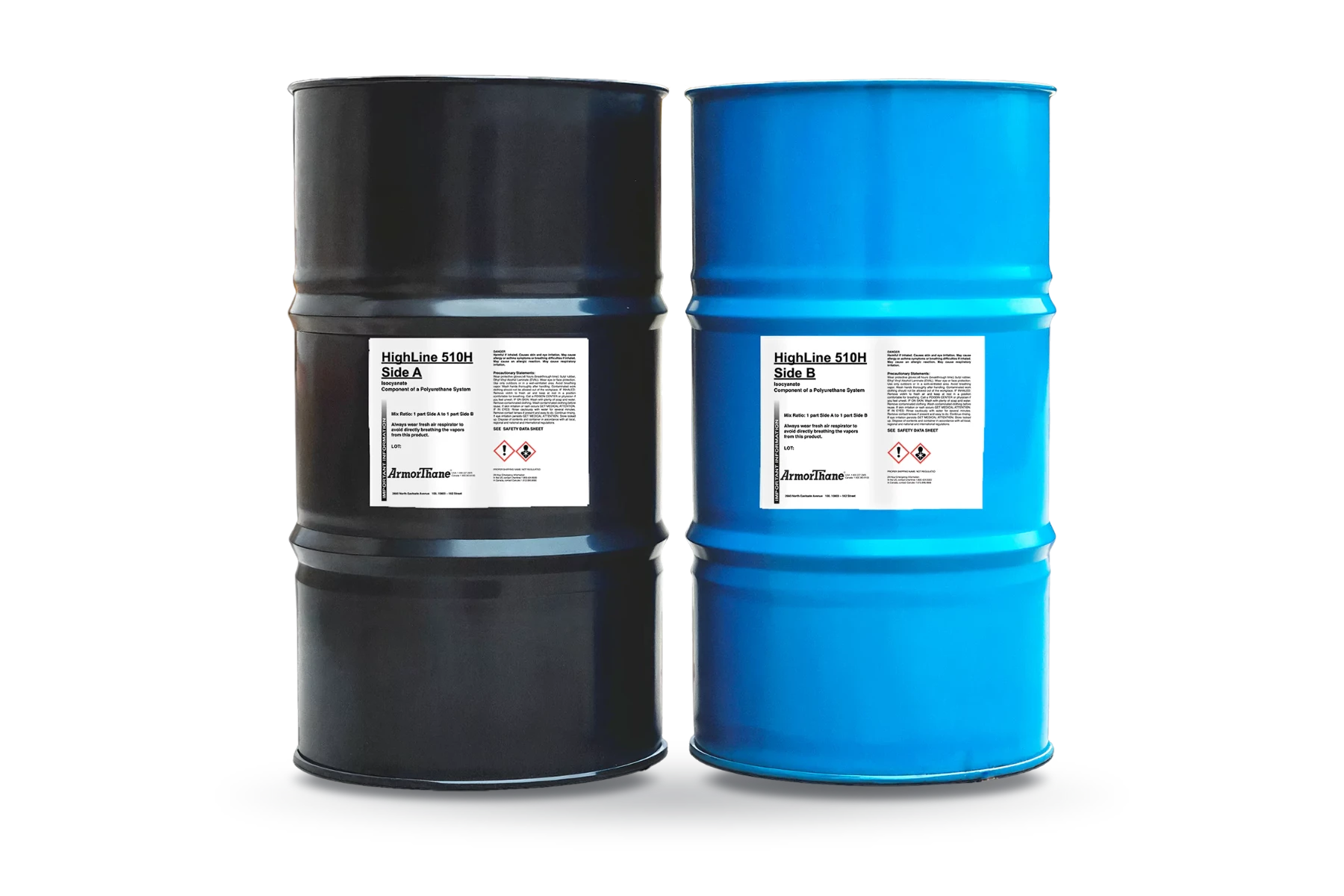
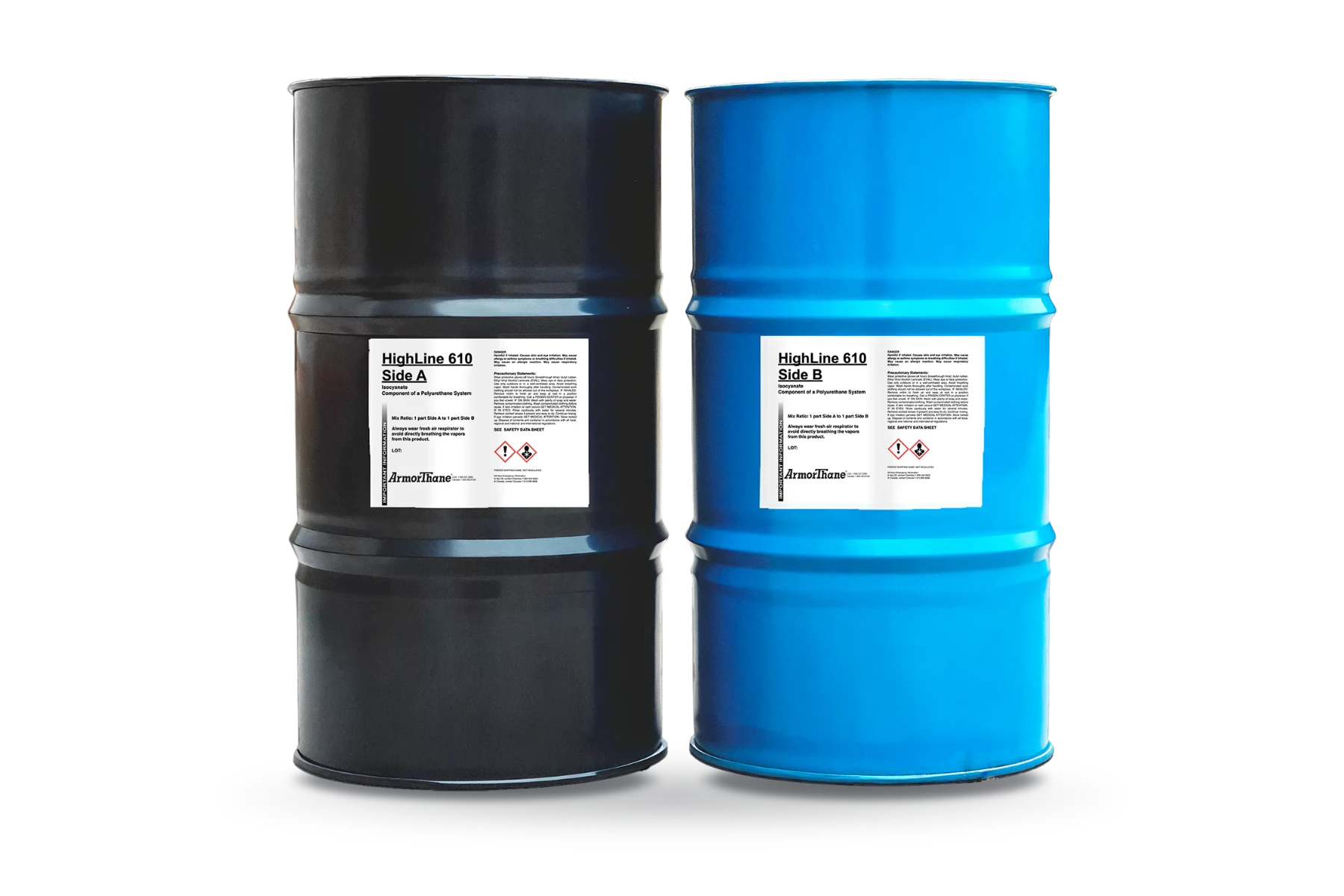
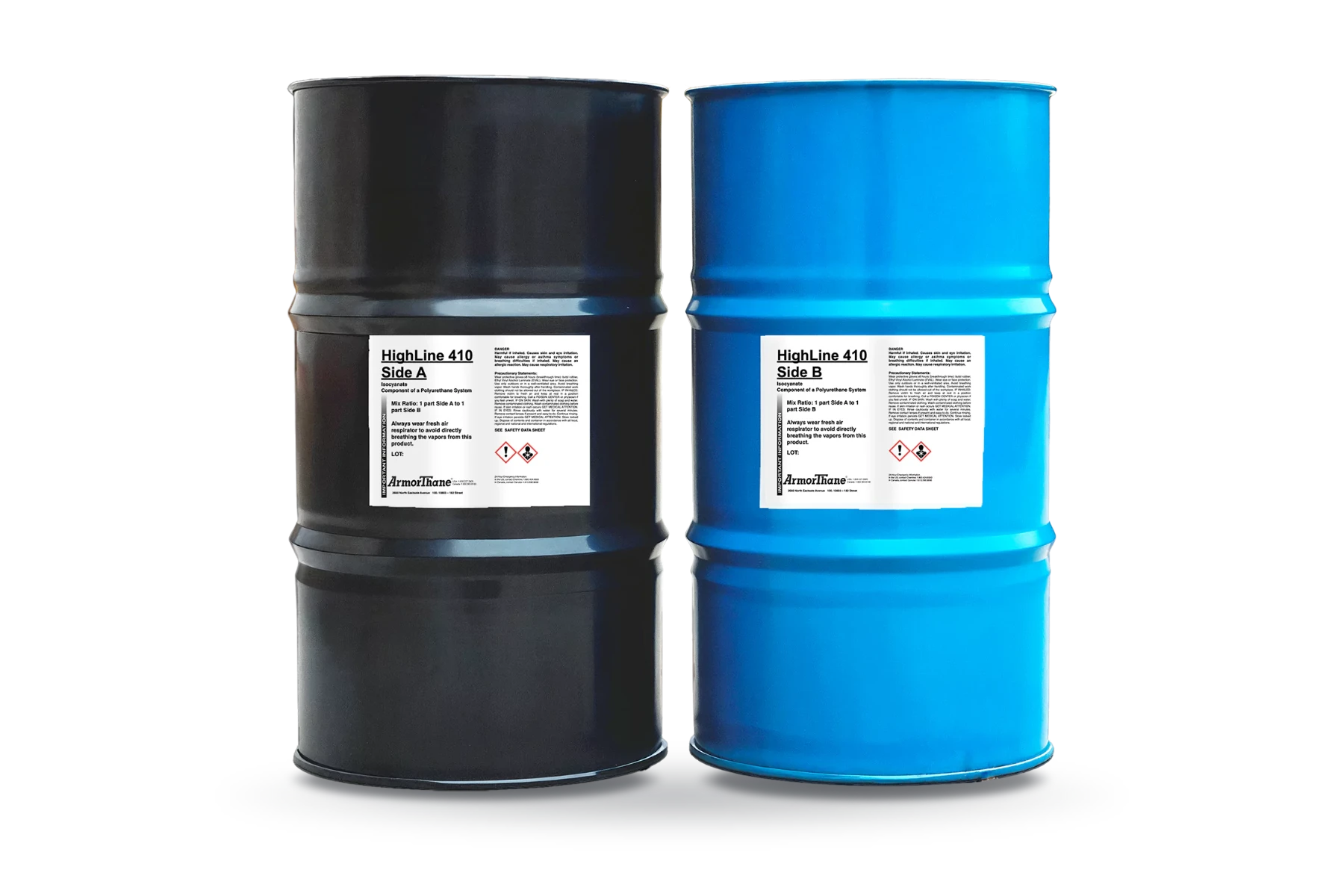
One kit is 100 gallons — a 50 gallon drum of Side A and a 50 gallon drum of Side B, metered 1:1 by volume. Both drums run with a desiccant device fitted, and neither side may be diluted.
Side A is the isocyanate, and it runs thicker than the resin side — around 100 cps at spray temperature against the resin's 50. No agitation needed, but it does need a desiccant on the drum.
Side B is the polyol resin. Power-agitate it with air-driven equipment until the color and the mixture are uniform, then pigment it. Thinner than Side A at around 50 cps.
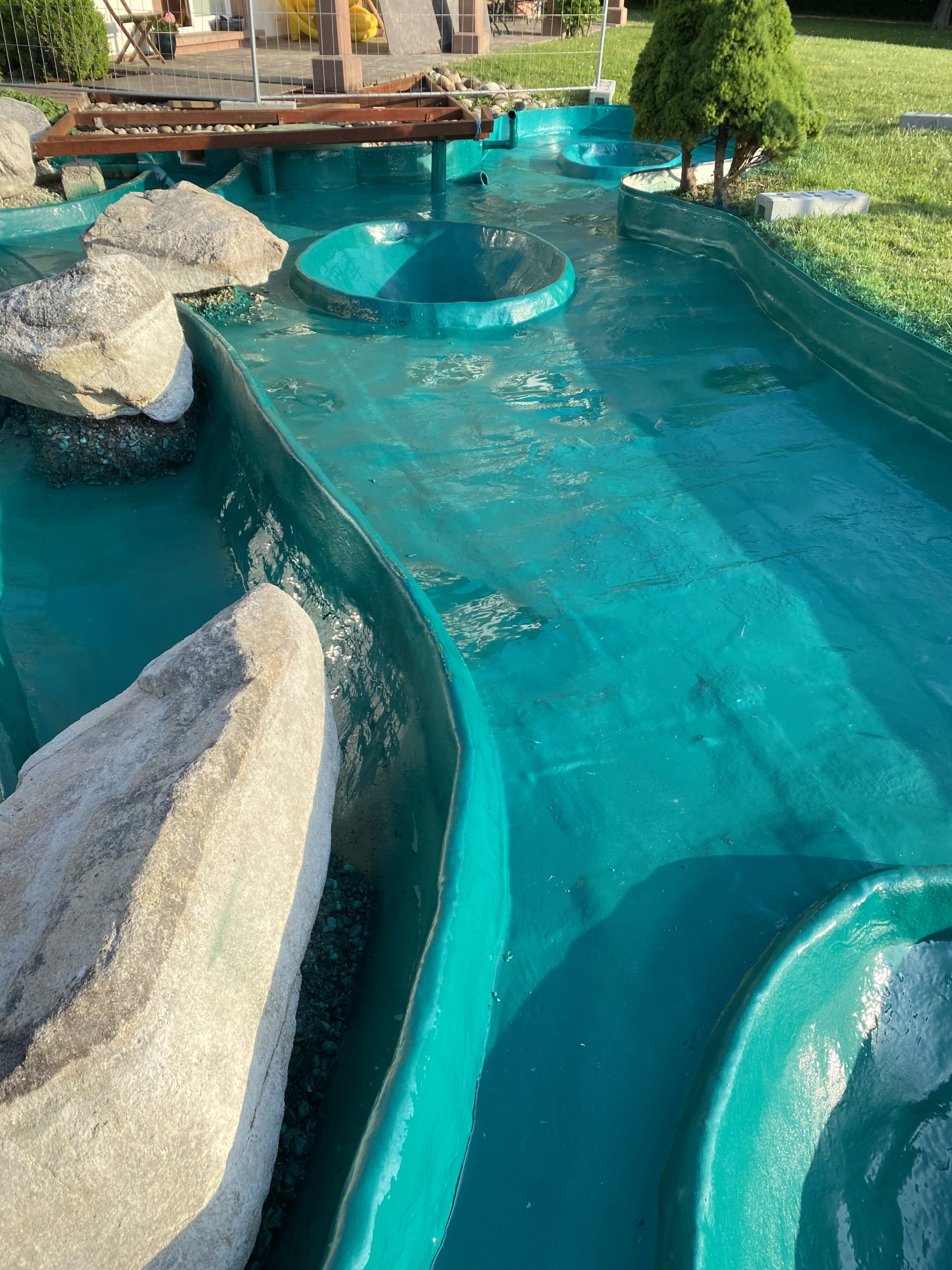
A natural swimming pond lined in AquaShield — rock, concrete and free-form shapes carried in one continuous membrane with no joint for water to find. Rated for constant immersion between 40 and 120°F.
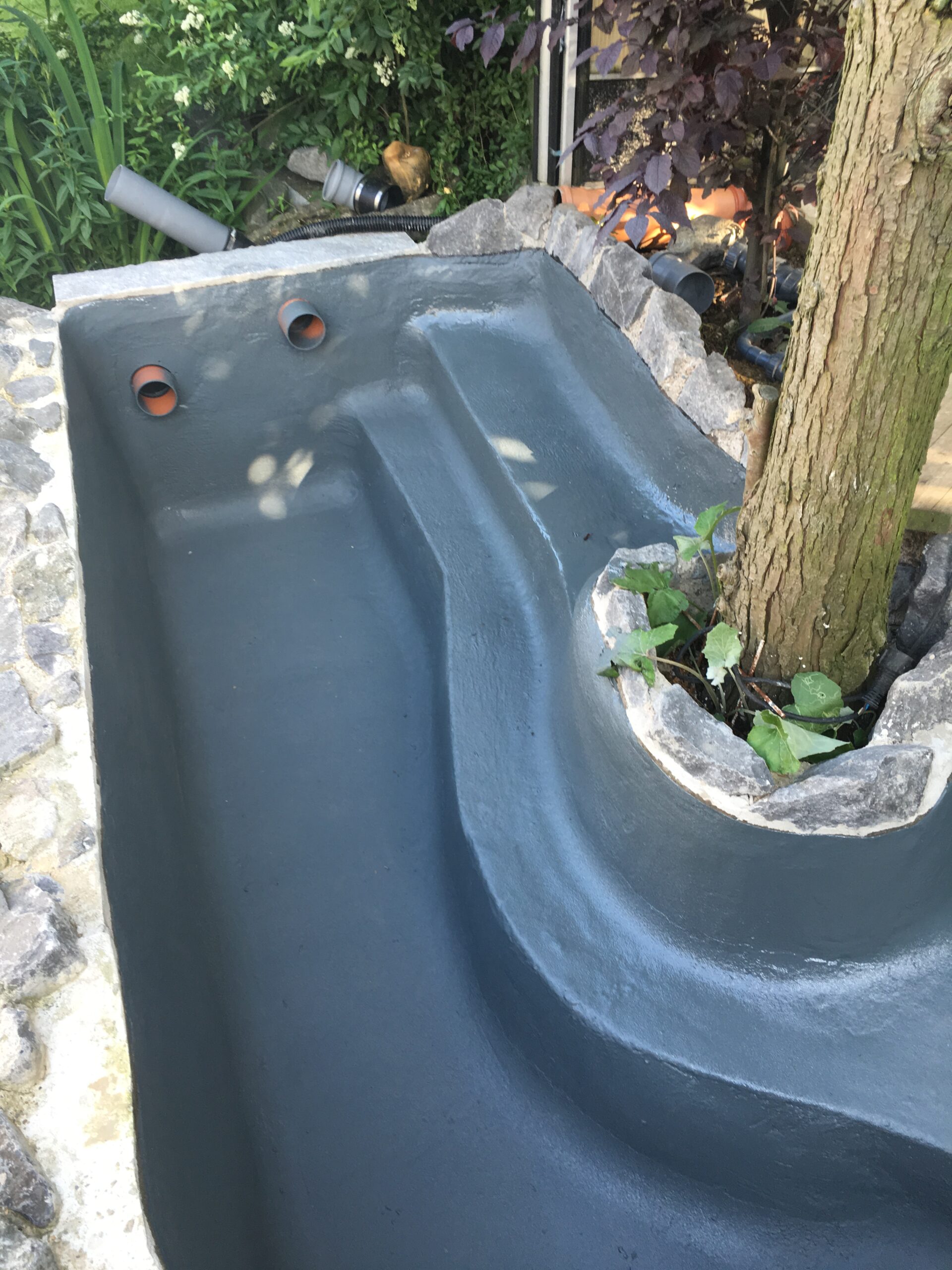
Sprayed over a formed channel: it takes the shape it is given, inside corners and all, and it will go on at twenty below if the schedule says so.
Formulated in-house for life in the water.
AquaShield is an ArmorThane formulation, part of the ArmorLine series. We have developed and manufactured our own polyurea and polyurethane chemistry since 1989. AquaShield is the one built for immersion and for weather that shuts other crews down.
It sprays at twenty below
Most polyurea has a floor somewhere around freezing. AquaShield is formulated with a gel time fast enough to go down on a surface at −20°F (−29°C). That is not a party trick — it is the difference between making a winter shutdown window and waiting until spring.
Applies down to −20°F · relatively insensitive to moisture and temperature during application
Rated for staying wet, not just getting wet
There is a real difference between a coating that sheds water and one that lives in it. AquaShield carries a published wet service range of 40 to 120°F alongside its dry range of −40 to 250°F, so you can specify it for something that is submerged all year rather than hoping for the best.
Wet service 40–120°F · dry service −40 to 250°F
Chemical resistance you can actually look up
We spot-tested a 70 to 75 mil film against 35 chemicals for seven days and published every result, including the ones where the answer is do not use it. Acids, caustics, fuels, solvents, sewage and salt water are all on the list, rated one to five.
Full chemical resistance table published on this page — including the four chemicals we do not recommend
Our own formulation, not a repackaged blend
AquaShield sits in the ArmorLine range alongside AquaSafe and the HighLine products, developed in-house rather than bought in and relabelled. Because the formulation is ours, we can adjust it for a particular job instead of asking a customer to live with a catalog product.
More than 200 ArmorThane formulations across the ArmorLine, ArmorFoam, ArmorFlooring, ArmorPrime and ArmorCoat families
Soft enough to move with the structure
Around 50 on the Shore D scale with roughly 400% elongation and a 450 pli tear strength. A pond liner, a canal or a tank that moves with temperature and load needs a membrane that moves with it rather than one that cracks and lets water behind.
Roughly 3,000 psi tensile · installed with or without reinforcement in transitional areas
Backed by the people who make it
Buying AquaShield means buying the chemistry, the plural-component rig that sprays it, the hands-on training that certifies the crew, and technical support for as long as you spray it. There are no franchise fees and no royalties on any of it.
$0 franchise fees · hands-on applicator training · support for the life of the business
The jobs AquaShield is genuinely the right answer for.
Each of these traces back to the published data sheet — the figures below are rounded.
Ponds, lakes and water features
Aquatic habitats and venues, free-form rockwork, water parks and playgrounds. One seamless membrane over concrete, shotcrete and rock, with a published wet service range behind it.
Working through the winter
Sprayable onto a surface at −20°F (−29°C). Canals, dams, basins and outdoor tanks get coated in the shutdown window you actually have, not the one the weather would prefer.
Chemistry you can look up before you quote
Thirty-five chemicals spot-tested for seven days at 70 to 75 mils and published with a one-to-five rating. Diesel, gasoline, hydraulic oil, sewage, salt water and dilute acids all come back clean.
Agriculture, food and cold storage
Livestock facilities and dairy farms, paper and pulp mills, cold storage and food-adjacent plants. Odorless, seamless, zero VOC and meets USDA criteria.
Steel that needs to stop corroding
Structural steel, offshore rigs and platforms, tank coatings and marine exposure. It coats carbon and mild steel without primer, and pipe nine inches in diameter and up.
Getting the asset back in service
Tack free in under a minute, recoatable for several hours, foot traffic within a few hours and full service in about a day. On a tank or a basin that is downtime you are not paying for.
Wet service and dry service are two different numbers.
A lot of coatings publish one service temperature range and leave you to work out whether it applies underwater. AquaShield publishes both: −40 to 250°F dry, and 40 to 120°F wet. If the surface is submerged or permanently damp, the wet number is the one that governs — and knowing that up front is how you avoid specifying a liner into a job it was never rated for.
- Wet service 40 to 120°F — submerged, constantly damp or in a tank that never drains
- Dry service −40 to 250°F — the same film on a structure that stays dry
- Suitable for marine exposure and submersed applications, per the data sheet
- An adhesion test on the actual substrate is recommended before any project starts
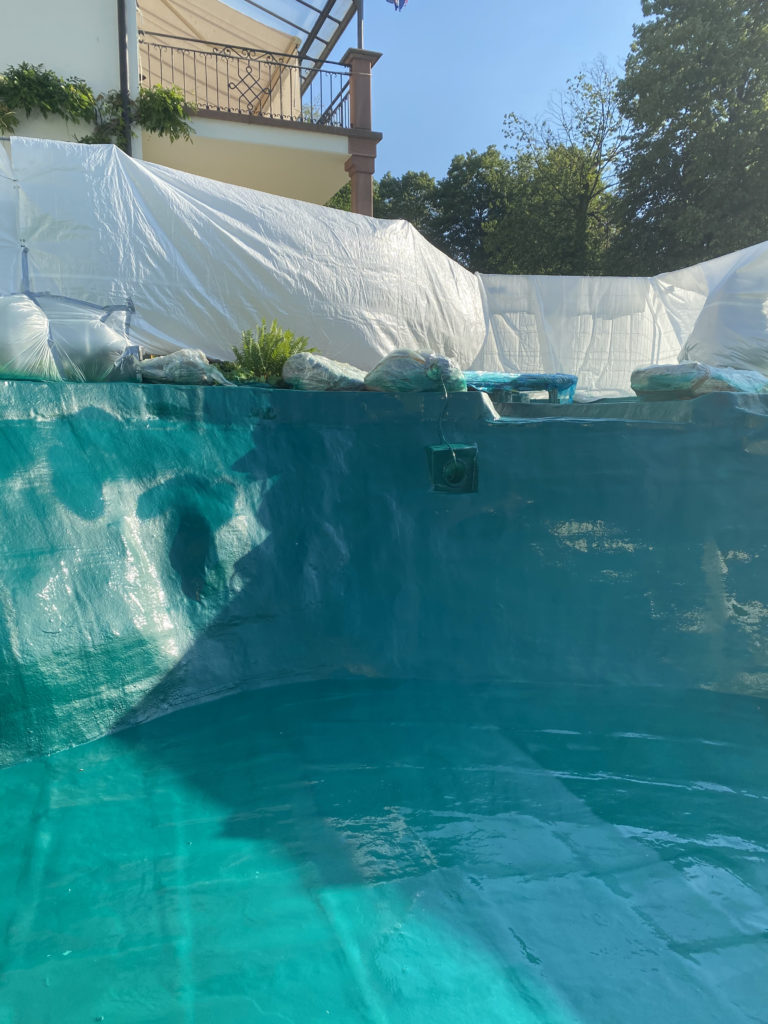
A swimming pond, lined in one piece.
Free-form water features are where a sheet liner gives up. Every rock, step and radius is a seam waiting to leak, and the shapes do not repeat. A sprayed membrane does not care about the shape — it goes over concrete, over rockwork, up and across in continuous passes, and the finished surface is one piece from the shallow end to the overflow.
- Over concrete, shotcrete and set rockwork in one continuous membrane
- No seams, no welds and no mechanical joints anywhere in the basin
- Takes inside corners, steps and radii without a detail strip
- Rated for the water staying in it, not just for getting it watertight on day one
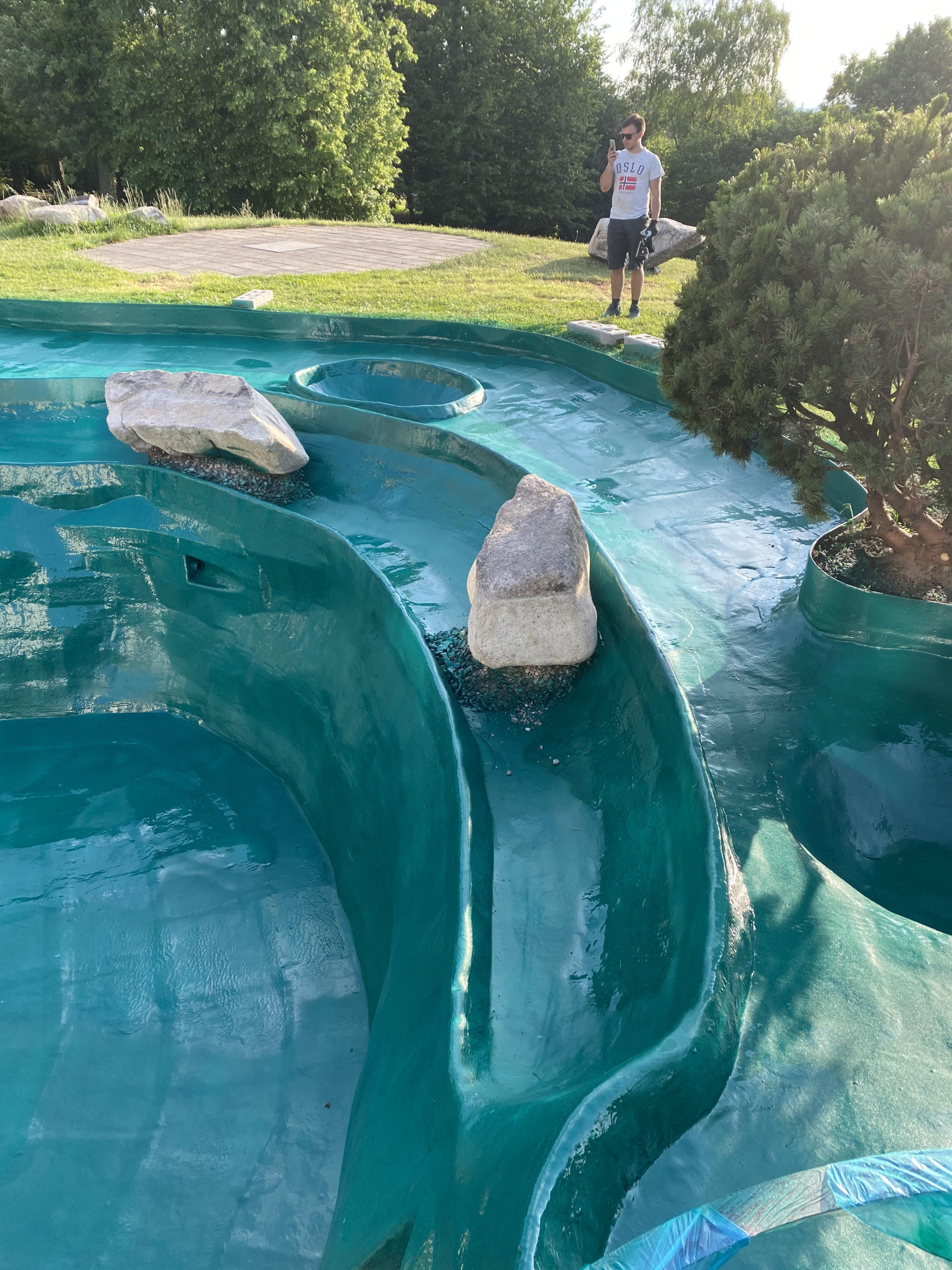
Where AquaShield earns its keep.
The published use list runs long — these are the places applicators put it most.
Aquatic habitats and venues
Ponds, lakes, water features, rockwork and water parks. The membrane takes whatever shape the landscape architect drew and stays watertight across all of it.
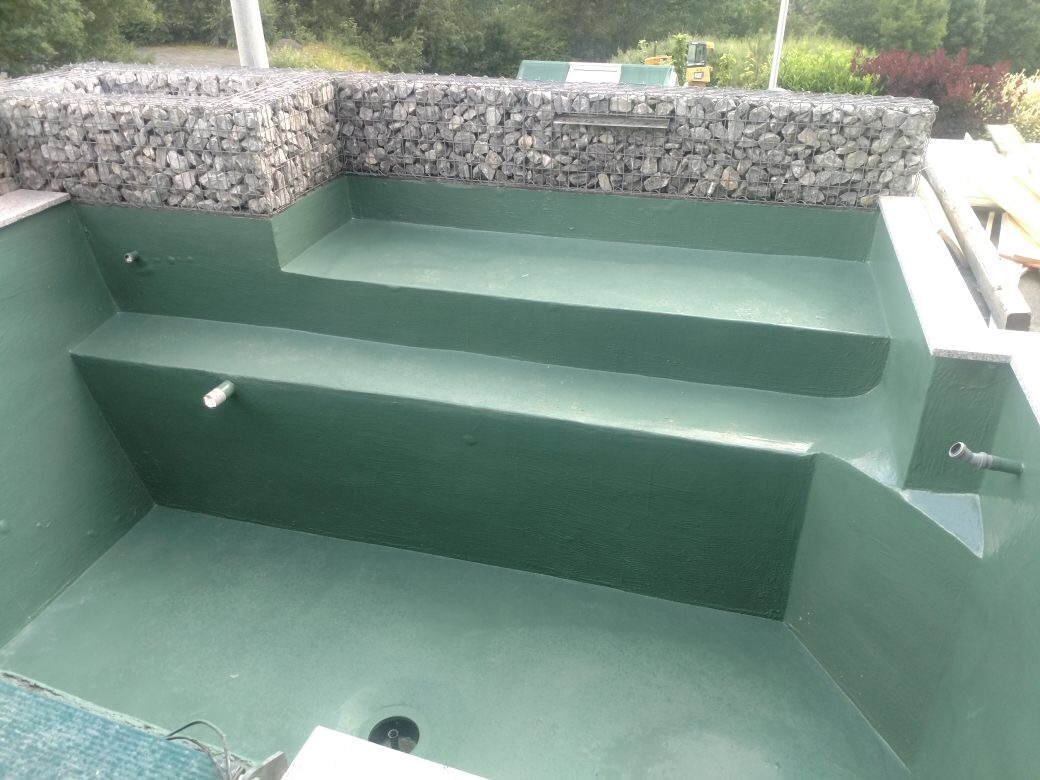
Canals, dams and basins
Water containment that has to hold through freeze and thaw. Applied down to −20°F, so winter shutdowns are workable rather than theoretical.
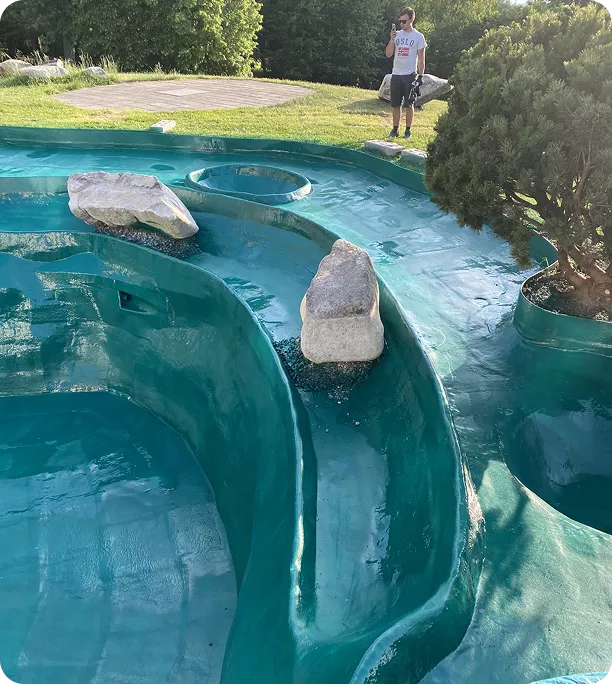
Rockwork, caves and waterfalls
Artificial rockwork and feature walls where the substrate is irregular and every joint would be a leak. Sprayed on and over, not fitted to.
Tanks and wastewater linings
Potable water tanks and pipe, wastewater treatment linings, and tank coatings generally — concrete or metal, and no primer needed on carbon or mild steel.
Livestock, dairy and cold storage
Barns, dairy floors, cold storage and food-adjacent plants. Odorless, seamless, zero VOC and meets USDA criteria.
Marine and offshore steel
Structural steel corrosion protection, offshore rigs and platforms, and submersed applications where the steel never gets a chance to dry out.
What to expect from the film.
Typical values, rounded so you can size the product up quickly. Filter by what you care about, search for a property, or flip the sheet to metric.
No published property matches that search.
These are typical, rounded values obtained on ArmorThane equipment and parameters — they are here to give you a feel for the product, not to specify a job. Exact published figures, tolerances and test conditions are on the current AquaShield technical data sheet; ask us and we will send it. Different spray equipment and parameters will affect these properties, so applicators should run their own testing and an adhesion test for a given job. AquaShield is for commercial use only and should only be applied by trained personnel.
Thirty-five chemicals, seven days, every result published.
Spot testing on a 70 to 75 mil AquaShield film, immersed at 70 to 75°F for seven days. Filter by the verdict — including the ones we do not recommend.
No published property matches that search.
Spot testing only, on a 70 to 75 mil film at 70 to 75°F (21 to 24°C) for seven days. Use caution wherever high temperatures are involved, wet or dry — heat changes these answers. Results were obtained in a controlled environment and will not represent every environment; application process, design and site conditions all vary. For any chemical not on this list, test before you coat, and talk to the ArmorThane technical department first.
How an AquaShield job actually goes down.
The short version of the data sheet, in the order a crew does it.
- 01
Prepare the substrate, then test it
Coating performance and adhesion are directly proportional to surface preparation, and most coating failures trace back to it. Everything has to come off: dust, dirt, oil, grease, rust, corrosion. On this product an adhesion test on the actual substrate is recommended before the project starts — not a sample, the real thing.
- 02
Precondition both drums and fit the desiccants
Bring Side A and Side B to 75–80°F (24–27°C) before you spray, and fit a desiccant device to both containers while they are in use. Do not open a drum until you are ready to use it, and never dilute either side.
- 03
Power-agitate Side B and pigment it
Side B is a blend of many components. Mix it with air-driven power equipment until the mixture and the color are homogeneous, then add ArmorThane pigment at 100 grams per gallon. Side A needs no agitation.
- 04
Check the surface against the dew point
Surface temperature needs to be at least 5°F (3°C) above the dew point. AquaShield will spray onto a surface down around −20°F (−29°C), which is far colder than most coatings tolerate — but the dew point rule still holds at every temperature.
- 05
Spray hot, at 2,000 psi or better
Minimum 2,000 psi with material above about 150°F (66°C), through the ArmorThane HighLine plural-component system. Hold pressure and temperature throughout, and work in smooth multidirectional passes for even thickness and appearance.
- 06
Build the thickness the job needs
Recommended applied thickness is more than about 2 mm. Theoretical coverage is about 1,600 sq ft per gallon at one mil, so divide that by your target dry film thickness to get the real rate. Recoat inside roughly six hours.
The chemistry is only half of what you get.
ArmorThane makes the coating, builds the plural-component rig that sprays it, trains your crew hands-on and certifies them, and answers the technical line afterwards. No franchise fees, no royalties, no territory you have to buy. Applicators have come first here since 1989.
- Equipment package matched to the work you want to take on
- Hands-on training and applicator certification
- Technical support for the life of the business
- Applicators in more than 50 countries
AquaShield, answered.
Can I really spray it at twenty below?
Onto a surface down around −20°F (−29°C), yes — the gel time is what makes it possible, and it is the main reason people choose this product over the rest of the range. The drums still have to be preconditioned to 75–80°F before they go through the rig, and the surface still has to sit at least 5°F above the dew point.
What is the difference between AquaShield and AquaSafe?
Both are ArmorLine pure polyureas that go against water, but they are tuned differently. AquaSafe is the potable-water product, with current third-party water-contact testing behind it and a 30°F application floor. AquaShield goes colder — down to −20°F — publishes a separate wet service range for immersion, and comes with a full 35-chemical resistance table. If the job is drinking water, start with AquaSafe and ask us for the documentation.
Is it approved for potable water?
The data sheet lists potable water tanks and pipe among its uses, but we are not publishing an NSF/ANSI 61 claim for AquaShield here until we can put the current test documentation next to it. Ask us before you specify it for drinking water and we will send you exactly what we hold.
What does the wet service range mean in practice?
It is the temperature range the film is rated for while it is submerged or permanently damp — 40 to 120°F. The dry range is much wider, −40 to 250°F. If your surface is underwater or never dries out, size the job against the wet number, not the dry one.
Which chemicals should I keep away from it?
Four are rated not recommended: hydrochloric acid at 35%, sulfuric acid at 60%, methanol, toluene and xylene. Sulfuric acid at 30% is rated for splash and spillage in secondary containment only, for 72 to 96 hours. Everything else on the published list is rated one or two. Use the table above and filter by verdict.
Why is the shelf life only six months?
That is what the data sheet states for AquaShield in original factory-sealed containers — shorter than most of the ArmorLine range. Rotate your stock, keep both drums above 60°F, never let them freeze, and do not open a drum until you are ready to spray it.
Does it need a primer?
Not on carbon or mild steel. It will also go on concrete and other prepared substrates, but because this product is so often specified for immersion, an adhesion test on the actual substrate is recommended before any project — the data sheet asks for it explicitly.
How much material will the job take?
Theoretical coverage is about 1,600 square feet per gallon at one mil. Divide that by your target dry film thickness and multiply by solids content to get an application rate. With a recommended thickness of more than 2 mm, plan accordingly and allow for overspray and surface profile.
What do we need to know before handling it?
This product contains isocyanate and curative material. Read the Safety Data Sheets for both sides before anyone touches a drum — regulations require that every employee be trained on the SDS for the chemicals they work around. Wear a fresh-air respirator, protective gloves and clothing, eye and face protection, and keep contaminated clothing out of circulation.
Tell us what you need to line.
Describe the pond, the tank, the canal or the barn, what goes in it and where you are. An ArmorThane specialist will come back with the right chemistry, the rig that sprays it and what a startup actually costs.
- Equipment package matched to your applications
- Hands-on training and applicator certification
- Chemical resistance and test documentation for your specification