
Dealer & Applicator Support
Technical answers, equipment help, orders and training — straight from the people who manufacture the chemical. We have been manufacturing protective coatings and spray equipment since 1989. Applicator support is part of every ArmorThane equipment and chemical purchase, and applicator support does not end after training.
Applicator support: pick the right desk
Four ways in. Send it to the right team first time and you get a straight answer instead of a transfer.
Technical Support
Chemistry, substrate prep, mil thickness, cure and job specs — answered by the people who make the material.
- Mix ratio, temperature and pressure
- Substrate prep and primer selection
- Adhesion, blistering and defect diagnosis
- Product selection for the job
Equipment & Spray Rigs
Proportioners, guns, hoses and heaters — from first start-up to a mid-job breakdown.
- Pressure and ratio troubleshooting
- Gun rebuilds, seals and mix chambers
- Hose heat and transformer faults
- Parts, consumables and spares
Orders, Freight & Billing
Product orders, lead times, freight and invoicing for ArmorThane dealers and applicators.
- Place or change an order
- Lead times and shipment tracking
- Damaged or short shipments
- Invoices and account questions
Portal & Account Access
Logins, tools and documents for certified ArmorThane applicators inside the dealer portal.
- Tech tips and technical bulletins
- Tools, calculators and job forms
- SDS and technical data sheets
- Marketing assets and support tickets
The applicator portal
Everything an ArmorThane applicator needs in one login — documents, tools, training and a support ticket history that stays with your account. If you spray our material, this is where your working day starts.
- Technical bulletin library
- Tech tips and how-tos
- Tools and job calculators
- Order forms and catalogs
- SDS and data sheet requests
- Marketing and sales assets
- Support ticket dashboard
- Training and certification

Already an applicator?
Raise a technical ticket from inside the portal and it lands with the technical team with your account, products and history attached — so nobody has to ask you the same questions twice.
Fix it on the job
The calls we take most often, and what to check first. This is a starting point, not a substitute for a conversation — if material is already down, call us.
Coating peels off concrete in sheets
- Likely cause
- Surface was never profiled, or vapour is driving up through the slab.
- What to check
- Confirm a proper mechanical profile — abrasive blast or diamond grind to a CSP 3–5 texture, not a smooth trowel finish. Check the slab is dry and inside ArmorThane’s published moisture limit before you spray, and use the primer called out for that substrate.
Bedliner lifts at the edges
- Likely cause
- Contamination or a missed abrasion zone right at the perimeter.
- What to check
- Wax, silicone and release agents travel. Solvent-wipe with a clean rag, change rags often, and carry the sanding profile all the way into corners, seams and lip returns before priming.
Lining disbonds from steel
- Likely cause
- Blast profile out of spec, or flash rust formed before the coat went on.
- What to check
- Blast to the standard the spec calls for — near-white (SSPC-SP 10 / NACE No. 2) for immersion and containment work — hold the anchor profile, and coat inside the window before any flash rust appears.
Second coat delaminates from the first
- Likely cause
- The recoat window was missed.
- What to check
- Past the window, polyurea needs mechanical help: abrade, solvent-wipe, then apply the tie coat named on the technical data sheet. Do not rely on chemical bite alone.
Film stays soft, sticky or tacky
- Likely cause
- Off-ratio, resin rich — or the material is simply too cold.
- What to check
- Shoot a ratio check into two separate containers and compare. Confirm both drums are at working temperature, look for a restricted A-side inlet, a clogged screen or a failing pump seal.
Film is brittle and crunchy
- Likely cause
- ISO rich, or moisture has reached the A-side.
- What to check
- Check the desiccant dryer on the A drum and reseal any open drum. Confirm pressures balance at the gun with the trigger pulled, then re-run the ratio test before spraying production work.
Pressures will not balance at the gun
- Likely cause
- A blocked screen or filter on one side, or a worn check valve.
- What to check
- Shut the rig down following the proper procedure, clean both screens, then test each side independently to find which one is lagging.
Cure is far slower than the data sheet
- Likely cause
- Low substrate temperature, or ambient conditions outside the product window.
- What to check
- Gel and tack-free times on a data sheet assume a stated temperature. Cold steel and cold concrete pull heat out of the film — measure surface temperature, not air temperature.
Gun fouls or crosses over
- Likely cause
- Worn mix chamber, tired side seals, or unbalanced pressures.
- What to check
- Rebuild the mix module, replace o-rings and check the side seals. Always bring both sides to matched pressure before you pull the trigger, and purge on schedule.
Heater will not hold temperature
- Likely cause
- Flow is outrunning heater capacity, supply voltage is low, or a hose heat zone has failed.
- What to check
- Check incoming voltage under load, confirm the hose heat circuit and sensor are reading, and slow the output if the rig is being asked for more than it can heat.
Pump cavitates or starves
- Likely cause
- Cold, thick material, a clogged inlet screen, or an undersized feed.
- What to check
- Preheat the drums, clean the inlet screens, and confirm the transfer pump and feed lines are sized for the proportioner — the problem is usually upstream of the machine.
Shutting the rig down between jobs
- Likely cause
- Short-term and long-term shutdown are not the same procedure.
- What to check
- Follow ArmorThane’s published proportioner shutdown steps. Most spring start-up failures are caused by a machine put away wrong in the autumn.
Pinholes and bubbles in the film
- Likely cause
- Outgassing from porous concrete, or trapped moisture.
- What to check
- Spray when the substrate is cooling rather than heating — a warming slab pushes air out through wet film. Seal porous substrates with the recommended primer first.
Colour fades or chalks outdoors
- Likely cause
- An aromatic product was used where sunlight hits it.
- What to check
- Aromatic polyurea is built for performance, not colour retention, and will chalk under UV. Where appearance matters, specify an aliphatic topcoat over the aromatic base.
Rough, sandy or dry texture
- Likely cause
- Gun held too far off, material too cold, or pressure too low.
- What to check
- Bring the gun back to the working distance on the data sheet, confirm drum and hose temperature, and verify pressure at the gun rather than at the pump.
Visible lap lines in the finished surface
- Likely cause
- Inconsistent overlap, or passes landing outside each other’s gel window.
- What to check
- Keep a consistent 50% overlap and a steady pass speed, and plan the sequence so adjoining passes land wet into wet.
Condensation under the coating
- Likely cause
- The substrate was at or below the dew point.
- What to check
- Measure substrate temperature and dew point, not just the weather. The industry rule is a surface at least 5°F (3°C) above the dew point and rising before you spray.
Cold weather work
- Likely cause
- Viscosity climbs and cure slows as temperature drops.
- What to check
- Preheat drums well before the shift, keep hoses up to temperature, allow longer cure before return to service, and expect reduced daily output.
Hot slab, afternoon spray
- Likely cause
- A heating substrate drives air up through the film.
- What to check
- Where you can, schedule porous substrates for the cooling side of the day. If you cannot, prime and seal first.
Wind on open jobsites
- Likely cause
- Overspray losses and an off-ratio pattern edge.
- What to check
- Screen the work area, shorten the gun distance, and watch the pattern edges — wind-stripped material is the thinnest and weakest part of the film.
Have this ready
Six things turn a long diagnostic call into a short one. Gather them before you dial and we can usually tell you what happened on the first call.
- Product and batchThe exact ArmorThane product and the batch or lot number from the drum label.
- SubstrateWhat you are spraying, and how it was prepared.
- ConditionsAir temperature, substrate temperature, relative humidity and dew point.
- EquipmentMachine model, hose length, and pressures and temperatures at the gun.
- TimelineWhen it was sprayed and when the problem first showed.
- PhotosWide shot plus a close-up — a photo usually answers the question faster than a description.
Guides, tech tips and training
A lot of what the technical line gets asked is already written down. Start here.
Tech Tips
Field notes on prep, application and equipment from the ArmorThane technical team.
Tech Tips Video Gallery
Watch the procedure instead of reading it — short videos covering common jobs.
Training Videos
Training footage covering application technique and equipment handling.
The Polyurea Guide
What polyurea is, where it belongs and how it behaves against other coating chemistries.
Proportioner Shutdown Guide
Short-term and long-term shutdown, step by step, so the rig starts next time.
Knowledge Hub
Guides on roofing, flooring, containment, foam and corrosion protection.
Brochures
Downloadable product and system literature for specifiers and customers.
Case Studies
Real projects — what was specified, what was sprayed and how it performed.
Find an Applicator
Locate a trained ArmorThane applicator for a project in your area.
We train you, then we stay on the phone
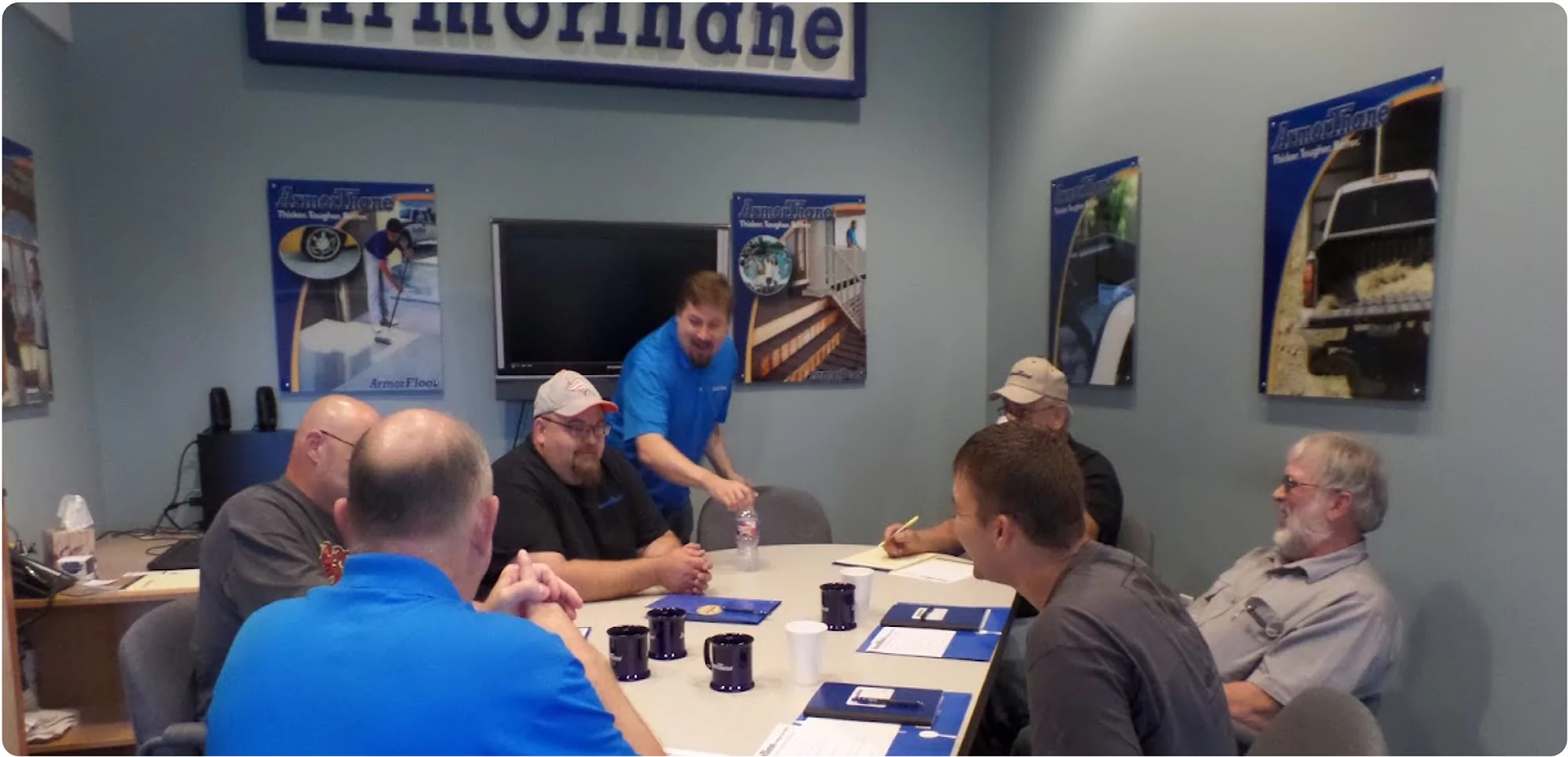
New applicators learn chemistry, equipment set-up, spray technique and maintenance hands-on — and the support does not stop when the training week does. The technical team you meet in Springfield is the same team that answers the phone two years later.
Contact ArmorThane
Two manufacturing and distribution locations serving applicators across North America and worldwide.
ArmorThane USA Inc.
2660 North Eastgate AvenueSpringfield, Missouri 65803
United States
Mon–Fri, 8:00 a.m. – 5:00 p.m. CST
ArmorThane Coatings, Inc.
100, 10803 – 182 StreetEdmonton, Alberta T5S 1J5
Canada
Frequently asked
Still need a human?
Call the plant, or tell us about the project below and a coatings specialist will come back to you.
Applicator support is free for every ArmorThane applicator, whether you bought your first rig last week or have been spraying with us for years. New applicators can also read how to become an ArmorThane applicator.
Start your coatings business with ArmorThane.
Tell us what you want to spray and where you are. An ArmorThane specialist will walk you through the equipment, chemicals, training and startup cost for the work you want to do.
- Equipment package matched to your applications
- Hands-on training and applicator certification
- Technical support once you are spraying