
How to Start an RV Roof Business
Startup cost, what sprayed roofs sell for, the margin on one roof and how many jobs it takes to pay off the rig. All of it published by the manufacturer, and we don’t charge a franchise fee.
Start an RV roof coating business
Spray RV roofs for a living.
ArmorThane sets you up to do this work, and you own the business. We make the chemistry, build the rigs, train you hands-on and answer the phone when a job gets difficult. You pay no franchise fee and no royalties. It has been that way since 1989.
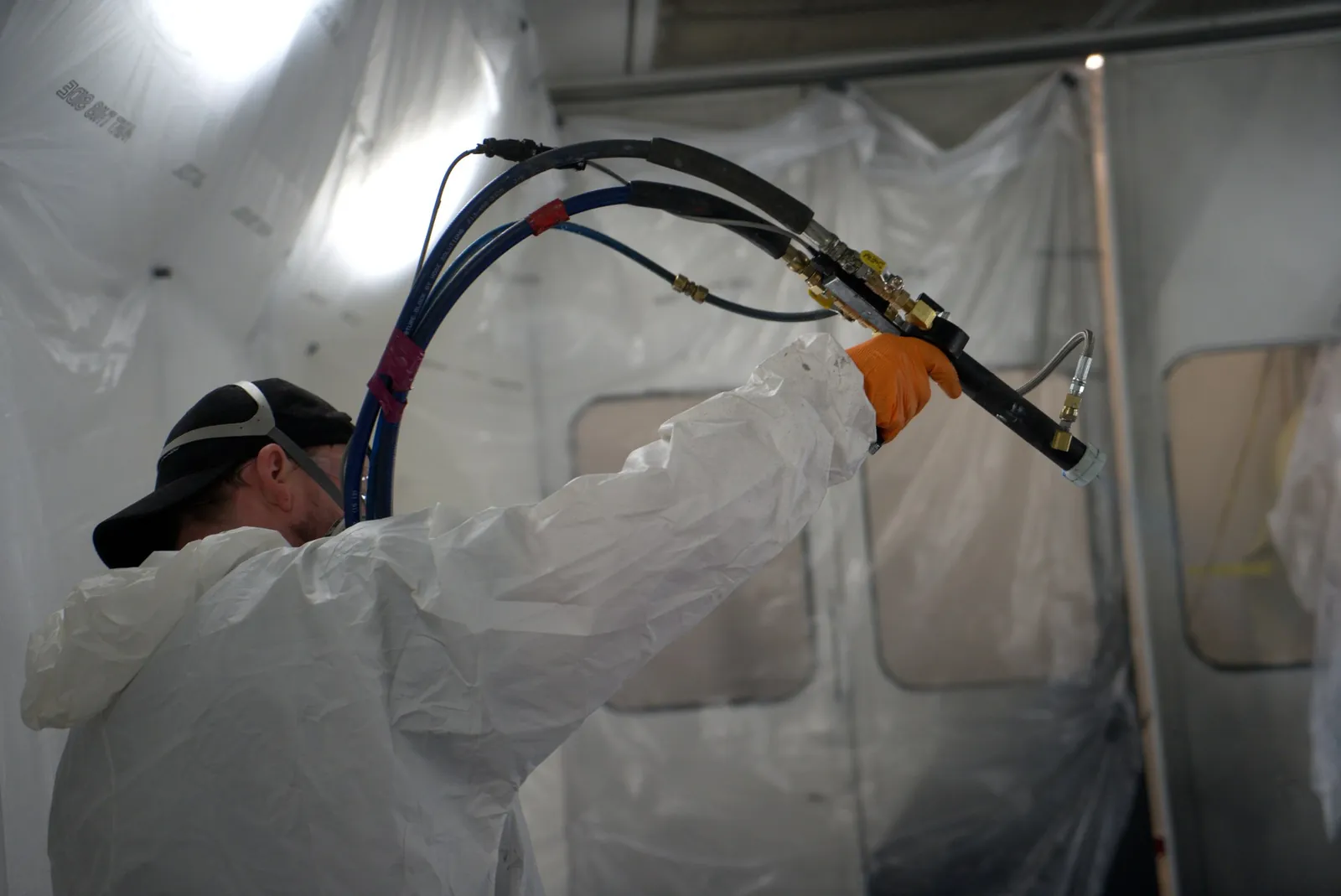
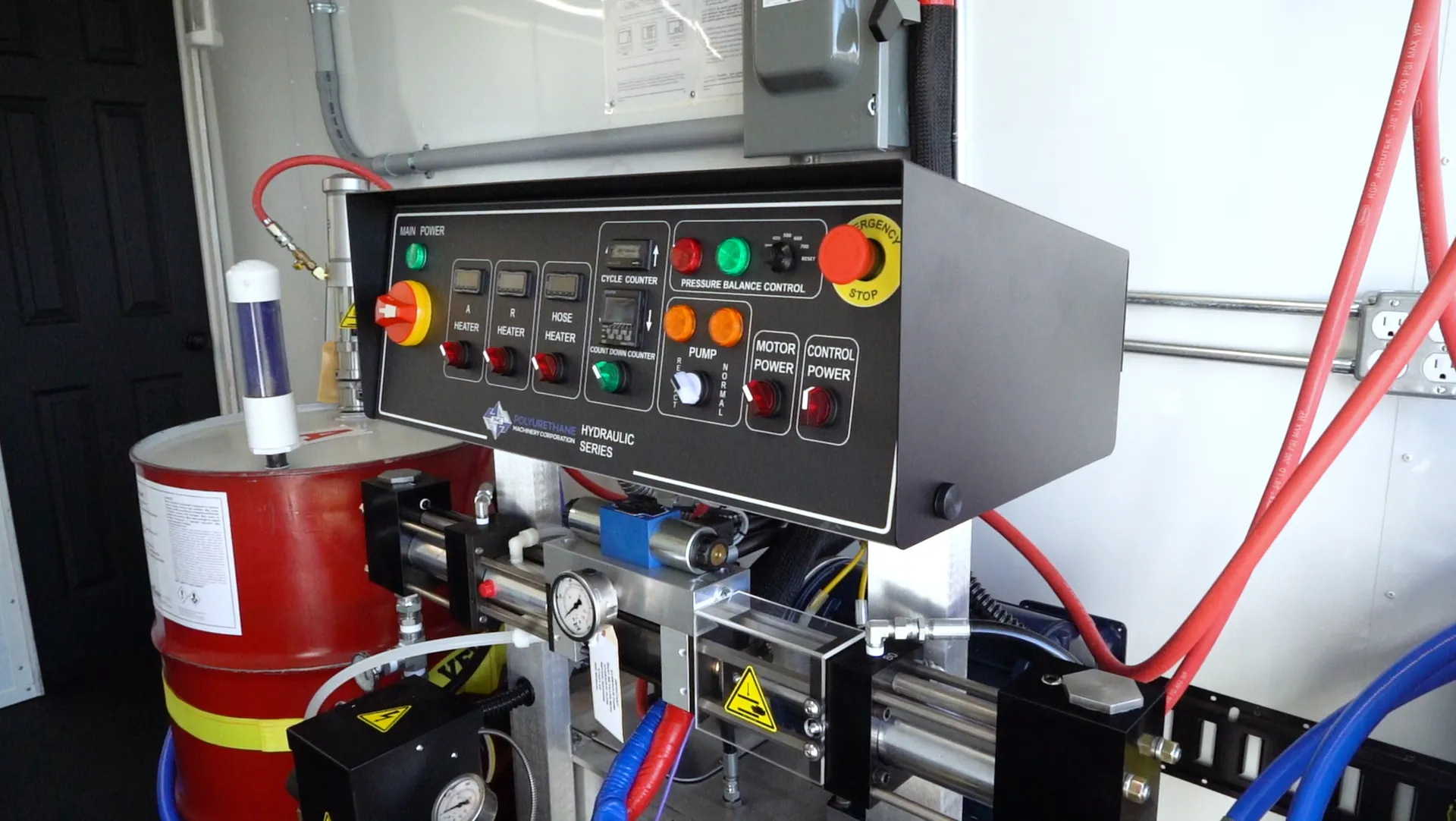
- $0
- franchise fees or royalties
- 35+
- years in business
- 50+
- countries with applicators
- 24/7
- technical support
Get the startup package
Run your payback numbers
- Manufacturing since 1989
- No franchise fee or royalty
- Hands-on spray training
By the ArmorThane applicator teamUpdated September 26, 2026Springfield, Missouri
$25,000Starting spray package
$33–$42Material per foot
$175+Retail per foot
~6 roofsTo pay off the rig
Starting an RV roof business in 6 steps
Most people can go from first phone call to first paid roof in four to eight weeks. Here is the order we’d do it in.
- Pick your modelMobile reseal and repair, sprayed-on roof replacement, or both. The sprayed roof is where the margin is.
- Budget $45K–$94K all-inA $25K or $55K spray package, plus trailer or shop, insurance, marketing and two months of runway.
- Get trained on the rigPlural-component spraying isn’t painting. Manufacturer training is how you avoid ruining a customer’s coach.
- Set up the businessLLC, local license, general liability, and garage keepers coverage for rigs left in your care.
- Price at marketSprayed RV roofs sell for roughly $170–$210 per linear foot. Don’t open with a discount.
- Line up referral partnersMobile RV techs, storage lots and campground hosts will fill your first calendar faster than ads.

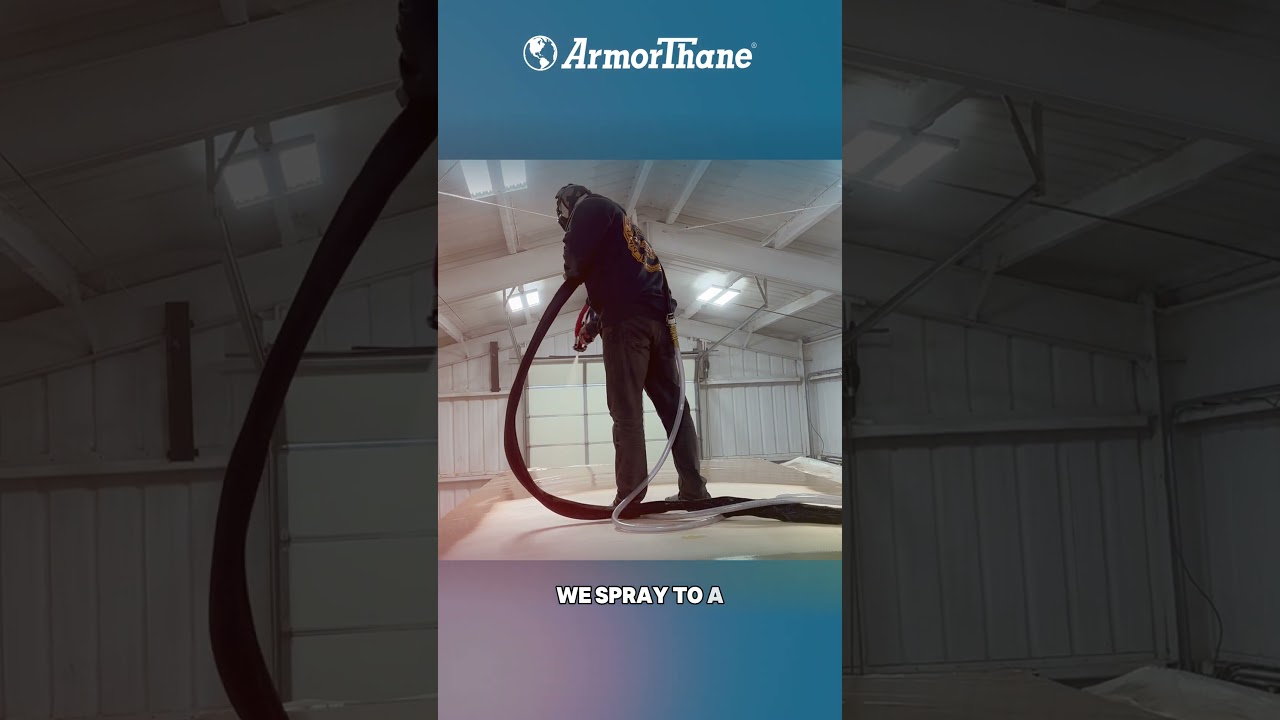
Watch an RV roof go down, then walk through the rig
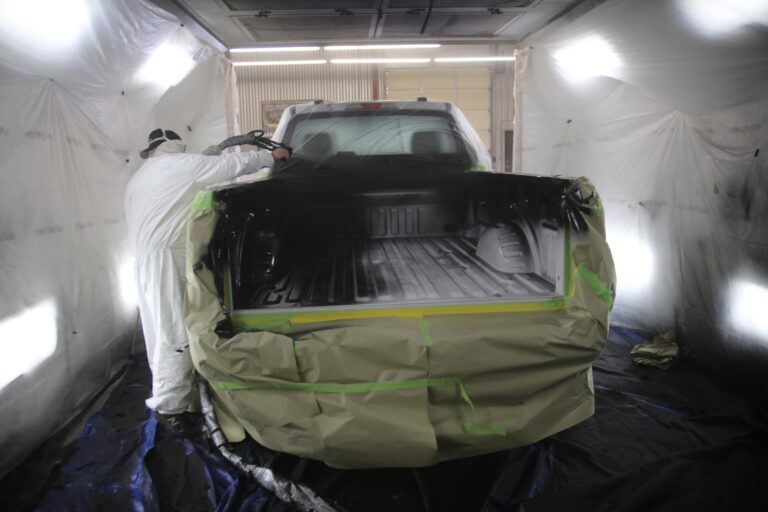
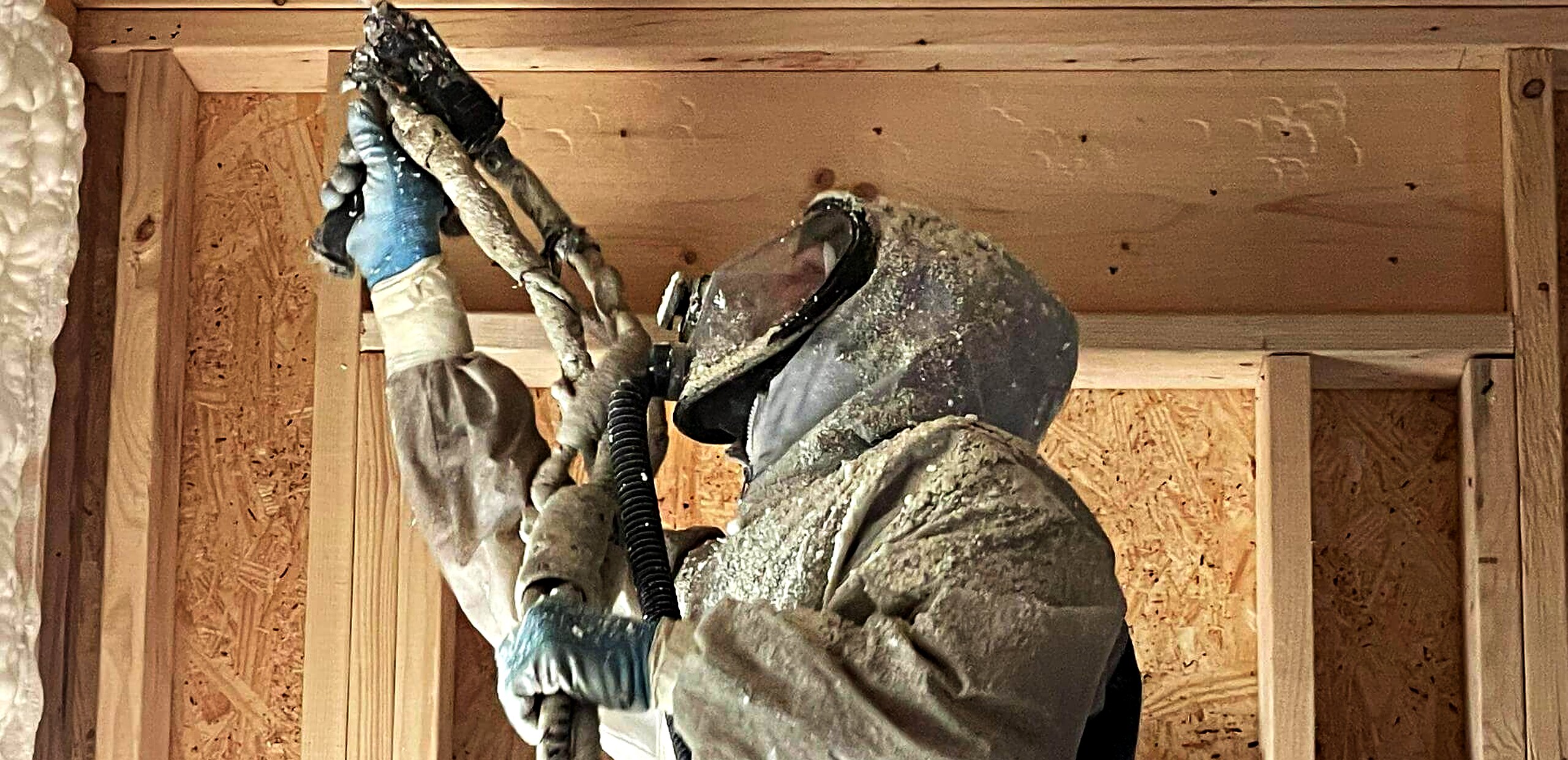
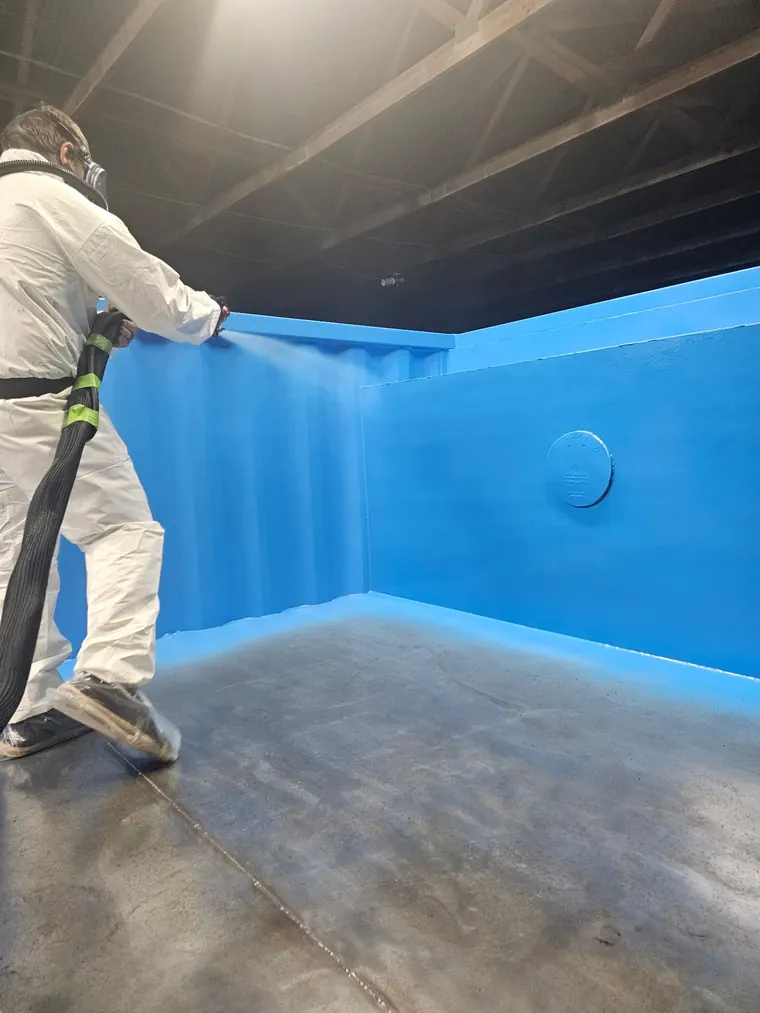
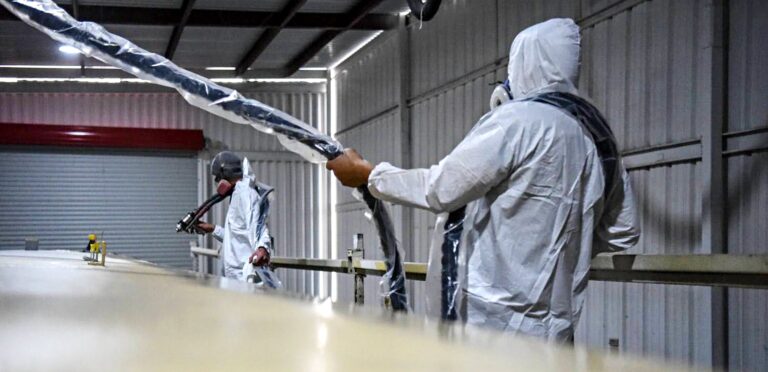
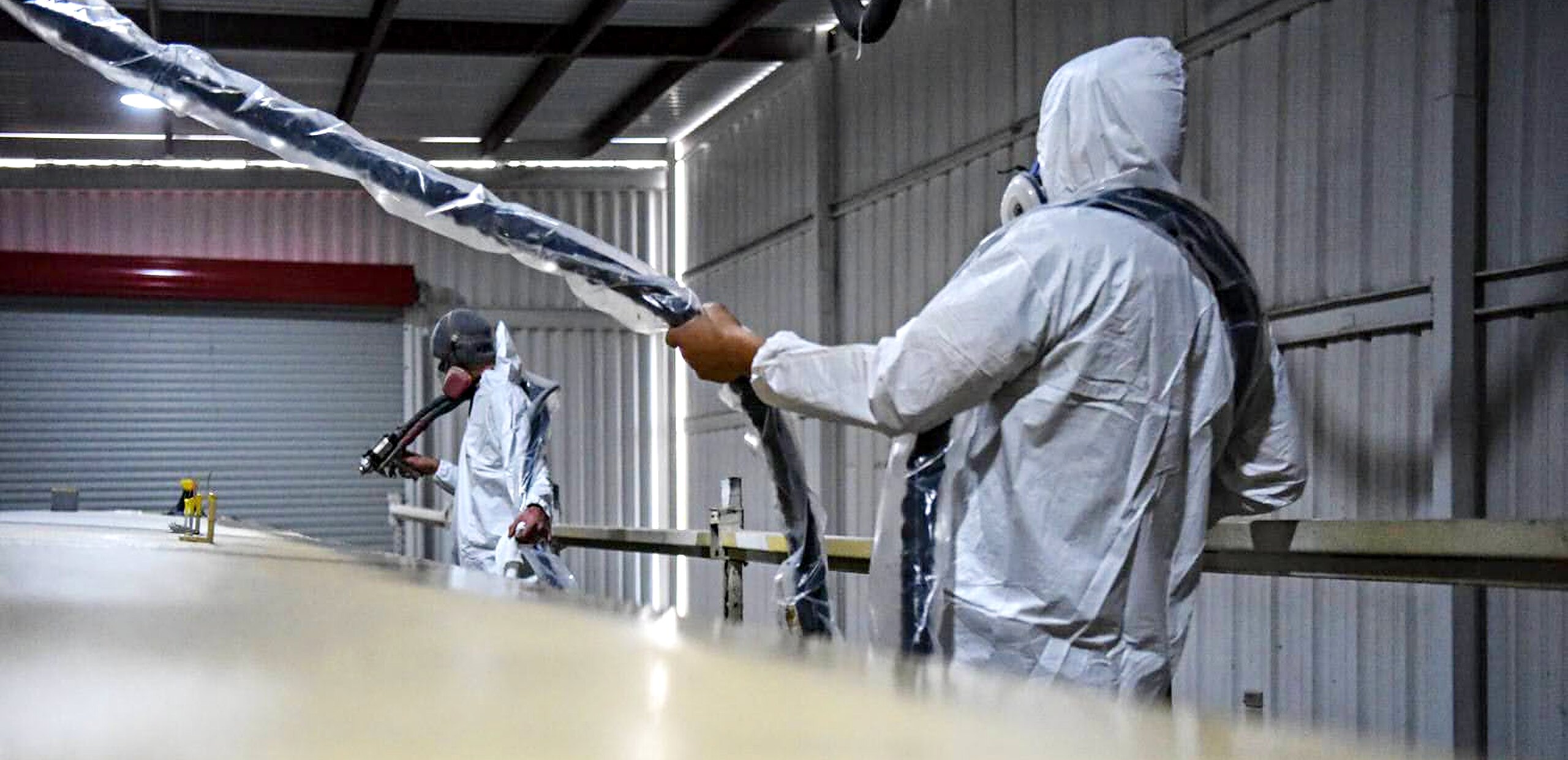
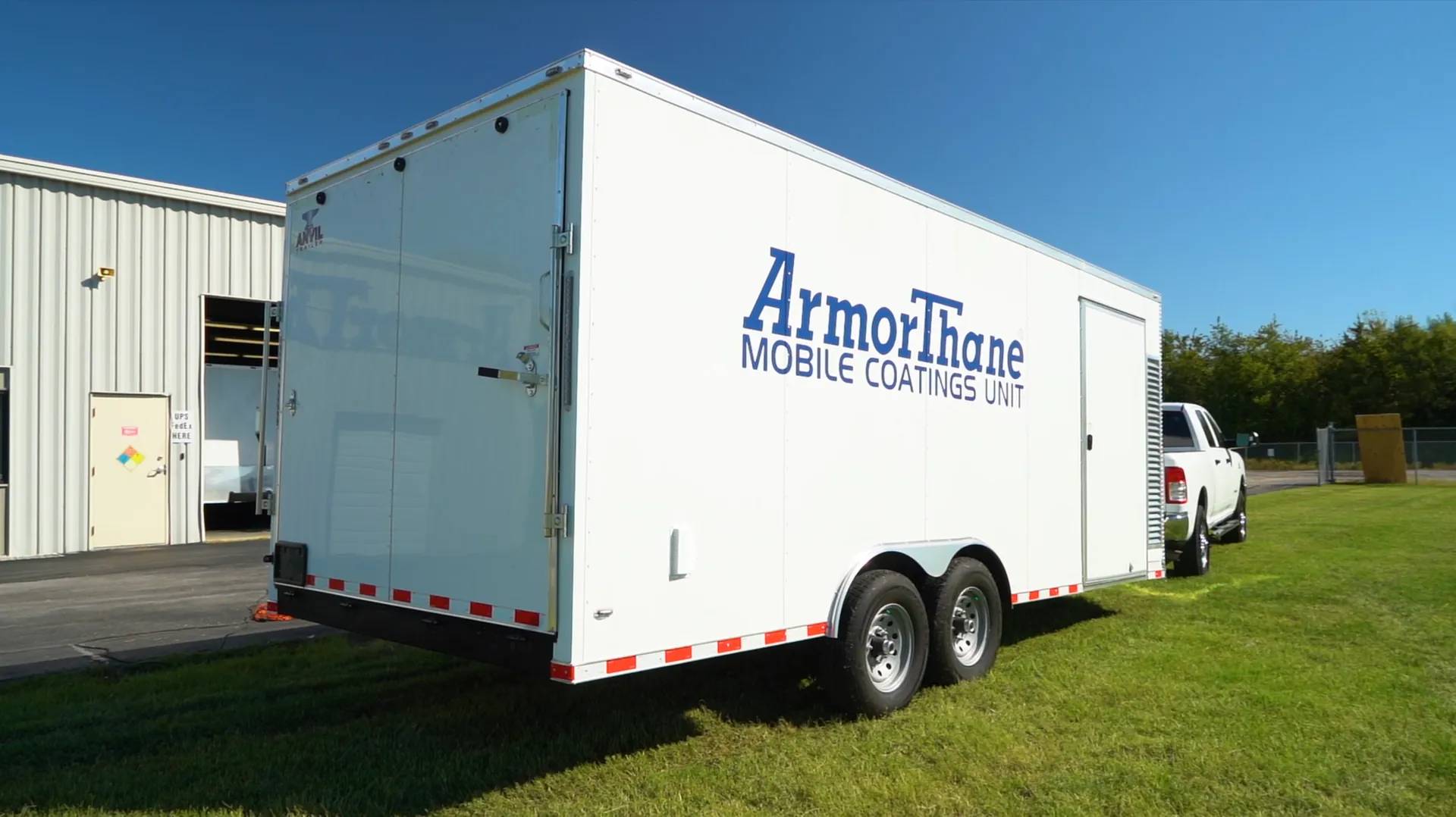
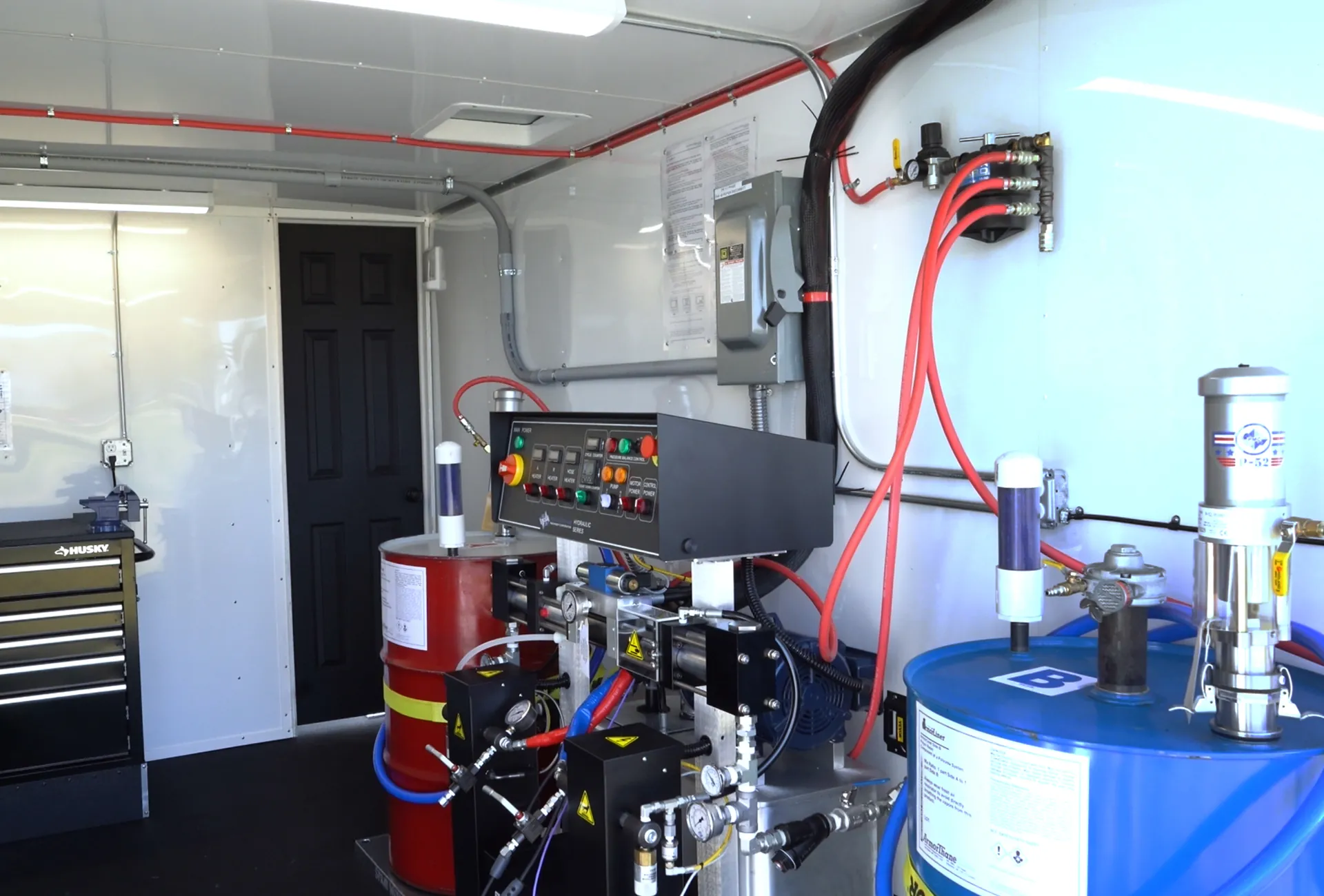
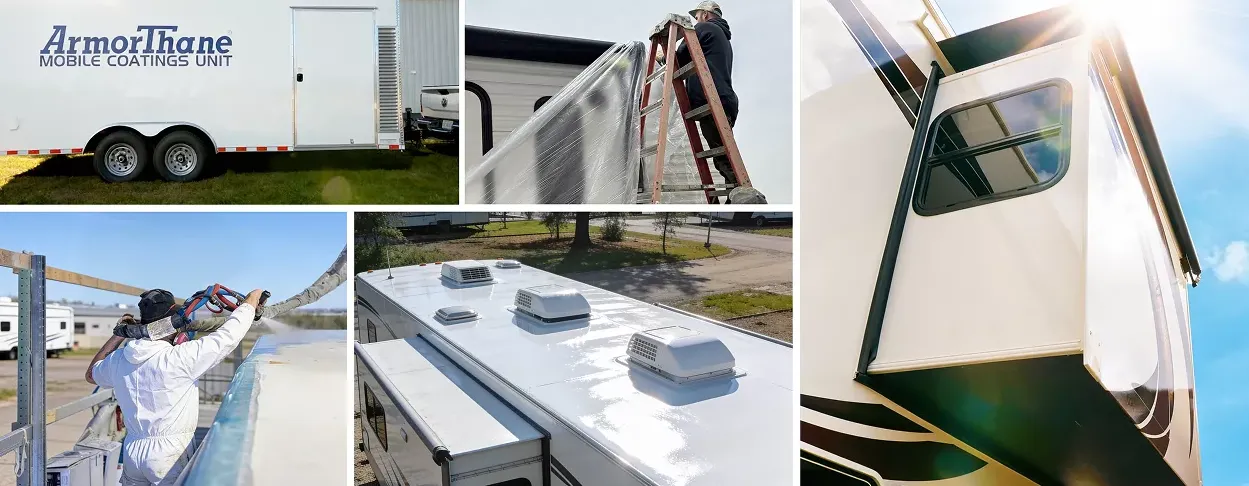
Before you look at a single number, look at the job. This is what you’d be selling: a seamless membrane sprayed over the whole roof, over the seams and around every vent, in one pass. The second video walks through a mobile coatings unit like the one in our packages.

- SeamlessNo seams, no lap sealant and no termination bar left to dry out. The failure points on a factory roof are gone.
- 120 milsThat’s roughly three times the film of a roll-on RV coating, and it’s thick enough to bridge the joint where the deck meets the aluminum rail.
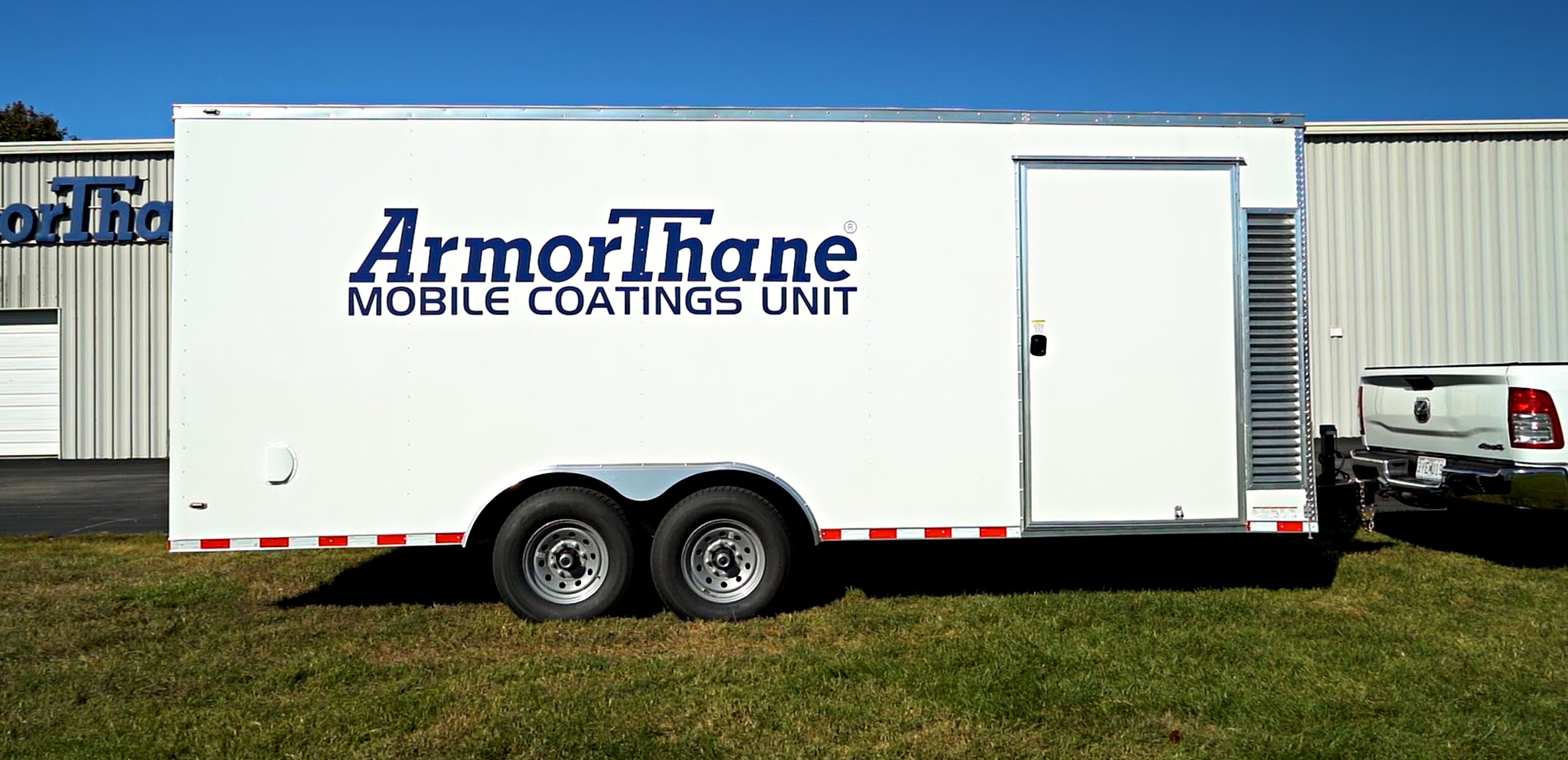
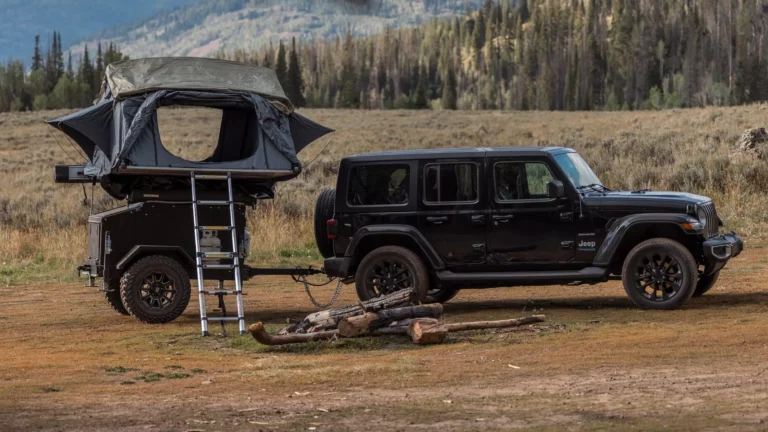
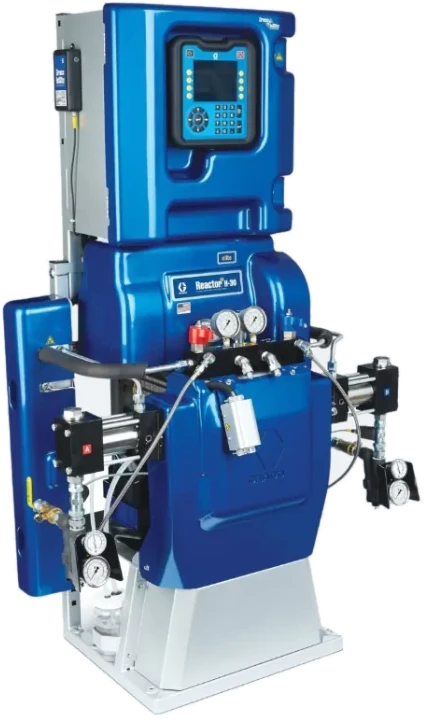
- Mobile or shopA trailer-mounted proportioner, heated hoses and drums, so you can spray at a storage lot or in a rented bay.
- Same-day possibleWith a fast topcoat the customer can drop the rig off in the morning and pick it up that afternoon.
What an RV roof business actually sells
An RV roof business sells three things: spot leak repairs on failing membranes, full sprayed-on roof systems that permanently replace the factory EPDM or TPO, and seasonal inspection and reseal work. The sprayed-on roof is where almost all of the money is. One job bills $4,500 to $8,000, compared with $150 to $600 for a patch.
A lot of people come into this trade thinking it’s roofing. It’s close, but not quite. A house roof sheds water with overlapping shingles and gravity. An RV roof is a single membrane glued to a plywood or luan deck. That deck flexes at 65 miles an hour, and the aluminum sidewall rail it’s sealed to expands and contracts at a completely different rate than the wood underneath.
That mismatch is the whole business. Almost every RV roof in North America is failing slowly in the same few places: the front cap seam, the rear cap seam, the perimeter termination bar and around every penetration (vents, antennas, skylights, the A/C shroud, the fridge stack). The middle of the roof usually looks fine. The failures are at the edges, and that means you can build two different businesses around them.
Version one
Mobile repair & reseal
Ladder, sealants, butyl tape, a good moisture meter and a truck. You drive to campgrounds and storage lots, find soft spots, reseal terminations and fix small delaminations.
$150–$900Typical ticket<$10KTo start
Honest take: it’s really a job with your name on the door. It’s good bridge income while you build toward version two.
Where the margin is
Version two
Sprayed-on roof systems
Plural-component or low-pressure spray equipment, a shop bay or a covered mobile setup, and a polyurea or urethane system sprayed at full film build. You’re selling a permanent fix with a warranty, not a patch.
$4,500–$8,000+Per roof$25K–$55KSpray package
Honest take: this is where the money is made. Most operators who do well end up running both, because reseal calls feed replacement jobs.
The reseal work fills the calendar and brings in leads. Roughly one in five owners you meet on a reseal call has a roof too far gone to reseal, and by then you’re the person they trust to quote the replacement.
Demand is structural, not seasonal hype
Yes. Roughly 11.2 million U.S. households own an RV, according to the RV Industry Association, and the roof membrane is one of the most common major failure points on a towable. Factory EPDM and TPO roofs are typically warranted for 10 to 12 years, so rigs built during the 2016–2021 sales boom are reaching replacement age now.
The household count isn’t the most important part. RVs don’t get thrown away. They get sold cheap to someone who now owns a fifteen-year-old trailer with a chalking roof and no dealer relationship. That buyer isn’t going to pay a dealership $12,000 for a full tear-off. They’re looking for exactly what you’d be selling.
So the used market is your market, and it gets bigger every year as boom-era units age, whether or not a single new RV sells this quarter. The trade also holds up well in a downturn. A tight year doesn’t stop people camping. It stops them trading up, so the twelve-year-old fifth wheel in the driveway has to last another decade.
Seasonality is real. In the upper Midwest you’re looking at a March-to-November window unless you have a heated bay. Snowbird corridors like Arizona, Florida and south Texas run closer to year-round, which is why so many of the busiest RV roof shops are there.
11.2M
U.S. households that own an RV
RV Industry Association
10–12 yr
Typical factory membrane warranty
EPDM / TPO manufacturer terms
$7K–$18K
Dealer quote for a full tear-off
Published dealer & roofer pricing
1–4/wk
Roofs a week at active FlexArmor shops
FlexArmor applicator program
RV roof business payback calculator
Move the sliders to match your market. The math uses the same per-roof costs our applicators work with, and you can send your scenario straight to us when you’re done.
Spray package
Coating system (at 120 mils)
Average box length 32 ft
20 ft45 ft
Your retail price $185 / ft
$130$230
Roofs per week 1
0.54
Working weeks per year 34
2050
Yearly overhead $35,000
$10K$90K
Per-roof costs built in: consumables $140, a helper for one day $280, fuel and mobilization $90, card processing 3%. Sprayed area is about 8.5 sq ft per linear foot on a standard 8′6″ body, with 15% for overspray and waste. Overhead covers rent, insurance, vehicle payment, marketing and admin, but not your own draw or taxes.
Equipment paid off in
6.0roofs
That’s about 6 weeks at your pace. After that, every roof is profit for the business, with no royalty to pay.
$5,920Invoice per roof
$4,144Contribution per roof
$201,280Yearly revenue
$105,910Pre-tax after overhead
Where one roof’s invoice goes
- Chemical $1,088
- Labor, supplies & fuel $510
- Card fees $178
- Contribution 70%
If this were a franchise at 7% royalty + 3% ad fund (the published terms for one RV roofing franchise), it would take $20,128 a year from the same roofs, or $201,280 over ten years.
Send me these numbers
Estimates for planning only. Your results depend on your market, pricing, weather and how hard you work the phone. Nobody can guarantee income, and anyone who does isn’t being straight with you.
What does it cost to start an RV roof business?
Budget $45,000 to $76,000 for a low-pressure mobile operation, or $72,000 to $94,000 for a high-pressure shop. Through ArmorThane the spray package itself is $25,000 (low pressure) or $55,000 (high pressure), and it covers equipment, training, your first set of chemical, and prep and safety gear. The rest goes to the vehicle, insurance, marketing and working capital, and those are the numbers people forget to budget.
Most “how to start a coatings business” articles stop at the equipment price. That’s the easy number, and it’s only about half of what leaves your account before the first invoice clears.
| Line item | Low-pressure, mobile | High-pressure, shop |
|---|---|---|
| Spray package: equipment, training, first chemical set, prep & safety gear | $25,000 | $55,000 |
| Enclosed trailer or box truck (used) | $8,000–$22,000 | — |
| Shop bay lease: first month plus deposit | — | $2,400–$7,200 |
| Generator and compressor | $2,000–$6,000 | Shop power |
| Ladders, staging, fall protection | $1,200–$3,000 | $1,200–$3,000 |
| General liability + garage keepers, year one | $1,800–$4,500 | $2,400–$6,000 |
| LLC formation, licenses, permits | $300–$800 | $300–$800 |
| Website, Google Business Profile, signage, first ad spend | $1,500–$5,000 | $2,500–$7,000 |
| Working capital: two months of runway | $5,000–$10,000 | $8,000–$15,000 |
| Realistic all-in to open | $45,000–$76,000 | $72,000–$94,000 |
Garage keepers coverage is the one that catches people out. Once you take custody of someone’s $80,000 fifth wheel, general liability alone isn’t enough. You need coverage for damage to a customer’s vehicle while it’s in your care. Agents who insure auto body shops understand this straight away. Agents who insure general contractors sometimes don’t, so start that conversation early.
Working capital is the other one. In month two you’ll do a job where the customer’s check takes three weeks and you still need to buy the next set of chemical. Good applicators go under because they run out of cash, not because they spray badly.
What do sprayed RV roofs sell for?
Sprayed RV roofs sell for roughly $170 to $210 per linear foot of box length. RV Armor advertises pricing starting at $175 per linear foot, and FlexArmor operators commonly quote $170–$200. That puts a 32-foot travel trailer at about $5,400 to $6,700 before any wood repair.
| Option the RV owner is comparing | Published or typical price | Turnaround | Notes |
|---|---|---|---|
| RV Armor (national mobile network) | From $175 / linear ft | Multi-day | Lifetime transferable material & labor warranty; mobile technicians |
| FlexArmor (authorized applicators) | ~$170–$200 / ft | Multi-day | Licensed process; shop-based network |
| Dealer EPDM / TPO tear-off | $7,000–$18,000 | 1–3 weeks | Puts back the same membrane that failed |
| Acrylic roll-on coating (Dicor, Kool Seal) | $500–$1,000 | 1 day | Repeats every 3–5 years; not really competing for the same job |
What’s missing from that table is a price war. Nobody in this trade competes on being cheapest, because the customer isn’t shopping for cheap. They’re shopping for “never again.” Someone paying six thousand dollars for a roof is paying to end a problem, and the operators who win are the ones who sound most certain it’s over.
Quote off the box length, not the brochure length. A travel trailer’s advertised length includes the tongue, and quoting off the brochure number is how new applicators give away four hundred dollars without noticing.
Franchise, licensed applicator, or manufacturer dealer?
There are three routes into the RV roof trade. A franchise sells you a name and a territory, then charges an upfront fee plus royalties on everything you bill. A licensed applicator program gives you access to one company’s proprietary product and process. A manufacturer dealer supplies equipment, chemical and training with no royalty, and the brand you build is yours.
Here’s how the programs you’ll run into when you search for this compare, using only what each one publishes. If a cell says “not published,” that means we couldn’t find it on their site. Ask them directly.
| Program | Model | Upfront cost | Ongoing royalty | Training | Can you spray other work? |
|---|---|---|---|---|---|
| RV Roofing Solutions | Franchise | $36,150–$91,500 total investment; $15K–$20K franchise fee | 7% royalty + 3% marketing | Franchise training | Per franchise agreement |
| Lifetime RV Roof | Franchise | Not published | Not published | Franchise training | Per franchise agreement |
| FlexArmor | Authorized applicator (licensed process) | Not published (info package on request) | Not published | Manuals + ongoing training | Not published |
| ApexArmor | Installer program | Not published | Not published | 5 days at your shop | Not published |
| ArmorThane | Manufacturer dealer | $25,000 LP / $55,000 HP, with equipment, training and first chemical included | None | Hands-on, plus phone tech support | Yes: bedliners, trailers, decks, anything |
The equipment is a one-time cost. A royalty is permanent. On a 32-foot roof at $185 a foot, a 7% royalty plus a 3% ad fund comes to $592. That’s not just for the first few roofs, it’s on every roof for as long as you’re in business. At two roofs a week, year-round, for ten years, that’s close to $600,000 paid for the right to use someone else’s logo.
A franchise can still be the right call if you want a system handed to you and you’d rather trade margin for structure. If you’d rather own the equity, most people are best served by buying from a manufacturer who’ll train them and then running the shop like a franchisee would: consistent process, documented prep, real warranty paperwork, and a phone that gets answered. You get the discipline without paying a royalty forever.
Which coating system should you spray?
Two systems work well on RV roofs, and they handle UV in different ways. Option one is a SureGrip basecoat with ArmorDeck Topcoat sprayed over it. Option two is ArmorFlex UV, an aliphatic product that goes on by itself with no topcoat, because aliphatic chemistry doesn’t need one. You wouldn’t put ArmorFlex UV over SureGrip. Either system goes on at 120 mils.
Most spray elastomers, SureGrip included, are aromatic polyureas. The isocyanate has a benzene ring in its backbone, and that ring absorbs UV in the 290–400 nm band. The bonds next to it start to break, so the surface chalks and changes color. The membrane underneath is fine, and mechanically it’s only cosmetic. Try telling that to a customer whose new white roof has turned tan in eighteen months, though. Aliphatic chemistry has no aromatic ring, so there’s nothing to chalk, and that’s why ArmorFlex UV can go on in one step.
SureGrip + ArmorDeck Topcoat
~$33–$35 per linear foot
SureGrip has very high friction and high elongation, which is what you want on a deck that flexes all day. ArmorDeck Topcoat takes the UV load and gives a bright, walkable finish. Plan on about one five-gallon pail of topcoat every two to three roofs.
Best for: the lowest material cost per roof. Most of our RV dealers run this system.
ArmorFlex UV (standalone)
~$42 per linear foot
It’s aliphatic, so it sprays as a complete system with nothing over it. It holds its color and doesn’t chalk. You stock one product and do one step in the booth.
Best for: simpler logistics, plus a stronger pitch to customers who care how the roof looks from a second-story window.
Why 120 mils isn’t a marketing number
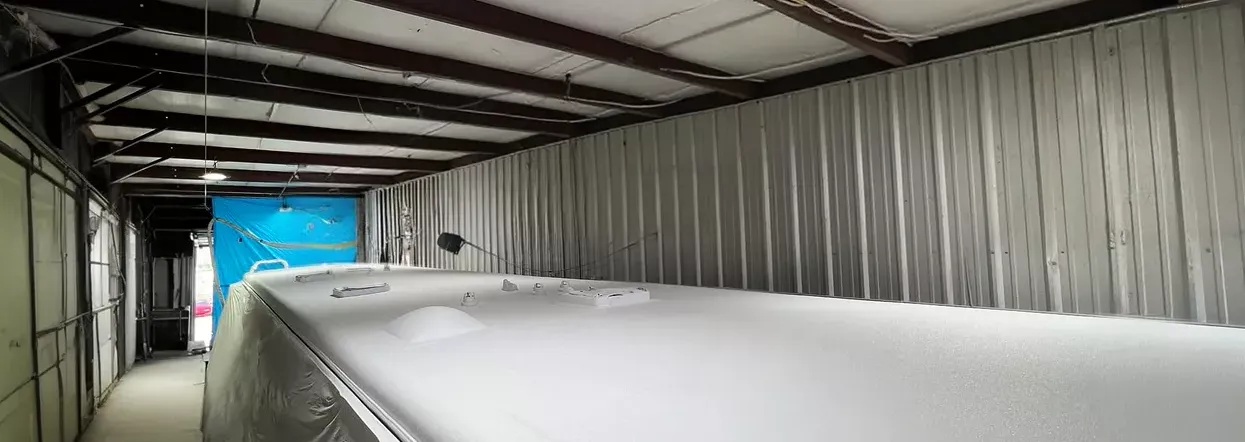
Most “RV roof coatings” at the parts counter go on at 30 to 40 mils. Our spec is 120. That’s the thickness where the membrane starts doing structural work, not just decorative work.
The deck is plywood or luan and the edge is an extruded aluminum rail, and the two expand at very different rates. A 35-mil acrylic can’t bridge that movement, so the crack shows through within a season or two. At 120 mils, with SureGrip’s elongation, the film has enough thickness and stretch to span that joint year after year.
Roll-on acrylic30–40 mils
Thin spray job60–80 mils
ArmorThane RV spec120 mils
Why cure speed is a business decision
ArmorDeck Topcoat MAX is tack-free in about an hour, compared with roughly eight hours for the competing topcoat most shops have been using. That’s the difference between handing the keys back the same afternoon and asking a customer to leave their rig with you for two or three days. Same-day turnaround is the biggest throughput lever in this business.
Multi-day process ~1.5 roofs / week
MonPrep ATueSpray AWedCure AThuPrep BFriSpray B
Same-day topcoat 2–3 roofs / week
MonRoof ATuePrepWedRoof BThuPrepFriRoof C
Look at it as a calendar question, not a chemistry one. If each roof ties up the bay for three days, you’re doing two a week at most, and closer to one and a half once weather and prep catch up with you. If a roof goes in and out the same day, two a week is comfortable and three is realistic in a good April. At about $4,100 per roof, that difference is somewhere between $80,000 and $180,000 a year, with the same equipment, the same crew and the same shop.
It helps you sell, too. A lot of your customers live in their rigs: full-timers, snowbirds partway through the migration, contract workers living out of a fifth wheel. For them, “two to three days” isn’t just inconvenient. It means a hotel bill and figuring out what to do with the dog. “Drop it at eight, pick it up at five” wins that job without a discount.
Licenses, insurance & the training that matters
No state requires a special license to repair or coat an RV roof. You need a business entity, a local business license, general liability and garage keepers coverage. Contractor licensing generally doesn’t apply because an RV is a vehicle, not a structure. The credential that really matters is manufacturer training on the equipment and the chemistry.
- 01
Form the entity Set up an LLC in your home state for $50 to $500, depending on the state, plus a registered agent if you don’t want your home address on a public filing. Get your EIN the same afternoon. It’s free and takes about ten minutes on the IRS website. - 02
Insurance, in this order General liability first, then garage keepers, then commercial auto if you’re mobile. Tell the agent you’re a coatings applicator working on customer-owned RVs that stay in your care overnight. If that confuses them, call an agent who insures auto body shops instead. - 03
Local licensing and zoning You’ll need a city business license almost everywhere. If you’re spraying in a leased bay, confirm the zoning allows coatings work and check whether your area needs an air permit. Most don’t at this scale, but some do. Ask before you sign the lease. - 04
Equipment and chemistry training This is the step that matters most. Ratio, temperature, pressure and gun maintenance all affect each other. The common failures (soft spots from spraying off-ratio, fish-eyes from contamination, gaps in the film) don’t show until it’s too late. Manufacturer training is what separates a business from an expensive hobby. - 05
Optional: RV technician credentials The RV Technical Institute and the National RV Training Academy both run programs. You don’t need either one to coat roofs. It helps if you want dealerships and mobile techs sending you work, though, because a certification tells them you won’t make them look bad.
Where your first ten customers come from
Your first ten jobs usually come from four places: mobile RV technicians who don’t do roofs and want someone to refer, RV storage lots and campground hosts, a Google Business Profile with real before-and-after photos, and dealership service writers who lose money on roof jobs and would rather hand them off. Paid ads are the slowest of these, not the fastest.
The first one on that list pays off the most, and hardly anyone works it properly. Every market in America has mobile RV technicians. They fix water heaters, slide motors, converters and fridges, and almost none of them do roofs. It takes different skills and different equipment, and the liability makes them nervous. Every one of them climbs onto customers’ roofs several times a month, sees chalking membrane and soft decking, and tells the owner to get it looked at, with nobody to send them to.
Make sure it’s you they send them to. Buy them coffee, hand them cards, and pay a referral fee if your state allows it. Five good relationships with mobile techs will keep a first-year applicator busier than $10,000 of Google Ads.
What works, in rough order
- Referral partnerships with mobile RV techs
- Storage lot and campground host relationships (ask about posting a flyer)
- A Google Business Profile with 30+ real photos and honest before-and-afters
- Dealership service departments that don’t want roof work
- Facebook RV owner groups, where you answer questions instead of posting ads
- Rallies and RV shows, once you can afford a booth
What disappoints people
- Cold Google Ads before you have reviews: expensive clicks and no trust to convert them
- Yard signs, because nobody drives past an RV shop looking for a roof
- Discounting to win the first jobs, which sets your price for good
- Waiting until the website is done before knocking on storage-lot doors
The mistakes that sink new RV roof shops
We’ve been putting people into this trade since 1989, and the failures are depressingly repetitive. These four account for nearly all of them.
Surface prep is 90% of the job. On an RV roof that means a proper degrease, not just a rinse, because the membrane has fifteen years of road film, silicone from old repairs and whatever the last owner smeared on it. Silicone is the one that gets people. Soap doesn’t take it off, and it causes fish-eyes that only show once the material is already on the roof. Test a small area every time.
Someone sees $1,088 of chemical on a 32-foot roof and decides to spray 80 mils instead of 120 to save three hundred dollars. The result is a coating that shows the cap seam through within two seasons, on a job with their warranty on it. They’ve traded three hundred dollars for five thousand in rework, and RV owners all talk to each other.
New applicators discount to win work, then find out their $150-a-foot “introductory rate” is what every referral partner now tells people they charge. Price at market from the first job. You’re not too new to charge $185 a foot, and the chemistry doesn’t care how long you’ve been in business.
If the surface is within 5°F of the dew point when you spray, you’ll trap moisture under the film. On a wood deck that means sealing in the very problem the customer paid you to fix, and it can keep rotting the deck for years before anyone notices. Buy a moisture meter and an infrared thermometer before you buy a second ladder.
One more that’s rarer but fatal: never putting the warranty in writing. Everyone in this space sells a lifetime or long-term guarantee. If yours is just something you said in a customer’s driveway, sooner or later you’ll disagree about what was promised, and you’ll lose that argument. Keep it to one signed page that says what’s covered, what isn’t, what voids it and whether it transfers.
What ArmorThane supplies, and what we don’t
ArmorThane’s RV roof applicator packages cost $25,000 for low pressure and $55,000 for high pressure. Both include the spray equipment, hands-on training, your first set of chemical, and prep and safety gear. There’s no franchise fee, no royalty, no territory to buy and no limit on what else you spray. Third-party equipment financing is available. We don’t finance in-house.
What’s included
- Spray equipment sized to your package, low or high pressure
- Hands-on training at our Springfield, Missouri facility
- Your first set of chemical: SureGrip and ArmorDeck Topcoat, or ArmorFlex UV
- Prep and safety gear to get started
- Phone tech support from people who have sprayed roofs themselves
- A listing in the ArmorThane applicator directory
- Marketing assets you’re free to use under your own brand
What we don’t do
- Charge a franchise fee or an ongoing royalty
- Sell or restrict territories
- Guarantee you income. Anyone who does isn’t being straight with you
- Require you to spray only our products
- Finance equipment in-house (we’ll point you to lenders who do)
- Run your marketing for you
We’ve been formulating and manufacturing polyurea and polyurethane in Springfield since 1989, and we’re still family owned, which is rarer in this industry than it should be. We make more than fifty formulations and have dealers around the world. When you call the tech line, you’ll talk to someone who can tell what went wrong on an off-ratio job.
RV roofs are one of the fastest-growing parts of our dealer network, and it’s easy to see why. The fleet is aging, the retail price is established, the margin is real and the customers are highly motivated. That combination is rare in any trade.
Run your own numbers with us
Tell us your market, the rig lengths you’d be quoting and whether you’re thinking mobile or shop. We’ll go through the math with you the same way it’s laid out on this page.
Get the startup package
No franchise fee · No royalty
Get the RV roof startup package
Tell us a little about yourself and an ArmorThane specialist will send you the equipment, material and training breakdown for an RV roof business, then go through it with you by phone.
- Low- and high-pressure package options and pricing
- Material cost per roof and retail pricing guidance for your area
- Hands-on spray training at our Springfield facility
- Third-party equipment financing contacts
Step 1Send the form. It takes about a minute.
Step 2A specialist emails you your startup breakdown.
Step 3We go through the numbers with you by phone.
Rather talk now?(417) 831-5090
Starting an RV roof business: questions we get asked
Plan on $45,000 to $76,000 all-in for a low-pressure mobile operation, or $72,000 to $94,000 for a high-pressure shop. The ArmorThane spray package is $25,000 or $55,000 of that and covers equipment, training, your first chemical set, and prep and safety gear. The rest is vehicle or shop, insurance, licensing, marketing and working capital, which is the part most startup guides leave out.
Yes, if you price at market and keep the calendar full. A 32-foot roof at $185 a foot invoices $5,920. After about $1,088 of chemical, $140 of consumables, a $280 helper day, $90 of fuel and 3% card fees, it contributes roughly $4,144, which is about 70% of the ticket. At 34 roofs a year that’s around $141,000 of contribution, or roughly $105,000 pre-tax after $35,000 of overhead for a solo operator who’s working hard. Results vary by market, and nobody can guarantee income.
No state requires a special license to repair or coat an RV roof. You need a business entity, a local business license, general liability insurance and garage keepers coverage for customer rigs in your care. Contractor licensing generally doesn’t apply because an RV is a vehicle, not a structure. If you lease a spray bay, check the zoning and whether your area needs an air permit.
On a sound roof, prep and spraying take about a working day. With a fast-cure topcoat like ArmorDeck Topcoat MAX, which is tack-free in about an hour, the customer can often pick the rig up the same afternoon. Rotten decking changes that. Replacing soft plywood or luan can add a day or more before you spray.
For a first-year operator, one roof a week is a realistic pace. Established shops with same-day turnaround usually do two or three. FlexArmor says most of its active locations complete one to four roofs a week, depending on crew size and goals.
It depends on how much you value a ready-made system over margin. One RV roofing franchise publishes a $15,000–$20,000 franchise fee, a 7% royalty and a 3% marketing fee. On a $5,920 roof that’s $592, on every roof, for as long as you’re in business. A manufacturer dealer model like ArmorThane’s has no franchise fee and no royalty, and the brand you build is yours.
Low pressure ($25,000) is the lower-risk way in. It’s easier to run mobile and it pays for itself in about six average roofs. High pressure ($55,000) sprays faster and handles bigger commercial and industrial work, but it needs about fourteen roofs to pay back and usually a shop. Many applicators start with low pressure and move up once they’re booked out.
You can do either. A trailer-mounted rig lets you spray at storage lots, campgrounds and customers’ properties, but weather controls your schedule. A shop bay gives you control over temperature and humidity and lets you work year-round in colder climates. A lot of operators start mobile and lease a bay once they have steady demand.
A sprayed-on RV roof typically runs $170 to $210 per linear foot, which is about $5,400 to $6,700 for a 32-foot travel trailer before any wood repair. A dealer tear-off and new EPDM or TPO membrane usually costs $7,000 to $18,000. An acrylic roll-on coating costs $500 to $1,000 but has to be redone every three to five years.
The 25% rule is a building-code provision used in many jurisdictions. If more than 25% of a building’s roof is repaired or replaced within a 12-month period, the whole roof has to be brought up to current code. It applies to houses and commercial buildings, not to RVs, which are vehicles. You’d only need to think about it if you add residential or commercial roofing later.
Yes, and it’s often the quickest way in. You already have the bay, the insurance and a customer base. The same spray equipment can also do bedliners, trailers, decks and industrial jobs, and ArmorThane dealers aren’t restricted to one product line.
We don’t finance in-house. Third-party equipment financing is available, and we’ll put you in touch with lenders who work with coatings applicators.
More to read on RV roofs
Short reads from ArmorThane on Issuu. Tap one to open it right here.


Start your own coatings business.
Equipment, chemicals, hands-on training and technical support for life, all from one manufacturer that puts its applicators first.
Need a job done?
Tell us where the project is and we’ll connect you with a certified ArmorThane applicator near you.