Van Insulation: Best Materials & Calculators
Thinsulate, wool, rigid board or spray foam, compared with real R-values, prices and moisture data. We make spray foam, so we’ll also tell you when it’s the wrong choice for your van or cargo trailer.
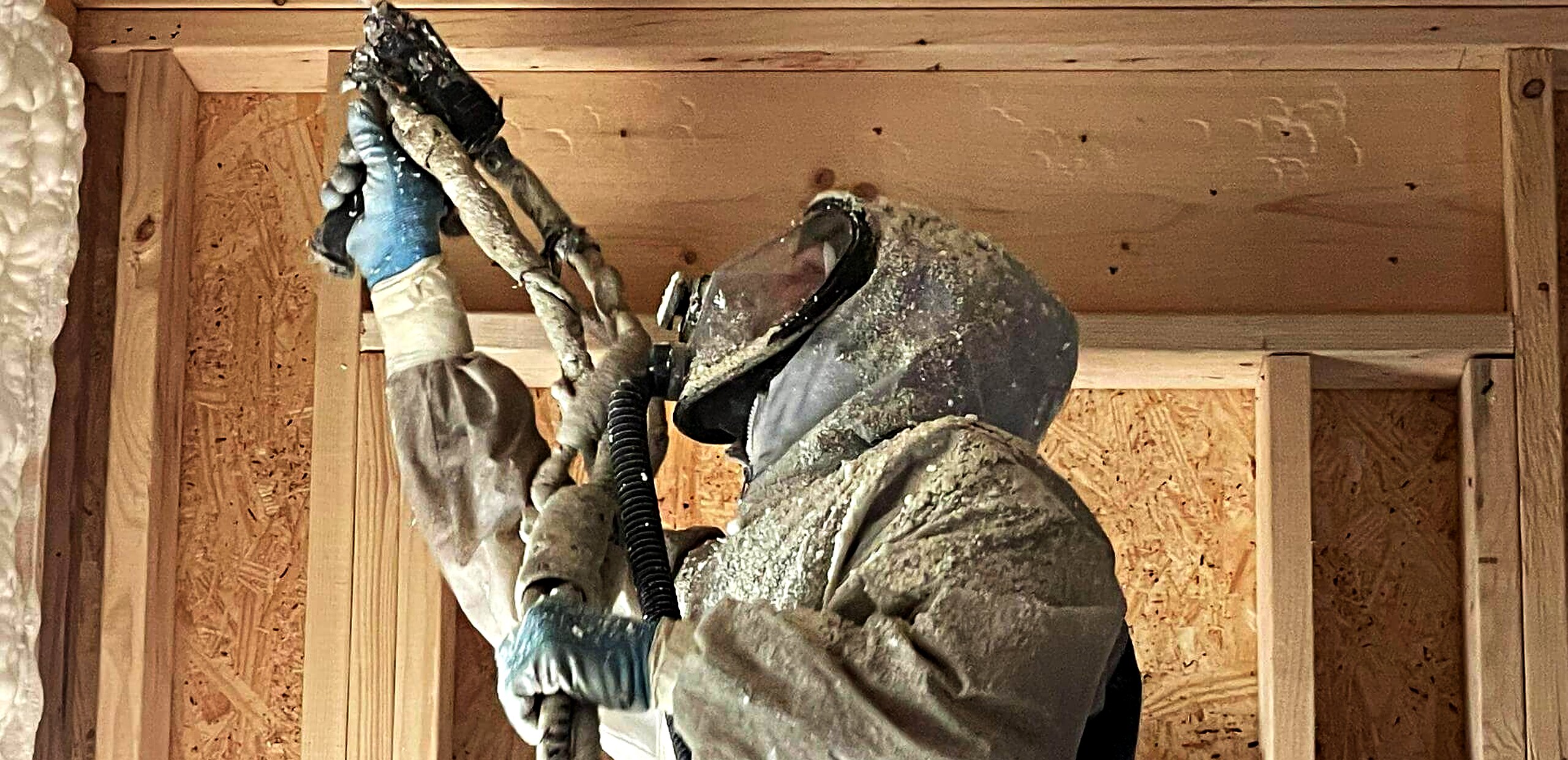
Spray foam for a living.
ArmorThane is the one-stop shop for applicators. We make the chemistry, build the equipment, train you hands-on and back you with technical support, with no franchise fees and no royalties. Applicators have come first here since 1989.
- $0franchise fees or royalties
- 35+years in business
- 50+countries with applicators
- 24/7technical support
A cargo van is a steel box with windows, and steel is a poor thing to sleep inside in January. Good van insulation isn't about finding one perfect material. It's about getting four things right at once: walls and ceiling, the floor, the windows, and the water your own breath puts into the air.
For most camper vans: Thinsulate or wool on the walls and ceiling, 1 in. of polyiso or XPS under the floor, thin foam over exposed ribs, and insulated window covers. Closed-cell spray foam gives the most R-value per inch (R-6.5, against about R-3.2 for Thinsulate) and keeps moist air off the metal, but it's permanent and has to go on in thin passes. It makes the most sense in cargo trailers, work vans and builds you'll keep for a decade. Skip fiberglass, denim and bubble foil as wall insulation. Jump to the materials calculator, the heat-loss calculator or the condensation check.
Most van insulation guides pick a favorite material and argue for it. Fair enough; most of the ones we read come from people who built vans and lived in them. What they rarely do is put numbers on the decision: how much heat each choice actually saves, how much water two sleepers add overnight, how much airflow it takes to keep the windows dry, or what spray foam does to thin sheet metal.
We make ArmorFoam spray foam and ArmorLiner polyurea in Springfield, Missouri, and we've supported spray applicators for 35 years. So you might expect us to tell you to spray-foam your van. (Insulating a travel trailer or motorhome instead? See our RV insulation guide.) For plenty of camper vans we won't. This guide shows where foam earns its place, where a removable blanket is the smarter call, and the math behind both.
- 1What is the best insulation for a van?
- 2Spray foam in a van: pros, cons and a fit checker
- 3How much insulation you need (calculator)
- 4Heat loss and heater sizing (calculator)
- 5Condensation, vapor barriers and rust (calculator)
- 6How to insulate a van, step by step
- 7Sprinter, Transit and ProMaster notes
- 8Cargo trailer insulation
- 9What van insulation costs
- 10Foam and liners from an ArmorThane applicator
- 11Van insulation FAQ
What is the best insulation for a van?
The best van insulation is the one that suits the surface. Flexible, water-shedding fiber (Thinsulate or wool) for curved walls and ceilings. Rigid board for the floor and flat panels. Closed-cell spray foam where you want the most R per inch and no air gap at the metal. Anything that soaks up water stays out.
| Material | R per inch | Water and vapor | Curves and cavities | Removable? | Price (date) | Best use | Watch out for |
|---|---|---|---|---|---|---|---|
| 3M Thinsulate SM600L | ≈3.2 (R-5.2 at 1.65 in.) | Fibers don't absorb water; vapor-open | Excellent | Yes | $12.45 per ft of 60 in. roll, ≈$2.49/sq ft (Sep 2026) | Walls, ceiling, doors, pillars | Cost; the skin behind it can condense |
| Havelock Wool van batts | ≈4.0 (R-8 at 2 in.) | Absorbs and releases moisture; vapor-open | Good; pulls apart for stuffing | Yes | $200 per 100 sq ft box (2026) | Walls, ceiling, nooks | Held water longest in one bench test |
| Polyiso board, foil-faced | 5.0–5.6; ≈4.5 on a cold day | Foil is vapor-tight; edges must be sealed | Poor on curves | Hard once glued | ≈$0.72/sq ft at 1 in. | Floor, flat walls, ceiling | Loses R in the cold; gaps on curves |
| XPS board | 5.0 | Low perm; keeps its R in the cold | Poor | Hard once glued | Check locally | Floor | Stiff; check the data sheet for heat limits |
| Closed-cell spray foam, DIY kit | 6.2 (Froth-Pak ESR) | Air barrier; vapor retarder at 1 in.+ | Excellent; bonds to metal | No | $1.22–$1.95 per board foot (2026 kits) | Trailers, work vans, long-term builds | Thick passes, drain holes, fumes |
| Closed-cell spray foam, pro rig | 6.5 aged (ArmorFoam) | Air barrier at 1 in.; 0.83 perm there | Excellent | No | $1.00–$2.12/bf installed, plus a job minimum | Trailers, fleets, full rebuilds | Permanence; finding a crew that does vans |
| Closed-cell rubber foam (EPDM) | ≈4.0 | Vapor-tight | Excellent; flexes | Glued | ≈$4/sq ft at 1 in. | Wheel arches, curves, thermal breaks | Price |
| Open-cell spray foam | 3.7 (ArmorFoam 0.5: 3.9) | Vapor-open (10–20+ perms) | Good | No | – | Not against a van skin | Permanent and vapor-open: worst of both |
| Fiberglass or recycled denim | 3.1–4.3 (batts) | Air-permeable; slow to dry once wet | Stuffable | Yes | Cheap | Nowhere in a van | FarOutRide and Bearfoot Theory list it as one to avoid |
| Reflectix / bubble foil | Little, pressed against metal | Vapor-tight | Easy | Yes | Cheap | Window covers | Works only facing an air space (DOE) |
3M Thinsulate: the easy default
Thinsulate SM600L is a polyester and polypropylene blanket, 1.65 in. thick, rated R-5.2 at that thickness in 3M's data sheet. That's about R-3.2 per inch. You'll see sellers quote "R-5.45 per inch (RSI 0.96)"; RSI 0.96 is the whole 44 mm blanket, so that figure is the total, not per inch. It's light (642 g/m²), passes the FMVSS 302 automotive flammability test, cuts with scissors and glues on with 3M 90 spray adhesive. 3M sells it as an acoustic absorber first, which is why vans with it are quieter.
The catch is physics, not the product. Thinsulate is vapor-open, so moist cabin air reaches the metal behind it, and that metal sits near outdoor temperature in winter. In Build A Green RV's bench test it showed "significant condensation" behind it, yet picked up only 11 g of water and dried back to within 1 g of its starting weight. That's the whole Thinsulate strategy: let it get damp, let it dry.
Sheep's wool
Havelock's van batts moved to a 24 x 48 x 2 in., R-8 product in April 2026 (the older batt was R-7), sold in 100 sq ft boxes. Wool buffers moisture: it absorbs it and gives it back. In the same bench test the wool gained 36 g and still held about 40% of that after eight hours of drying, so several damp nights in a row stack up. Havelock adds boric acid against insects. It's pleasant to handle, harder to hold in place (most builders run strings across the cavity), and a sensible pick if you want a natural fiber.
Rigid board: polyiso and XPS
Foil-faced polyiso is the best R per dollar: about $0.72 per sq ft at 1 in., rated R-5.0 to 5.6 per inch. Two cautions. Its R-value drops in the cold; Building Science Laboratories measured roughly R-6 per inch in summer and R-4.5 on a cold winter day. And it only works as a vapor barrier if every edge is glued and sealed with canned foam, so moist air can't get behind it. Done that way, the bench-test polyiso picked up zero grams of water. XPS holds its R-5 in the cold and is rated for at least 25 psi in compression (DuPont), which is why builders reach for it under the floor. Neither bends around a Sprinter's upper walls.
What to skip
- Fiberglass and recycled denim. Air-permeable and slow to dry once wet. FarOutRide and Bearfoot Theory both list them under materials to avoid, and we agree.
- Reflectix as wall insulation. A radiant barrier needs an air space in front of it to work (DOE). Glued to the metal it adds little. It's fine in window covers, where there's air on one side.
- Open-cell spray foam. It's our product too, and great in a house wall. Against a van skin it's the wrong mix: permanent like closed-cell, vapor-open like fiber, and it holds more water. Our open-cell spray foam guide covers where it belongs.
- Insulating paint. We couldn't find independent R-value data for it.
What about road noise?
Insulation and sound deadening are different jobs. Soft fiber (Thinsulate, wool) absorbs mid and high frequencies. Rigid closed-cell foam absorbs less; in house walls it tests a couple of STC points below open-cell (see does spray foam reduce noise). Panel drumming is handled by a butyl deadening mat stuck to the sheet metal before any insulation goes in.
Spray foam van insulation: the honest pros and cons
Closed-cell spray foam is the best-performing van insulation per inch and the only one that bonds right to the metal, so cabin air never reaches the cold skin. It's also permanent, easy to overdo on thin panels, and a nuisance if the body ever needs repair. It's a good fit for trailers, work vans and long-term builds, and a weaker one for a leased or soon-sold camper.
Performance you can't get from a blanket
- R per inch. ArmorFoam closed-cell tests at R-6.5 per inch aged. One inch beats a full layer of Thinsulate (R-5.2) and takes less wall depth.
- No air gap at the skin. It's an air barrier at 1 in. (ASTM E2178) and 0.83 perm there, a Class II vapor retarder. Moist air has no path to the metal, the same reason the sealed board stayed dry in the bench test.
- Fills the awkward parts. Ribs, corners and wheel-arch curves, with nothing to slump or rattle. It also stiffens thin sheet metal.
- Not as heavy as people say. One inch over a Sprinter 144's walls and ceiling is roughly 31–35 lb of foam; a layer of Thinsulate is about 28 lb (our math from density and 3M's weight).
What usually gets glossed over
- Panel distortion. Foam expands and gives off heat as it cures. Van builders report distorted panels when it goes on thick (FarOutRide). Our own rule for closed-cell is lifts of 1.5–2 in. at most, because thicker lifts trap heat; on thin van skin we'd stay near 1 in. per pass.
- It's permanent. New wiring, a dent or a rust repair means cutting foam out. FarOutRide also reports that some body shops won't touch foamed panels.
- Drain holes and mechanisms. Foam in a door can jam latches, window regulators and the sliding-door track. Foam in a drain hole traps water.
- Rust you can't see. Foam bonded to clean, primed metal keeps water off it. Foam over existing rust, or over voids fed by seams and drain holes, just hides the problem.
- Cost and access. A van rarely clears a crew's $1,000–$2,000 job minimum, and our own closed-cell guide rates professional van jobs "hard to source."
If you do spray foam a van, do it this way
Get to clean, dry, primed metal
Sand rust to bright metal and prime it, including every hole you drilled. The Froth-Pak evaluation report says not to spray wet, frosted or oily surfaces.
Run wiring first
Conduit or loom with pull strings, plus rivnuts and backing for anything you'll bolt on. Once foam is in, changes mean digging.
Mask what moves or drains
Factory drain holes, the sliding-door track, door latches and regulators, seat-belt anchors and wiring grommets. Leave closed pillars and frame rails hollow; they need to drain and dry.
Thin passes, warm chemical
About 1 in. per pass on sheet metal, with a cool-down between passes (Tiger Foam's report says at least 15 minutes; HandiFoam suggests 10). Both kit reports we checked cap a pass at 2 in. DuPont wants Froth-Pak at 75°F or warmer; cold kits yield badly, so read spraying in cold weather first.
Ventilate like a pro
The Froth-Pak evaluation report calls for 10 air changes an hour during spraying and for at least an hour after. In a Sprinter 144 high roof that's about 71 CFM. Wear an organic-vapor/P100 respirator; OSHA links isocyanates to occupational asthma.
Trim flush, then break the bridge
Shave foam flush with the ribs, then fur out the paneling with a thin foam strip between wood and metal.
Is spray foam right for my van or trailer?
Eight questions, a score and a plan. It's a rule-of-thumb screen built on the trade-offs above, not a guarantee.
How we scored it
- You want the most R-value in the thinnest wall: closed-cell spray foam is R-6.5 per inch.
Do these
- Run all wiring first, in conduit or loom, with pull strings for later.
- Keep factory drain holes open and mask the sliding-door track, door latches, window regulators and wiring grommets.
- Don’t fill closed pillars and frame rails solid; they need to drain and dry.
The removable plan
- Thinsulate or wool on walls and ceiling, 1 in. polyiso or XPS under the floor, thin foam strips over exposed ribs, and insulated window covers.
- Either way: treat bare metal, keep drain holes clear and ventilate. Want it sprayed? Find an ArmorThane applicator.
Kit or crew? Our DIY spray foam insulation guide compares kit coverage and safety in detail, and spray foam insulation cost breaks down professional pricing. For a single van, kits usually win on price, because the job sits below most crews' minimum. Our closed-cell spray foam guide reaches the same conclusion.
How much insulation does a van need?
A high-roof Sprinter 144 has about 211 sq ft of walls and ceiling, a Sprinter 170 about 276 and a ProMaster 136 about 194, before the rear doors and floor. That works out to roughly 40–55 ft of 60-inch Thinsulate, two or three boxes of wool, eight to ten sheets of polyiso, or 250–350 board feet of spray foam at 1 in. with waste.
How much to buy, what R-value you get, and what it costs
Pick your van or trailer, the surfaces and a material. Cargo dimensions are from FarOutRide's van comparison; edit them for your vehicle. Prices are Sep 2026 listings.
Sprinter 144 high roof (132.9 x 70.4 x 79.1 in.): walls 146 + ceiling 65 + rear doors 39 sq ft, minus 12 sq ft of glass = 238 sq ft. Adds roughly 31 lb. Box-shaped estimate: ribs, pillars and wheel wells add some, windows take some away.
What the numbers mean
- 53 linear ft at $12.45/ft (SM600L, Campervan HQ, Sep 2026). Pre-cut kits for common vans list at $469–$834.
- Each layer is 1.65 in. thick and R-5.2 total (3M data sheet), about R-3.2 per inch. Sellers who quote “R-5.45 per inch” are quoting the whole blanket.
- Glue with 3M 90 spray adhesive on both faces; FarOutRide used four cans on its build. Stuff offcuts into pillars and ribs.
Before you buy
- Floor not included. An uninsulated floor added about 40% to one tested van’s total heat loss; 1 in. of board under plywood fixes it.
- Seal or cover exposed ribs with a thin foam strip or furring before paneling; bare metal frames are the coldest surfaces in the van.
How we calculated this: walls = 2 x length x height, ceiling and floor = length x width, rear doors = width x height, minus glass, converted to square feet. Thinsulate: area x (1 + waste) ÷ 5 ft roll width. Boards: area ÷ 32 sq ft per sheet. Spray foam board feet = area x thickness x (1 + waste); kits are priced as the cheapest mix of five listed kits. Pro range = board feet x $1.00–$2.12, with a $1,000–$2,000 minimum. Estimates only.
Thinsulate by van model: seller amounts vs. our area math
| Van (high roof) | Cargo L x W x H (in.) | Walls + ceiling (our calc) | Rear doors | Thinsulate, seller minimum | Pre-cut 3M kit |
|---|---|---|---|---|---|
| Sprinter 144 | 132.9 x 70.4 x 79.1 | 211 sq ft | 39 sq ft | 40–45 ft | $619 |
| Sprinter 170 | 173.6 x 70.4 x 79.1 | 276 sq ft | 39 sq ft | 50–55 ft | $775.67 |
| Sprinter 170 extended | 189 x 70.4 x 79.1 | 300 sq ft | 39 sq ft | 55–60 ft | $834 |
| Transit 148 | 143.7 x 70.2 x 81.5 | 233 sq ft | 40 sq ft | 40–45 ft | $655.67 |
| Transit 148 extended | 172.2 x 70.2 x 81.5 | 279 sq ft | 40 sq ft | 55–60 ft | $810.67 |
| ProMaster 136 | 122.8 x 75.6 x 76.2 | 194 sq ft | 40 sq ft | 35–40 ft | $512 |
| ProMaster 159 | 145.9 x 75.6 x 76.2 | 231 sq ft | 40 sq ft | 40–45 ft | $539.84 |
| ProMaster 159 extended | 160.3 x 75.6 x 76.2 | 254 sq ft | 40 sq ft | 45–50 ft | $668.12 |
How thick? There's no building code for a camper van, so the target is comfort and heater size. Parked in Paradise suggests 1–2½ in. on the ceiling, and Build A Green RV's package of about 1 in. of foam everywhere, roughly R-7 to R-8 per assembly, cut its heat loss by about 80%. The next calculator shows how quickly extra thickness stops paying.
How warm will it stay? Van heat loss and heater sizing
Insulating the walls, ceiling and floor cuts a van's heat loss by roughly three-quarters. After that, the wall material matters less than most debates suggest. In our Sprinter 144 example at 20°F, swapping Thinsulate for 1 in. of closed-cell foam trims total heat loss by about 11%. Leaving the floor bare would add nearly half again, and covering the windows saves more than the foam upgrade does.
How much heat will my van lose, and how much fuel per night?
Conduction through each surface plus outside air, using handbook R-values for air films, plywood and glass. Try switching the floor or adding window covers before you upgrade the walls.
Sprinter 144 high roof, 68°F inside and 20°F outside: 238 sq ft of walls, ceiling and doors at R-6.36 (less 25% for metal-frame bridging), 65 sq ft of floor at R-7.08, 12 sq ft of glass at R-0.91 and 4 CFM of outside air. Compared with the same van bare, with a plain plywood floor and no window covers (16,345 Btu/h), that’s 79% less heat. The biggest remaining loss is walls, ceiling, rear doors. Vented propane at 75% efficiency (an assumption; one tested furnace delivers 9,000 of its 12,000 Btu input). Steady-state estimate: sun, wind and stratification move real numbers by 20% or more.
How we calculated this: heat loss = Σ area x (inside − outside) ÷ R, plus 1.08 x CFM x (inside − outside) for outside air. Wall assembly R = 0.68 (inside air film) + insulation + 0.31 (¼ in. plywood panel) + 0.17 (outside air film); bare metal = 0.85. Floor = 0.68 + 0.63 (½ in. plywood) + insulation + 0.17. Glass = 0.91 plus any cover. Handbook values from the Colorado Energy R-value table. Fuel: propane 91,420 Btu/gal and diesel 138,490 Btu/gal (higher heating values, U.S. DOE AFDC).
Five things the heat-loss math shows
- Insulate the floor. From temperatures measured in its van at 34°F, Build A Green RV worked out that a plain ½ in. plywood floor raises total heat loss by about 40%, and put the fix at "$40 materials and an hour of labor."
- The ceiling deserves the thickest layer. On a clear night the roof radiates to the sky and runs colder than the air. In a separate three-day logging test, the same builder found the ceiling losing about 2.35 times as much heat per square foot as the floor on clear nights.
- Glass is the biggest hole once the walls are done. Single glass is about R-0.9. An insulated cover with an air gap behind it is the cheapest upgrade left.
- Bare frames leak, but less than you'd think. In IR photos at 23°F outside, a bare metal frame read 58.2°F against 65°F for the insulated panel next to it; ribs under a ceiling panel read 51.1°F. The builder estimated the overall penalty at about 25%. Furring strips with foam between wood and metal fix most of it.
- Ventilation costs heat. Every 10 CFM of outside air at a 48°F difference costs about 520 Btu/h. You still need it (see the next tool); just count it.
Condensation, vapor barriers and rust in a van
Condensation in a van comes mostly from you: about 50 g of water vapor an hour per adult at rest, plus cooking and any unvented heater. It condenses on anything colder than the air's dew point, which in winter means glass, bare metal and the skin behind vapor-open insulation. Ventilation removes it; insulation and covers decide where it lands.
How much water am I adding, and how much airflow keeps the windows dry?
Moisture rates from the USDA Forest Products Laboratory (50 g/h per adult at rest, 240 g per meal) and propane chemistry; steady-state humidity from a simple air-exchange balance.
| Surface | Temperature | At a 29°F dew point |
|---|---|---|
| Single-pane glass | 32°F | Stays dry |
| Bare sheet metal or an uncovered rib | 30°F | Stays dry |
| Metal skin behind 1.65 in. Thinsulate | 21°F | Condenses (or frosts) |
| Inside face of the insulated wall | 63°F | Stays dry |
Dry About 2.4 L of water a day (1.4 L from breathing and skin at 50 g/h per adult, 0.7 L from cooking, 0.25 L from wet gear). Overnight, 100 g/h goes into 428 cu ft of air with 29 CFM of exchange. For scale: only 125 g of water takes this van’s air from outdoor humidity to 70% RH at 68°F. Keeping bare glass dry takes about 22 CFM of steady outside air, which costs about 1,160 Btu/h of heat. Behind vapor-open insulation the skin sits near outdoor temperature, so some condensation there is normal; the insulation has to be able to dry. Steady-state screening at sea level; it ignores moisture stored in wood and fabric.
How we calculated this: daily water = adults x 50 g/h x hours + meals x (240 g + burner combustion water) + unvented heater water + wet gear. Burning propane makes 4 molecules of water per molecule of fuel; with NIST's heat of combustion that's about 0.034 g of water per Btu, or 343 g per 10,000 Btu. Humidity ratio from the Magnus formula at sea level; indoor humidity ratio = outdoor + moisture rate ÷ (air density x airflow). Surface temperatures use the same R-values as the heat-loss tool. Steady-state screening only.
Vapor barrier or not? Pick one strategy and commit
There are two ways to keep a van wall healthy, and each works on its own terms:
- Vapor-tight at the metal. Bonded closed-cell spray foam, or rigid board glued on with every edge sealed. No cabin air reaches the skin, so there's nothing to condense on it.
- Vapor-open and drying. Water-shedding fiber (Thinsulate, wool) with no plastic sheet over it, plus enough ventilation that whatever condenses behind it dries out between cold nights.
What fails is the mix: fiber behind a plastic sheet with gaps at every screw and seam. Moist air gets in and can't get out, which is why FarOutRide, Parked in Paradise and Bearfoot Theory all steer builders away from a separate vapor barrier in a van. Metal is already a vapor barrier on the outside.
What one bench test found
| Sample | Thickness | Water picked up overnight | Condensation behind it | After 8 h of drying |
|---|---|---|---|---|
| Havelock wool | 2 batts, 3.5 in. | +36 g | Significant | Still held about 40% of it |
| 3M Thinsulate | 2 layers, 3⅜ in. | +11 g | Significant | Back within 1 g of dry |
| Polyiso, edges sealed with canned foam | 2 boards, 2 in. | 0 g | None | Dry |
How little water it takes
A Sprinter 144 high roof holds about 428 cu ft of air. By our psychrometric math, only about 70–90 g of water takes 70°F air in that space from 30–40% to 70% humidity. Two sleepers make 100 g an hour. That's why a sealed van fogs up by midnight no matter what's in the walls, and why a steady 20–30 CFM of exchange, as in the default above, matters more than any insulation brand. A roof fan on low or a cracked window is how you get it.
Heaters and stoves
Vented heaters, diesel or propane, send their combustion water outside. Unvented portable propane heaters put all of it inside: about 343 g for every 10,000 Btu burned, by our stoichiometric math. (FarOutRide quotes 450 mL an hour; that figure comes from a natural-gas burner in the USDA paper.) Unvented heaters also need a CO alarm and fresh air.
Where rust starts, and how to keep it from starting
Our undercoating guide puts it plainly: water that gets into frame box sections and floor-pan seams starts rust from the inside out. Insulation doesn't cause that, but it can hide it and slow drying. Before you close anything up: treat every bare or scratched spot and every drilled hole, keep the factory drain holes open, don't pack closed frame rails solid, and consider a cavity wax in seams you won't see again. Wax products need reapplying, so do the hidden spots before the insulation goes in.
How to insulate a van, step by step
Strip the cargo area to bare metal, fix and prime any rust, add sound deadener, run wiring, then insulate the floor, walls and ceiling, stuff the pillars, add thermal breaks over the ribs, and finish with window covers and a roof fan. Most DIY builds take a couple of weekends; FarOutRide logged 16 hours for its Thinsulate install alone.
Strip, clean and treat rust
Pull the factory liner and floor. Vacuum, degrease, sand any rust to bright metal and prime it. Prime drilled holes too. Keep every drain hole open.
Sound deadener, if you want it
Butyl mats go directly on large flat panels to stop drumming. They're not insulation; they just make the panels quieter.
Plan and run wiring
Lights, roof fan, solar and outlets. Use loom or conduit with pull strings, and fit rivnuts or backing blocks for cabinets and panels now.
Floor
Seal holes, template the floor in cardboard, lay 1 in. polyiso or XPS (between furring strips if you want screw points), then plywood on top. Build A Green RV's 1 in. polyiso floor works out to about R-7.6 as an assembly.
Walls and ceiling
Thinsulate: spray 3M 90 on the metal and the white face, wait 30–60 seconds until tacky, press it on (FarOutRide's method). Board: glue with canned foam in a grid and seal every edge. Spray foam: thin passes, per the list above.
Pillars, ribs and doors
Pull Thinsulate or wool offcuts into the frame cavities without blocking drain paths. Door cards come off for the same treatment.
Thermal breaks
Where paneling meets bare ribs, add a strip of closed-cell foam or foam tape, or fur out with wood and fill the gap. Ceiling ribs are the worst offenders.
Windows and ventilation
Make or buy insulated window covers, and fit a roof fan that can run in exhaust mode with an intake low and far from it.
Sprinter van insulation, plus Transit and ProMaster notes
A Sprinter 144 high roof has about 211 sq ft of walls and ceiling to insulate, plus 39 sq ft of rear doors. The walls and ceiling alone take roughly 45 ft of Thinsulate, three boxes of wool, or eight sheets of polyiso. Its upper walls curve in, so flexible materials or spray foam fit better there than board. The ProMaster's flatter walls suit board best.
Curved upper walls
High roof: 70.4 in. wide, 79.1 in. standing height; cargo length 132.9 in. (144), 173.6 in. (170) or 189 in. (170 extended). Flexible Thinsulate, wool or foam handles the curve where the wall meets the roof. Seller kits run $619 (144) to $834 (170 extended).
Tallest high roof
81.5 in. standing height in the high roof, 70.2 in. wide; 143.7 in. of floor in the 148 and 172.2 in. in the extended. Our area math puts the 148 at about 233 sq ft of walls and ceiling, a little over the 40–45 ft of Thinsulate sellers suggest.
Widest, flattest box
75.6 in. wide with nearly vertical walls and 76.2 in. of standing height. Flat walls make edge-sealed polyiso practical on most of the surface, with fiber or foam in the tighter curves. The 136 is the smallest high-roof box here, at about 194 sq ft.
Dimensions from FarOutRide's van comparison; they vary by model year and roof, so measure before you order. Areas are our box-model math.
Cargo trailer insulation: what changes from a van
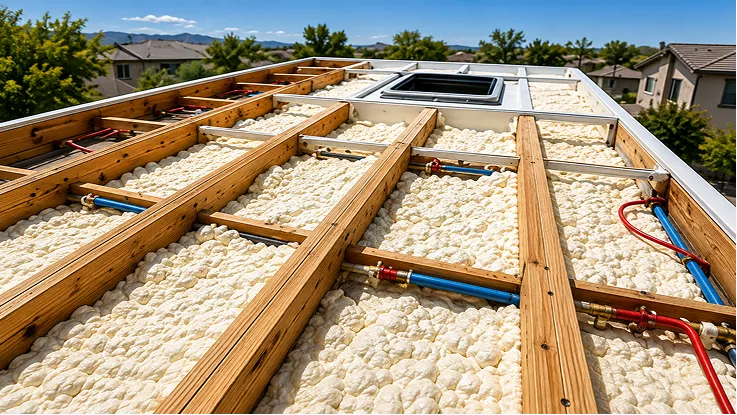
Enclosed cargo trailers are easier than vans: flat walls between uprights, a flat or gently curved roof and a plywood floor, with few mechanisms in the way. The rules are the same. Keep moist air off the cold outer skin, insulate the floor, and ventilate. Closed-cell spray foam or edge-sealed rigid board between the uprights works best.
How a cargo trailer wall is built
Most have a steel or aluminum tube frame, a thin exterior skin, plywood or composite interior walls, roof bows and a plywood floor over crossmembers. The depth of the uprights is the cavity you can fill, and it varies by builder, so measure it with a wall panel off.
Three ways to insulate one
- Rigid board between uprights. Cut polyiso or XPS to the cavity, glue it to the skin and seal every edge with canned foam before the plywood goes back.
- Closed-cell spray foam. It bonds to the skin, fills around the tubes and leaves no gap for condensation. Trim flush and re-panel. This is where we think foam makes the most sense.
- Fiber batts behind plywood. Workable only if the cavity can dry. Fiber against a cold aluminum skin, closed in by plywood, is the combination most likely to stay damp.
Floors, roofs and vents
Insulating a trailer floor from below leaves the insulation facing road spray, so most conversions put board on top of the old floor under a new plywood layer. Give the roof the thickest layer, since it radiates to the night sky. And check what the manufacturer built in: Pace American, for one, fits flow-through sidewall vents to "help manage interior temperature and reduce moisture buildup." If you close them off, add a roof fan.
A trailer used as a mobile shop or camper still gets the knocks of a trailer. Our trailer coatings page covers polyurea on floors and exteriors, and overland trailer coatings covers the off-road version. Converting a steel box that doesn't move? Shipping container insulation deals with the same cold-skin problem at a bigger scale.
How much does van insulation cost?
For a Sprinter 144 high roof's walls and ceiling, materials run about $200–$250 for polyiso board, roughly $600–$650 for Thinsulate or wool, and about $650 in DIY spray foam kits at 1 in. A professional closed-cell job usually lands at the crew's $1,000–$2,000 minimum. Add about $40–$50 of board for the floor.
| Approach | Sprinter 144 HR walls + ceiling (≈211 sq ft) | What's in the number | Source |
|---|---|---|---|
| Polyiso board, 1 in. | ≈$200–$250 | $0.72/sq ft plus canned foam at $17 a can | Build A Green RV prices; our quantities |
| 3M Thinsulate SM600L, cut yourself | ≈$580–$640 | 47–51 ft at $12.45/ft; adhesive extra | Campervan HQ, Sep 2026 |
| Thinsulate pre-cut kit | $619 | Walls, ceiling and door cavities; no floor or cab | Campervan HQ, Sep 2026 |
| Havelock wool | $600 | Three 100 sq ft boxes; shipping extra | Havelock, 2026 |
| Closed-cell spray foam kits, 1 in. | ≈$650 | Cheapest kit mix for ≈264 bf with 25% waste | 2026 kit listings; our math |
| Closed-cell rubber foam, 1 in. | ≈$930 | ≈$4/sq ft | Build A Green RV |
| Professional closed-cell, 1 in. | $1,000–$2,000 | Job minimum; foam alone is ≈211 bf | HomeGuide minimum (Dec 2025); our estimate |
| Floor, 1 in. board | ≈$40–$50 | About 65 sq ft of board | Build A Green RV ("$40 materials") |
The cheapest option isn't automatically the worst. Edge-sealed polyiso did better than both fibers in the moisture bench test, and it's the best R per dollar. It just takes the most patience on curved walls. At the other end, a pro foam job only pencils out if you want the performance and permanence, or you're bundling it with other work.
Van spray foam and liners from an ArmorThane applicator
If the fit checker points to foam, an ArmorThane-certified applicator can spray ArmorFoam closed-cell in thin, controlled passes to a thickness you agree on up front. Our closed-cell tests at R-6.5 per inch aged, passes as an air barrier at 1 in., and measures 0.83 perm there.
The other half of what we make matters in vans too. ArmorLiner is a two-component, 1:1, 100% solids, fast-set polyurea that applicators spray on van floors, door jambs and exteriors; see ArmorLiner on Sprinter vans. If you're gluing in Thinsulate yourself, a sprayed floor or underbody may be the part worth handing to a pro. More on foam in spray foam insulation.

ArmorFoam closed-cell
Aged, ASTM C518. One inch beats a full layer of Thinsulate in less depth.
Air barrier
Passes ASTM E2178 at 1 in. and measures 0.83 perm, a Class II vapor retarder.
ArmorLiner polyurea
Two-component, 100% solids, fast set, for floors, jambs and exteriors.
Vans are small foam jobs. Bundle them.
A van is a 250–350 board-foot foam job; a 55-gallon ArmorFoam closed-cell set yields about 5,000. Pair foam with polyurea floors, undercoating and trailer coatings and a van becomes a full day. We supply ArmorFoam, ArmorLiner, matched spray equipment and training. Startup packages start at $25,000, with no franchise fee and no royalties.
Questions first? Call (417) 831-5090.
Van insulation FAQ
What is the best insulation for a van?
For most camper vans, a water-shedding fiber such as 3M Thinsulate or sheep's wool on the walls and ceiling, 1 in. of polyiso or XPS under the floor, and insulated window covers. Closed-cell spray foam gives the most R-value per inch (R-6.5) and keeps moist air off the metal, but it's permanent, so it suits trailers, work vans and long-term builds best. Avoid fiberglass, denim and bubble foil as wall insulation.
Is spray foam good for van insulation?
Closed-cell spray foam performs very well: about R-6.5 per inch, an air barrier at 1 in., and bonded to the metal so condensation can't form behind it. The downsides are permanence, the risk of distorting thin panels if it goes on thick, and cutting it out for any body repair. Spray about 1 in. per pass, keep drain holes and door mechanisms clear, and treat bare metal first.
Does spray foam cause rust in a van?
Not when it's bonded to clean, dry, primed metal, because air and water can't reach that surface. Rust starts where foam goes over existing rust, or where water gets into unsealed voids through seams and blocked drain holes, and the foam hides it. Treat rust and drilled holes first and never fill drain holes or closed frame rails.
Can spray foam warp van panels?
It can. Foam expands and gives off heat as it cures, and van builders report distorted panels when it's sprayed thick in one pass. Our guidance for closed-cell is lifts of 1.5–2 in. at most; on thin van sheet metal we'd keep each pass near 1 in. and let it cool before the next.
Do I need a vapor barrier in a van?
Usually not a separate plastic sheet. Either keep moist air off the metal with bonded closed-cell foam or edge-sealed foam board, or use a water-shedding fiber with no plastic and enough ventilation that it dries. A plastic sheet over fiber tends to leak at every seam and trap moisture behind it.
What R-value is Thinsulate, and how much do I need?
3M rates Thinsulate SM600L at R-5.2 for its 1.65 in. thickness, about R-3.2 per inch; the "R-5.45 per inch" some sellers quote is the whole blanket. A Sprinter 144 high roof takes about 40–45 ft of the 60 in. roll for walls and ceiling, a Sprinter 170 about 50–55 ft. Use the estimator for your van.
Should I insulate my van floor?
Yes. Build A Green RV calculated from measured temperatures that a plain ½ in. plywood floor adds about 40% to an otherwise insulated van's heat loss, and put the fix at about $40 in materials. One inch of polyiso or XPS under the plywood is the usual choice.
Is Reflectix good van insulation?
Not as wall insulation. A radiant barrier only works when the reflective face looks onto an air space, according to the U.S. Department of Energy, so glued to sheet metal it adds very little. It's useful for window covers, where it faces air.
Is sheep's wool good insulation for a van?
It works and it's pleasant to install. Havelock's current van batt is R-8 at 2 in. Wool absorbs moisture and releases it slowly: in one bench test it picked up 36 g of water overnight and still held about 40% after eight hours of drying, so it needs good ventilation.
Can I use fiberglass to insulate a van?
We wouldn't. Fiberglass is air-permeable, slow to dry once it's wet, and it can slump with road vibration. Thinsulate and wool cost more but shed or manage moisture far better in a vehicle.
How much does it cost to insulate a van?
For a Sprinter 144 high roof's walls and ceiling, materials run about $200–$250 in polyiso board, roughly $600–$650 in Thinsulate or wool, and about $650 in DIY closed-cell kits at 1 in. A professional foam job usually lands at the crew's $1,000–$2,000 minimum. Add about $40–$50 for a board floor.
How do I stop condensation in my van?
Ventilate steadily, use vented heaters, and cover the windows. Two adults add about 100 g of water an hour; in our winter example, about 22 CFM of steady outside air keeps bare glass dry. Unvented propane heaters add about 343 g of water per 10,000 Btu, so avoid them. The condensation check runs your numbers.
How do I insulate a cargo trailer?
Glue polyiso or XPS between the uprights with every edge sealed, or spray closed-cell foam against the skin and trim it flush, then re-panel. Put board on top of the floor under new plywood, give the roof the thickest layer, and keep or replace any factory vents with a roof fan.
Written from manufacturer data sheets, published van-builder test data and 35+ years of making and supporting spray foam and polyurea. Last updated September 26, 2026.
Methodology and sources
Material properties come from manufacturer data sheets and evaluation reports; handbook R-values for air films, plywood and glass from the Colorado Energy table; fuel energy from U.S. DOE AFDC; moisture rates from the USDA Forest Products Laboratory. Van dimensions are FarOutRide's compiled figures. Measured van data (bench moisture test, IR thermal-bridge photos, floor heat loss) is from Build A Green RV. Heat-loss, humidity and area figures are our own steady-state calculations: screening tools, not a substitute for testing your own build. Prices are dated retail listings.
- 3M, Thinsulate Acoustic Insulation TAI and SM Series technical data sheet (PDF): cdn.shopify.com/s/files/1/1216/0450/files/3M_Thinsulate_Technical_Data
- Campervan HQ, 3M Thinsulate SM600L listing (Sep 2026): campervan-hq.com/products/3m-thinsulate-insulation-sm600l
- Campervan HQ, camper van insulation: Thinsulate amounts by van (Oct 2024): campervan-hq.com/blogs/van-build-guide/insulating-your-camper-van
- Campervan HQ, Sprinter Thinsulate kit: campervan-hq.com/products/3m-thinsulate-van-insulation-kit-for-mercede
- Havelock Wool, wool insulation for vans: havelockwool.com/pages/applications-vans
- Havelock Wool, Vanlife Batts 2.0 (Apr 2026): havelockwool.com/blogs/blog/the-next-evolution-of-vanlife-insulation-a
- Build A Green RV, insulation testing for van conversions: buildagreenrv.com/insulation-testing-for-van-conversions/
- Build A Green RV, van insulation testing, chapter 2: buildagreenrv.com/design-and-build-information-for-camper-vans/install
- Build A Green RV, thermal bridging due to metal frames: buildagreenrv.com/thermal-bridging-insulation-due-metal-frames/
- Build A Green RV, ceiling vs. floor heat loss: buildagreenrv.com/van-camper-ceiling-vs-floor-heat-loss/
- Build A Green RV, is it worth insulating the floor: buildagreenrv.com/design-and-build-information-for-camper-vans/install
- Build A Green RV, heat loss calculator for camper vans: buildagreenrv.com/design-and-build-information-for-camper-vans/heat-lo
- FarOutRide, van insulation guide: faroutride.com/insulation/
- FarOutRide, Thinsulate installation: faroutride.com/thinsulate/
- FarOutRide, condensation and moisture in a van: faroutride.com/condensation-moisture-van/
- FarOutRide, van selection (cargo dimensions): faroutride.com/van-selection/
- Parked in Paradise, DIY van insulation: parkedinparadise.com/insulate-van/
- Bearfoot Theory, van insulation guide: bearfoottheory.com/van-insulation-walls-soundproofing/
- GreenBuildingAdvisor, cold-weather performance of polyisocyanurate (2015): greenbuildingadvisor.com/article/cold-weather-performance-of-polyisocy
- Colorado Energy, R-value table: coloradoenergy.org/procorner/stuff/r-values.htm
- DuPont, Styrofoam Brand Square Edge XPS: dupont.com/products/styrofoam-brand-square-edge.html
- U.S. DOE Energy Saver, radiant barriers: energy.gov/energysaver/radiant-barriers
- U.S. DOE Energy Saver, types of insulation: energy.gov/energysaver/types-insulation
- 49 CFR 571.302, FMVSS 302 flammability of interior materials: law.cornell.edu/cfr/text/49/571.302
- TenWolde and Pilon, The Effect of Indoor Humidity on Water Vapor Release in Homes, USDA FPL (PDF): fpl.fs.usda.gov/documnts/pdf2007/fpl_2007_tenwolde001.pdf
- NIST Chemistry WebBook, propane: webbook.nist.gov/cgi/cbook.cgi?ID=C74986&Mask=1
- U.S. DOE Alternative Fuels Data Center, fuel properties comparison: afdc.energy.gov/fuels/properties
- ICC-ES ESR-3228, Froth-Pak (PDF): icc-es.org/wp-content/uploads/report-directory/ESR-3228.pdf
- ICC-ES ESR-3183, Tiger Foam (PDF): icc-es.org/wp-content/uploads/report-directory/ESR-3183.pdf
- A Warehouse Full, Froth-Pak kit listings: awarehousefull.com/froth-pak-spray-foam-kits/
- Energy Efficient Solutions, HandiFoam 605 kit listing: energyefficientsolutions.com/products/handifoam-600bf-quick-cure-fr-hf
- Tiger Foam, spray foam kits: tigerfoam.com/order-products/spray-foam-kits/
- Tiger Foam, estimating: tigerfoam.com/technical/estimating/
- OSHA, isocyanates: osha.gov/isocyanates
- HomeGuide, spray foam insulation cost (Dec 2025): homeguide.com/costs/spray-foam-insulation-cost
- Pace American, Journey SE cargo trailer: paceamerican.com/series/journey-se-cargo-trailer/
- ArmorThane, closed cell spray foam guide: armorthane.com/closed-cell-spray-foam/
- ArmorThane, protect your Sprinter van with ArmorLiner: armorthane.com/protect-your-sprinter-van-with-armorliner/
Start your coatings business with ArmorThane.
Tell us what you want to spray and where you are. An ArmorThane specialist will walk you through the equipment, chemicals, training and startup cost for the work you want to do.
- Equipment package matched to your applications
- Hands-on training and applicator certification
- Technical support once you are spraying
Want it sprayed, lined or undercoated? Find a certified applicator.
Tell us what you're building and where. We'll connect you with an ArmorThane-certified applicator for closed-cell spray foam, ArmorLiner floors and exteriors, or undercoating, quoted with thickness in writing.
- Camper vans, work vans and upfits
- Enclosed cargo trailers and RV shells
- Closed-cell foam sprayed in thin, controlled passes
- Contractors: ask about foam and polyurea rigs