Epoxy Floor Coating: Types, Cost & Data-Sheet Facts
Water-based, 100% solids, self-leveling, novolac, MVB and ESD epoxy compared with real data-sheet numbers and 2026 prices, plus a system selector and coverage calculator.
Start a floor coating business
Coat floors for a living.
ArmorThane sets you up to do this work, and you own the business. We make the chemistry, build the rigs, train you hands-on and answer the phone when a job gets difficult. You pay no franchise fee and no royalties. It has been that way since 1989.




- $0
- franchise fees or royalties
- 35+
- years in business
- 50+
- countries with applicators
- 24/7
- technical support
"Epoxy floor coating" covers everything from a $90 water-based garage kit to a quarter-inch troweled mortar in a meat-packing plant. They share a chemistry and not much else. We make polyaspartic and polyurea floor systems, and we still put epoxy under a lot of them, because for moisture control and adhesion on indoor slabs it's hard to beat. Here's the honest version: the types, the real data-sheet numbers, what it costs in 2026, and the two places epoxy reliably lets people down.
An epoxy floor coating is a two-part resin (epoxy resin plus an amine hardener) that cures into a hard, chemical-resistant film bonded to concrete. Residential installs run about $4–$10 per sq ft in 2026; industrial systems run $3–$15+ depending on thickness and chemistry. A professional 100% solids system lasts roughly 10–20 years indoors; a water-based DIY kit, 3–5. Epoxy's two weak spots are sunlight (manufacturers' own data sheets say it ambers and chalks) and cold slabs (most need 50°F or warmer). Indoors, out of the sun, on a dry, ground slab, it's an excellent floor. Find the right system for your floor.
- 1What epoxy floor coating is
- 2The 9 types of epoxy floor coating
- 3Real data-sheet numbers, side by side
- 4Which epoxy system do you need? (selector)
- 5Coverage & kit calculator
- 6How temperature changes your schedule
- 7Where epoxy falls short
- 8Epoxy floor coating cost in 2026
- 9How it's installed
- 10Epoxy vs polyaspartic vs polyurea
- 11Epoxy floor FAQ
What epoxy floor coating is
Almost every floor epoxy starts with the same resin: bisphenol-A diglycidyl ether (often written DGEBA or BADGE), made by reacting bisphenol A with epichlorohydrin. On its own it's a thick syrup. Mix it with a hardener, usually a polyamine or polyamide, and the two cross-link into a thermoset plastic that won't melt or dissolve once cured.
That reaction is what gives epoxy its strengths: excellent adhesion to concrete, high compressive strength (Benjamin Moore's Corotech V430 lists 11,500 psi), and good resistance to oils, many solvents and alkalis. It also explains its quirks:
- Pot life. The clock starts when you mix. A 100% solids epoxy may give you 30 minutes at 77°F; a solvent-borne high-solids product, about 4 hours. Leave it in the bucket and the reaction heats up and kicks faster.
- Recoat windows. Each coat bonds chemically to the one below only within a window, often 12–24 hours. Miss it and the surface must be abraded first.
- The aromatic ring. Bisphenol A contains benzene rings that absorb ultraviolet light. That's why epoxies yellow, "amber" and chalk in sunlight, and why outdoor floors use an aliphatic top coat.
- Solids vs carrier. Water-based and solvent-based epoxies thin the resin so it rolls easily; the carrier then evaporates. Only the solids remain as film, so a 45% solids product leaves less than half the thickness you rolled on.
The 9 types of epoxy floor coating
Sherwin-Williams groups resinous floors by thickness: coatings at 4–30 mils, slurries at 30–250 mils and mortars at 125–250+ mils. Within those bands, these are the types you'll see on quotes and shelves. Click a heading to sort.
| Type | Build per coat | Solids by volume | Best for | Installed $/sq ft |
|---|---|---|---|---|
| Water-based | ≈2–4 mils (300–600 sq ft/gal) | 43–49% | DIY garages, low-odor recoats, sealing dusty slabs | $0.50–$2 materials |
| Solvent-borne high-solids | 3–5 mils | ≈61–65% | Primers, thin industrial coatings, penetration on dense slabs | $3–$5 (thin film) |
| 100% solids roll coat | 10–15 mils | ≈100% | Garages, shops, warehouses | $5–$8 high-build |
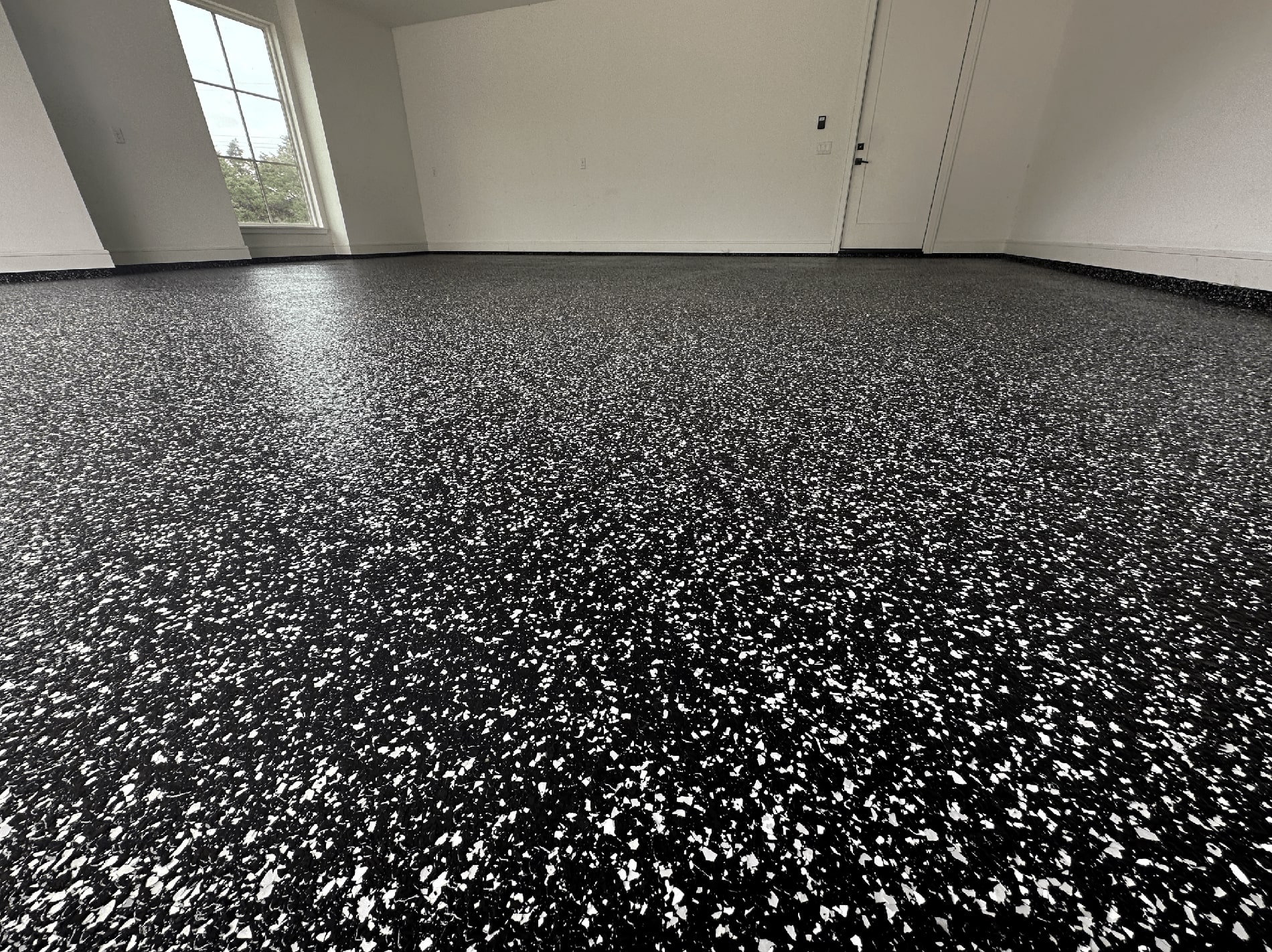
| Flake or quartz broadcast | System 20–60+ mils | ≈100% binder | Garages, kitchens, locker rooms (texture + hide) | $5–$9 |
| Metallic | Flood coat | ≈100% | Showrooms, retail, decorative interiors | $8–$12 |
| Self-leveling / slurry | 30–250 mils | ≈100% + filler | Flattening rough slabs, food plants, labs | Quote |
| Mortar / troweled | 3/16–1/4 in | Resin + aggregate | Impact, forklifts, thermal shock zones | Quote (often $9+) |
| Novolac | 15–24 mils | ≈100% | Secondary containment, strong acids | $8–$12 |
| ESD / static-control | System | Conductive fillers | Electronics, data centers, munitions | $8–$15 |
| Moisture-vapor barrier (MVB) | One coat, 250–300 sq ft per 2.64 gal | ≈100% | Damp slabs, under any resin floor | +$2–$4 add-on |
The three most people mix up
Water-based vs 100% solids. The water-based kit is easier to roll and safer to breathe, but at 43–49% solids it leaves roughly 2–4 dry mils per coat. A 100% solids epoxy leaves 10–15. That's the difference between a floor you'll redo in three to five years and one you may not touch for fifteen.
Novolac vs standard epoxy. Novolac resins have more reactive sites per molecule, so they cross-link more tightly. Five Star's novolac lists resistance to sulfuric acid from 1% to 98%, the kind of exposure a standard bisphenol-A epoxy won't survive. It also stains brown-red under sulfuric and nitric acid, which is cosmetic.
MVB epoxy vs a primer. A moisture-vapor-barrier epoxy is formulated and tested to hold back vapor: Sika MB is rated to 100% RH (ASTM F2170) and 25 lb/1,000 sq ft/24 h (ASTM F1869), and Simiron MVB to 25 lb. An ordinary primer is not, even if it's the same color.
Real data-sheet numbers, side by side
Here's what six widely used epoxy floor products publish on their technical data sheets. We picked one per category, not the "best" in each, so you can see how far apart the categories really are. Abrasion is Taber CS-17 at 1,000 g and 1,000 cycles: lower is better.
| Product (type) | Pot life | Recoat window | Foot traffic | Full cure | Min. temp | Abrasion / strength |
|---|---|---|---|---|---|---|
| Westcoat EC-11 (water-based) | 60–90 min @ 72°F | Dry to touch, within 24 h | 6 h | Vehicles 72 h | 50°F | — |
| SW ArmorSeal 1000HS (solvent high-solids) | 4 h @ 77°F | 8–24 h min, 7 days max | 24 h | 7 days | 50°F | Taber 64.8 mg |
| BM Corotech V430 (100% solids) | 30 min @ 77°F | 12–24 h (abrade after 72 h) | — | 7 days | 50°F | Taber 0.06 g; 11,500 psi compressive |
| Sikafloor-264 (self-leveling) | 25 min @ 68°F | 8–24 h @ 68°F | 8–24 h | 4–10 days | 50°F | Taber 90 mg; Shore D 80–85 |
| Five Star Epoxy Novolac | 35 min @ 70°F | 3 h – 14 days | In service 24 h | 3–5 days | 40°F, rising | 5,600 psi tensile |
| Sika MB (moisture barrier) | — | Per system | — | — | — | 100% RH / 25 lb rating |
Two things jump out. First, pot life shrinks as solids rise: the thicker, tougher products give you less time to work. That's why 100% solids epoxy is usually poured out onto the floor in ribbons and spread immediately, not rolled out of a tray. Second, every one of these products needs a slab at 40–50°F or warmer. In an unheated garage in February, epoxy isn't the right chemistry no matter whose label is on it.
Which epoxy system do you need?
Answer six questions and the selector builds a layer-by-layer system, the way a specifier would. It also tells you when epoxy isn't the right answer.
Your floor, layer by layer
Typical systems only. A data sheet or an applicator's written spec has the final word.
Epoxy coverage & kit calculator
Coverage on the label is theoretical. Real coverage depends on how porous the slab is and how thick you put it down. This calculator uses the industry formula, gallons = area × dry mils ÷ (1,604 × solids), then adds waste.
How many gallons and kits
Presets use data-sheet solids. Slurry presets follow Sikafloor-264's published rates.
How temperature changes your schedule
Epoxy cure is a chemical reaction, and reactions slow down when it's cold. Sika publishes how Sikafloor-264 behaves at three temperatures, which makes it a good illustration of what happens to any epoxy:
| Slab / air temperature | Pot life | Recoat window | What it means on the job |
|---|---|---|---|
| 50°F | ≈50 min | 24–48 h | Long working time, but a two-coat floor becomes a three-day job. |
| 68°F | ≈25 min | 8–24 h | The "normal" schedule most installers plan around. |
| 86°F | ≈15 min | 6–12 h | Mix smaller batches; the bucket can kick before the floor is done. |
Where epoxy falls short
We'd rather you hear this from us than find it on your floor in year two.
It ambers. The makers say so.
Corotech V430's sheet says it "will amber and chalk" in UV. Sikafloor-264's says it "will discolor over time." ArmorSeal 1000HS: "may darken or yellow." Where sun reaches the floor, top it with an aliphatic polyaspartic or polyurethane.
It stalls below 50°F
Most floor epoxies need a 50°F slab, rising. Below that, cure slows and can stay incomplete. Polyaspartics and polyureas cure at much lower temperatures.
It's slow to return to service
Even fast epoxies need 24 hours for foot traffic and 48–72 for vehicles, with full chemical resistance at about 7 days. A 1-day polyaspartic floor is usually back in use the next day.
Thin films lift
A 3-mil water-based film over an acid-etched slab is the classic hot-tire-pickup floor. A thick 100% solids system over a ground slab is far more resistant.
It's hard, not flexible
Shore D 80–85 is great for wear but poor at bridging moving cracks. Cracks that move will reflect through any rigid coating.
Gloss is slippery when wet
Smooth epoxy needs a broadcast aggregate or grit in the top coat anywhere water, oil or grease reaches the floor.
Epoxy floor coating cost
Price ranges vary by source, region and slab condition, so treat these as planning numbers. Prep is where quotes diverge most: a clean, dry slab that just needs grinding is a very different job from one that needs coating removal, crack repair and a moisture barrier.
| System | Installed, per sq ft | Source |
|---|---|---|
| DIY water-based or solvent kit (materials) | $0.50–$2 | National Concrete Polishing; Today's Homeowner |
| Solid-color epoxy (residential) | $3–$5 | FindEpoxyPro, Mar 2026 |
| Epoxy, general residential range | $4–$10 | HomeGuide 2026 |
| Flake epoxy | $5–$8 | FindEpoxyPro, Mar 2026 |
| Industrial high-build (10–20 mils) | $5–$8 | Summit Industrial, Jun 2026 |
| Quartz / flake broadcast (industrial) | $6–$9 | Summit Industrial |
| Metallic epoxy | $8–$12 | FindEpoxyPro |
| Novolac | $8–$12 | Summit Industrial |
| ESD / static control | $8–$15 | Summit Industrial |
What a typical garage costs. At $4–$10 per sq ft, a 2-car garage of about 400–576 sq ft lands around $1,600–$5,800 before any moisture work. Our garage floor coating cost guide breaks this down by garage size, and the garage floor coating pillar has a lifetime-cost calculator that compares epoxy with polyaspartic and polyurea over the years you'll own the floor.
Lifespan. HomeGuide puts water-based epoxy at 3–5 years and 100% solids at 10–20; National Concrete Polishing puts DIY at 2–5 years and professional installs at 10–20+. Sherwin-Williams describes properly installed resinous floors as lasting "ten years or greater." The spread is mostly prep and thickness.
How an epoxy floor is installed
Test the slab
Moisture (ASTM F2170 RH or F1869), concrete age (28+ days), old sealers (water-drop test) and slab temperature versus dew point.
Profile the concrete
Diamond grind or shot blast to the profile the data sheet calls for, typically CSP 2–3 for high-build coatings, then vacuum thoroughly. Acid etching only reaches about CSP 1.
Repair
Fill cracks, spalls and pitting with an epoxy or polyurea patch and grind flush. Honor moving joints.
Prime or block moisture
A penetrating primer on a dry slab, or an MVB epoxy if the slab tested wet.
Body coats
Roll or squeegee the body coat to the specified wet mils; broadcast flake or quartz if the system calls for it. Work within pot life and the recoat window.
Top coat
A clear epoxy top coat indoors, or an aliphatic polyaspartic or polyurethane top coat anywhere UV, abrasion or hot tires are a concern. Add grit for slip resistance.
Cure before service
Typically foot traffic at 24 hours, vehicles at 48–72 and full chemical cure around 7 days at room temperature, longer when it's cool.
Epoxy vs polyaspartic vs polyurea
The short version: epoxy is the best-value indoor coating and the best moisture-barrier primer; polyaspartic is the best top coat and the fastest install; spray polyurea is the toughest and most flexible. Many of the best floors use two of the three.
| Epoxy | Polyaspartic | Spray polyurea | |
|---|---|---|---|
| UV stability | Ambers (aromatic) | Color-stable (aliphatic) | Aromatic grades need a top coat |
| Cold-weather install | ≈50°F minimum | Down to ≈35–40°F | Fast-set grades to −20°F |
| Return to service | 2–3 days | ≈24 h | ≈24 h |
| Working time | 15 min – 4 h | 10–20 min | Seconds (machine-applied) |
| Flexibility | Rigid | Moderate | High elongation |
| Moisture barrier option | Yes (MVB epoxy) | No | No |
| DIY friendly | Yes | Hard (short pot life) | No (plural-component rig) |
Epoxy where it shines, polyaspartic where it doesn't.
ArmorThane-certified applicators build hybrid floors: an epoxy or MVB base where the slab needs it, finished with our UV-stable ArmorFloor polyaspartic. One quote, one crew, prep and mils in writing.
Coating contractor? Add our floor systems →
Epoxy floor coating FAQ
How long does an epoxy floor coating last?
Water-based DIY epoxy typically lasts 2–5 years. A professionally installed 100% solids system lasts roughly 10–20 years indoors. Sherwin-Williams describes resinous floors as lasting ten years or more when properly installed. Prep, thickness and sunlight exposure matter more than brand.
How much does epoxy flooring cost per square foot?
In 2026, residential epoxy runs about $4–$10 per sq ft installed (HomeGuide), with solid colors from $3–$5, flake $5–$8 and metallic $8–$12. Industrial systems run from $3–$5 for thin films to $8–$15 for novolac and ESD. DIY kits cost $0.50–$2 per sq ft in materials.
Does epoxy turn yellow?
Yes, in sunlight. Standard epoxies are aromatic and absorb UV, and manufacturers' own data sheets warn that they amber, chalk or discolor. Indoors, away from sun, it's rarely a problem. Outdoors or near an open door, use an aliphatic polyaspartic or polyurethane top coat.
Can you put epoxy on a basement floor?
Yes, if the slab passes a moisture test or you use a moisture-vapor-barrier epoxy. Products such as Sika MB are rated for slabs up to 100% RH (ASTM F2170) and 25 lb/1,000 sq ft/24 h (ASTM F1869). Without moisture control, basement epoxy is prone to blistering and delamination.
How long before you can walk or drive on epoxy?
Typically 24 hours for foot traffic, 48–72 hours for vehicles and about 7 days for full chemical resistance at room temperature. Cold slabs extend all of these.
What's the difference between water-based and 100% solids epoxy?
Water-based epoxy is about 43–49% solids, so roughly half of what you roll on evaporates, leaving 2–4 dry mils per coat. 100% solids epoxy leaves 10–15 mils per coat, lasts much longer and has a much shorter pot life (about 30 minutes).
Is epoxy flooring slippery?
Smooth, glossy epoxy can be slippery when wet or oily. A broadcast of flake or quartz, or grit mixed into the top coat, adds traction.
Can epoxy go over an old coating or painted concrete?
Not over paint. A sound, well-bonded epoxy can be abraded and recoated, but peeling or unknown coatings should be ground off so the new epoxy bonds to concrete.
What temperature is too cold to apply epoxy?
Most floor epoxies require at least 50°F and rising, and the slab must be at least 5°F above the dew point. Some novolacs allow 40°F. Below that, choose a polyaspartic or polyurea system.
Is epoxy better than polyaspartic?
It's better as a moisture-barrier primer, cheaper, and easier for DIY. Polyaspartic is better as a top coat: UV-stable, faster to return to service and workable in the cold. Many professional floors use an epoxy or polyurea base with a polyaspartic top coat.
Sources
- Bisphenol A diglycidyl ether: en.wikipedia.org/wiki/Bisphenol_A_diglycidyl_ether
- Duraamen, coatings coverage chart: duraamen.com/resources/coatings-coverage-chart/
- Sherwin-Williams, epoxy flooring systems: industrial.sherwin-williams.com
- Westcoat EC-11 water-based epoxy specification: westcoat.com
- Sherwin-Williams ArmorSeal 1000HS product data sheet: paintdocs.com
- Benjamin Moore Corotech V430 technical data sheet: benjaminmoore.com
- Sikafloor-264 product data sheet: usa.sika.com
- Sikafloor-160 product data sheet: dciflooring.com
- Five Star Epoxy Novolac Coating TDS: fivestarproducts.com
- Sika MB moisture barrier: usa.sika.com
- Simiron MVB: simiron.com/products/mvb/
- HomeGuide, epoxy flooring cost (2026): homeguide.com/costs/epoxy-flooring-cost
- FindEpoxyPro, epoxy flooring cost (Mar 2026): findepoxypro.com
- Summit Industrial, industrial epoxy flooring pricing (Jun 2026): sumind.com
- Today's Homeowner, epoxy floor cost (2025): todayshomeowner.com
- National Concrete Polishing, cost to epoxy a floor: nationalconcretepolishing.net

Start your coatings business with ArmorThane.
Tell us what you want to spray and where you are. An ArmorThane specialist will walk you through the equipment, chemicals, training and startup cost for the work you want to do.
- Equipment package matched to your applications
- Hands-on training and applicator certification
- Technical support once you are spraying
Epoxy, polyaspartic or both? Get a written spec from a certified applicator.
Tell us about the floor: size, use, sunlight and what's on it now. An ArmorThane-certified applicator will test the slab and quote the prep, system and mils in writing.
- Epoxy, MVB, polyaspartic and polyurea systems
- Garages, shops, kitchens and warehouses
- Moisture testing included in the quote
- Contractors: ask about floor systems and training
More to read on floors and decks
Short reads from ArmorThane on Issuu. Tap one to open it right here.