Polyaspartic vs Epoxy: What the Data Sheets Say
Cure times, moisture limits, abrasion, UV and cost over the life of the floor, compared with manufacturer data sheets. We make polyaspartic, not epoxy, and we’ll still tell you when epoxy is the better pick.
Coat floors for a living.
ArmorThane is the one-stop shop for applicators. We make the chemistry, build the equipment, train you hands-on and back you with technical support, with no franchise fees and no royalties. Applicators have come first here since 1989.
- $0franchise fees or royalties
- 35+years in business
- 50+countries with applicators
- 24/7technical support
Almost every page that ranks for "polyaspartic vs epoxy" was written by an installer or a product seller, and several lean on lines like "4x stronger" and "98% more flexible" with no test method attached. We're not neutral either. We make polyaspartic. But we don't make an epoxy floor product, and the honest answer turns out to be more useful than a pitch: on most good floors, the two chemistries end up working together.
So this comparison is built from manufacturer data sheets and the ASTM methods printed on them. Taber abrasion, Shore D hardness, tensile and elongation, QUV weathering, and the two slab moisture tests that decide more floors than all the others combined. Where a number comes from an installer or a cost guide, we say so. Where epoxy is the better tool, we say that too.
For a garage or any floor the sun reaches, usually yes. On the data sheets cited here, polyaspartic takes heavy traffic in about 24 hours, versus 2–3 days for the epoxies cited and about 7 days before a professional epoxy is fully cured, keeps its color under UV, loses less to abrasion (30 mg vs 50–110 mg Taber) and installs down to 30–35°F. Epoxy wins on slab moisture (primers rated to 25 lb or 95% RH, against 3 lb or 75% for polyaspartic applied straight to concrete), thick smooth builds, working time and upfront cost ($3–$7 vs $5–$12 per sq ft). Most professional floors use both: an epoxy or polyurea base under a polyaspartic top. Test the slab's moisture first. That decides which systems are even eligible.
- 1Polyaspartic vs epoxy at a glance
- 2The difference in chemistry
- 3Performance data from real data sheets
- 4Data-sheet face-off (tool)
- 5Cure time and return to service (planner)
- 6Moisture, temperature and dew point (checker)
- 7Cost, upfront and over the floor's life (calculator)
- 8When epoxy actually wins
- 9When polyaspartic wins
- 10Polyaspartic over epoxy: the hybrid system
- 11Safety, VOCs and jobsite rules
- 12Which should you choose?
- 13Polyaspartic vs epoxy FAQ
Polyaspartic vs epoxy at a glance
Polyaspartic is the faster, UV-stable, more abrasion-resistant wear layer. Epoxy is the cheaper, more moisture-tolerant, more forgiving base. Every cell below names the product it came from, because numbers vary more between brands than between chemistries. Read each row as "this product," not "every polyaspartic" or "every epoxy."
| Property | Polyaspartic (products cited) | Epoxy (products cited) |
|---|---|---|
| Chemistry | Aliphatic polyurea: polyaspartic ester + aliphatic polyisocyanate | Epoxide resin (usually BADGE) + amine hardener |
| UV and color | 87–89 gloss retained after 1,000 hr QUV (Simiron HS) | Discolors or yellows in sunlight (Sikafloor-261, Simiron 1150FC) |
| Taber abrasion, ASTM D4060 | 30 mg loss (Simiron HS) | 50 mg (Simiron MVB), ~110 mg (Sikafloor-261) |
| Hardness, Shore D | 70 at 24 hr, 86 at 5 days (HS); 80 (Aspartic 85); 65 ± 5 (ArmorFloor TopCoat) | ~76 (Sikafloor-261); 78–80 (MVB) |
| Elongation | 5–10% (HS); 2.4% (Aspartic 85) | ~22% (Sikafloor-261) |
| Working time / pot life | 14 min to 2 hr by grade and humidity (HS); 15–20 min (Aspartic 85) | ~15–60 min by temperature (Sikafloor-261); 1–2 hr (Rust-Oleum kit) |
| Walk-on | 4–34 hr by grade (HS); 5–7 hr (Aspartic 85) | ~1 day per coat at 68°F (Sika); 24 hr (Rust-Oleum) |
| Vehicles / heavy traffic | 24 hr (HS; XTRA Slow grade 3 days) | 72 hr (Rust-Oleum); ~2 days light traffic per coat (Sika) |
| Full cure / chemicals | Chemical ratings after 5-day cure (HS) | ~7 days at 68°F (Sika); 5 days (MVB) |
| Minimum application temp | 35°F (HS, Fast grade below 60°F); 30°F (Aspartic 85) | 50°F (Sika); 60°F (Rust-Oleum) |
| Slab moisture limit | 3 lb MVER / 75% RH direct to concrete (HS) | 12 lb / 85% (1150FC base); 25 lb / 95% (MVB primer) |
| DIY-friendly? | Kits exist; short working time is the catch | Easiest to DIY; kit film is thin |
| Installed price | About $5–$12 per sq ft | About $3–$7 per sq ft |
| Best job | Topcoat / wear layer | Primer, moisture barrier, base coat |
Two rows deserve a second look before anything else: moisture and elongation. Most of what you'll read online gets both of them backwards.
Difference between epoxy and polyaspartic: the chemistry in two minutes
No, they're not the same, and they aren't even related. Epoxy and polyaspartic cure by different reactions, and nearly every practical difference on this page, from yellowing to cure time to humidity sensitivity, traces back to that.
Epoxy. Most floor epoxies are built on bisphenol A diglycidyl ether (BADGE), made from epichlorohydrin and bisphenol A, and cured with a polyfunctional amine hardener. The backbone carries aromatic rings from the bisphenol A, and that's the part sunlight attacks. Epoxy coatings chalk under UV exposure, and epoxy resins yellow with time even when they're kept out of the sun.
Polyaspartic. A modified polyurea. The resin side is a polyaspartic ester, made by reacting an amine with a dialkyl maleate (an aza-Michael reaction). The result is a sterically hindered secondary amine that reacts with isocyanate far more slowly than the amines in spray polyurea. The technology was introduced in the early 1990s, with patents to Bayer in Germany and Miles Corp. in the United States. Paired with an aliphatic polyisocyanate, the cured film is UV and light stable.
Writing in Adhesives & Sealants Industry, Dr. Jeffrey Dormish placed its reactivity between very fast-curing polyurea and slower polyurethane, with a pot life long enough to apply it without plural-component impingement mixing. Its cure speeds up with heat and is "greatly accelerated with increasing humidity." Epoxy, on the cure tables we used, is driven by temperature. Covestro, the successor to Bayer MaterialScience, markets its polyaspartic floor systems as curing "up to eight times faster" than conventional floor coatings. That's a maker's claim, but the data-sheet cure tables below point the same way.
One more thing: "polyaspartic epoxy" isn't a chemistry. If a label uses both words, read the data sheet to see which layer is which. For the product-side detail, see our polyaspartic floor coating guide and advantages of polyaspartic coatings.
Polyaspartic vs epoxy performance: what the data sheets show
On the data sheets we compared, polyaspartic wins on abrasion and UV, the two are close on hardness, and the epoxy is the more flexible film. Whether polyaspartic is "stronger" depends on which epoxy you pick. Each property below comes with its test method, so you can check the claims yourself.
Abrasion and scratch resistance (Taber, ASTM D4060)
A Taber test spins abrasive wheels on a coated panel and weighs what wears off; lower is better. On the three sheets using the same setup (CS-17 wheels, 1,000 g, 1,000 cycles), Polyaspartic HS loses 30 mg, Simiron's MVB epoxy 50 mg and Sikafloor-261 about 110 mg. That's 1.7 to 3.7 times less wear, by our arithmetic. Real, but not the "10X" some installers advertise, and the labs differ. Aspartic 85's 20 mg was measured at 500 cycles, so it doesn't line up with the others.
Hardness isn't toughness (Shore D)
Shore D (ASTM D2240) measures how far an indenter presses in. That's hardness, not wear resistance, and the numbers overlap: Polyaspartic HS is 70 at 24 hours and 86 at five days, Aspartic 85 is 80, our ArmorFloor TopCoat is 65 ± 5, and the epoxies are about 76 (Sikafloor-261) and 78–80 (MVB). Neither "epoxy is harder" nor the reverse holds as a blanket rule. Note the climb from 70 to 86: a floor you can walk on in hours keeps hardening for most of a week.
Strength and flexibility: checking "4x stronger" and "98% more flexible"
Tensile strength varies by formulation, not family. Polyaspartic HS tests at 4,000 psi and Sikafloor-261 at about 1,073, so against that epoxy "4x stronger" is close (3.7x). Simiron's MVB epoxy tests at 9,600 psi, 2.4 times the polyaspartic. Same claim, opposite answer.
Flexibility runs the other way from what you'll usually read. Floor-grade polyaspartic topcoats are rigid films: 5–10% elongation for Polyaspartic HS and 2.4% for Aspartic 85, against about 22% for Sikafloor-261. "98–100% more flexible" doesn't survive a data sheet. Real stretch belongs to elastomeric spray polyurea, used as a base or membrane (see the hybrid system), and Simiron warns that moving joints and shrinkage cracks may reflect through regardless. The tensile figures use three methods (ASTM D2370, D638 and D412), so treat small gaps as noise.
UV stability and yellowing
This is polyaspartic's clearest win. Polyaspartic HS kept 87–89 gloss units after 1,000 hours of QUV weathering (ASTM G154). The epoxy makers say the opposite about their own products: Sikafloor-261 "will discolour over time when exposed to sunlight," and Simiron's 1150FC base "will yellow over time," so spots the chip doesn't cover discolor. If daylight reaches the floor, epoxy shouldn't be the top layer.
Chemical and stain resistance
Chemical resistance is published per product and depends on cure time. Here's Simiron's chart for Polyaspartic HS after a five-day cure:
| Rating | Chemicals (Simiron Polyaspartic HS, 5-day cure) |
|---|---|
| Excellent | Brake fluid, transmission fluid, motor oil, unleaded gasoline, E85/E95, Skydrol, MEK, xylene, bleach, 20% salt water |
| Good | 10% acetic acid, vinegar, 10% citric acid, 10% and 30% hydrochloric acid, 50% sodium hydroxide |
| Fair | Mineral spirits, 50% phosphoric acid, 10%, 37% and 70% sulfuric acid |
| Not recommended | 10% nitric acid |
That's strong for fuel, fluids and road salt. For a battery room or an acid process area, get the exact chart for the exact product. On the epoxy side, Sika lists "full cure or chemical exposure" at about seven days at 68°F.
Hot tire pickup: what really causes it
Tires can exceed 140°F after a drive, per one installer's 2026 write-up, and heat softens and peels coatings that are poorly bonded or under-cured; the same source says low-solids epoxy and DIY kits tend to fail first. No resin is a cure-all, though. Simiron's premium polyaspartic sheet says "tire marking may occur," and its epoxy-base guide suggests sheet metal or plexiglass under the tires. What actually prevents failures is the unglamorous part: grind to CSP 3, test moisture, respect the cure time.
Polyaspartic vs epoxy data-sheet face-off
Pick a property. The chart ranks seven real products on it with the test method and caveats, and pulls up the installer claim that property settles. A blank means the maker doesn't publish that number, and we'd rather show a gap than guess.
Seven products, one property at a time
Values come from different manufacturers and labs. Compare within the same test method only, and treat them as representative, not universal.
Method: ASTM D4060, CS-17 wheels, 1,000 g load, 1,000 cycles · Unit: mg lost
Blue bars are polyaspartic, gold bars are epoxy. Range bars span the published range.
Best published value here: Simiron Polyaspartic HS (30 mg).
Not on the chart:
- Exterior Coatings Aspartic 85: 20 mg, but at 500 cycles, so not comparable
- ArmorThane ArmorFloor TopCoat: Not published
- Simiron 1150FC base: Not published
- Rust-Oleum EpoxyShield kit: Not published
“Polyaspartic resists scratching better”
Taber loss 30 mg (HS) vs 50 mg (MVB) and ~110 mg (Sika), same wheels, load and cycles. Different labs, so keep the caveat.
Claim seen on: most comparison pages.
Values come from different manufacturers and labs. Compare within the same test method only, and treat them as representative, not universal.
Myth vs data sheet
These are the claims that show up again and again on the pages ranking for this topic, checked against the published numbers.
| What you'll read | Verdict | What the data sheets show |
|---|---|---|
| "Polyaspartic is 4x stronger than epoxy" | Depends | Polyaspartic HS 4,000 psi vs Sikafloor-261 ~1,073 psi (3.7x). But Simiron MVB epoxy is 9,600 psi, 2.4x the polyaspartic. |
| "98–100% more flexible than epoxy" | Not supported | Polyaspartic topcoats: 5–10% (HS) and 2.4% (Aspartic 85) elongation. Sikafloor-261 epoxy: ~22%. Flexibility belongs to elastomeric polyurea basecoats. |
| "Epoxy is harder" | Comparable | Polyaspartic HS reaches Shore D 86 at 5 days. Epoxies: ~76 (Sika) and 78–80 (MVB). |
| "Polyaspartic resists scratching better" | Supported | Taber loss 30 mg (HS) vs 50 mg (MVB) and ~110 mg (Sika), same method. Different labs, so keep the caveat. |
| "Polyaspartic handles moisture better" | False here | Polyaspartic direct to concrete: 3 lb / 75% RH. Fast-cure epoxy base: 12 lb / 85%. Epoxy MVB primer: 25 lb / 95%. |
| "Epoxy yellows" | True | Sika and Simiron both say so about their own epoxies. Polyaspartic HS kept 87–89 gloss after 1,000 hr QUV. |
| "Polyaspartic installs in any weather" | Partly | Minimums of 35°F (HS) and 30°F (Aspartic 85) vs 50°F (Sika) and 60°F (Rust-Oleum). We found no published data sheet behind the −40°F and "as low as zero" claims. |
| "Polyaspartic stops hot tire pickup" | Nuanced | Simiron's own polyaspartic sheet says "tire marking may occur." Hot-tire failures trace mostly to adhesion, prep and cure. |
The full data table
Click any column header to sort. "n/p" means not published on the source.
| Product | Type | Shore D | Taber mg | Tensile psi | Elong. | Min °F | Max MVER lb | Max RH | Vehicles | VOC g/L |
|---|---|---|---|---|---|---|---|---|---|---|
| Simiron Polyaspartic HS (04/2026) | Aliphatic polyaspartic | 70 (24 hr) / 86 (5 d) | 30 | 4,000 (D2370) | 5–10% | 35 | 3 | 75% | 24 hr | < 50 |
| Exterior Coatings Aspartic 85 | Polyaspartic topcoat | 80 | 20 (500 cycles) | > 3,900 (D638) | 2.4% | 30 | n/p | n/p | 24–48 hr | < 160 |
| ArmorThane ArmorFloor TopCoat | Aliphatic polyaspartic | 65 ± 5 | n/p | 3,500 ± 300 (D412) | n/p | n/p | n/p | n/p | n/p | SCAQMD compliant |
| Sikafloor-261 CA (11/2021) | High-solids epoxy | ~76 | ~110 | ~1,073 (D638) | ~22% | 50 | n/p | 85% | ~2 d per coat | < 50 |
| Simiron MVB | Epoxy moisture primer | 78–80 | 50 | 9,600 (D638) | n/p | per system | 25 | 95% | n/a (primer) | 0 |
| Simiron 1150FC | Fast-cure epoxy base | n/p | n/p | n/p | n/p | 35 (system) | 12 | 85% | n/p | n/p |
| Rust-Oleum EpoxyShield WB (2018) | Water-based epoxy kit | n/p | n/p | n/p | n/p | 60 | Plastic sheet | n/a | 72 hr | < 50 |
Polyaspartic vs epoxy cure time and return to service
A polyaspartic topcoat takes foot traffic in hours and vehicles in about a day at 72°F. Epoxy takes days: the DIY kit cited here needs three days before you park on it, and a two-coat professional epoxy needs roughly a week at 68°F before fluids should touch it. Cold slabs and dry air stretch both.
Polyaspartic: hours, set by temperature and humidity
Simiron publishes its Polyaspartic HS in four cure speeds. Humidity cuts both ways: it shortens the working time (the Fast grade drops from 25 minutes to 14 at 80% RH) and it speeds the cure.
| Grade | Working time, 20% / 80% RH | Tack-free, 20% / 80% RH | Foot traffic | Heavy traffic |
|---|---|---|---|---|
| Fast | 25 / 14 min | 110 / 40 min | 4–6 hr | 24 hr |
| Medium | 32 / 17 min | 3.5 hr / 90 min | 10–12 hr | 24 hr |
| Slow | 70 / 28 min | 6.5 / 3.75 hr | 17–20 hr | 24 hr |
| XTRA Slow | 2 hr / 70 min | 10.5 / 6.5 hr | 30–34 hr | 3 days |
Aspartic 85, a low-temperature grade, lists light foot traffic at 5–7 hours and heavy traffic or full cure at 24–48 hours at 70°F.
Epoxy: days, set by temperature and recoat windows
Sika's table for Sikafloor-261 shows the pattern for a professional epoxy. Foot and light traffic times double between 68°F and 50°F.
| Temp | Pot life | Overcoat window | Foot traffic | Light traffic | Full cure / chemicals |
|---|---|---|---|---|---|
| 50°F | ~60 min | ~30–72 hr | ~2 days | ~4 days | ~10 days |
| 68°F | ~40 min | ~8–48 hr | ~1 day | ~2 days | ~7 days |
| 86°F | ~15 min | ~6–24 hr | ~18 hr | ~2 days | ~5 days |
The number that bites is the recoat window. Miss the maximum and the next coat won't bond chemically. Simiron's MVB sheet allows 5 to 24 hours, and "if the re-coat window is missed, the coating system will need to be sanded." The DIY kit is simpler: Rust-Oleum lists foot traffic at 24 hours and vehicles at 3 days at 70–80°F and 50% RH.
When a "one-day floor" takes two
The one-day flake floor is real. Simiron's 1-Day Polyurea guide has the base ready to scrape in about 1.5 hours, and the Polyaspartic HS top takes heavy traffic in 24 hours at every grade but XTRA Slow. Add an hour to scrape and vacuum (our assumption) and you're parking about 26.5 hours after the base went down. It stretches to two days or more with a slab under 60°F (Fast grade required, longer traffic times), dry air, the XTRA Slow grade, or an epoxy base, whose scrape time isn't published. One installer's own schedule for its polyaspartic system is 96 hours to vehicles (a national garage-floor franchise’s published schedule). Get yours in writing, then run it through the planner.
When can you walk on it, park on it, and spill on it?
Built from the manufacturers' cure tables. Adjustments below their reference temperature are our estimate and are labeled as such.
- Polyurea base applied: Fri 8:00 AM
- Base ready to scrape and vacuum: Fri 9:45 AM
- Polyaspartic topcoat applied (Slow grade): Fri 10:45 AM
- Walk on it: Sat 10:00 AM (23–26 hr after start)
- Park a vehicle: Sat 2:45 PM (30.7 hr)
- Fluids and chemicals OK: Thu 6:45 AM, day 7 (142.7 hr)
Below the sheet’s 72°F reference, times are stretched by 1.17x. Estimate: reaction rates roughly halve per 18°F drop, consistent with Sika’s epoxy data. Base-to-scrape of about 1.5 hr is from Simiron’s 1-Day Polyurea guide; scrape and cleanup time is your input. Chemical-resistance ratings on the HS sheet are after a 5-day cure. Clock times use the longer end of each range.
Hours until a vehicle can go on it
At 68°F and 55% RH, longer end of each range. Gold = epoxy, blue = polyaspartic systems.
Manufacturer cure tables are measured at stated lab conditions. Cold slabs and dry air extend them.
Moisture, temperature and dew point: the conditions that pick the winner
Slab moisture settles more polyaspartic vs epoxy decisions than any lab test. Applied straight to concrete, the polyaspartic cited here tolerates 3 lb or 75% RH. Epoxy primers and bases are rated to 12 lb and 85%, and up to 25 lb and 95%. That's why epoxy is the moisture layer in so many professional systems, and polyaspartic is the top.
Moisture-vapor limits by chemistry
| System (product) | Max MVER, ASTM F1869 | Max slab RH, ASTM F2170 | Role |
|---|---|---|---|
| Polyaspartic direct to concrete (Simiron HS) | 3 lb | 75% | Topcoat; direct only on dry slabs |
| Fast-cure epoxy base, 16 mils (Simiron 1150FC) | 12 lb | 85% | Base under chip and a polyaspartic top |
| Epoxy moisture-vapor-barrier primer (Simiron MVB) | 25 lb | 95% | Primer below everything else |
| Professional epoxy coating (Sikafloor-261) | Not stated | 85% (and ≤ 4% by Tramex CME) | Above 85%, Sika points to its 1610 or EpoCem products |
| DIY water-based epoxy (Rust-Oleum) | Plastic-sheet test | – | "Not intended for… floors that have a moisture problem" |
ASTM F1869 (calcium chloride) measures the emission rate at the surface; ASTM F2170 reads relative humidity with probes set into the slab. The taped-down plastic sheet (ASTM D4263) is qualitative only, and Sika calls it just "a visual indication of vapour drive." Only one page-one source says it plainly: vapor-barrier epoxies outperform on moisture vapor emission. Nobody on page one puts numbers on it. Our own WC-111 moisture-reactive primer isn't in these tables because we haven't published an MVER or RH rating for it; ask our technical team about your readings.
Application temperature windows
Polyaspartic HS: 35–85°F air and surface, material at 60–85°F, and the Fast grade below 60°F. Aspartic 85: 30–90°F with RH under 90%. Sikafloor-261: 50–85°F. Rust-Oleum's kit: 60–85°F for air, material and surface, RH at or below 85%. Installer claims of polyaspartic going down "as low as zero" or at −40°F involve proprietary products, and we found no published data sheet behind either.
The 5°F dew-point rule
Sika, Rust-Oleum and Simiron all require the surface to be at least 5°F (3°C) above the dew point, or you're coating over condensation you can't see. At 75°F and 60% RH, the dew point is about 60.2°F, so the slab needs to be about 65°F or warmer. Sika adds a warning worth taping to the wall: don't apply while air and slab temperatures are rising, because pinholes may occur. Our note on weather conditions and coating applications goes deeper on dew point.
Prep decides more than chemistry
Both Simiron system guides require a CSP 3 or greater profile by diamond grinding or shot blasting (ICRI 310.2, SSPC-SP13/NACE 6). The DIY epoxy kit uses a citric-acid etch. New concrete needs 28 days of cure either way. That prep gap is bigger than the chemistry gap, and it explains most "epoxy peels" stories. Honor isolation, expansion and moving joints; sawcut joints can be filled and coated, but the coating may crack there if the slab moves. See coating surface preparation.
Which systems can go on your slab today?
Checks each system against its maker's moisture, temperature and dew-point limits. Nothing is stored.
16 mils of fast-cure epoxy base, a chip broadcast, then a polyaspartic topcoat.
Dew point 53.1°F at 70°F and 55% RH (Magnus formula). Slab margin: 12.9°F (needs 5°F or more).
Polyaspartic direct to concrete
Simiron Polyaspartic HS
- In-slab RH 80% is over its 75% limit.
- Temperatures are inside its 35–85°F range.
- UV-stable top layer (Polyaspartic HS kept 87–89 gloss after 1,000 hr QUV).
Low-temp polyaspartic topcoat
Exterior Coatings Aspartic 85
- The maker says it isn’t for direct-to-concrete use, so the base coat’s moisture limit applies.
- Temperatures are inside its 30–90°F range.
- UV-stable top layer (Polyaspartic HS kept 87–89 gloss after 1,000 hr QUV).
Epoxy base (16 mils) + polyaspartic top
Simiron 1150FC + Polyaspartic HS
- In-slab RH 80% is within its 85% limit.
- Temperatures are inside its 35–85°F range.
- Keep the epoxy base fully covered by chip and the polyaspartic top; exposed 1150FC yellows.
Epoxy moisture-barrier primer + base + top
Simiron MVB
- In-slab RH 80% is within its 95% limit.
- Temperature limits follow the full system data sheet.
- Keep the epoxy base fully covered by chip and the polyaspartic top; exposed 1150FC yellows.
Professional epoxy coating
Sikafloor-261 CA
- In-slab RH 80% is within its 85% limit.
- Temperatures are inside its 50–85°F range.
- Sunlight reaches this floor, and this epoxy discolors in UV. Don’t use it as the top layer.
DIY water-based epoxy kit
Rust-Oleum EpoxyShield
- Our call: a reading over the tightest professional limit (75%) is a moisture problem, and the kit is “not intended for” floors that have one.
- Temperatures are inside its 60–85°F range.
- Sunlight reaches this floor, and this epoxy discolors in UV. Don’t use it as the top layer.
Polyaspartic vs epoxy cost: upfront and over the life of the floor
Installed, professional epoxy runs about $3–$7 per square foot and professional polyaspartic flake systems about $5–$12, going by 2024–2026 installer and publisher guides. That's a premium of roughly $2–$5 per square foot, or $800–$2,000 on a 400 sq ft garage (our arithmetic). Whether it pays back depends on how long each floor lasts, and nobody has good lifespan data.
Installed price ranges, with dates
| Source (date) | Polyaspartic installed | Epoxy installed | Lifespan quoted |
|---|---|---|---|
| The Garage Guide (Mar 2026) | $5–$12/sq ft; 2-car $2,400–$6,000 | Pro $3–$7/sq ft; 2-car $1,600–$2,800 (solid), $1,200–$2,000 (water-based) | Epoxy 5–10 yr; polyaspartic 15–20 yr |
| National installer A (Sep 2026) | "Industry" $4–$9; 2-car (~360 sq ft) $2,000–$5,800 | "Industry" $4–$10; 2-car $1,500–$3,500 | Epoxy 5–7 yr; polyaspartic 15–25 yr |
| ALLBRiGHT (Dec 2025) | $4–$12; 2-car $2,000–$6,900 | $3–$7 | Epoxy 5–7 yr; polyaspartic up to 20+ |
| Cascade Concrete Coatings, installer (Jul 2025) | $7–$12 (Penntek); 2-car $2,000–$4,500 | $3–$7; 2-car $1,200–$3,000 | Epoxy 3–5 yr |
| Bob Vila (Apr 2024) | – | $3–$12; 2-car (360 sq ft) $1,100–$4,300 | – |
For polyaspartic-only pricing by garage size, flake options and slab repairs, use the cost estimator in our polyaspartic floor coating guide. We won't repeat it here.
What the quote leaves out: prep, removal and downtime
Diamond grinding runs $1–$3 per square foot and acid etching $0.50–$1.50 (The Garage Guide). Removing an old coating is another $1–$3, and it hits twice: now, if there's a failed floor, and again every time a worn coating comes off before the next one. Urban Northeast and West Coast jobs run 15–30% higher. One installer adds 15–40% for flake and custom blends and 25–50% for metallics.
Then there's downtime. A home garage out for three days costs patience. A shop or showroom closed for three days costs money, and the calculator lets you put a number on it.
DIY epoxy kit vs professional systems: the 3-mil problem
Rust-Oleum's water-based EpoxyShield is 52.6–52.8% solids by volume and goes down at 3.0–3.5 mils dry over a citric-acid etch; the label says one coat is enough in most cases. Simiron's 1-Day Polyurea flake system is over 50 mils nominal on a ground CSP 3 profile, roughly fifteen times the film (our arithmetic). Two-car kits cost $150–$650 (The Garage Guide), and there's a reason. Polyaspartic DIY kits exist too, whatever some installer pages say. The catch is working time: 14–25 minutes for Fast grades at 72°F, depending on humidity.
Polyaspartic vs pro epoxy vs DIY epoxy, over the years you'll own the floor
Defaults are midpoints of The Garage Guide's 2026 ranges. Replace them with your quotes. Lifespans are industry estimates, not independent studies.
Upfront premium over pro epoxy: $1,400. Polyaspartic breaks even with pro epoxy in year 7. Against the DIY kit, break-even comes in year 6.
Prices are 2024–2026 installer and publisher estimates; lifespans are industry estimates, not independent studies. Replace them with your quotes.
What each floor has cost you, year by year
Each step up is a redo: removal at your $/sq ft plus a new install. Hover a year for the numbers; on a phone, swipe the chart sideways.
Year-by-year table
| Year | DIY epoxy kit | Pro epoxy | Polyaspartic |
|---|---|---|---|
| 0 | $400 | $2,000 | $3,400 |
| 1 | $400 | $2,000 | $3,400 |
| 2 | $1,600 | $2,000 | $3,400 |
| 3 | $1,600 | $2,000 | $3,400 |
| 4 | $2,800 | $2,000 | $3,400 |
| 5 | $2,800 | $2,000 | $3,400 |
| 6 | $4,000 | $2,000 | $3,400 |
| 7 | $4,000 | $4,800 | $3,400 |
| 8 | $5,200 | $4,800 | $3,400 |
| 9 | $5,200 | $4,800 | $3,400 |
| 10 | $6,400 | $4,800 | $3,400 |
| 11 | $6,400 | $4,800 | $3,400 |
| 12 | $7,600 | $4,800 | $3,400 |
| 13 | $7,600 | $4,800 | $3,400 |
| 14 | $8,800 | $7,600 | $3,400 |
| 15 | $8,800 | $7,600 | $3,400 |
Tick "assume epoxy lasts as long as polyaspartic" and watch the answer flip. At equal lifespans, professional epoxy is simply cheaper. The polyaspartic premium only pays back if the floor really does last longer, and the lifespan numbers everyone quotes, us included, come from installers rather than long-term studies. If your floor is in the sun or you need it back in a day, those are firmer reasons to pay the premium than a lifespan guess.
When epoxy actually wins
Epoxy wins when the slab is damp, the build needs to be thick and smooth, the installer needs time, or the budget is tight and the sun never touches the floor. We don't sell an epoxy floor product, and we'd still pick one in these cases.
- High-moisture slabs, as the primer or base. Simiron's MVB epoxy is rated to 25 lb or 95% RH and its 1150FC base to 12 lb or 85%, against 3 lb or 75% for the polyaspartic applied direct.
- Smooth, thicker builds. Sikafloor-261 is a 20–30 mil smooth coating. Simiron's Polyaspartic HS sheet says not to use it as the topcoat for a smooth floor at all; it's designed for full broadcast, up to 16 mils per pass.
- Working time. The DIY epoxy kit gives 1–2 hours of pot life. Polyaspartic HS at 80% RH gives 14 to 70 minutes, depending on grade. For a first-timer, that hour matters.

- Interior, no-UV, budget floors. At roughly $3–$7 per square foot against $5–$12, epoxy's weak spot, sunlight, doesn't matter in a windowless basement shop.
- Humid installs. Humidity speeds polyaspartic up and shortens its working time. The epoxy cure tables we used are temperature-driven. Heat still shortens both: Sikafloor-261 pot life drops to about 15 minutes at 86°F.
- Heavy compressive loads under a primer. Simiron's MVB lists 11,600 psi compressive (ASTM D695), 12,800 psi flexural and 9,600 psi tensile strength. That's one product, not a family trait, but it's a strong one.
Where epoxy loses is on top, in daylight, when the floor has to be back in service tomorrow. Which is why the best answer on most floors is both.
When polyaspartic wins
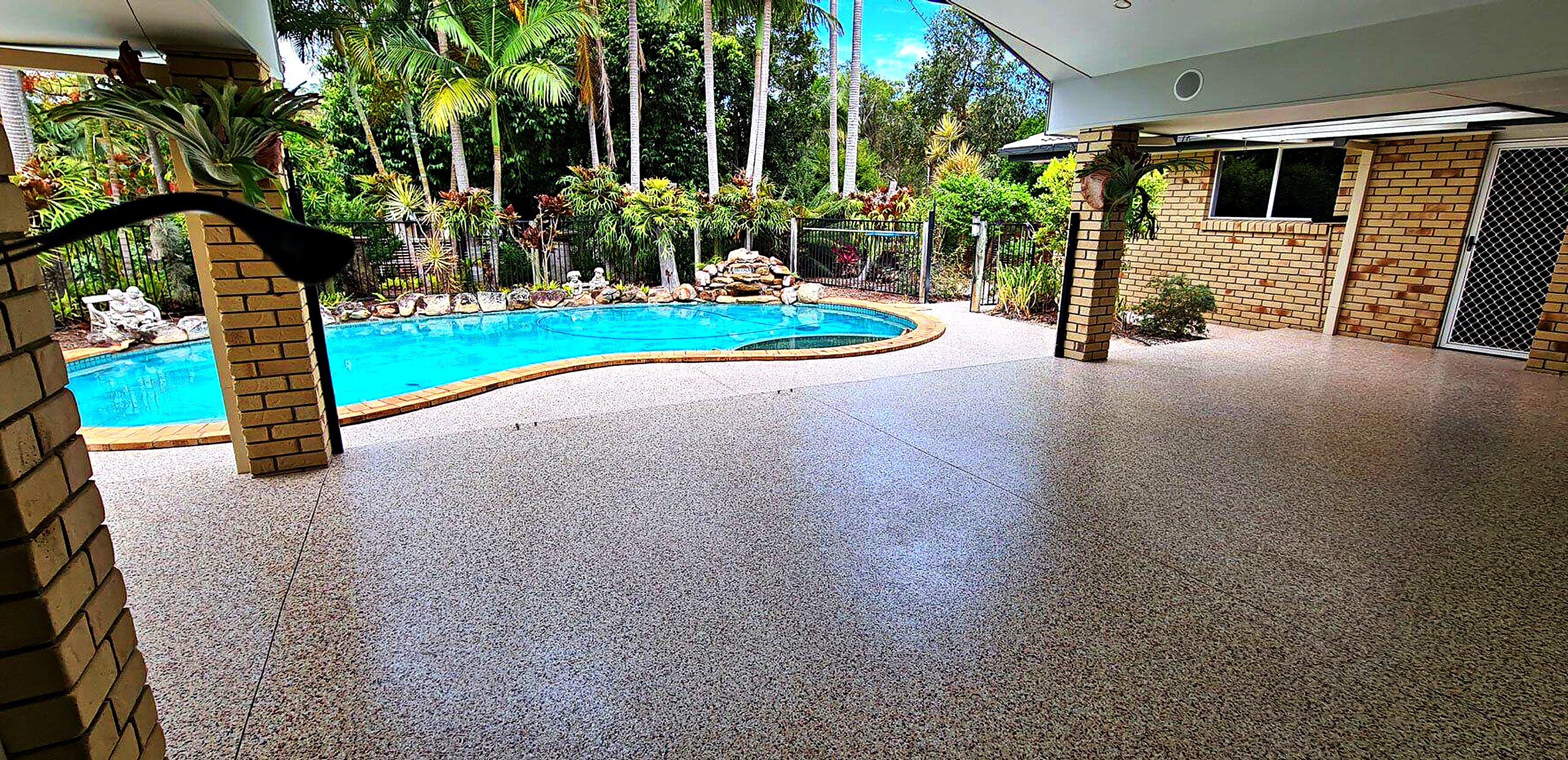
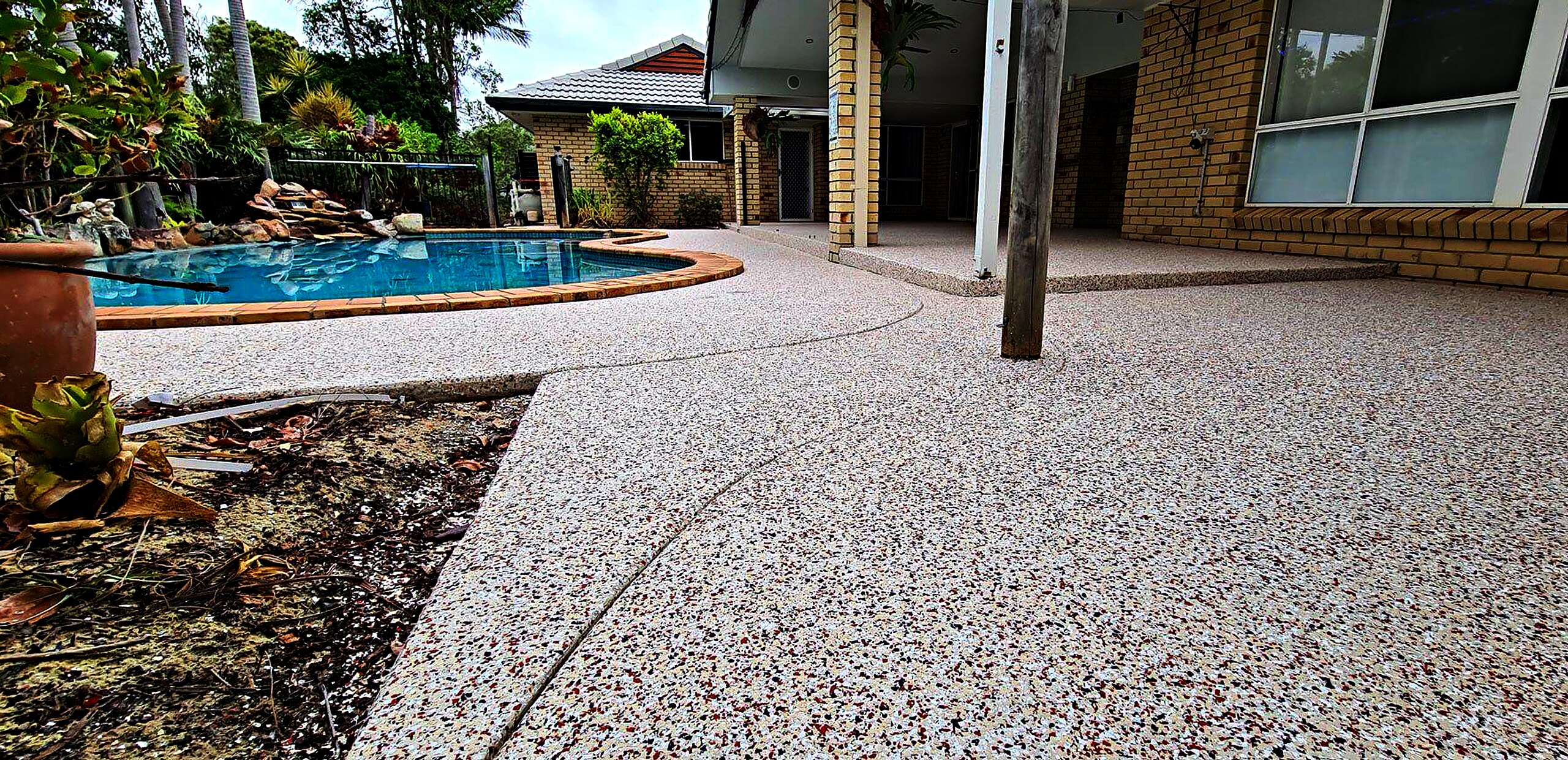
Polyaspartic wins wherever the floor sees sunlight, has to be back in use the next day, gets installed in cold weather, or takes enough wear that the top layer matters more than what's under it. Those four cases cover most garages, showrooms, patios and pool decks.
Sunlit floors
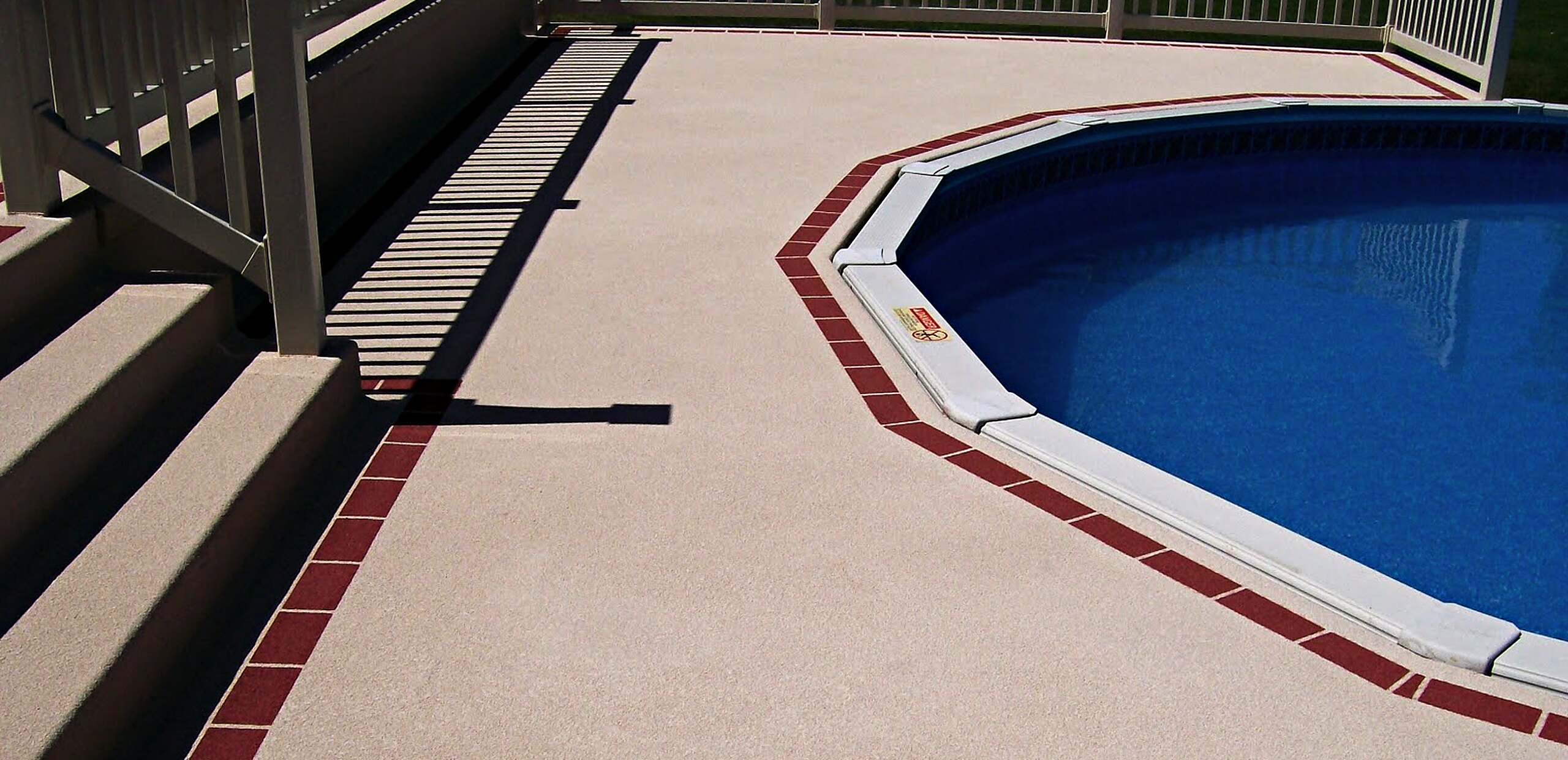
Retained after 1,000 hours of QUV (Simiron HS). Garages with the door open, patios, pool decks and showrooms with glass fronts all need a top layer that won't yellow.
Back in service tomorrow
Heavy traffic at 24 hours for three of Simiron's four grades at 72°F, against about 2–3 days for the epoxies cited. For a business, that's days of revenue.
Cold-season installs
Published minimums of 35°F (HS, Fast grade) and 30°F (Aspartic 85), where the epoxies cited stop at 50–60°F. Traffic times still stretch in the cold.
The wear layer
Lowest Taber loss on the comparable sheets, and "Excellent" ratings against gasoline, brake fluid, motor oil and 20% salt water after a 5-day cure.
For what goes into a polyaspartic floor, from flake to film thickness to install steps, see the polyaspartic floor coating guide. This page stays on the head-to-head.
Polyaspartic over epoxy: the base coat + topcoat system
Yes, you can put polyaspartic over epoxy, and on most professional floors that's the design. An epoxy or polyurea base handles moisture, build and adhesion. A broadcast of chip or quartz adds texture. A polyaspartic topcoat takes the UV, abrasion and chemicals. Manufacturers publish it as a system, not a workaround.
Simiron's 1-Day Epoxy guide puts its 1150FC 100%-solids epoxy base down at 16 mils, broadcasts chip, and tops it with Polyaspartic HS; at 16 mils the base "resists moisture vapor transmission up to 12 pounds" or 85% RH. The 1-Day Polyurea version uses a 6–8 mil polyurea base, scrapes in about 1.5 hours, and builds over 50 mils nominal, with adhesion over 400 psi and 100% concrete failure (ASTM D7234).

| Layer | Its job | What the cited system guides specify |
|---|---|---|
| 1. Prep | Mechanical key | CSP 3+ by diamond grinding or shot blasting; slab cured at least 28 days |
| 2. Moisture primer, only if readings call for it | Stops vapor drive | Epoxy MVB, rated to 25 lb / 95% RH |
| 3. Base coat | Adhesion, build, moisture tolerance | Epoxy 1150FC at 16 mils (12 lb / 85% RH), or polyurea at 6–8 mils |
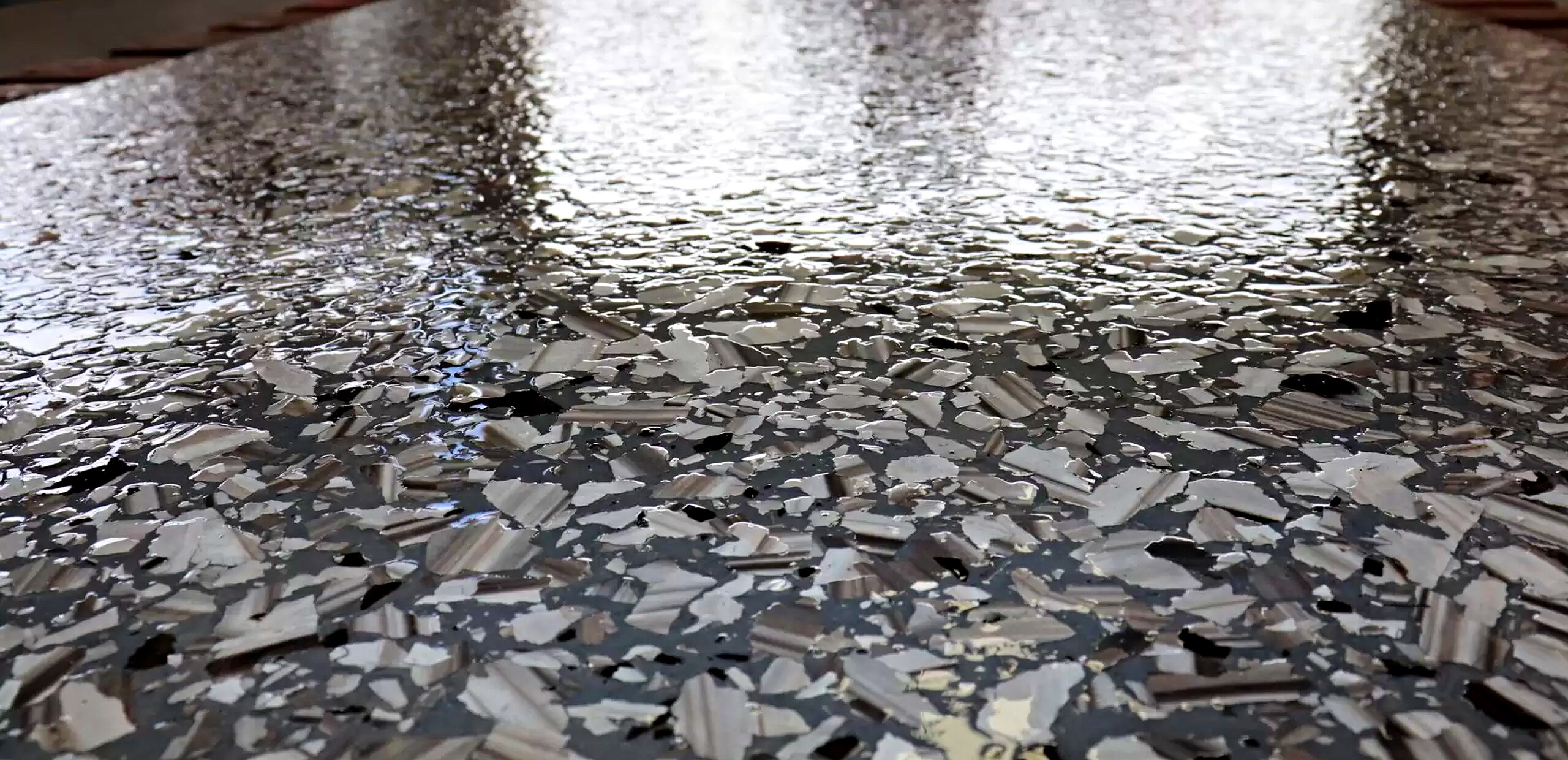
| 4. Broadcast | Texture; covers the base | 1/4-inch chip, full broadcast |
| 5. Topcoat | UV, abrasion, chemicals | Polyaspartic HS, 10–16 wet mils; second coat within 24 hours |
One caution from Simiron's own guide: the 1150FC base "will yellow over time," so any spot the chip doesn't cover discolors. Full broadcast isn't just decoration here. It's the base coat's UV protection. Their outgassing tip is worth copying too: a thin 3–5 mil prime pass first, then the rest of the base.
Can you put polyaspartic over an existing epoxy floor?
If the epoxy is sound, yes. Anything flaking, peeling, blistered or moisture-affected comes off, and you start again from ground concrete. On a sound floor, scuff the entire surface (glossy, unscuffed epoxy won't give a mechanical bond), clean it, and pull-off test a few spots (ASTM D4541 or D7234) before committing. On new work, stay inside the recoat windows so the layers bond chemically.
Can you put epoxy over polyaspartic?
Same rules: abrade, clean, test adhesion. But you'd be putting the UV-sensitive layer on top, which gives away the main reason to own a polyaspartic floor.
Polyaspartic vs epoxy vs polyurea
Polyaspartic is a modified polyurea, slowed down so it can be rolled. Conventional spray polyurea is the elastomeric, high-build base or membrane. Epoxy is the economical primer and moisture barrier. For the base-coat decision, read our polyurea vs epoxy floor coatings comparison. On decks and plant floors, sprayed aliphatic polyurea such as HighLine 410 is another route: 100% solids, no VOCs and intrinsically UV resistant.
Where ArmorThane fits
We make the polyaspartic top and polyurea bases, not the epoxy. ArmorFloor is our two-component aliphatic polyaspartic for moderate to severe chemical environments, indoors or out. It takes Color Quartz or decorative chips, goes on by roller, spray or cup gun at 5 mils minimum, and may not be diluted under any circumstance. ArmorFloor TopCoat is the thin-film version for membrane systems.
Dry film per coat
ArmorFloor TopCoat, mixed 1A:1B by volume.
Tensile strength
3,500 ± 300 psi (ASTM D412), Shore D 65 ± 5 (ASTM D2240).
Air-quality compliant
Formulated for Southern California's air-quality standard.
Polyaspartic vs epoxy safety: silica, isocyanates and VOCs
Both systems start with the same hazard: grinding concrete throws respirable silica. After that, polyaspartic's concern is the isocyanate in its hardener, and epoxy's is skin sensitization. The rules below apply to whoever holds the grinder and the roller, whether that's a crew or you.
- Silica (both systems). OSHA 29 CFR 1926.1153 sets the limit at 50 µg/m³ over an 8-hour average, with an action level of 25. Its Table 1 requires walk-behind grinders to have integrated water delivery, or dust collection that is 99%+ efficient with a filter-cleaning mechanism, plus a HEPA vacuum between passes indoors. Followed that way, Table 1 requires no respirator for a walk-behind grinder; handheld grinders used indoors more than four hours a shift call for APF 10.
- Isocyanates (polyaspartic). The hardener is an aliphatic polyisocyanate. OSHA lists the main effects as "occupational asthma and other lung problems, as well as irritation of the eyes, nose, throat, and skin." Simiron's guides require NIOSH-approved respirators, nitrile gloves and eye protection. Follow the product SDS.
- Epoxy sensitization. Epoxy resins and amine hardeners cause contact dermatitis and allergic reactions, and sensitization builds with repeated exposure. That matters most to DIYers who skip gloves.
- VOCs. South Coast AQMD Rule 1113 caps floor coatings, including garage, deck and porch floors, at 50 g/L. Polyaspartic HS, Sikafloor-261 and the Rust-Oleum kit all list under 50. Aspartic 85 lists under 160, over the limit wherever Rule 1113 applies. Low-solids "diluted" polyaspartics are a real category, so check the sheet. More in understanding VOCs in coatings.
- Slip resistance. Ask for the wet DCOF (ANSI A326.3) of the actual system. Simiron's flake systems test at .63–.65. Smooth, glossy films of either chemistry need broadcast texture wherever they'll be walked on wet.
Polyaspartic or epoxy: which should you choose?
Start with the slab's moisture reading, then sunlight, then schedule, then budget. In that order. Here's how that plays out on the floors we get asked about most. For commercial and industrial floors, the same logic applies with heavier bases.
| Your floor | Our pick | Why (from the data) |
|---|---|---|
| Sunlit garage or open-door shop | Base coat + full chip + polyaspartic top | Epoxy discolors in UV; HS held 87–89 gloss after 1,000 hr QUV |
| Shaded garage, tight budget, DIY | Epoxy kit is defensible if you grind and the slab is dry | 1–2 hr pot life; 3 mils over an etch is the weak spot |
| Basement or damp slab-on-grade | Epoxy moisture primer rated for your reading, then base + top | 25 lb / 95% RH vs 3 lb / 75% for polyaspartic direct |
| Auto shop or garage with fluids | Polyaspartic top over a base | "Excellent" vs fuels, brake fluid, motor oil (5-day cure) |
| Acid exposure (battery room, process area) | Get the exact product's chemical chart first | Same sheet: sulfuric "Fair," 10% nitric not recommended |
| Fall or winter install, slab 35–50°F | Polyaspartic, Fast grade below 60°F | 30–35°F minimums vs 50–60°F for the epoxies cited |
| Showroom or retail floor | Polyaspartic wear layer | Taber 30 mg vs 50–110 mg; HS lists 92–95 gloss |
| Existing, sound epoxy floor | Scuff, test, polyaspartic topcoat | Never over peeling or moisture-blistered epoxy |
| Slab over 25 lb or 95% RH | Specialist moisture assessment | Beyond every product cited here |
Add one-day polyaspartic floors to your business
Floors pair naturally with bedliners, roofing and spray foam: same customers, same crews. We make the ArmorFloor polyaspartic and the polyurea bases, supply the equipment and train your team, with no franchise fee and no royalties. Starter packages begin at $25,000.
Polyaspartic vs epoxy FAQ
Is polyaspartic better than epoxy?
For most garages and any floor the sun reaches, yes. On the data sheets cited here, polyaspartic takes heavy traffic in about 24 hours at 72°F, holds its color under UV, and loses less to Taber abrasion (30 mg vs 50–110 mg). Epoxy is still the better moisture-mitigating primer and the cheaper choice for interior floors on a budget, which is why the strongest systems use both.
Is polyaspartic the same as epoxy?
No. Polyaspartic is an aliphatic polyurea made from a polyaspartic ester and an aliphatic polyisocyanate, a technology introduced in the early 1990s. Epoxy is an epoxide resin, usually bisphenol A diglycidyl ether, cured with an amine hardener. They cure by different chemistry, which is why epoxy yellows in sunlight and aliphatic polyaspartic doesn't.
Can you put polyaspartic over epoxy?
Yes, and it's a standard professional build: an epoxy base, a chip broadcast and a polyaspartic topcoat. On an existing floor, the epoxy has to be fully bonded and free of blisters or moisture problems, scuffed across the whole surface, and ideally pull-off tested first. Never topcoat peeling epoxy; remove it and start from ground concrete.
Can you put epoxy over polyaspartic?
You can if you abrade it, clean it and test adhesion, the same as any recoat. But it puts the UV-sensitive layer on top, which gives up the main advantage of the polyaspartic. In our view it only makes sense on floors that never see sunlight.
Is polyaspartic more expensive than epoxy?
Usually by about $2–$5 per square foot installed. Recent installer and publisher guides put professional epoxy at about $3–$7 per sq ft and polyaspartic flake systems at about $5–$12 (2024–2026 estimates). On a 400 sq ft garage that works out to roughly $800–$2,000 more, by our arithmetic.
Is polyaspartic worth the extra money?
It is if the floor sees sunlight, has to be back in use in a day, or will outlast at least one epoxy redo while you own it. The lifespans usually quoted (epoxy 5–10 years, polyaspartic 15–20) are installer and publisher estimates, not studies. Run your own quotes through the cost-over-life calculator, including the equal-lifespan check.
How soon can I drive on polyaspartic vs epoxy?
A polyaspartic topcoat is typically ready for heavy traffic in about 24 hours at 72°F or warmer (Simiron Polyaspartic HS; its XTRA Slow grade takes 3 days). The DIY epoxy kit cited here needs 3 days before vehicles, and a two-coat professional epoxy about 2.3 days at 68°F, with roughly 7 days to full chemical cure. Cold slabs and dry air extend both.
Which handles concrete moisture better, epoxy or polyaspartic?
Epoxy, when it's a moisture-vapor-barrier formulation. One manufacturer rates its epoxy MVB primer to 25 lb per 1,000 sq ft per 24 hours (ASTM F1869) or 95% RH (ASTM F2170), while its polyaspartic applied directly to concrete is limited to 3 lb or 75% RH. Test the slab first; the reading decides which systems are eligible.
Can polyaspartic be applied in cold weather?
Yes, within limits. The data sheets cited list minimums of 35°F (Simiron, Fast grade below 60°F) and 30°F (Aspartic 85), against 50–60°F for the epoxies cited. The surface must also be at least 5°F above the dew point, and traffic times run longer in the cold.
Does epoxy turn yellow?
Standard epoxies discolor in sunlight. Sika states its Sikafloor-261 "will discolour over time when exposed to sunlight," and Simiron says its 1150FC epoxy base "will yellow over time." An aliphatic polyaspartic kept 87–89 gloss units after 1,000 hours of QUV testing (ASTM G154).
Does polyaspartic prevent hot tire pickup?
It helps, but it isn't a guarantee. Even a premium polyaspartic data sheet notes that "tire marking may occur." Hot-tire peeling usually traces to weak adhesion from poor prep or to thin, under-cured coatings, so grinding to CSP 3, testing moisture and respecting the cure time matter more than the resin.
Which has better chemical resistance, epoxy or polyaspartic?
For garage fluids, a quality polyaspartic rates "Excellent" against gasoline, E85, brake and transmission fluid, motor oil and Skydrol after a 5-day cure (Simiron Polyaspartic HS). The same sheet rates sulfuric and phosphoric acids "Fair" and 10% nitric acid "not recommended." Chemical resistance is product-specific, so for battery rooms or acid exposure, ask for the exact chart.
Can I DIY polyaspartic?
Retail polyaspartic kits exist, but the working time is short: 14–25 minutes for Fast grades at 72°F, depending on humidity. DIY epoxy kits give 1–2 hours of pot life but go on at about 3 mils over an acid-etched slab. For either one, a diamond-ground CSP 3 profile is the biggest upgrade you can make.
Polyaspartic vs epoxy vs polyurea: which is best?
They do different jobs. Polyurea is the high-build, flexible base or membrane, epoxy is the economical primer and moisture barrier, and polyaspartic is the UV-stable, abrasion-resistant wear layer. See our polyurea vs epoxy comparison for the base-coat decision.
Written from manufacturer data sheets, code text and 35+ years of spraying and supporting applicators. Last updated September 26, 2026.
How this comparison was built
We compared seven manufacturer data sheets and system guides (read September 26, 2026), using only values with a named product and, where given, a test method: ASTM D4060, D2240, D412, D638, D2370, G154, F1869 and F2170. Test values are the makers' own and come from different labs. Cost figures are dated installer and publisher estimates, and lifespans are industry estimates, not field studies. The return-to-service planner's cold-weather and dry-air adjustments are our estimates (reaction rates roughly halve per 18°F drop, consistent with Sika's epoxy table), not manufacturer values. ArmorFloor elongation, cure times and moisture limits aren't on our product pages yet; ask our technical team for current data.
Sources
- Polyaspartic esters: chemistry and history (Wikipedia): en.wikipedia.org/wiki/Polyaspartic_esters
- Dormish, J., Polyaspartic Coatings, Adhesives & Sealants Industry (Mar. 2016): adhesivesmag.com/articles/94477-polyaspartic-coatings
- Epoxy (Wikipedia): en.wikipedia.org/wiki/Epoxy
- Covestro, Pasquick polyaspartic floor coatings: solutions.covestro.com/en/highlights/articles/theme/product-technology
- Simiron Polyaspartic HS product data sheet (PDF, 04/2026): simiron.com/wp-content/uploads/2020/09/SIM_Polyaspartic-HS_ProductData
- Simiron SimFlake SB 1-Day Polyurea system guide (PDF): simiron.com/wp-content/uploads/2024/07/SIM_SimFlake-SB_1-Day-Polyurea_
- Simiron SimFlake SB 1-Day Epoxy system guide (PDF): simiron.com/wp-content/uploads/2024/07/SIM_SimFlake-SB-1-Day-Epoxy_Sys
- Simiron MVB moisture vapor barrier sell sheet (PDF): simiron.com/wp-content/uploads/2020/09/SIM_MVB_SELLSHEET_8.5x11.pdf
- Sikafloor-261 CA product data sheet (PDF, Nov. 2021): cdn.shopify.com/s/files/1/0579/9483/8195/files/sikafloor-261-CA__Produ
- Rust-Oleum EpoxyShield water-based garage floor coating TDS (2018): rustoleum.com/~/media/DigitalEncyclopedia/Documents/RustoleumUSA/TDS/E
- Exterior Coatings, Aspartic 85 low-temp polyaspartic: exteriorcoatings.com/product/aspartic-85-low-temp-polyaspartic-concret
- ArmorThane, ArmorFloor aliphatic polyaspartic: armorthane.com/products/armorflooring-product-page/armorfloor-aliphati
- ArmorThane, ArmorFloor TopCoat: armorthane.com/products/armorcoat/armorfloor-topcoat-4/
- ArmorThane, WC-111 primer: armorthane.com/products/armorprime/wc-111/
- ArmorThane, HighLine 410 aliphatic polyurea: armorthane.com/products/armorline-products/high-pressure/highline-410-
- Dew point and the Magnus formula (Wikipedia): en.wikipedia.org/wiki/Dew_point
- OSHA 29 CFR 1926.1153, respirable crystalline silica: osha.gov/laws-regs/regulations/standardnumber/1926/1926.1153
- OSHA, Isocyanates: osha.gov/isocyanates
- South Coast AQMD Rule 1113, architectural coatings (PDF): aqmd.gov/docs/default-source/rule-book/reg-xi/r1113.pdf
- The Garage Guide, garage floor coating cost (Mar. 2026): thegarage.guide/cost-guides/garage-floor-coating-cost
- Croc Coatings, polyaspartic vs epoxy cost breakdown (Sep. 2026): croccoatings.com/polyaspartic-vs-epoxy-cost-breakdown/
- ALLBRiGHT, polyaspartic vs epoxy cost (Dec. 2025): allbrightpainting.com/blog/2025/december/polyaspartic-vs-epoxy-cost-a-
- Bob Vila, epoxy garage floor cost (Apr. 2024): bobvila.com/articles/epoxy-garage-floor-cost/
- Garage Force, hot tire pickup explained (Sep. 2026): garageforce.com/2026/09/15/2026-hot-tire-pickup-heat-related-coating-f
- Danley's, polyaspartic over epoxy: danleys.com/blog/polyaspartic-over-epoxy/
- Stronghold Floors, polyaspartic vs epoxy garage floors: strongholdfloors.com/blog/polyaspartic-vs-epoxy-which-is-better-and-wh
- Resinwerks, polyaspartic vs epoxy vs polyurea (Dec. 2025): resinwerks.com/blogs/news/the-differences-between-epoxies-polyurea-and
- Garage Living, polyaspartic vs epoxy comparison (Jan. 2023): garageliving.com/blog/polyaspartic-vs-epoxy-comparison
- FloorTek Coatings, epoxy vs polyaspartic test results: floortekcoatings.com/posts/epoxy-vs-polyaspartic-coatings-real-test-re
- Garage Kings, polyaspartic vs epoxy flooring: garagekings.com/polyaspartic-vs-epoxy-flooring-a-comprehensive-compari
Not sure which system your slab can take? Get it tested and quoted.
Tell us about the floor and how you use it. We'll connect you with an ArmorThane-certified applicator who can moisture-test the slab, grind it properly and quote the right base coat and topcoat for it.
- Slab moisture testing (ASTM F2170 or F1869)
- Polyaspartic, polyurea and hybrid floor systems
- Garages, shops, showrooms and commercial floors
- Contractors: ask about adding one-day floors