










Concrete Primer: Which Type, When You Need It & How to Apply It
Masonry primers, block filler, bonding primers and epoxy primers each do a different job. Here is how to pick the right concrete primer, or skip it.
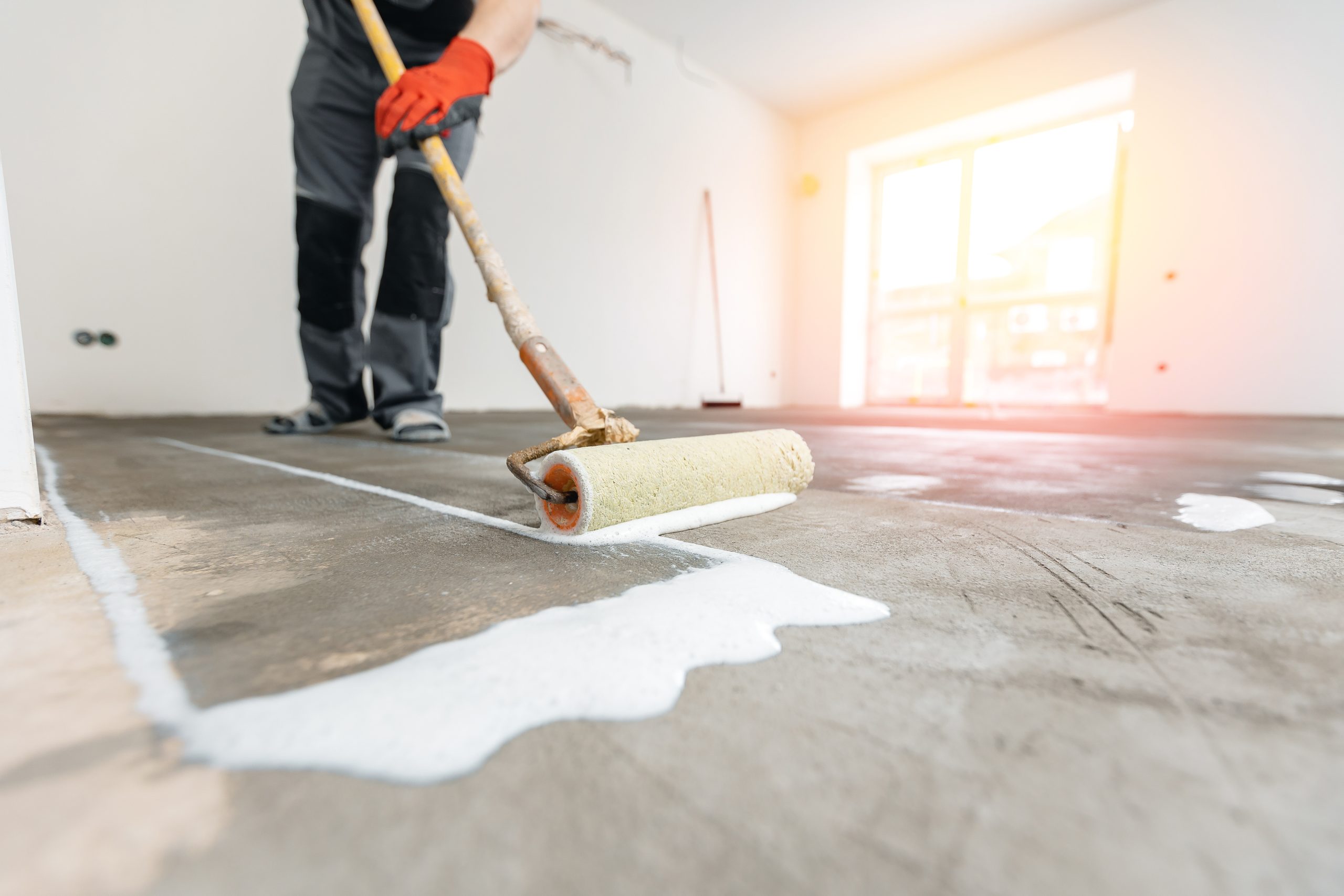
Start a floor coating business
Coat floors for a living.
ArmorThane sets you up to do this work, and you own the business. We make the chemistry, build the rigs, train you hands-on and answer the phone when a job gets difficult. You pay no franchise fee and no royalties. It has been that way since 1989.




- $0
- franchise fees or royalties
- 35+
- years in business
- 50+
- countries with applicators
- 24/7
- technical support
Concrete primer is not one product. A primer for a block wall, a primer under a self-leveling underlayment, and a primer under a polyurea floor do three different jobs, and using the wrong one is a common reason a coating lets go. The right concrete primer depends on what goes on top, how porous and alkaline the concrete is, and how much moisture is moving through it. We make primers for our polyurea systems, and we have seen most of the ways primers fail. This guide sorts out the types, when you need one at all, and how to pick and apply it.
Walls being painted: an acrylic masonry primer, or block filler on rough CMU. Floors being painted: many floor enamels are self-priming on etched concrete; check the label. Under self-levelers: the leveler maker's own diluted bonding primer. Under epoxy, polyaspartic or polyurea: the primer named in that system's data sheet, usually a penetrating epoxy or polyurethane, or a moisture-vapor-barrier epoxy if the slab tests high. Use the primer selector.
What a concrete primer actually does
Concrete is porous, alkaline, dusty at the surface and full of air. A primer deals with some combination of those, depending on the type:
- Seals porosity so the topcoat does not soak in unevenly and leave a blotchy, thin film.
- Bonds to the concrete and to the next coat. It penetrates the surface pores, locks down fine dust, and leaves a surface the topcoat is designed to stick to.
- Resists alkalinity on young concrete, which can attack some paints. Masonry primers are formulated for high pH.
- Blocks air and moisture. A thin, penetrating prime coat seals pores before a thick coat goes on, which cuts down on pinholes. Special epoxy primers also limit moisture vapor coming up from the slab.
- Fills texture. Block filler is a thick primer that fills the pores in concrete block so the paint can form a continuous film.
Types of concrete primer compared
Acrylic masonry primer-sealer
For walls, foundations and other above-grade masonry under latex paint. Sherwin-Williams Loxon Concrete & Masonry Primer is a common example: 200–320 sq ft per gallon, 2.1–3.2 dry mils, goes on concrete at least 7 days old with a pH from 6 to 13, minimum 40°F, 24 hours to recoat. It is not a floor primer.
Block filler
A high-build primer for concrete block, which is too porous and pitted for paint to cover alone. Behr Pro Block Filler covers 75–100 sq ft per gallon, wants masonry cured at least 30 days with moisture under 15%, and is for above-grade walls only. Back-roll it into the pores; do not just spray and walk away.
Bonding primers for self-levelers and overlays
These are thin, water-based products that stop a cement underlayment from losing its water into the slab and help it bond. Ardex P 51 is mixed 1 part primer to 1 part water on normal absorbent concrete, or 1:3 then 1:1 on extremely absorbent concrete, covers 400–600 sq ft per gallon, and needs 30 minutes to 24 hours before the underlayment goes on. Always use the primer the underlayment maker specifies.
Penetrating epoxy primers
Used under epoxy, polyaspartic and many polyurea floor systems. They are thin so they soak in. MiraPrime ML, a water-based 2-part epoxy, covers 320 sq ft per gallon at 5 wet mils and is designed to penetrate up to 300 microns into concrete, with a topcoat window that depends on what goes over it.
Moisture-vapor-barrier epoxy primers
Heavier epoxy primers for slabs that test too wet for a normal system. MV2112, as an example, is rated to control vapor emission up to 20 lb per 1,000 sq ft per 24 hours (ASTM F1869) and 75–95% RH (ASTM F2170), applied at 17–18 mils, about 90–94 sq ft per gallon, over at least a CSP 3 ground profile. Tnemec, by comparison, puts the general limit for most primers around 3 lb or 75–80% RH.
Polyurethane and polyurea primers
Spray polyurea systems have their own primers chosen for the substrate. Our ArmorPrime line includes UltraPrime, a fast-cure polyurethane primer, WC-111, a modified polyurethane designed to react with moisture and contaminants for adhesion, and Primer 41, a two-component multi-purpose primer. Which one goes on a given slab is set by the system specification, not by guesswork.
| Primer type | Coverage (sq ft/gal) | Min. concrete age | Walls / floors | Moisture tolerance | Goes under |
|---|---|---|---|---|---|
| Acrylic masonry primer (Loxon) | 200–320 | 7 days | Walls | Breathable, above grade | Latex and elastomeric paint |
| Block filler (Behr Pro) | 75–100 | 30 days | Walls | Under 15% moisture | Paint on CMU |
| Bonding primer (Ardex P 51, 1:1) | 400–600 | Per underlayment spec | Floors | Per underlayment spec | Self-levelers, toppings |
| Penetrating epoxy (MiraPrime ML) | 320 at 5 wet mils | Per data sheet | Floors | Normal slabs | Epoxy, polyaspartic, urethane |
| Vapor-barrier epoxy (MV2112) | 90–94 at 17–18 mils | Per data sheet | Floors | Up to 20 lb / 95% RH | Coating systems on damp slabs |
Concrete primer selector: which primer, or none?
Tell us what goes on top and what the concrete is like. The selector picks the primer category, flags age and moisture problems, and tells you when the topcoat's own data sheet should decide.
Pick a concrete primer
Uses topcoat type, concrete age, porosity and moisture test results against the published limits above.
Concrete primer coverage calculator
Primer coverage varies more than paint coverage because porous concrete drinks it. The calculator uses the midpoint of each type's published range and, for diluted bonding primers, tells you how much concentrate to buy versus how much mixed primer you will roll out.
How much concrete primer?
Area x coats / coverage + 10% waste. Diluted primers: concentrate = mixed volume x primer share of the mix.
How to prime concrete the right way
Read the topcoat data sheet first
The topcoat maker names the primer, the profile and the recoat window. Mixing brands across one system is the fastest way to lose any warranty and the second fastest way to get delamination.
Profile the surface
Primers only bond to clean, open concrete. For paint and thin primers, an etched or lightly ground surface is enough. Thick floor systems need grinding or shot blasting; the MV2112 vapor-barrier primer, for example, calls for at least ICRI CSP 3, which feels like 60-grit sandpaper.
Remove all dust
Vacuum, do not just sweep. Grinding dust left on the slab becomes a weak layer between primer and concrete.
Test moisture
Plastic sheet for paint projects; calcium chloride (ASTM F1869) or in-slab RH probes (ASTM F2170) for coating systems. The readings decide whether a standard primer will do or a vapor-barrier primer is needed.
Apply thin and work it in
Most primers fail from being too thick, not too thin. Roll or squeegee, then back-roll so it soaks in. Avoid puddles in low spots. Block filler is the exception: it should be worked into every pore.
Hit the recoat window
Topcoat inside the window the data sheet gives. Too soon and solvents or water get trapped; too late and some epoxy primers cure too hard for the next coat to bite, which means scuffing or re-priming.
Pinholes, bubbles and outgassing
If you have ever seen a fresh floor coating full of tiny craters, that was probably outgassing. Concrete holds a surprising amount of air: Sherwin-Williams estimates 11 to 28 gallons of air space per 100 sq ft in a 6-inch slab. When the slab warms up, that air expands and pushes up through the wet coating, and it sets as bubbles and pinholes.
Prime on a falling temperature
Both Sherwin-Williams and Euclid Chemical recommend applying when the slab is at its warmest and starting to cool, typically afternoon or evening. A cooling slab draws primer in instead of pushing air out.
Use a thin, penetrating prime coat
Euclid notes that low-viscosity primers are effective at sealing the surface before the main coat. Seal first, build second.
Sun and heaters
Direct sun moving across a slab, or a heater kicking on overnight, can start outgassing in the middle of a cure. Shade the floor or control the heat.
Primer over damp concrete
Blistering a few days or weeks later, rather than pinholes on day one, usually points to moisture rather than air. That is a vapor problem, and the fix is a vapor-barrier primer or mitigation.
Let a certified applicator handle the prep and prime.
ArmorThane applicators grind, test moisture, prime and coat concrete with polyurea and polyaspartic systems as one specified system. Tell us about your project and we will connect you with one near you.
Contractors: become an applicator →
Where our primers fit, and where they do not
ArmorPrime products are made for our polyurea and polyurethane systems. If you are painting a basement wall or a porch, buy the primer your paint maker specifies; our primers are not a substitute and would be overkill. Where we do fit is a coated floor, a tank, a containment area or a concrete coating project where the primer, membrane and topcoat are specified together. There, the applicator chooses the primer based on the surface and the moisture readings, and the whole stack is designed to bond.
For more on preparing concrete for any coating, see our surface preparation article, the garage floor coating guide and the epoxy floor coating guide.
Concrete primer questions
Do I need to prime concrete before painting?
Walls and block usually benefit from a masonry primer or block filler. Many floor paints are self-priming on clean, etched concrete. The topcoat label is the authority; if it calls for a primer, use the one it names.
What is the best primer for concrete floors?
It depends on the topcoat. Under floor paint, often none or the paint maker's own primer. Under epoxy, polyaspartic or polyurea, a penetrating epoxy or the system's specified primer. Under self-levelers, the underlayment maker's bonding primer. On damp slabs, a moisture-vapor-barrier epoxy primer.
Can I use drywall primer on concrete?
It is not a good idea. Concrete is alkaline and porous, and masonry primers are formulated for that. Loxon, for example, is rated for pH 6 to 13. A drywall primer is not designed for those conditions.
How long should concrete cure before priming?
It varies by product: Loxon Concrete & Masonry Primer allows 7-day-old concrete, while Behr Pro Block Filler asks for 30 days and under 15% moisture. Floor coating primers follow their system's moisture limits rather than a fixed age.
What is block filler and when do I need it?
Block filler is a thick primer that fills the pores of concrete block so paint can form a continuous, pinhole-free film. Use it on bare CMU walls before painting. It covers only about 75–100 sq ft per gallon because it is filling texture.
Does a primer stop moisture coming through concrete?
Ordinary primers do not. Specialty moisture-vapor-barrier epoxy primers are rated to hold back a measured amount, for example up to 20 lb per 1,000 sq ft per 24 hours, but they do not fix active leaks or hydrostatic pressure. Drainage problems need drainage fixes.
Why does my primer have bubbles and pinholes?
Most often outgassing: air in the concrete expanding as the slab warms. Apply when the slab temperature is falling, use a thin penetrating first coat, and keep direct sun and heaters off the floor during cure.
How do I dilute a concrete bonding primer?
Only as the maker specifies. Ardex P 51 is mixed 1:1 with water on normal concrete and 1:3 followed by 1:1 on extremely absorbent concrete. Other products differ, and many epoxy primers must never be thinned.
Sources
- Sherwin-Williams, Loxon Concrete & Masonry Primer-Sealer product data: buildsite.com/pdf/sherwinwilliams
- Behr Pro, Block Filler Primer No. PR050: behr.com/pro/products
- Ardex, P 51 Primer technical data: ardexamericas.com
- Miracote, MiraPrime ML product technical data sheet: miracote.com
- Exterior Coatings, MV2112 Moisture Vapor Barrier Primer: exteriorcoatings.com
- Tnemec, 3 Ways to Test Concrete Moisture: tnemec.com
- Sherwin-Williams Industrial, Outgassing and Outgas Bubbles: industrial.sherwin-williams.com
- Euclid Chemical, Coating Defects Caused by Concrete Outgassing (CP-03): euclidchemical.com
The primer is part of the system. Let a pro specify it.
Homeowners and facility managers: a certified ArmorThane applicator tests, preps, primes and coats as one system. Contractors: join our applicator network with no franchise fee and no royalties.
Start your coatings business with ArmorThane.
Tell us what you want to spray and where you are. An ArmorThane specialist will walk you through the equipment, chemicals, training and startup cost for the work you want to do.
- Equipment package matched to your applications
- Hands-on training and applicator certification
- Technical support once you are spraying
Coating a slab and not sure about the primer? Ask a certified applicator.
Tell us the surface, its size and age, any moisture test results, and what you want on top. We will match you with an ArmorThane applicator near you.
- Moisture testing and grinding
- Primer chosen for your slab
- Polyurea and polyaspartic systems
- Free on-site assessment
More in Floors & concrete
 Floors & concretePolyurea Garage Floor
 Floors & concretePolyurea vs Polyaspartic
 Floors & concretePorch Paint: Best Types for Wood & Concrete, Prep and CoverageFloors & concreteSelf Leveling Concrete
 Floors & concreteShot Blasting Concrete
 Floors & concreteSpalled Concrete Repair: Causes, Methods & Cost
 Floors & concreteStart a Concrete Business
 Floors & concreteStart a Floor Coating Business