foundation waterproofing
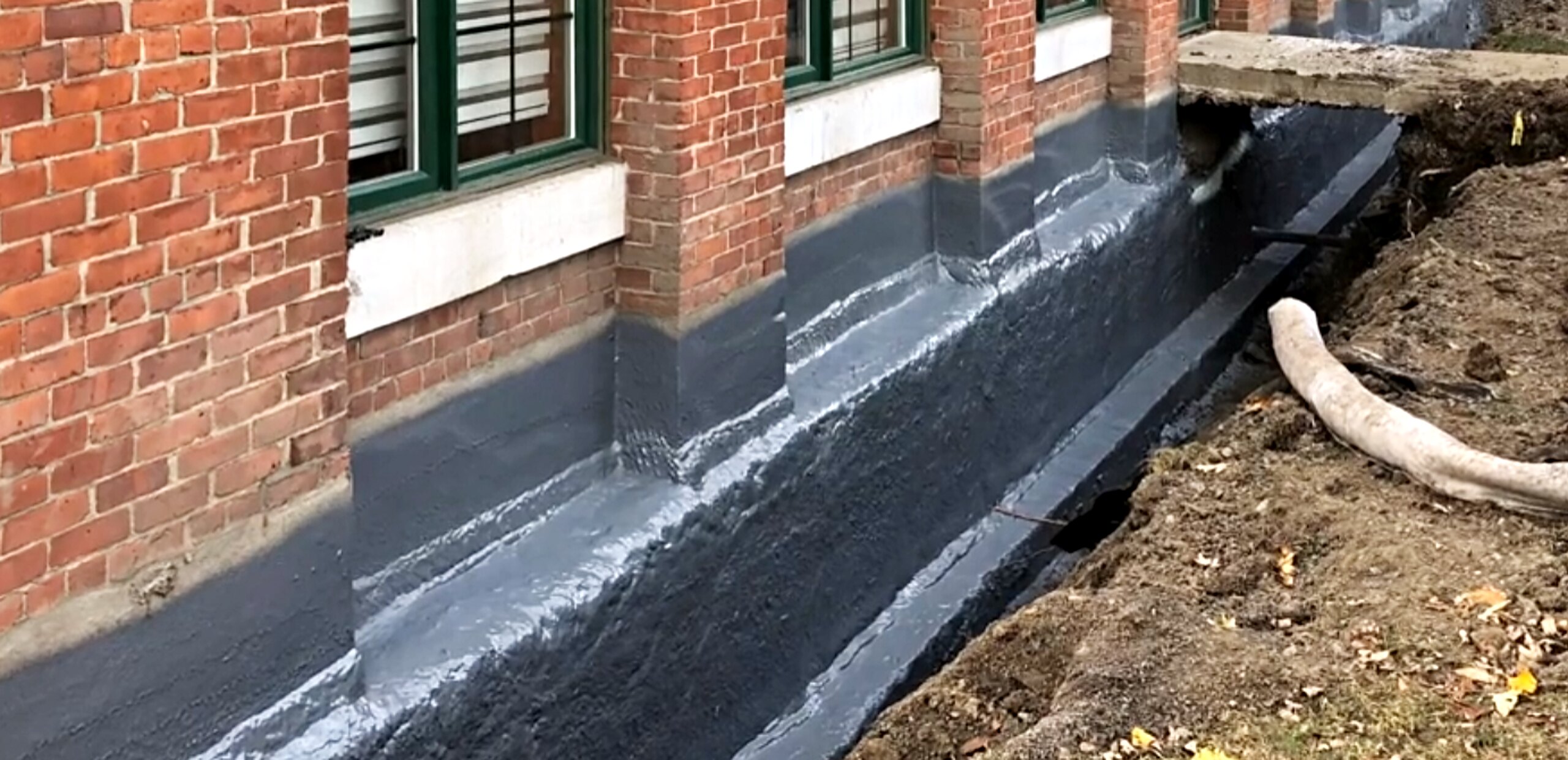
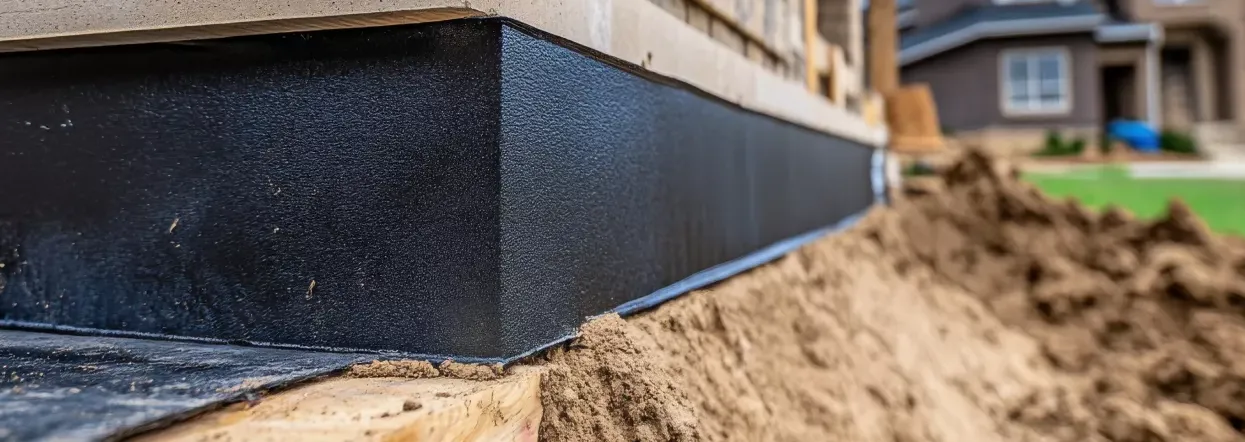
Foundation waterproofing is the process of sealing below-grade foundation walls and floors so groundwater and moisture cannot get into the structure. A seamless spray polyurea membrane is one of the most durable ways to do it. Every year, water damage costs U.S. homeowners and commercial property owners more than $13 billion.
Get a quote for your project
Tell us what needs protecting and an ArmorThane coatings specialist will come back with the right product, the right system and a realistic price.
- Product and system matched to your substrate
- Coverage and budget guidance before you commit
- A certified applicator near you
- 30+ years of field-proven polyurea and polyurethane
What’s Inside This Guide
- 1. Why Foundation Waterproofing Matters
- 2. Dampproofing vs. Waterproofing
- 3. How Water Attacks Your Foundation
- 4. Foundation Waterproofing Methods Compared
- 5. Why Polyurea Wins
- 6. The ArmorThane HighLine 510h System
- 7. Performance Data & Charts
- 8. Installation Process
- 9. Cost & ROI Calculator
- 10. The Evolution of Foundation Waterproofing
- 11. Frequently Asked Questions
Every year, water damage costs U.S. homeowners and commercial property owners more than $13 billion. Of that, the majority traces back to a single failure point: an inadequate foundation waterproofing system. Whether you’re protecting a suburban basement, a commercial below-grade structure, or a civil infrastructure project, the material you choose to seal your foundation will determine whether you’re dry for decades — or spending tens of thousands on remediation. This is the definitive 2026 guide to foundation waterproofing, and specifically to how ArmorThane HighLine 510h pure polyurea performs against the alternatives on published, independently verifiable test data — including where it leads and where it does not.
Retaining walls need the same thinking. See how to waterproof a retaining wall.
2,800 PSI
Tensile strength at break, ASTM D412 Die C — per the HighLine 510h data sheet
0.05
Perm-inch water vapour permeance, ASTM E96 — near-zero moisture transmission
400%
Elongation before rupture — bridges any crack
4-8 sec
Polyurea gel time — walk- on same day
Why Foundation Waterproofing Matters
Foundations are the literal interface between a structure and the earth. Below grade, they face a constant, unrelenting assault: hydrostatic pressure from groundwater, soil moisture vapor migrating through concrete pores, freeze-thaw cycling that cracks even well-poured walls, and chemical attack from sulfates and chlorides in aggressive soils.
According to the 2023 American Housing Survey, 11.7 million U.S. homes experience water leakage from external sources — and that number grows every year as aging building stock encounters more extreme precipitation events linked to climate change.
The consequences compound quickly. Water intrusion leads to mold growth (beginning within 24–48 hours of saturation), structural spalling of concrete, corrosion of embedded reinforcing steel, loss of bearing capacity in the soil beneath footings, and catastrophic reductions in property value. The American Society of Civil Engineers estimates that deferred infrastructure maintenance related to moisture damage costs the U.S. economy over $40 billion annually. Getting foundation waterproofing right the first time is not an upgrade — it is the single most important decision in below-grade construction.
Key Insight: Studies consistently show that exterior foundation waterproofing delivers 3–5× the ROI of interior drainage mitigation alone, because it stops water at the source rather than managing it after it enters the building envelope.
How Water Attacks Your Foundation: The Physics
To choose the right waterproofing system, you need to understand the three mechanisms by which water destroys foundations:
1. Hydrostatic Pressure.
When the soil surrounding a foundation becomes saturated, water presses against the wall with a force proportional to the depth and the duration of saturation. At just 10 feet of head, this pressure exceeds 4.3 psi enough to force water through any crack wider than 0.2 mm. Traditional dampproofing, which is essentially a thick paint, cannot withstand sustained hydrostatic pressure at this level.
2. Capillary Action.
Concrete is a porous material. Even without a visible crack, water molecules are drawn through the microscopic pore network by capillary forces. This is why “waterproofing paint” applied to the interior of a basement fails: it’s fighting capillary action from the wrong side of the wall. The solution must be applied on the positive-pressure (exterior) face, or it must be a material dense enough to seal the pore structure from within.
3. Vapor Migration.
Below-grade walls experience a perpetual vapor pressure gradient from wet soil to drier interior air. Over years, this vapor migration carries dissolved minerals that deposit as efflorescence, accelerates carbonation of concrete, and degrades interior finishes. An elastomeric membrane with a low moisture vapor transmission rate (MVTR) like ArmorThane HighLine 510h polyurea at less than 0.1 perms arrests this process completely.
Tensile Strength by Waterproofing System (Published Manufacturer Data)
Sources: ArmorThane HighLine 510H TDS (PDF); GCP Bituthene 3000; Carlisle Coatings & Waterproofing. Test methods differ by manufacturer and are stated per row; ASTM D412 and ASTM D2370 results are not strictly interchangeable. Values are the manufacturers’ own published figures at the time of writing and are not the result of side-by-side testing by ArmorThane.
Dampproofing vs. Waterproofing: The Critical Distinction
These two terms are routinely misused even by experienced contractors with expensive consequences. Understanding the difference is the first step to specifying the right system.
Dampproofing is a single or double coat of bituminous (asphalt-based) material designed to resist moisture vapor and incidental water contact. It is emphatically not rated for hydrostatic pressure. Think of dampproofing as a water-resistant jacket: fine for light rain, inadequate in a downpour. IRC Section R406.1 allows dampproofing only where no high water table or severe soil-water conditions exist.
Waterproofing creates a positive barrier against liquid water under pressure.
It spans cracks, bridges construction joints, and withstands the full column of groundwater that may press against a foundation wall during a saturating rain event. IRC Section R406.2 mandates waterproofing whenever “a high water table or other severe soil-water conditions are known to exist.” In practice, forward-thinking builders now specify waterproofing as the baseline for all below-grade work the cost delta (typically $3,000–$5,000 for a residential foundation) is trivial compared to a $15,000–$40,000 remediation.
Pricing a job? See what basement and foundation waterproofing costs in 2026.
Field Insight Tyler Gleckler, Coatings Specialist
On a 2025 residential deep-basement project in the Mid-Atlantic, an ArmorThane HighLine 510h polyurea system was applied over a poured concrete wall showing active seeping at two cold joints. After surface preparation and application at 80 mils, the wall showed zero moisture intrusion through the following winter including two consecutive 100-year flood events that saturated the site. The same project’s original asphalt dampproofing had failed within 18 months of installation.
Foundation Waterproofing Methods Compared
The market offers more options for foundation waterproofing than at any point in history. Here is a comprehensive evaluation of every major category with ArmorThane HighLine 510h polyurea benchmarked against each.
Asphalt / Bituminous Coatings
The original “black stuff” solvent- or emulsion-based asphalt coatings have dominated the foundation market since the 1950s due to their low material cost and ease of application with a brush or spray. Performance limitations are severe: asphalt coatings are rigid at low temperatures (cracking during freeze-thaw), soften at elevated temperatures, cannot bridge cracks wider than 0.5 mm, and have no meaningful hydrostatic resistance. Typical service life is 5–10 years before UV and thermal degradation render them porous.
Important: Asphalt dampproofing is code-minimum in many jurisdictions but is increasingly recognized as inadequate for finished below-grade spaces, high water table sites, or any structure expecting a service life beyond 15 years.

| METHOD | HYDROSTATIC RESISTANCE | CRACK BRIDGING | ELONGATION | INSTALL TIME | SERVICE LIFE | SEAMS / LAP RISK | COLD TEMP INSTALL |
|---|---|---|---|---|---|---|---|
| ArmorThane HighLine 510hBEST | Excellent | 400% | 400% | Hours | 50+ years | None — monolithic | Down to -40°F |
| Peel-and-Stick Membrane | Good | ~3/16" | 200–400% | 1–3 days | 20–30 years | Lap seams | 40°F minimum |
| Modified Asphalt Spray | Moderate | Limited | 100–300% | 1–2 days | 15–25 years | Seamless | 40°F minimum |
| Cementitious / Crystalline | Moderate | None | <1% | 2–3 days | 20–30 years | Seamless | Limited |
| Asphalt Dampproofing | None | Minimal | 10–30% | Hours | 5–10 years | Seamless | 40°F minimum |
| Dimple Mat Alone | Drainage only | N/A | N/A | 1–2 days | 30+ years (HDPE) | Panel joints | Yes |
Why Polyurea Wins Every Foundation Waterproofing Benchmark
The technical case for polyurea in foundation waterproofing is overwhelming but it is the combination of properties, not any single metric, that makes it categorically superior to every alternative.
Seamless, Monolithic Coverage
Every other liquid-applied waterproofing system has either a cure window during which it is vulnerable, lap seams where membranes overlap, or a brittleness that develops with age. Pure polyurea has none of these. The spray-applied system conforms perfectly to every irregular surface, penetration, and corner detail, creating a single continuous membrane with no mechanical joints for water to exploit. In a 10,000 sq ft below-grade commercial slab, a polyurea system might have zero seams; a peel-and-stick system on the same substrate could have 500+ lap joints each a potential failure point.
Extreme Elongation and Crack Bridging
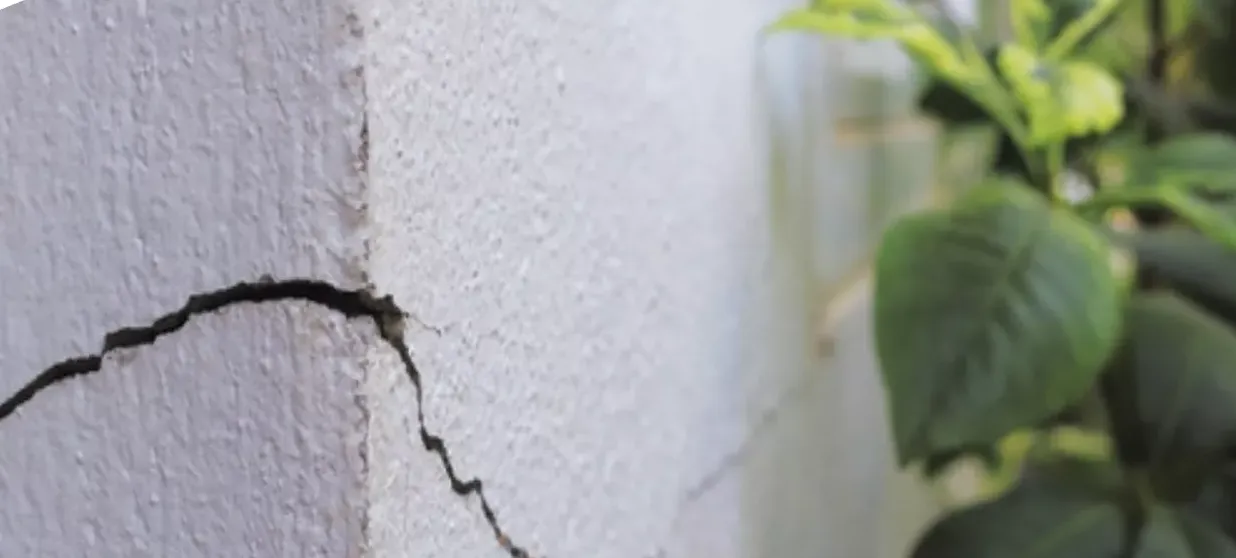
Concrete moves. Temperature changes, soil settlement, hydration shrinkage, and seismic activity all cause concrete foundations to crack. The critical question is not whether your foundation will crack it will but whether your waterproofing can follow. With elongation of 400% (ASTM D412-C), ArmorThane HighLine 510h stretches with cracks rather than failing at them. A 1/4-inch crack that would instantly breach a rigid cementitious coating is completely spanned by an 80-mil polyurea membrane stretched to only a fraction of its failure threshold.
Chemical and Biological Resistance
Below-grade environments are chemically aggressive. Sulfate-bearing soils attack concrete and conventional coatings. Chlorides from de-icing salts migrate downward to attack reinforcing steel. Organic acids from decomposing soil matter degrade asphalt-based systems. Microbial communities metabolize some polymer coatings. Pure polyurea is inert to all of these it passes immersion testing in acids, alkalis, hydrocarbons, and sulfates with no measurable degradation, making it the correct choice wherever chemical soil conditions are unknown or aggressive.
Speed of Application
In construction, time is money. A conventional peel-and-stick waterproofing job on a large residential foundation takes 2–4 days, requiring temperature management, primer drying, careful seam overlap, and protection board installation before backfill. ArmorThane HighLine 510h can coat the same foundation in 4–8 hours, with the membrane ready for light backfill contact in under an hour. On commercial projects, this compression of the waterproofing schedule routinely saves 3–5 days of critical-path time.
Waterproofing Effectiveness
The ArmorThane HighLine 510h Foundation Waterproofing System
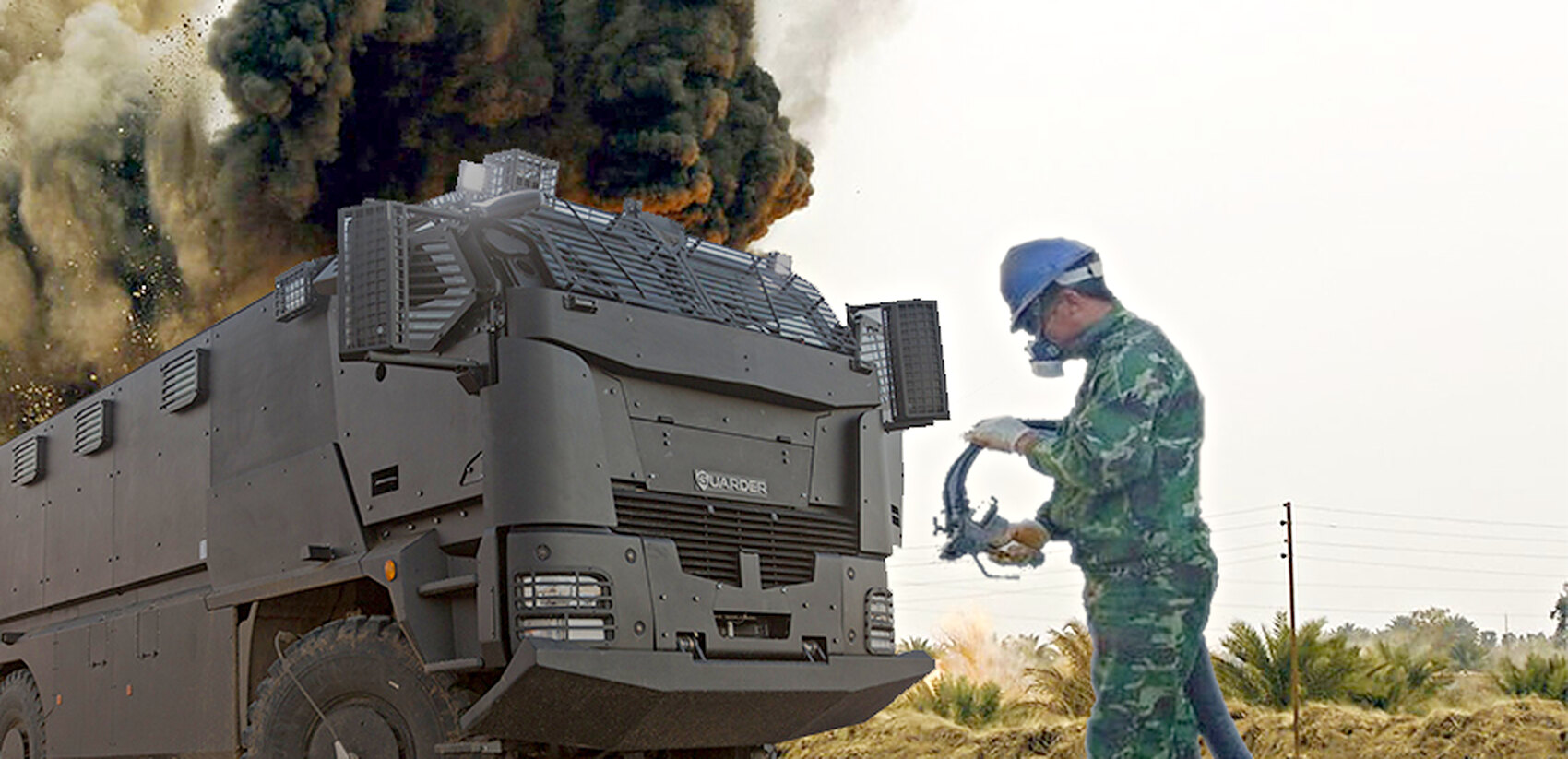
ArmorThane has spent three decades engineering pure polyurea systems for the world’s most demanding environments blast mitigation in the Gulf, secondary containment for chemical plants, and extreme-condition infrastructure protection. The same chemistry that stops blast fragmentation and chemical spills is now available as the definitive solution for foundation waterproofing.
HighLine 510h The Standard System
HighLine 510h is optimized for residential foundations, crawl spaces, and light commercial below-grade walls. Applied at 40–80 mils, it delivers a seamless membrane with 900%+ elongation, tensile strength of 2,800 psi, and zero VOC emissions after cure. Its hydrophilic primer chemistry allows application over slightly damp concrete a critical advantage in the field, where perfectly dry substrates are the exception, not the rule. HighLine 510h is the system of choice for new residential construction and for retrofitting existing foundations without excavation using the negative-side injection variant.
HighLine 510h Pro Heavy-Duty for Challenging Conditions
HighLine 510h Pro steps up the performance envelope for applications where hydrostatic head exceeds 20 feet, soils are chemically aggressive, or the structure demands the highest available performance margin. Applied at 80–150 mils, Pro delivers tensile strength of 4,200 psi, elongation of 1,100%, and chemical resistance to sulfuric acid at pH 2. It is the standard specification for commercial underground parking structures, below-grade data centers, bridge abutments, tunnels, and any infrastructure project where failure is genuinely not an option.
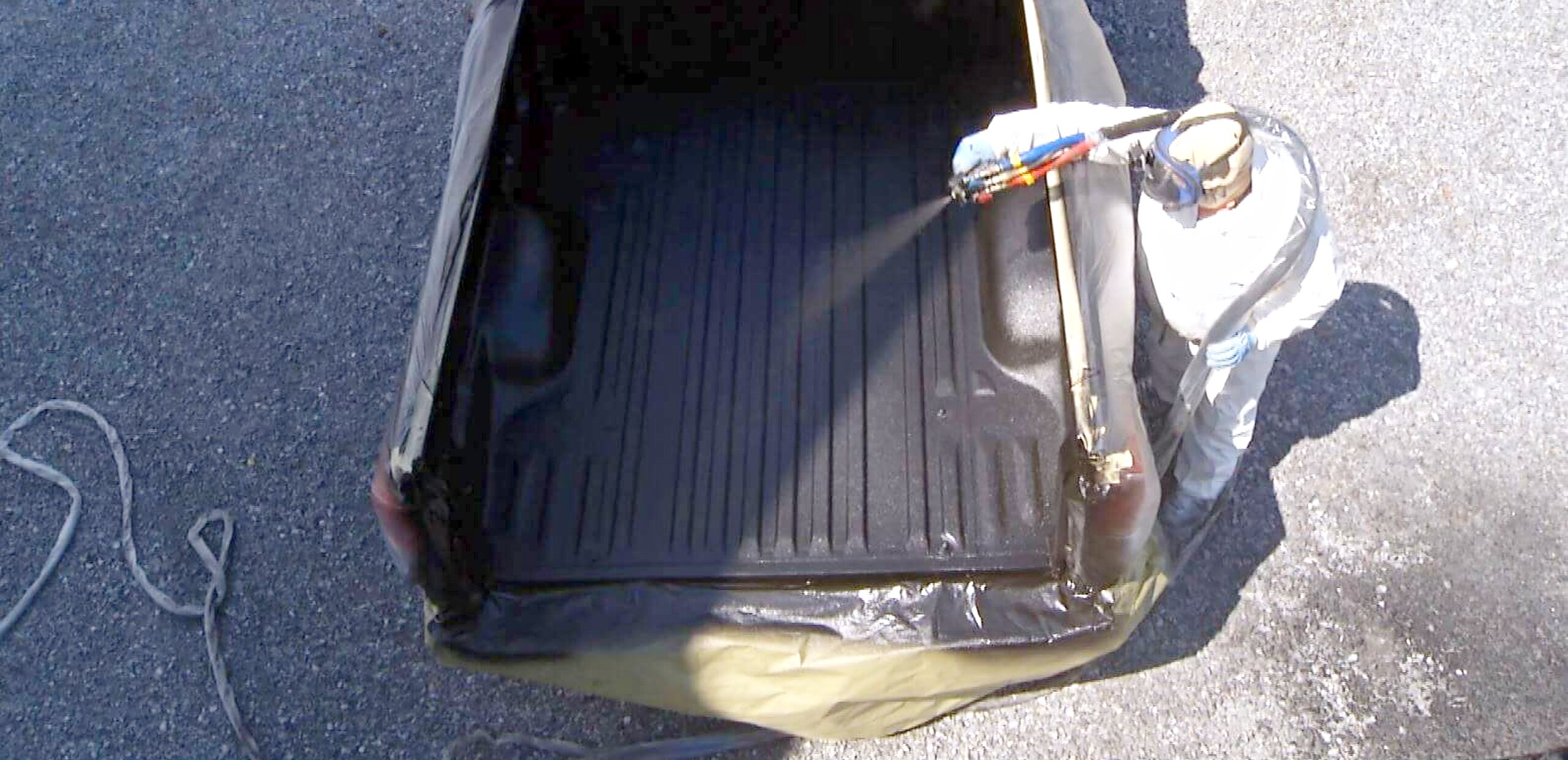
Critical Specification Note: Not all polyureas are equal. Generic spray polyureas designed for truck bed liners or agricultural tanks may share the same chemistry class but do not deliver the elongation, adhesion, or tested hydrostatic performance of a purpose-engineered foundation waterproofing system like HighLine 510h. Always specify by tested performance ASTM D412 elongation, ASTM D624 tear strength, and ASTM E96 moisture vapor transmission not by marketing claims.
The Negative-Side System: Waterproofing from the Interior
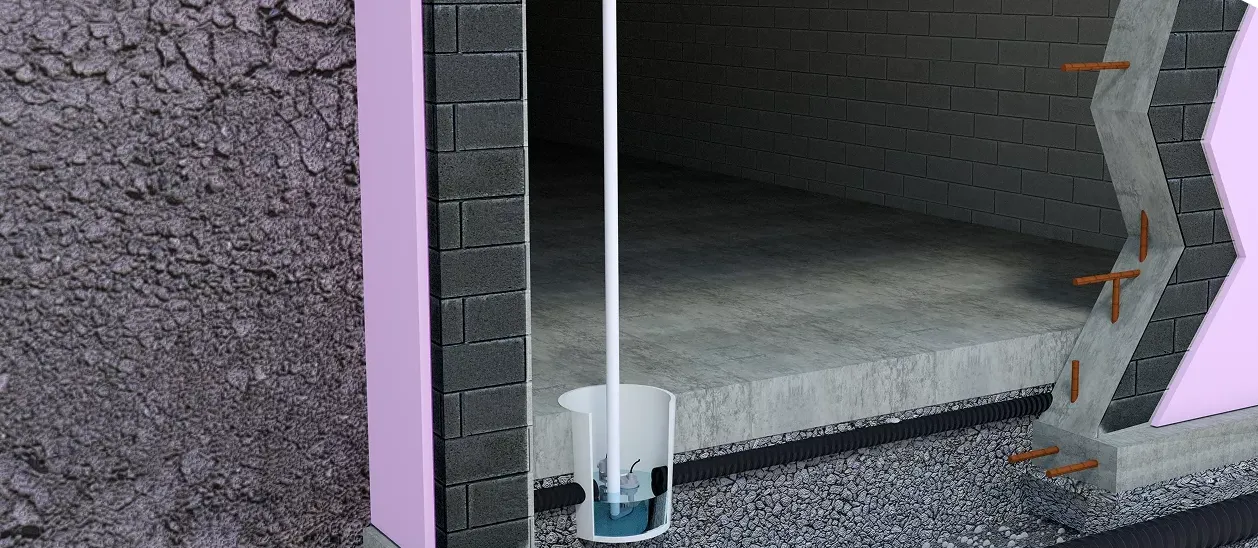
When exterior excavation is impossible on a finished urban building, a structure with adjacent utilities, or a heritage property ArmorThane offers a negative-side polyurea system. Applied to the interior face of the foundation wall, the negative-side system works differently: rather than blocking water before it enters the wall, it captures and manages water in a drainage cavity that routes moisture to a sump. This is the second line of defense effective, but best combined with exterior HighLine 510h waterproofing for new construction.
Elongation at Break by Waterproofing System (Published Manufacturer Data)
How to read this: HighLine 510H is not the stretchiest product on this list — sprayed modified-asphalt membranes elongate further. Elongation only describes how far a film stretches before it tears; it says nothing about how much force it takes to get there. HighLine 510H pairs 400% elongation with 2,800 psi tensile strength, roughly 8× the tensile strength of the peel-and-stick membrane above and about 30× that of a fluid-applied asphalt coating. That combination — not elongation alone — is what resists backfill abrasion, root pressure and settlement shear.
Sources: ArmorThane HighLine 510H TDS (PDF); Carlisle Coatings & Waterproofing (Barritech VP / NP); Tremco (TREMproof 260); GCP (Bituthene 3000); ASTM D6878 (TPO). All figures are the manufacturers’ or standards bodies’ own published values at the time of writing, not side-by-side testing by ArmorThane. Product lines vary; confirm against the current data sheet for the specific product being specified.
HighLine 510H Performance Specifications (ASTM Test Data)
On crack bridging: ASTM C836, using test method ASTM C1305, requires no cracking after 10 cycles at −15°F. The HighLine 510H data sheet reports 25 cycles at −13°F (−25°C) — two and a half times the required number of cycles, at a temperature 2°F warmer than the standard’s stated test condition. Both figures are given above so the result can be compared with the requirement directly.
On service life: no accelerated-ageing or expected-service-life figure is published for HighLine 510H, and the same is true of most competing systems. Real-world service life depends on substrate preparation, film thickness, drainage, backfill and soil chemistry, so any single number quoted for a waterproofing system should be treated as an estimate rather than a tested specification. For a project-specific expectation, ask for the warranty terms in writing.
Source: ArmorThane HighLine 510H technical data sheet (download PDF). Test values are typical laboratory results on properly prepared substrates and are not a warranty of performance in any specific installation.
ArmorThane HighLine 510h
Seamless, monolithic, 400% elongation, 50+ year life. The gold standard for any below-grade application.
Peel-and-Stick Membrane
Good waterproofing, but lap seams create vulnerability. Sensitive to low-temperature installation.
Cementitious / Crystalline
Excellent for integral concrete treatment, but zero elongation cracks are fatal to coverage.
Asphalt Dampproofing
Code-minimum only. Not a waterproofing system. Fails under hydrostatic pressure and ages rapidly.
HDPE Dimple Mat
A drainage layer, not a waterproofing membrane. Best used in combination with a primary system.
Polyurethane Liquid
Good performance but lower elongation and moisture sensitivity during cure vs. pure polyurea.
The ArmorThane HighLine 510h Installation Process
Proper installation is as critical as material selection. A world-class polyurea system, applied incorrectly, will underperform a mediocre system applied correctly. Here is the complete, step-by-step process that ArmorThane-certified applicators follow on every foundation waterproofing project.
1. Site Assessment & System Specification
Before a single drop of polyurea is mixed, the project requires a thorough site assessment: soil boring or percolation testing to determine groundwater conditions, analysis of soil chemistry for sulfate and chloride concentrations, review of structural drawings to identify penetrations and cold joints, and selection of the correct HighLine 510h specification based on hydrostatic head, temperature range, and expected service life requirements.
2. Surface Preparation
Surface preparation is 80% of the battle in any coating application, and foundation waterproofing is no exception. Concrete must be clean, sound, an profiled to ICRI CSP 3-5 (typically achieved by shotblasting or mechanical scarification). All laitance, curing compound, form release agent, and existing coating must be removed. Bug holes and honeycombing are filled with ArmorThane’s fast-setting polyurea patch compound. Substrate moisture is measured with a calibrated meter HighLine 510h tolerates up to 19% surface moisture, but standing water must be removed. Steel substrates are abrasive-blasted to SSPC-SP 6/NACE 3.
3. Primer Application
All concrete substrates receive ArmorThane’s moisture-tolerant, amine-functional primer at 4–6 mils DFT. This primer serves two purposes: it seals residual porosity (reducing the risk of pinholes in the polyurea topcoat) and provides a reactive amine interface that the isocyanate component of the HighLine 510h bonds to chemically not just mechanically. Pull-off adhesion values on properly primed, prepared concrete consistently exceed 350 psi. Primer must cure to tack-free before polyurea application, typically 30–60 minutes.
4. Detail Work Penetrations, Cold Joints & Tie Holes
Details are where waterproofing systems fail. Every pipe penetration receives a polyurea-compatible sleeve seal or a hand-applied polyurea flashing at a minimum of 6 inches radius. Cold joints receive a polyurea filler bead before the main application. Form tie holes are filled with the patch compound and primed. Corners and changes in plane receive a coved polyurea fillet before the field coat.
5. HighLine 510h Application
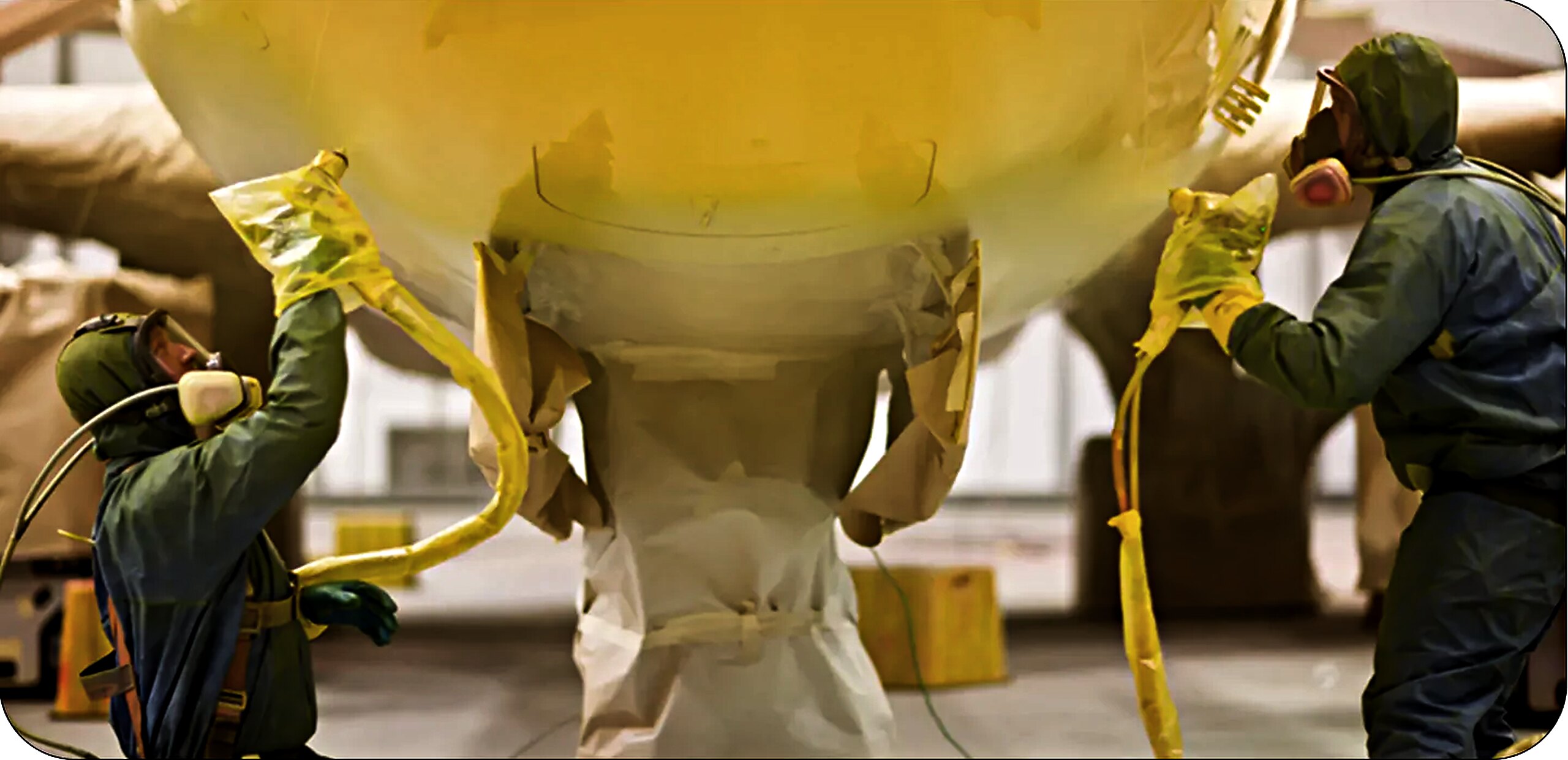
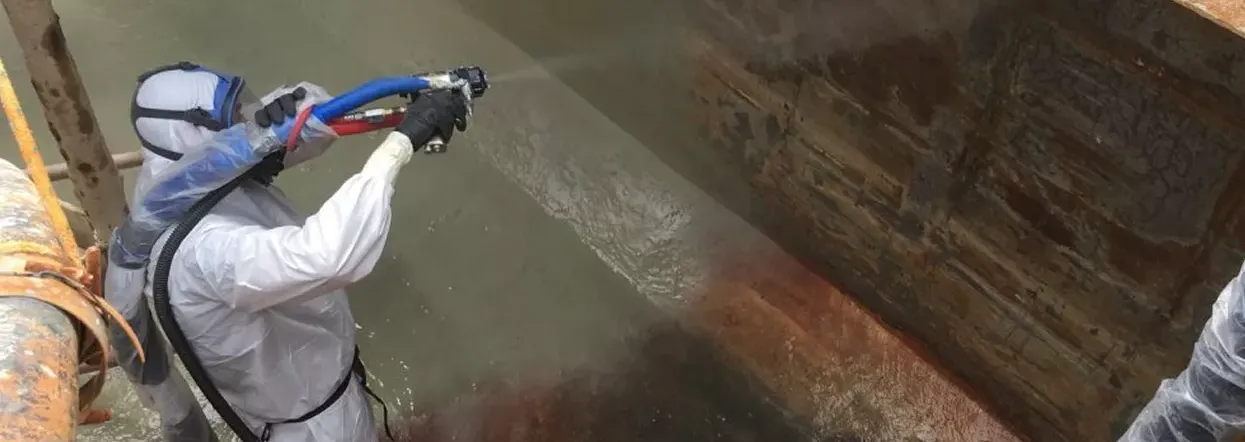
HighLine 510h is applied using high-pressure (2,000–3,500 psi), heated (160–175°F) plural-component spray equipment typically a Graco or Gusmer reactor by ArmorThane-certified applicators. A single pass at 40 mils is typically followed by a second pass at 40 mils for a total of 80 mils. Critical details receive a third pass. An experienced two-person crew can apply 5,000 sq ft of 80-mil membrane in a single shift. Atmospheric conditions must be monitored dew point must be at least 5°F below substrate temperature to prevent moisture contamination of the polyurea surface.
6. QA/QC Inspection and Testing
Every ArmorThane foundation waterproofing installation includes mandatory QA: holiday (spark) testing per ASTM D5162 to locate any pinholes or discontinuities, dry film thickness measurement per SSPC-PA 2, and pull-off adhesion testing per ASTM D4541 at a minimum of one test per 2,500 sq ft. All test results are documented in a project completion package provided to the owner. Zero holidays are the acceptance criterion any detected discontinuity is repaired before the project is certified complete.
7. Protection Layer and Backfill
Where substrate preparation reveals sharp aggregate or where backfill includes fractured rock or angular fill, a protection board (rigid insulation or dedicated protection mat) is mechanically fastened over the cured polyurea before backfilling. Backfill equipment must not directly contact the membrane. On heavy commercial projects, ArmorThane specifies drainage composite (dimple mat with geotextile facing) over the HighLine 510h to manage any residual surface water and reduce long-term hydrostatic pressure on the membrane.
Foundation Waterproofing Cost & ROI: Interactive Calculator
The cost of foundation waterproofing varies widely by system, substrate, and project scale. Use the interactive tool below to estimate your material investment and compare it to the cost of water damage remediation.
vs. average water damage remediation cost of $22,000 — 1.8× return if one event is avoided
The Math: ArmorThane HighLine 510h starts at $8/sq ft installed on a typical foundation, compared to $0.50–$1.00 for asphalt dampproofing. On a 1,500 sq ft foundation, that is $12,000 — a premium of roughly $10,500–$11,250 over dampproofing. The average interior water damage remediation job in the U.S. costs $22,000 (IICRC, 2024). A single avoided remediation event returns about 1.8× the polyurea investment.
The Evolution of Foundation Waterproofing Technology
The Asphalt Era
Bituminous coatings dominate the market. Code-minimum dampproofing is the industry standard. Water damage is accepted as an inevitable part of building ownership.
Dimple Mats & Drainage Innovation
HDPE dimple drain mats emerge as a drainage-plane innovation. The concept of actively managing groundwater rather than simply resisting it gains traction.
Self-Adhering Membranes
Peel-and-stick rubberized asphalt membranes enter the market, offering genuine waterproofing capability for the first time in the residential sector.
Crystalline & Spray-Applied Systems
Crystalline technology matures. Early polyurethane and polyurea sprays begin appearing on commercial projects. IRC Section R406 codifies dampproofing vs. waterproofing distinction.
Pure Polyurea Enters Foundation Market
ArmorThane pioneers pure polyurea for foundation waterproofing with HighLine 510h, transferring military-grade blast protection chemistry to civilian infrastructure. The performance gap vs. alternatives becomes undeniable.
Polyurea Becomes the Performance Standard
Pure polyurea now specified on commercial, civil, and high-value residential projects as the baseline performance system. Smart-sensor-embedded membranes and self-healing polyurea hybrids enter specification documents.
Foundation Waterproofing by Application Type
Different below-grade applications have different requirements. Here is how ArmorThane HighLine 510h performs across the full range of foundation types:
Poured Concrete Foundations
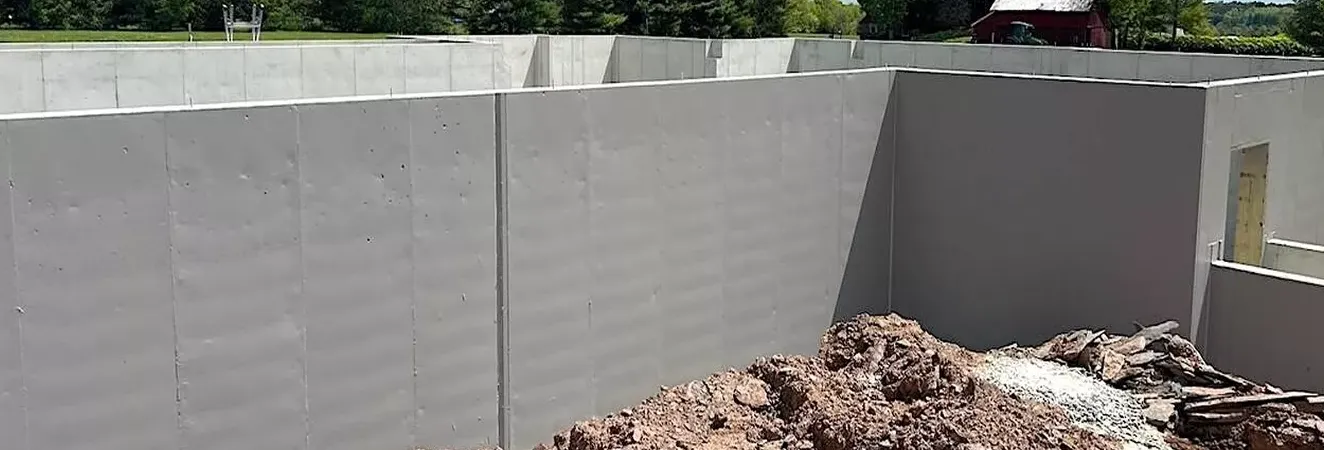
The most common residential and commercial foundation type. HighLine 510h bonds directly to clean, prepared concrete at 300–600 psi pull-off. Cold joints between pours the primary failure point in poured concrete foundations are sealed with a polyurea fillet before the main application. Bug holes and honeycombs are pre-filled. The result is a membrane that performs consistently across the entire foundation, regardless of pour sequence or surface variation.
Concrete Masonry Unit (CMU) / Block Foundations
CMU foundations present a specific challenge: the mortar joints are perennially weak points, and the block surface is porous and irregular. IRC R406.1 requires a 3/8-inch Portland cement parging coat before dampproofing on CMU walls. When HighLine 510h is specified, the parging is still applied (filling the block face irregularities), followed by the primer and the main polyurea coat. The result outperforms bare-CMU applications of any other system.
Insulated Concrete Form (ICF) Foundations
ICF foundations are increasingly common in high-performance residential and commercial construction. They present a specific challenge for waterproofing: the expanded polystyrene foam insulation is incompatible with solvent-based products, including most asphalt systems. ArmorThane HighLine 510h is 100% solids and solvent-free it is fully compatible with ICF substrates and bonds to both the exposed concrete and the foam face when ICF faces are not stripped before application.
Below-Grade Commercial Slabs and Podium Decks
Horizontal waterproofing for below-grade occupied spaces parking decks, plaza decks, terraces over occupied space demands the highest performance. ArmorThane’s traffic-bearing grade HighLine 510h Pro combines the full waterproofing performance with sufficient hardness and abrasion resistance to withstand vehicular traffic without a separate wear coat. This simplifies the specification and eliminates the inter-coat adhesion risks inherent in multi-product systems.
Tunnels, Underpasses, and Below-Grade Infrastructure
Civil infrastructure represents the most demanding environment for foundation waterproofing: continuous hydrostatic pressure, vibration from traffic loads, chemical exposure from de-icing salts, and access constraints that make failure remediation extraordinarily expensive. ArmorThane HighLine 510h systems are specified on tunnel bore liners, cut-and-cover tunnels, underpasses, and below-grade transit stations applications where service life expectations of 50–100 years are standard.
ArmorThane HighLine 510h Achieves ASTM D6083 / D412 Certification for Foundation Waterproofing Systems
HighLine 510h has been independently tested to ASTM D6083, D412, D624, E96, and ASTM C836, with full third-party test packages available to specifying engineers on request. Contact ArmorThane’s technical services team for project-specific documentation.
Frequently Asked Questions About Foundation Waterproofing
What is the best method for foundation waterproofing?
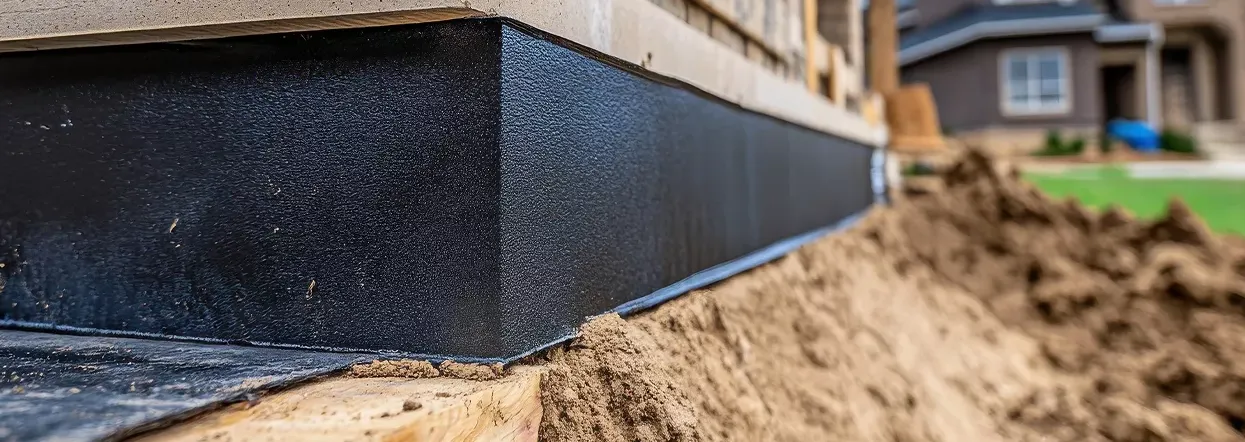
The best method is an exterior, positive-side spray-applied pure polyurea membrane. Because it cures into a seamless, monolithic film with no lap seams or cold joints, it stops water at the source rather than managing it after it has entered the building envelope. With 400% elongation (ASTM D412-C) it bridges shrinkage and settlement cracks, and it delivers a 50+ year service life. For best results, pair it with a functioning drainage plane and footing drain.
What is the difference between dampproofing and waterproofing?
Dampproofing is a code-minimum asphalt or bituminous coating that resists soil moisture and water vapor, but it is essentially a thick paint and fails under sustained hydrostatic pressure. Waterproofing is engineered to resist liquid water under head pressure. The cost difference reflects that gap: roughly $0.50–$1.00 per square foot for asphalt dampproofing versus $8 or more per square foot for a spray-applied polyurea waterproofing system.
How much does foundation waterproofing cost?
ArmorThane HighLine 510h starts at $8 per square foot installed, compared with $0.50–$1.00 per square foot for asphalt dampproofing. On a typical 1,500 sq ft foundation that is about $12,000, a premium of roughly $10,500–$11,250 over dampproofing. Measured against the $22,000 average U.S. interior water damage remediation job (IICRC, 2024), avoiding a single event returns about 1.8× the investment. Final pricing depends on substrate condition, applied thickness, and site access.
Does polyurea waterproofing work on existing foundations?
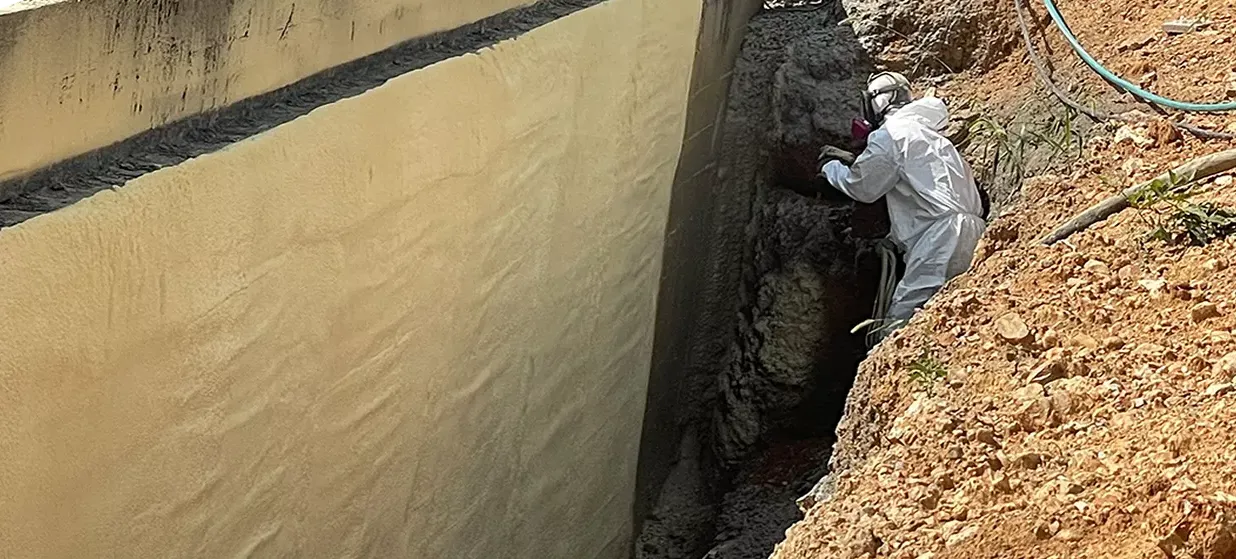
Yes. Polyurea is regularly specified as a retrofit. The foundation wall is excavated to expose the substrate, the surface is cleaned and prepared, and the membrane is spray-applied. On a 2025 deep-basement project in the Mid-Atlantic, HighLine 510h was applied at 80 mils over a poured concrete wall that was actively seeping at two cold joints; the wall showed zero moisture intrusion through the following winter, including two consecutive 100-year flood events.
Can I apply polyurea waterproofing myself?
No. Pure polyurea requires heated, high-pressure plural-component spray equipment and has a pot life of only 4–8 seconds, which leaves no margin for correcting application errors. Film thickness, surface preparation, and ambient conditions all have to be controlled. This is certified-applicator work, and we recommend having a trained ArmorThane applicator handle the installation.
How long does foundation waterproofing last?
A pure polyurea system such as ArmorThane HighLine 510h has an expected service life of 50+ years, compared with 5–15 years for asphalt-based coatings. Because polyurea stays flexible and retains 400% elongation (ASTM D412-C), it continues to bridge cracks caused by settlement and freeze-thaw cycling rather than becoming brittle and delaminating the way bituminous coatings do.
Do I need foundation waterproofing if I have a sump pump?
Yes. A sump pump is a water management device — it removes water only after it has already entered the building envelope. Waterproofing stops water at the source, on the outside face of the wall. The two are complementary rather than interchangeable: the membrane keeps water out, while the pump and drainage system handle groundwater collecting around the footing.
What is polyurea and why is it better for waterproofing than polyurethane?
Polyurea is formed by reacting an amine-terminated resin with an isocyanate, which produces a gel time measured in seconds and makes the coating insensitive to moisture and humidity during cure. Polyurethane uses a hydroxyl-terminated resin, cures more slowly, and is moisture-sensitive while curing, which can cause foaming or pinholing on damp concrete. Pure polyurea also offers substantially higher elongation, so it bridges movement that would tear a polyurethane film.
Is foundation waterproofing worth it?
In most cases, yes. Keeping water out of a foundation helps prevent mold, concrete deterioration, rusting reinforcement and damage to finished space, and it is far easier to do before leaks appear than after.
Can you waterproof a foundation from the inside?
Yes. Interior waterproofing uses sealers, coatings and drainage to control moisture and water that has already reached the wall. It does not stop water at the outside face the way an exterior membrane does, so the right choice depends on access and the severity of the problem.
Does spray foam waterproof a foundation?
Closed-cell spray foam resists water and can insulate a foundation wall, but it is not a substitute for a waterproofing membrane. Use a dedicated waterproofing system for liquid water, and add insulation on top if needed.
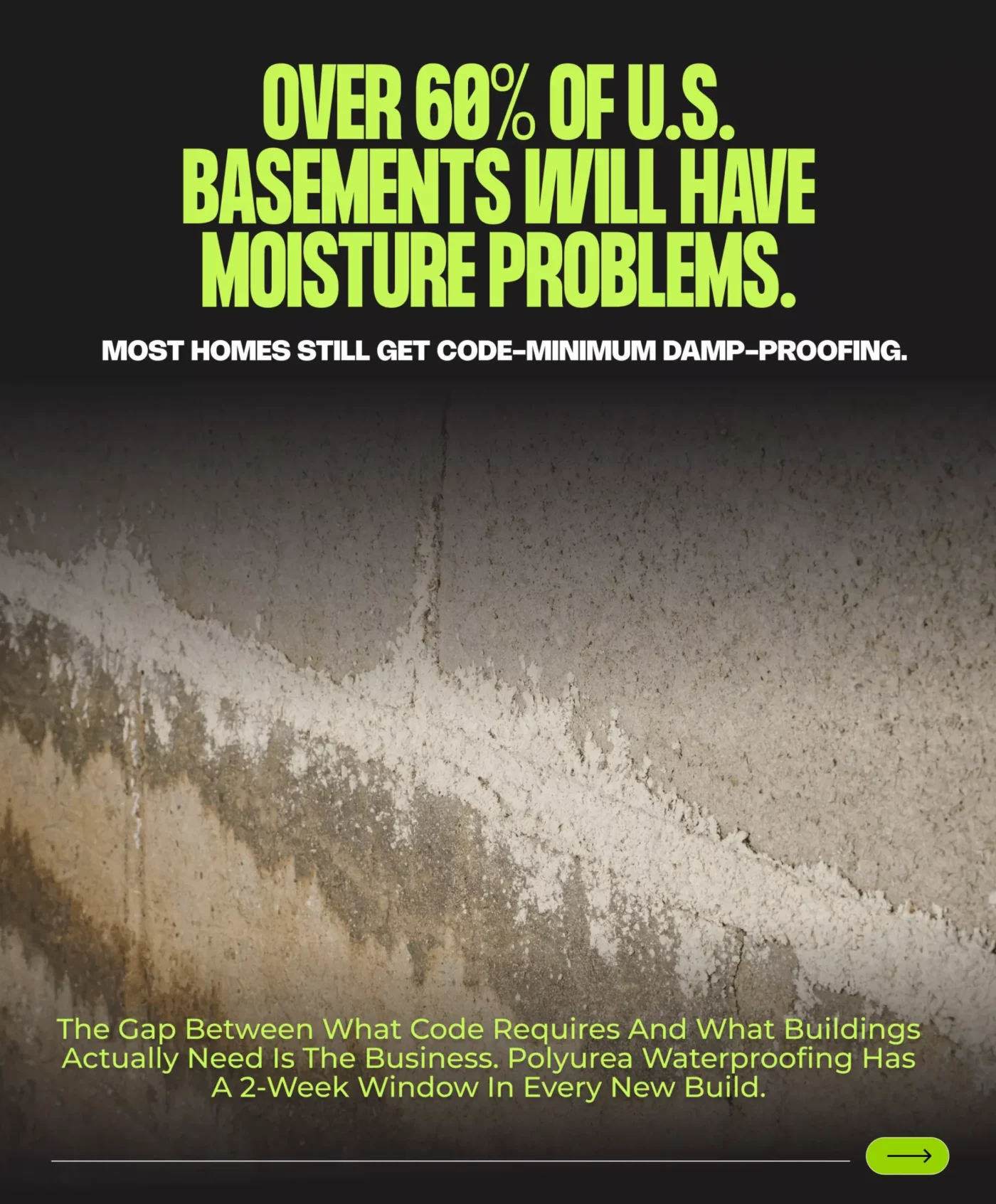
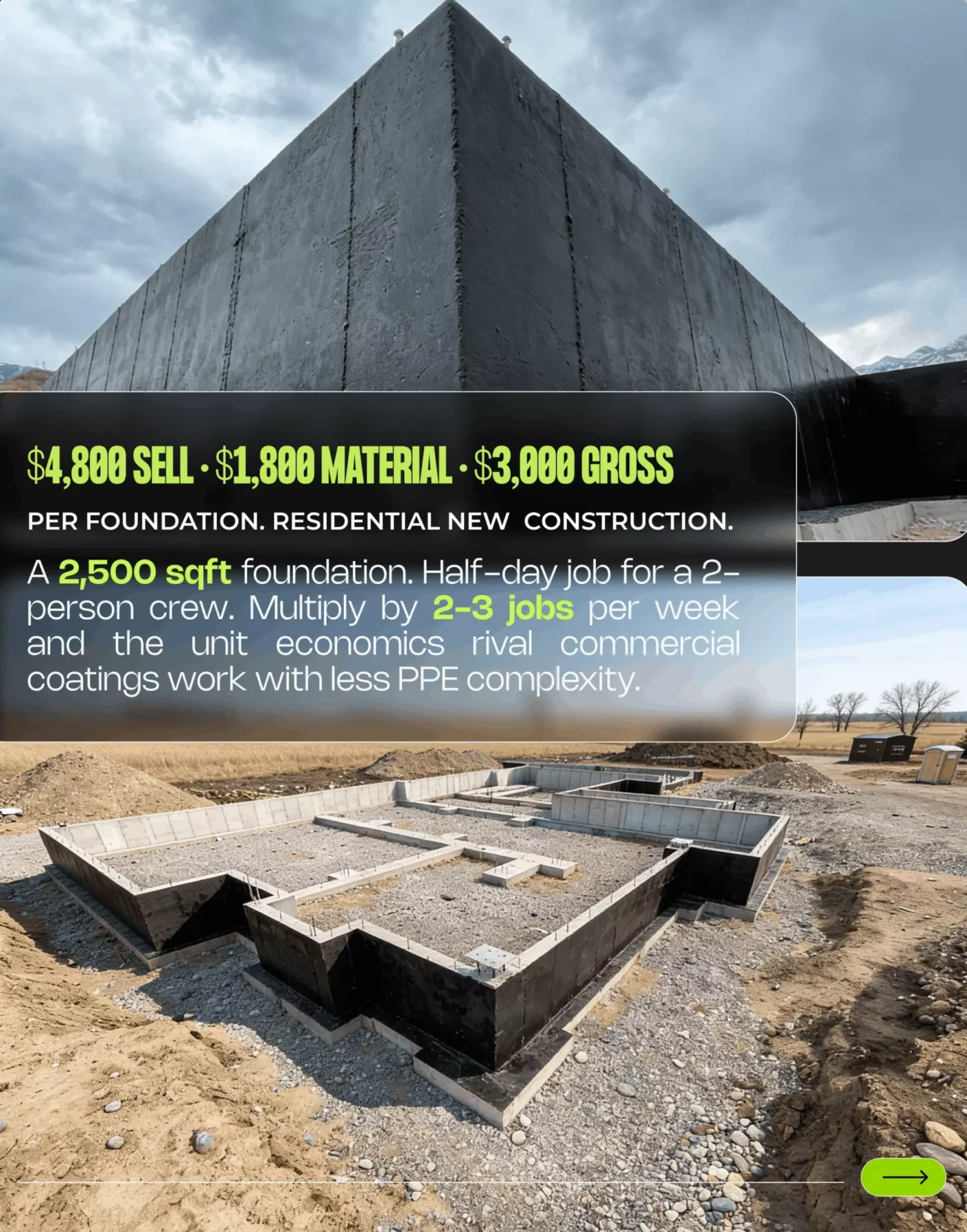
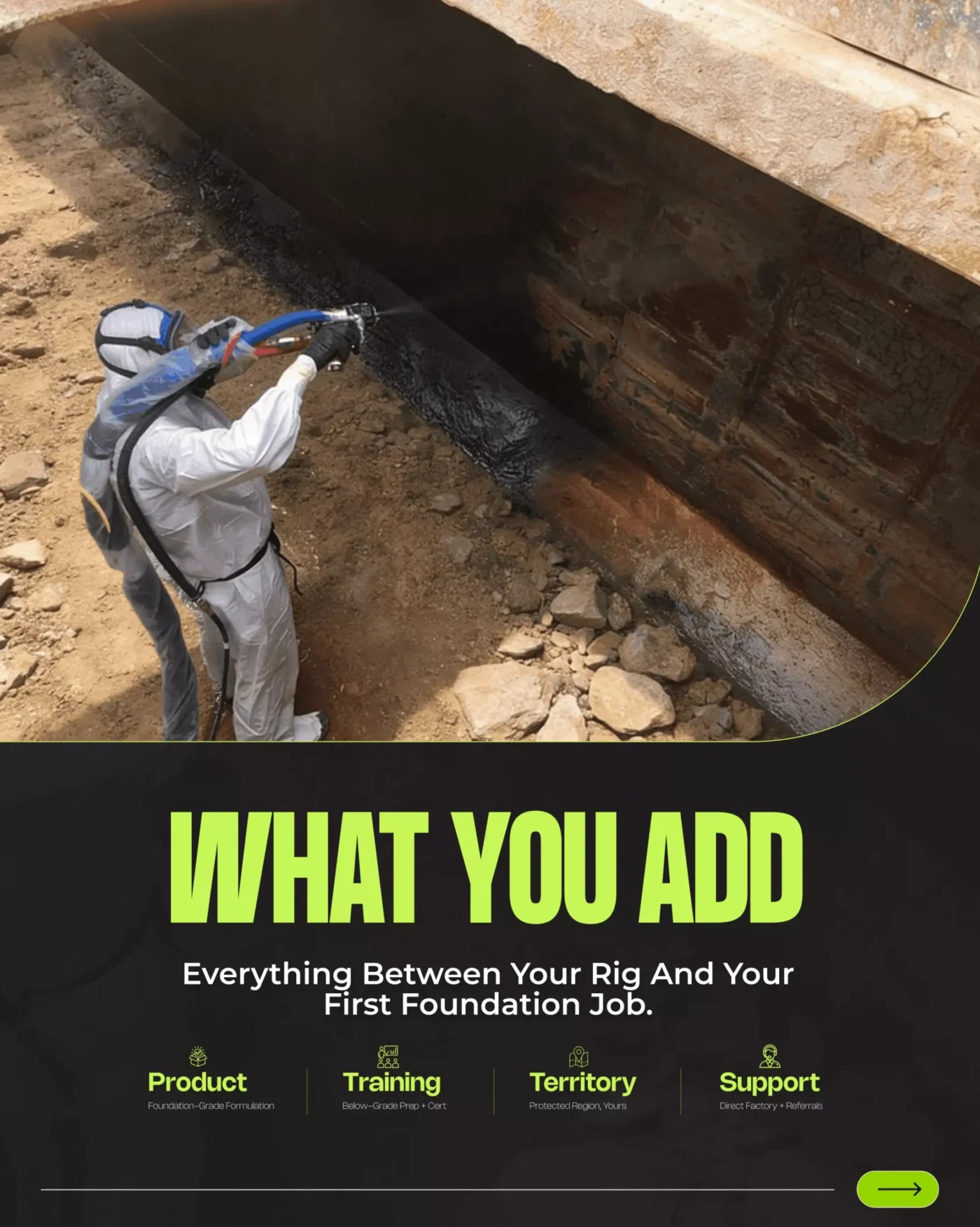
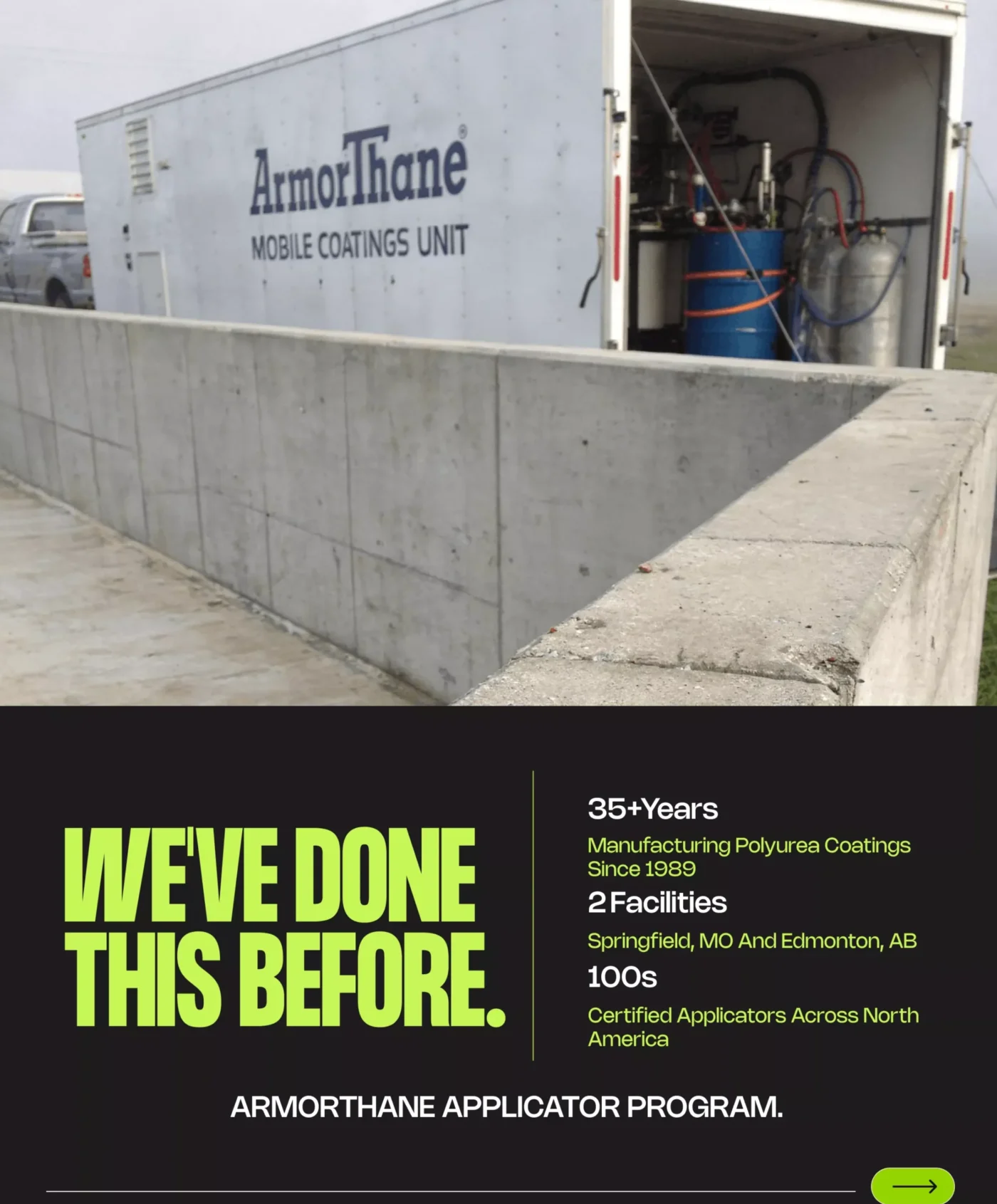
ArmorThane HighLine 510h In the Field
Pure polyurea foundation waterproofing applied by certified ArmorThane specialists worldwide.
Spray-Applied Polyurea - Sets Up Within Seconds
HighLine 510h bonds monolithically to concrete – no seams, no joints, no weak points. One coat delivers 60+ mil DFT of seamless waterproof protection.
Specify ArmorThane HighLine 510h on Your Next Foundation Project
From residential basements to commercial underground structures, ArmorThane’s pure polyurea waterproofing systems deliver 50+ years of proven protection with certified applicators across North America and worldwide. Talk to our engineering team about your specific waterproofing needs and project timeline.
50+
Year Lifespan
100%
Seamless Barrier
30s
Full Cure Time

About the author
Tyler Gleckler is a coatings specialist with deep field expertise in polyurea, polyaspartic, and high-performance protective systems. His writing appears regularly in Polyurea Magazine, the American Polyurea Organization, ArmorThane’s technical library, and a range of industry publications. He focuses on translating laboratory chemistry into specifications that engineers, owners, and applicators can actually deploy.
Foundation waterproofing vs damp-proofing
Damp-proofing is a thin, usually asphalt-based coating that slows moisture from soil but is not designed to stop water under pressure. Foundation waterproofing uses a continuous, flexible membrane that blocks liquid water even when the soil around the wall is saturated and bridges small cracks as the foundation moves. If your walls are below the water table or in poorly draining soil, damp-proofing alone is rarely enough.
Interior vs exterior foundation waterproofing
Exterior foundation waterproofing applies the membrane to the outside of the foundation wall, stopping water before it reaches the concrete. It requires excavation, so it is most practical on new construction or when the wall is already exposed.
Interior foundation waterproofing manages water that has already reached the wall using interior sealers, drainage channels and sump systems, or interior-applied coatings. It is less disruptive and a common choice for finished basements, and it works best as part of a complete moisture plan. For floors and slabs, see our basement floor coatings, and for the chemistry behind seamless membranes, read the polyurea guide.
What affects foundation waterproofing cost
Foundation waterproofing cost varies from project to project. The main factors are:
- Interior or exterior application, and whether excavation is needed
- Total wall area and foundation depth
- Condition of the concrete and the amount of crack or joint repair required
- Surface preparation and priming requirements
- Drainage work such as footing drains, drainage board or sump systems
- Membrane material and applied thickness
- Site access, soil conditions and local labor rates
An ArmorThane applicator can inspect your foundation and quote the work. Related project types include cistern liner solutions for below-grade water containment.
Signs your foundation needs waterproofing
- Damp spots, water stains or standing water on basement walls or floors
- Efflorescence (white, chalky mineral deposits) on the concrete
- A musty smell or visible mold and mildew
- Peeling paint, bubbling coatings or flaking concrete
- Cracks in foundation walls or floors that seep after rain
- Water entering at the wall-floor joint or around pipe penetrations
- Rusting metal or warped flooring in the lowest level
Wondering whether spray foam is waterproof? Closed-cell foam resists water, but it is an insulation product, not a replacement for a dedicated waterproofing membrane.