Intumescent Coating
Intumescent coating guide: how it works, thin-film vs. epoxy, UL 263 and UL 1709 ratings, W/D, coatings over spray foam, plus W/D and product selector tools.
Start a protective coatings business
Spray protective coatings for a living.
ArmorThane sets you up to do this work, and you own the business. We make the chemistry, build the rigs, train you hands-on and answer the phone when a job gets difficult. You pay no franchise fee and no royalties. It has been that way since 1989.




- $0
- franchise fees or royalties
- 35+
- years in business
- 50+
- countries with applicators
- 24/7
- technical support
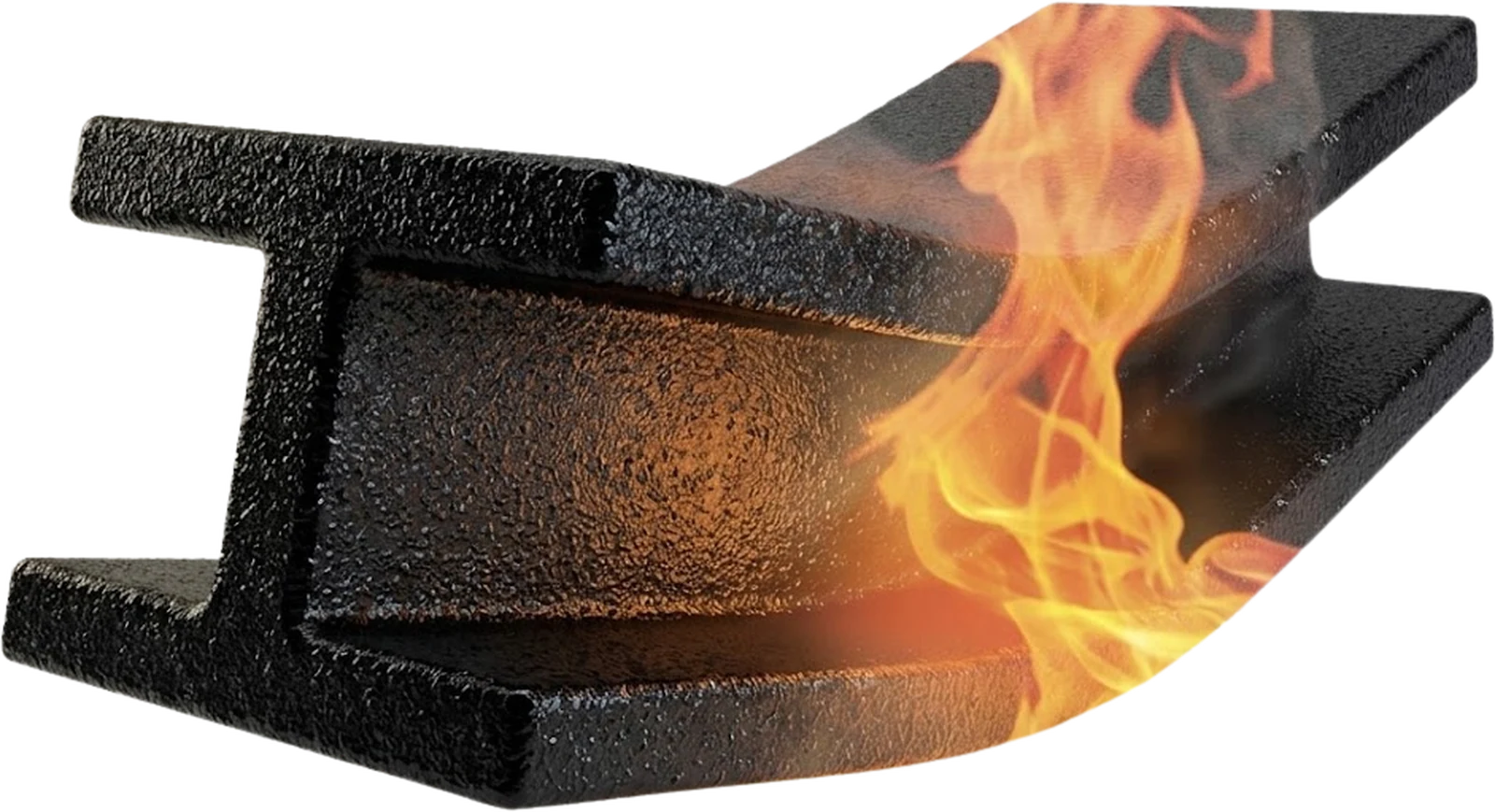
An intumescent coating is a paint-like fire protection layer that swells into a thick, insulating char when it gets hot. The same basic chemistry shows up in two very different jobs: protecting structural steel so it keeps carrying load during a fire, and protecting spray foam insulation as a code-listed thermal or ignition barrier. We do not manufacture intumescent coatings. We make spray foam and polyurea, and our applicators put listed intumescent coatings over foam every week and work next to fireproofing crews on steel buildings. This guide explains how intumescent coating works, the main types, the tests and ratings that matter, what drives thickness and cost, and where it is and is not the right answer. Two tools estimate steel W/D and coating quantity, and help you pick the right type.
Intumescent coating is a fire-resistive coating that expands when heated, typically starting around 200 to 250°C, to form an insulating char many times its original thickness. On structural steel, thin-film products expand about 50 times and are rated in fire tests such as UL 263 (ASTM E119) for building fires, while epoxy products tested to UL 1709 cover hydrocarbon fires in plants and refineries. Over spray foam, intumescent coatings serve as thermal or ignition barriers only at the thickness listed in an evaluation report for that exact foam.
How intumescent coating works
At normal temperatures an intumescent coating is a hard paint film. When a fire heats it, three ingredients react together: an acid source (commonly ammonium polyphosphate), a carbon source (commonly pentaerythritol) and a blowing agent (commonly melamine). The binder softens, the carbon source chars, and gas from the blowing agent puffs the char into a light, microporous foam. That char is a poor conductor of heat, so it slows the temperature rise of whatever is underneath.
- Thin-film coatings expand roughly 50 to 1, so about 1 mm of coating grows to around 50 mm of char, according to the Steel Construction Institute.
- Thick-film epoxy coatings expand much less, about 5 to 1, but are applied far thicker and produce a tough char that holds up to the turbulence of hydrocarbon fires.
- Activation typically begins around 200 to 250°C, well before steel loses meaningful strength.
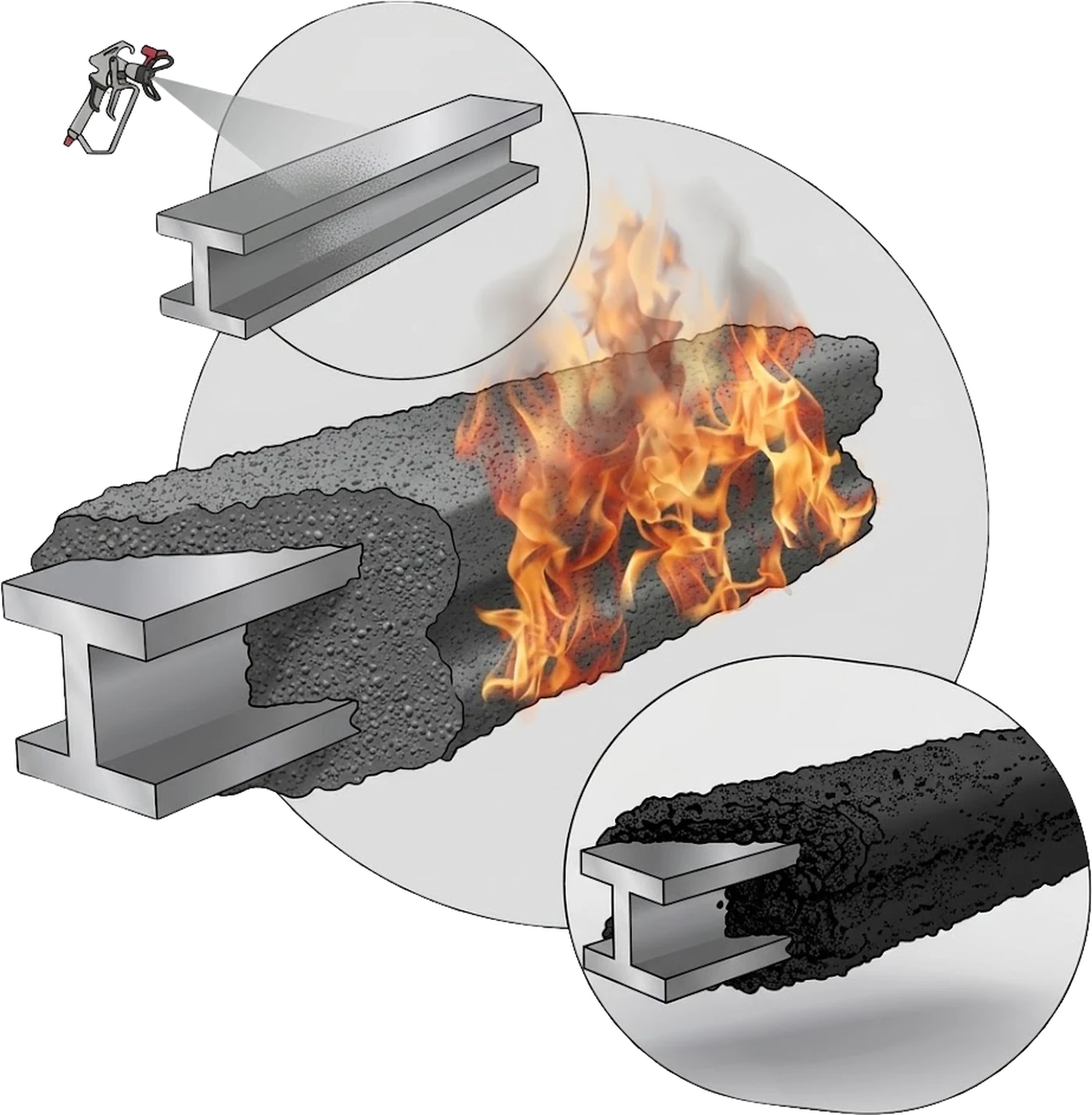
Two different jobs for intumescent coating
People searching for intumescent coating are usually after one of these, and the rules are completely different.
Fire-resistance rated steel
Keeps beams, columns and braces below their failure temperature for a rated period, such as 1, 2 or 3 hours. Thickness comes from a tested design listing (for example a UL design) and depends on the steel section, the rating and the exposure. Applied by specialty fireproofing contractors and inspected.
Thermal or ignition barrier over foam
Replaces drywall or other code materials over foam plastic insulation. Approval comes from room-corner fire tests such as NFPA 286 and AC377 Appendix X, documented in an evaluation report that names the foam. Our ignition barrier guide covers the code side in detail.
Refineries, LNG and petrochemical
Epoxy intumescents tested to UL 1709 for rapid-rise pool fires, and some for jet fires. They often double as corrosion protection in offshore and coastal plants.
Fire-retardant paints for wood
Coatings that lower the flame spread rating of wood or other surfaces in ASTM E84 testing. Useful, but they do not create an hourly fire-resistance rating on steel.
Intumescent coating types compared
The product families below cover nearly every intumescent coating you will see specified in North America. Volume solids and film ranges are examples from published product data; always use the data sheet and listing for the product on your job. Click a column heading to sort.
| Type | Main use | Expansion | Key fire test | Exposure | Example data |
|---|---|---|---|---|---|
| Thin-film, water-based | Exposed steel in buildings | About 50:1 | UL 263 / ASTM E119 | Interior, dry | Interchar 1120: 68% volume solids, 300–700 µm typical DFT |
| Thin-film, solvent-based | Steel in buildings, some exterior or humid areas | About 50:1 | UL 263 / ASTM E119 | Interior; exterior with topcoat per maker | See product data sheet |
| Thick-film epoxy | Petrochemical, offshore, hydrocarbon fire | About 5:1 | UL 1709 (hydrocarbon) | Exterior, harsh | Chartek 7: 100% volume solids, 0 g/L VOC |
| Coating over spray foam (thermal barrier alternative) | Foam facing occupied space | Product-specific | NFPA 286, per evaluation report | Interior | DC315: about 9–15 dry mils, by foam (ESR-3702) |
| Coating over spray foam (ignition barrier) | Service-only attics and crawl spaces | Product-specific | AC377 Appendix X, per evaluation report | Interior | DC315: about 3–4 dry mils, by foam (ESR-3702) |
Watch the char form
Drag the slider through a standard building fire and watch a paint-thin film swell into insulating char. Switch between a thin-film coating and a thick-film epoxy to see why the two families behave so differently on the same section.
as applied, before the fire
Illustration, not a design tool. Film and char are drawn schematically and exaggerated for clarity. Fire temperature follows the standard cellulosic curve used in ASTM E119 and UL 263; char thickness is simply the dry film multiplied by the published expansion ratio, about 50:1 for thin-film and about 5:1 for thick-film epoxy. The thickness for a real member comes from the tested design for its W/D and required rating, not from this graphic.
Fire ratings, tests and the W/D ratio
For steel, the building code sets how many hours of fire resistance each element needs, based on construction type. Under IBC Table 601, the primary structural frame needs 3 hours in Type IA construction, 2 hours in Type IB, 1 hour in Types IIA, IIIA and VA, and no rating in Types IIB, IIIB and VB, with footnotes that adjust some cases such as roof framing. Type IV heavy timber has its own rules.
The rating is earned in a furnace test. ASTM E119, also published as UL 263, exposes loaded or restrained assemblies to a standard building fire curve and measures heat transmission, hot gas passage and load-carrying ability. UL 1709 uses a much faster temperature rise to represent hydrocarbon pool fires. ASTM notes that E119 results describe performance under the test conditions only, and that the test does not measure smoke, toxic gases or flame spread.
Why W/D drives thickness
A heavy steel section with a small heated perimeter heats slowly; a light, thin section with a large perimeter heats fast. North American fire designs express this as W/D: weight per foot (lb/ft) divided by the heated perimeter (inches). The higher the W/D, the less intumescent coating a given rating needs. The UK and Europe use the inverse idea, the section factor. Each tested design lists coating thickness against W/D for each rating, so two beams on the same floor can need very different film builds.
Steel W/D and intumescent quantity calculator
Pick a wide-flange shape or enter your own dimensions, choose 3-sided (beam under a deck) or 4-sided (column) exposure, and enter the dry film thickness from the fire design. The calculator gives W/D, the surface area to coat and the gallons of material.
W/D, surface area and gallons
Heated perimeter for contour-applied coating on a W-shape: 4 sides = 4bf + 2d - 2tw; 3 sides = 3bf + 2d - 2tw. W/D = weight (lb/ft) / perimeter (in). Gallons = area x DFT (mils) / (1,604 x volume solids), plus waste. Default 68% volume solids is Interchar 1120's published figure; use your product's. Shape dimensions from the AISC shapes database.
Which intumescent coating? Type selector
Tell us what you are protecting, where it lives and what kind of fire you are designing for. The selector points you to the product family, the test standard to ask for and the questions to put to your supplier.
Match the coating to the job
Logic follows the test standards behind each product family: UL 263 / ASTM E119 for building fires, UL 1709 for hydrocarbon fires, and NFPA 286 or AC377 Appendix X for coatings over foam plastic insulation.
Applying and inspecting intumescent coating
Intumescent coatings fail in the field for the same reasons most coatings fail: bad prep, the wrong primer, poor film build and the wrong environment. The difference is that a thin intumescent does not show its failure until there is a fire.
-
Confirm the listing first
For steel, get the fire design number and the thickness table for each member's W/D. For foam, get the evaluation report and confirm it names the foam and the foam thickness on the job.
-
Prepare and prime as listed
Steel needs the surface prep and a primer that the intumescent manufacturer lists as compatible. Primers outside the listing can cause delamination in a fire. Foam needs to be clean, dry, fully cured and free of dust.
-
Watch temperature and humidity
Water-based products dry slowly in cold, damp air and can sag or blister when built too fast. Follow the data sheet limits for surface temperature, dew point and recoat times.
-
Build and measure film
Apply in the passes the manufacturer specifies, check wet film as you go and verify dry film on steel with a calibrated gauge. Record readings by member or area.
-
Topcoat when required
Exterior and humid exposures usually need a listed topcoat. Do not substitute a decorative paint the listing does not name.
-
Protect it from damage
Trades that follow will hang hangers, weld clips and scrape coating off steel. Any damage has to be repaired to the listed thickness before the work is closed in.
For corrosion protection on steel that is not fire rated, see our corrosion prevention coatings and the metal coating guide. For foam jobs, our closed-cell spray foam guide covers where coatings go on, and the metal building insulation guide covers foam on steel buildings.
Spray foam with the right intumescent barrier.
Certified ArmorThane applicators spray foam and apply listed thermal and ignition barrier coatings as one documented job.
Contractors: become an applicator →
Intumescent coating questions
What is intumescent coating?
Intumescent coating is a fire-resistive coating that swells when heated, typically starting around 200 to 250°C, into a thick insulating char. The char slows heat transfer to the steel, foam or other material underneath. Thin-film products expand about 50 times their original thickness.
How long does intumescent paint protect steel?
As long as the tested design it is applied to: commonly 1 or 2 hours, and 3 hours for some products and designs. The Steel Construction Institute notes thin-film intumescents are mainly used for 30, 60 and 90 minute ratings, with newer products reaching 120 minutes. The thickness needed depends on the rating, the section's W/D and the specific listing.
Is intumescent coating the same as fire-retardant paint?
No. Fire-retardant paints are generally used to lower the flame spread rating of wood and other surfaces in ASTM E84 testing. Intumescent fireproofing on steel is tested in furnace tests such as UL 263 or UL 1709 to earn an hourly fire-resistance rating. Some products do both, but you need the listing for the job you are doing.
Can intumescent coating be used outdoors?
Some can. Thick-film epoxy intumescents are built for exterior and harsh environments. Many thin-film water-based products are interior-only, and some intumescent materials lose performance with humidity and weathering. Exterior use requires a product and topcoat listed for that exposure.
Can intumescent coating replace drywall over spray foam?
Yes, when the coating has an evaluation report that lists it as a thermal barrier alternative over the specific foam you sprayed, at the listed thickness. ESR-3702 for DC315, for example, lists roughly 9 to 15 dry mils depending on the foam. Without that listing, drywall or another code material is required.
How thick is intumescent coating on steel?
It ranges widely. One published water-based product lists a typical dry film of 300 to 700 microns, about 12 to 28 mils, while epoxy hydrocarbon systems are much thicker. The required thickness for each member comes from the fire design's table for that member's W/D and rating.
Does ArmorThane make intumescent coatings?
No. We manufacture spray foam, polyurea, polyurethane and polyaspartic coatings. Our applicators use listed intumescent coatings from other manufacturers as thermal and ignition barriers over foam, and we are honest that polyurea is not a substitute for fireproofing.
Do I need to remove old fireproofing before applying intumescent?
That depends on the listing and the condition of the old material. In older buildings, sprayed fireproofing may contain asbestos, so have it tested by an accredited inspector before anyone disturbs it, and plan any removal with a licensed abatement contractor.
Sources
- Steel Construction Institute, fire protecting structural steelwork: steelconstruction.info/Fire_protecting_structural_steelwork
- ASTM E119-22, standard test methods for fire tests of building construction and materials: store.astm.org/e0119-22.html
- ICC, 2021 International Building Code, Chapter 6 Types of Construction (Table 601): codes.iccsafe.org/content/IBC2021P2/chapter-6-types-of-construction
- ICC-ES, ESR-3702 DC315 Intumescent Coating: icc-es.org/wp-content/uploads/report-directory/ESR-3702.pdf
- AkzoNobel International, Interchar 1120 product page: international-pc.com/products/interchar-1120
- AkzoNobel International, Chartek 7 product page: international-pc.com/products/chartek-7
- Intumescent (overview of char chemistry and limitations): en.wikipedia.org/wiki/Intumescent
- US EPA, actions to protect the public from exposure to asbestos (1973 spray-applied ban): epa.gov/asbestos/epa-actions-protect-public-exposure-asbestos
Start your own coatings business.
Equipment, chemicals, hands-on training and technical support for life, all from one manufacturer that puts its applicators first.
Need a job done?
Tell us where the project is and we’ll connect you with a certified ArmorThane applicator near you.