Ice Dam Prevention: Fix the Attic, Not the Icicles
Why ice dams form, the air sealing, insulation and ventilation that stop them, what heat cables and chipping really do, and two tools to check your attic.
Start a protective coatings business
Spray protective coatings for a living.
ArmorThane sets you up to do this work, and you own the business. We make the chemistry, build the rigs, train you hands-on and answer the phone when a job gets difficult. You pay no franchise fee and no royalties. It has been that way since 1989.




- $0
- franchise fees or royalties
- 35+
- years in business
- 50+
- countries with applicators
- 24/7
- technical support
Ice dam prevention is about one thing: keeping the roof deck above the attic cold enough that snow does not melt on the upper roof and refreeze at the eaves. That means stopping warm house air from leaking into the attic, adding enough insulation, and venting out whatever heat still gets through. Heat cables, salt pucks and roof rakes treat symptoms. We manufacture the closed-cell spray foam our certified applicators use to air-seal and insulate attics and roof decks, and this guide explains how ice dams form, which fixes stop them and which do not, and two tools: an attic insulation gap checker and an ice dam risk and ventilation calculator.
Seal the air leaks from the house into the attic first (top plates, light fixtures, plumbing and duct chases, the attic hatch, bath fans), then bring attic insulation up to the ENERGY STAR level for your climate zone (R-49 to R-60 in most snow country), and make sure soffit and ridge vents provide at least the code minimum vent area with clear air channels at the eaves. Install an ice barrier membrane at the eaves when you re-roof. Use a roof rake to pull snow off the lower few feet of roof during big storms. Avoid chipping ice, and treat heat cables as a last resort for spots you cannot fix.
How ice dams form
Three things have to be true at once: snow on the roof, a warm upper roof above 32°F, and a cold lower roof at or below freezing. Snow melts on the warm section, the water runs down to the eave overhang, which sits outside the heated house and stays as cold as the outdoor air, and it refreezes. Each day the ridge of ice at the eave gets taller, water ponds behind it, and that water backs up under the shingles. Shingles shed water running downhill; they are not made to hold back a pond.
Building scientist John Straube describes the cause as part of a roof getting warm enough to melt the snow above it, with the meltwater refreezing when it reaches a cold surface. The heat comes from the house. In his digest on ice dams, he identifies warm air leaking through the ceiling into the attic, and leaking ductwork in the attic, as the most common and most damaging problem, because that air bypasses the insulation entirely.
Sun plays a part too. InterNACHI notes sunlight can pass through 6 inches of snow and cause melting on a clear day even at 14°F. That is why ice dams sometimes form on unheated garages, and why fixing the attic reduces ice dams but cannot promise zero in every storm.
Ice dam prevention, step by step
Do these in order. Each step makes the next one cheaper and more effective, and the first one does the most for the least money.
Seal the attic floor
Find and seal every path warm air takes into the attic: gaps at top plates, wiring and plumbing holes, recessed lights, chimney and flue chases (with fire-rated materials), duct boots, the attic hatch and bath fan housings. Straube's digest calls air leakage the most common and most damaging cause. Move or seal any ductwork running through the attic, and vent bath and kitchen fans outdoors, not into the attic.
Add insulation
Bring the attic floor up to ENERGY STAR's recommended level: R-30 in zone 1, R-49 in zones 2 and 3, and R-60 in zones 4 through 8 for an uninsulated attic. Straube sets R-30 as the minimum below a ventilated attic for ice dam control, with more in very cold climates. Pay attention to the eaves, where the roof is low and insulation is often thin.
Ventilate the attic properly
The IRC requires net free vent area of at least 1/150 of the attic floor, or 1/300 when a Class I or II vapor retarder is installed on the warm side in zones 6 to 8 and 40 to 50 percent of the vents are high, within 3 feet of the ridge. Install baffles so insulation does not block the soffit vents. Ventilation finishes the job; Straube notes it cannot remove a lot of heat on its own.
Fix cathedral ceilings and complex roofs
Vaulted ceilings, dormers and valleys are where most stubborn ice dams live, because there is little room for insulation and air. InterNACHI recommends at least a 3 inch air space between insulation and sheathing in vented sloped ceilings. Straube recommends R-35 under ventilated cathedral ceilings and R-40 under unventilated ones. Closed-cell spray foam is often the only way to get there in a shallow rafter bay.
Protect the eaves when you re-roof
In areas with a history of ice forming at the eaves, the IRC requires an ice barrier membrane from the edge of the roof to at least 24 inches inside the exterior wall line. It does not prevent ice dams, but it keeps backed-up water out of the house when one forms.
Manage the snow
After heavy snowfall, pull snow off the lower few feet of roof with a roof rake from the ground. No snow at the eave, no meltwater to freeze there.
Attic insulation gap checker
Measure the depth of insulation in your attic in a few spots, including near the eaves, and enter the lowest typical reading. The checker converts it to an R-value range, compares it to ENERGY STAR's target for your climate zone and Straube's ice dam minimum, and tells you how much to add.
Is my attic insulation enough to stop ice dams?
R per inch from the ColoradoENERGY table (loose fiberglass 2.20–4.30, cellulose 3.60–3.70, rock wool 3.10–4.00, batts 3.14–4.30, vermiculite 2.13) and SPFA (closed-cell foam 5.7). Inches to add use the low end of the range.
Ice dam prevention methods compared
Only the first four rows change the conditions that create ice dams. The rest limit damage or remove ice after it forms. Effectiveness is our technical team's rating; costs are 2026 HomeGuide figures where one exists. Click a heading to sort.
| Method | Fixes the cause? | Effectiveness (1–5) | Typical cost | Drawbacks |
|---|---|---|---|---|
| Air sealing the attic floor | Yes | 5 | Varies with access | Fire-rated materials needed at chimneys and flues |
| Closed-cell foam at roof deck | Yes | 5 | Varies with thickness | Must meet code R-value and fire protection rules |
| Adding attic insulation | Yes | 4 | Varies with depth | Do it after air sealing; keep soffit vents clear |
| Attic ventilation | Partly | 3 | Varies | Cannot remove much heat on its own |
| Ice barrier membrane at eaves | Limits damage | 3 | Part of re-roofing | Only installed when the roof is replaced |
| Roof rake | No | 2 | Low | Work in every storm; can scuff shingles |
| Heat cables | No | 2 | Varies | Energy use, shingle damage, fire risk |
| Salt or calcium chloride tablets | No | 1 | $200–$300 | Melts a channel, not the dam |
| Steam removal | No | 1 | $800–$2,400 | Removes the ice; the cause remains |
| Chipping or hammering ice | No | 0 | $800–$1,800 | Damages shingles and gutters; injury risk |
Ice dam risk and attic ventilation calculator
On a cold day with snow on the roof, put a thermometer in the attic near the underside of the roof deck, halfway up the slope, and note the outdoor temperature. A cold attic tracks outdoor temperature closely; a warm one means heat is leaking in. Then enter your attic floor area to check your ventilation against the code minimum.
Is my attic warm enough to build ice dams?
Risk uses Hansen's thresholds (under-roof above 30°F with outdoor below 22°F) and the basic melt condition (roof above 32°F with outdoor at or below freezing). Vent area = attic floor / 150, or / 300 when both IRC R806.2 conditions are met.
Where spray foam fits in ice dam prevention
For most houses with an open, walkable attic, the cheapest effective fix is air sealing plus blown insulation. We say that even though we sell spray foam. Foam earns its place where blown insulation cannot do the job:
Cathedral ceilings and knee walls
Shallow rafter bays cannot hold R-35 to R-40 of fiberglass and still vent. Closed-cell foam, starting at R-5.7 per inch, gets more R-value into the space and air-seals at the same time.
Air sealing the attic floor
A thin layer of closed-cell foam over top plates and penetrations seals the leaks that drive ice dams, before blown insulation goes on top. It is the most labor-efficient way to seal a large, leaky attic.
Unvented roof decks
Foam applied under the roof deck brings the attic inside the thermal envelope, so ducts and equipment up there stop leaking heat into a cold attic. It must meet code R-values for an unvented roof assembly.
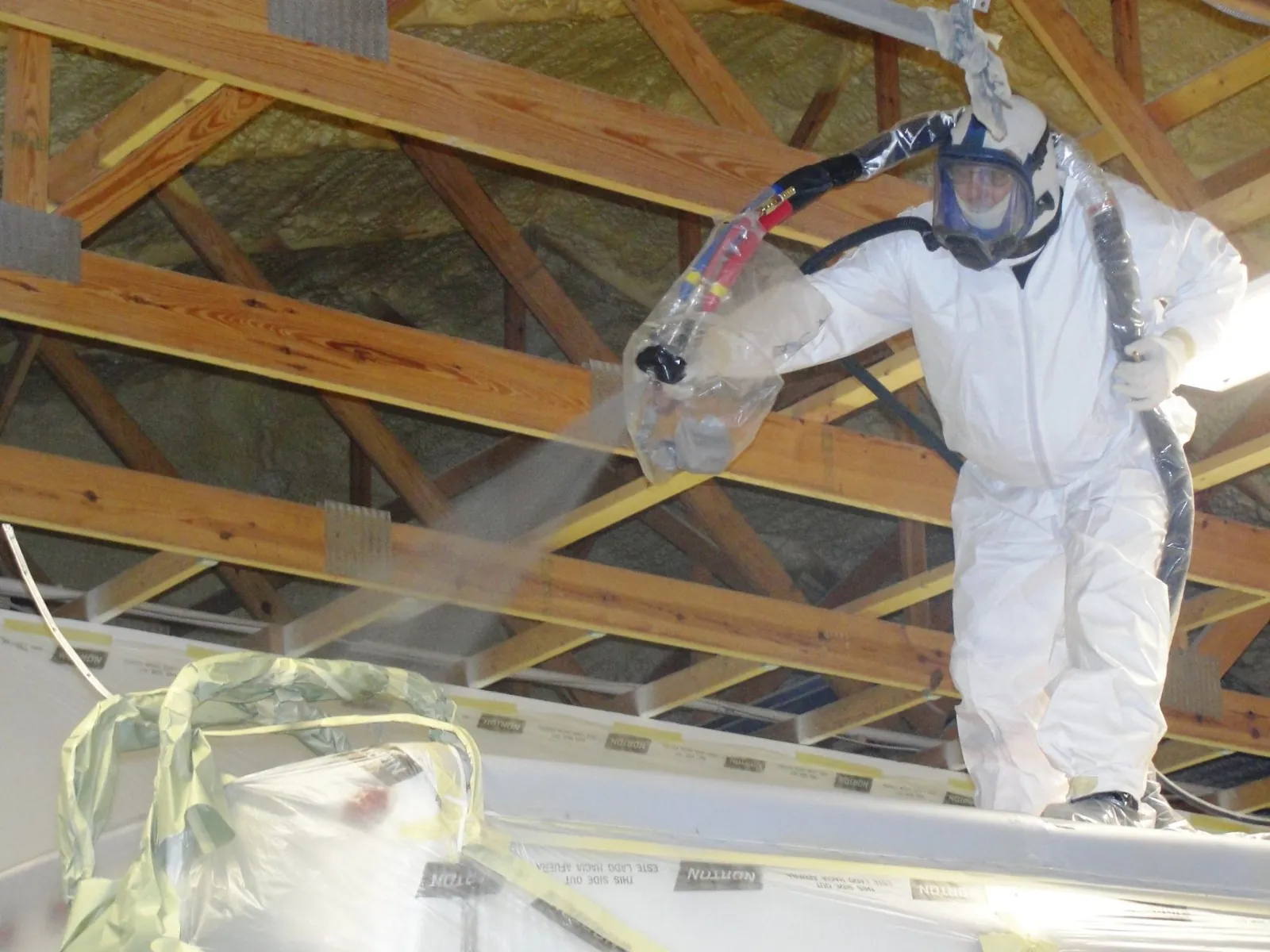
Our certified applicators install closed-cell spray foam and attic foam insulation. For pricing and R-values see attic insulation cost and the spray foam R-value guide. Foam also needs the code-required thermal or ignition barrier for the space it is in.
Fix the attic, not the icicles.
A certified ArmorThane applicator can find the air leaks, seal them and insulate the attic or roof deck to the level your climate needs.
Contractors: become an applicator →
If you already have an ice dam
Get the snow off the lower roof
Use a roof rake from the ground to clear the bottom few feet of roof above the dam. Less snow means less meltwater feeding it.
Open a drain channel if water is coming in
A calcium chloride tablet or sock laid across the dam can melt a channel for trapped water. It does not remove the dam.
Hire steam, not hammers
Professional ice dam steamers run at about 290°F and remove ice without cutting shingles; HomeGuide puts it at $800 to $2,400. Chipping and hammering damage shingles and gutters.
Dry out the interior
Wet insulation and drywall at the top of exterior walls need to dry or be replaced. HomeGuide puts ice dam repair and restoration at $1,500 to $5,000 or more.
Fix the cause before next winter
Ice dams come back every year until the air leaks and insulation are fixed.
Ice and meltwater also cause trouble on flat and metal roofs. See commercial roof leak repair, metal roof leak repair and metal roof condensation.
Ice dam prevention questions
What is the best way to prevent ice dams?
Stop heat from reaching the roof deck. Seal the air leaks from the house into the attic, bring attic insulation up to the ENERGY STAR level for your climate zone, and ventilate the attic to at least the code minimum. Those three steps keep the roof cold enough that snow does not melt and refreeze at the eaves.
Do heat cables prevent ice dams?
They can keep a channel open for meltwater, but they do not fix the cause. InterNACHI says they rarely work, and published guidance notes they use energy, can damage asphalt shingles and present a fire risk. Use them only for spots you cannot fix with air sealing and insulation.
How much attic insulation do I need to stop ice dams?
ENERGY STAR recommends R-49 for an uninsulated attic in zones 2 and 3 and R-60 in zones 4 through 8. Building scientist John Straube sets R-30 as the minimum under a ventilated attic for ice dam control, with more in very cold climates. Insulation only works fully once the air leaks are sealed.
Does attic ventilation stop ice dams?
It helps carry away heat that gets into the attic, but Straube notes ventilation cannot remove a lot of heat. It is the last step after air sealing and insulation, not a substitute for them.
Is ice and water shield required?
Where there is a history of ice forming at the eaves, the IRC requires an ice barrier membrane extending from the roof edge to at least 24 inches inside the exterior wall line. Local codes can require more. It limits leaks when a dam forms; it does not stop dams forming.
Should I chip ice dams off my roof?
No. Chipping and hammering damage shingles and gutters and put you on a slippery ladder. Rake snow off the lower roof from the ground, use calcium chloride to open a drain channel, or hire a steaming service.
Can spray foam prevent ice dams?
Yes, when it is used to air-seal the attic floor or to insulate the roof deck to the required R-value. It is especially useful in cathedral ceilings and complex roofs where blown insulation does not fit. In an ordinary open attic, air sealing plus blown insulation is usually the more economical fix.
Sources
- John Straube, BSD-135: Ice Dams, Building Science Corporation: buildingscience.com/documents/digests/bsd-135-ice-dams
- ENERGY STAR, Recommended Home Insulation R-Values: energystar.gov insulation R-values
- InterNACHI, Ice Dams: nachi.org/ice-dams.htm
- Wikipedia, Ice dam (roof), citing Hansen (2000) and Fisette: en.wikipedia.org/wiki/Ice_dam_(roof)
- Building Code Trainer, How to Calculate Roof Ventilation (IRC R806.2): buildingcodetrainer.com/how-to-calculate-roof-ventilation
- International Code Council, 2021 IRC Chapter 9, R905.1.2 Ice barriers: codes.iccsafe.org IRC 2021 chapter 9
- HomeGuide, Ice Dam Removal Cost (2026): homeguide.com/costs/ice-dam-removal-cost
- HomeGuide, Roof Leak Repair Cost (2026): homeguide.com/costs/roof-leak-repair-cost
- ColoradoENERGY, R-Value Table: coloradoenergy.org/procorner/stuff/r-values.htm
- Spray Polyurethane Foam Alliance, R-Values and Performance: whysprayfoam.org/new-construction/r-values-and-performance
- US EPA, Protect Your Family from Exposures to Asbestos: epa.gov/asbestos/protect-your-family-exposures-asbestos
Cold roof, warm house.
Homeowners get a certified ArmorThane applicator who air-seals and insulates attics and roof decks to stop ice dams at the source. Contractors can add spray foam with no franchise fee and no royalties.
Start your coatings business with ArmorThane.
Tell us what you want to spray and where you are. An ArmorThane specialist will walk you through the equipment, chemicals, training and startup cost for the work you want to do.
- Equipment package matched to your applications
- Hands-on training and applicator certification
- Technical support once you are spraying
Ice dams every winter? Stop the heat that causes them.
Tell us about your home, the roof shape, what insulation is in the attic now and where the ice dams form. We will connect you with a certified applicator near you.
- Home size and roof shape
- Where the ice dams form
- Current attic insulation
- Cathedral ceilings or dormers