Attic Insulation Cost: Blown-In vs Spray Foam
What an attic really costs per R-value, from manufacturer coverage charts and 2026 price data. We make spray foam, and we’ll still show you when blown-in on the floor is the smarter buy.
Spray foam for a living.
ArmorThane is the one-stop shop for applicators. We make the chemistry, build the equipment, train you hands-on and back you with technical support, with no franchise fees and no royalties. Applicators have come first here since 1989.
- $0franchise fees or royalties
- 35+years in business
- 50+countries with applicators
- 24/7technical support
Attic insulation is the cheapest energy upgrade most houses will ever get, and it's also where quotes vary the most. One contractor says $1,400. Another says $9,000. They're usually not pricing the same job.
Most homeowners pay $1,700–$2,500 to insulate an attic, or about $1–$3 per square foot (HomeAdvisor and Angi, 2026). The cheapest way to add R-value is blown-in fiberglass or cellulose on the attic floor: HomeGuide prices 1,000 sq ft at R-60 at $1,400–$2,400, which works out to roughly 2–4 cents per square foot for every R-point. Spray foam under the roof deck usually costs three times as much or more for the same attic, and it earns that price mainly when ducts or an air handler live up there. Price your attic or count the bags.
The missing number in almost every attic insulation price guide is depth. "$1.50 a square foot" means nothing until you know whether that buys R-19 or R-60, and whether the old insulation stays, gets topped up or gets vacuumed out first. So this guide prices attic insulation per R-value, from manufacturer coverage charts and dated published rates, and shows the math.
A word about who's writing. We make ArmorFoam spray foam in Springfield, Missouri, and we've supported spray foam applicators for 35 years. Even so, the honest answer for an empty, vented attic is usually a blowing machine, not a spray rig. We'll show you exactly where that flips.
- 1Attic insulation cost calculator
- 22026 prices and cost by attic size
- 3Cost per square foot by type (and per R)
- 4Blown-in insulation: bags, depth, DIY
- 5How much insulation you need
- 6Spray foam attic cost: deck vs floor
- 7Floor or roof deck? (decision tool)
- 8Extra costs quotes leave out
- 9Is it worth it? Payback and 2026 incentives
- 10What a good quote includes
- 11When spray foam is the right call
- 12Attic insulation cost FAQ
Attic insulation cost calculator
Enter the attic's footprint and what's up there now. The calculator works out how much R-value you need to add for your climate zone, then prices every realistic way of getting there side by side: blown-in fiberglass, blown-in cellulose, flash-and-fill, open-cell foam on the floor, and open- or closed-cell spray foam on the roof deck.
What will it cost to bring my attic up to code?
Installed prices from 2025–2026 published rates. Not sure of your climate zone? Most of the Gulf Coast and Florida is 1–2, the Southeast 3, the Midwest and Mid-Atlantic 4–5, the northern tier 6–7.
| Method | Where | Final R | What’s installed | Installed range | $/sq ft per R added | Air barrier | Ducts inside |
|---|---|---|---|---|---|---|---|
| Blown-in fiberglass or cellulose Best value | Floor, 1,500 sq ft | R-60 | Add 17.3 in fiberglass or 13.6 in cellulose (settled) | $2,000–$3,900 | $0.039 | With air sealing | No |
| Flash-and-fill | Floor | R-60 | 1 in closed-cell (1,500 bf), then 18.4 in blown fiberglass; old insulation removed | $4,870–$9,540 | $0.080 | Yes | No |
| Open-cell spray foam on the floor | Floor | R-60 | 16.2 in of foam (24,324 bf); old insulation removed | $12,200–$20,760 | $0.184 | Yes | No |
| Open-cell spray foam on the roof deck | Deck + gables, 1,902 sq ft | R-22.2 | 6 in (11,412 bf); floor insulation removed | $6,520–$11,330 | $0.270 | Yes | Yes |
| Closed-cell spray foam on the roof deck | Deck + gables, 1,902 sq ft | R-19.5 | 3 in (5,706 bf); floor insulation removed | $7,210–$15,100 | $0.381 | Yes | Yes |
Deck area is 1,902 sq ft vs 1,500 sq ft of floor (pitch factor 1.118 plus 225 sq ft of gable ends). Roof-deck foam at 6 in open-cell reaches R-22.2, well under the R-60 target; foam decks are usually approved through the performance path, so ask which one your quote assumes. Blown-in includes 50 eave baffles and attic-floor air sealing. Not included: ignition barrier, sealing roof vents for an unvented attic, electrical or duct work.
Want a roof-deck foam price? Find an ArmorThane-certified applicator.
How we calculated this: existing R = depth x R per inch (batts 3.1, old blown fiberglass 2.5, cellulose 3.6, rock wool 3.1, vermiculite 2.13); R to add = target − existing. Blown-in = floor area x R added x $0.022 / $0.031 / $0.040 (low / typical / high, derived from HomeGuide's 2025 per-R price table), plus air sealing at $250 / $500 / $750 (Angi, 2026) and one baffle per 2 ft of eave at $2–$3 (HomeGuide). Spray foam = square feet x inches x $0.44–$0.73 per board foot open-cell or $1.00–$2.12 closed-cell (our 2026 median bands). Roof deck area = floor area x √(1 + (pitch/12)²), plus both gable triangles on a gable roof. Removal at $1–$2 per sq ft (HomeGuide). Estimates, not quotes.
How much does attic insulation cost in 2026?
Published national averages cluster around $1,800–$2,500 per attic, with most jobs between $1,700 and $2,500 and a square-foot range of $1 to $3. The two newest data sets, HomeAdvisor's and Angi's (both 2026), put the average at $2,100. Older guides that quote $1 to $7 per square foot are mixing spray foam and SIPs into the same number.
| Source (updated) | Average | Typical range | Per sq ft |
|---|---|---|---|
| HomeAdvisor (Jun 2026) | $2,100 | $1,700–$2,500 | $1–$3 |
| Angi (Jul 2026) | $2,100 | $1,700–$2,500 | $1–$3 |
| HomeGuide (Jan 2026) | $1,800 | $1,000–$2,700 (low $500, high $6,000) | $1–$4 |
| Forbes Home (Feb 2025) | ≈$1,500–$2,500 | $1,500–$3,500 | $1–$7 |
| Bob Vila (Oct 2023) | $2,500 | $1,500–$3,500 | $1–$7 |
| Fixr (Sep 2022) | $2,500 | $2,000–$3,250 | $1–$7 (typical $2–$3.25) |
Attic insulation cost by attic size
Here are the published size tables next to our own per-R math for blown-in insulation. Our columns are the cost of the insulation itself; they leave out air sealing, baffles, removal and minimum charges, which the published numbers fold in.
| Attic floor | HomeAdvisor / Angi (2026) | HomeGuide (2026) | Our math: bare attic to R-60 | Our math: 4 in of old fiberglass to R-60 |
|---|---|---|---|---|
| 500 sq ft | $500–$1,500 | $500–$2,000 | $660–$1,200 | $550–$1,000 |
| 800 sq ft | $800–$2,400 | – | $1,060–$1,920 | $880–$1,600 |
| 1,000 sq ft | $1,000–$3,000 | $1,000–$4,000 | $1,320–$2,400 | $1,100–$2,000 |
| 1,200 sq ft | – | $1,200–$4,800 | $1,580–$2,880 | $1,320–$2,400 |
| 1,500 sq ft | $1,500–$4,500 | $1,500–$6,000 | $1,980–$3,600 | $1,650–$3,000 |
| 2,000 sq ft | – | $2,000–$8,000 | $2,640–$4,800 | $2,200–$4,000 |
Why attic insulation quotes vary so much
- Depth. Going from R-30 to R-60 roughly doubles the material. Quotes rarely lead with it.
- What's already there. Topping up good insulation is cheap. Vacuuming out wet, moldy or rodent-damaged insulation first adds $1–$2 per square foot (HomeGuide).
- Floor or roof. Spray foam on the underside of the roof covers more area than the floor and costs far more per R-point.
- What's included. Air sealing, baffles, a new hatch cover and dams around flues can add a few hundred dollars. Leaving them out is how some quotes look cheap.
- Access. Low-slope roofs, tight trusses and floored-over attics slow crews down.
- Minimums. HomeGuide notes some companies won't blow insulation for less than $1,500–$2,000, which punishes small attics.
Attic insulation cost per square foot, by type
On an open attic floor, blown-in fiberglass and blown-in cellulose are the cheapest per square foot and by far the cheapest per R-value. Batts cost about the same per square foot but leave gaps around wiring and framing. Spray foam costs the most and does a different job: it air-seals and can move the insulation up to the roofline.
| Type | Installed $/sq ft | R per inch | Where it fits in an attic | DIY? |
|---|---|---|---|---|
| Blown-in fiberglass | $1.00–$2.80 (HomeGuide, 2025) | 2.2–2.9; AttiCat R-30 at 10¾ in | Open attic floors; topping up any existing insulation | Yes, with a rented blower |
| Blown-in cellulose | $1.20–$2.80 (HomeGuide, 2025) | 3.1–3.8; Greenfiber R-30 at 8.3 in settled | Open attic floors, around dense wiring and obstructions | Yes, with a rented blower |
| Fiberglass batts and rolls | $0.80–$2.60 (HomeGuide); $2–$4 (HomeAdvisor) | 3.1–4.3 | Open joists with few obstructions; hatch covers; knee walls | Easiest |
| Blown rock wool | $1.90–$4.20 (HomeGuide) | 3.1–4.1 | Where fire or sound resistance matters | Pro recommended |
| Open-cell spray foam | $0.44–$0.73 per board foot (≈$2.60–$4.40 at 6 in) | 3.7 (ArmorFoam 0.5: 3.9 at 1 in) | Underside of the roof deck (unvented attic) | No |
| Closed-cell spray foam | $1.00–$2.12 per board foot (≈$3.00–$6.40 at 3 in) | 6.5 aged | Roof deck in cold zones, flash-and-fill, tight spaces | Small areas only |
| Radiant barrier | $0.50–$2.20 (HomeGuide) | Not rated as bulk R | Under the roof deck in hot, sunny climates | Moderate |
| Rigid foam board | $2–$5 (Angi, 2026) | ≈4–5.6 | Hatch covers, knee walls, above the deck at a re-roof | Yes |
Cost per R-value: the number nobody shows you
Divide an installed price by the R-value it buys and the market gets simple. HomeGuide's own blown-in table works out to about 2.2 to 4.0 cents per square foot per R-point at every depth from R-30 to R-60. It's close to linear, which means you can price any top-up on a napkin.
| Attic R-value | Blown fiberglass depth | Cellulose depth (settled) | Installed per 1,000 sq ft | Cents per sq ft per R |
|---|---|---|---|---|
| R-30 | 10¾ in | 8.3 in | $660–$1,200 | 2.2–4.0¢ |
| R-38 | 13½ in | 10.4 in | $840–$1,500 | 2.2–3.9¢ |
| R-49 | 17 in | 13.3 in | $1,100–$1,900 | 2.2–3.9¢ |
| R-60 | 20½ in | 16.1 in | $1,400–$2,400 | 2.3–4.0¢ |
| Open-cell spray foam | R-3.7 per inch | – | 11.9–19.7¢ | |
| Closed-cell spray foam | R-6.5 per inch | – | 15.4–32.6¢ | |
Blown-in fiberglass
Light, cheap and fast. Owens Corning says its AttiCat system can do a 1,000 sq ft attic up to R-30 in as little as two hours of blowing, and that it has "virtually no settling." The catch is depth: at roughly R-2.8 per inch you need about 20½ inches for R-60, so make sure the attic has the height, especially at the eaves.
Blown-in cellulose
Denser and a bit higher in R per inch, so it reaches R-60 in about 16 inches instead of 20. It settles: Greenfiber's chart has you blow 17.3 inches for R-60 so that 16.1 inches remain. It's heavier, which is why its bag counts run two to three times fiberglass's for the same R. Installed prices are nearly the same.
Batts and rolls
Fine for an open, rectangular attic with nothing in the way, and the easiest DIY. Lay the second layer across the joists, unfaced, as ENERGY STAR's DIY guide shows. They struggle around wiring, blocking and irregular framing, and every gap is lost R-value. In most attics we'd blow it instead.
Spray foam
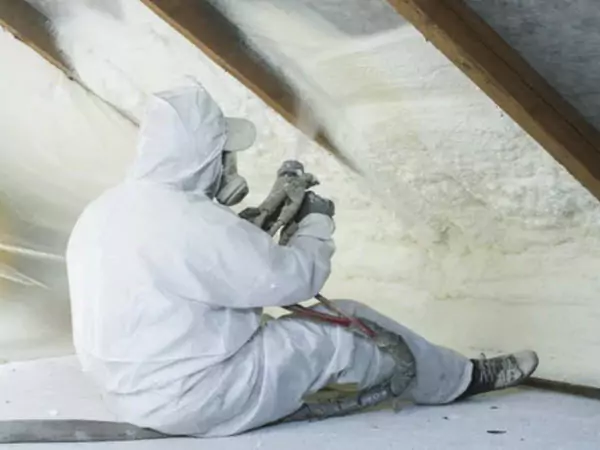
Almost always sprayed on the underside of the roof deck to create an unvented, semi-conditioned attic. It's priced by the board foot (one square foot, one inch thick), not per square foot. Our spray foam insulation cost guide covers the pricing in full; section 6 below covers the attic-specific math.
Radiant barriers
The DOE says "some studies show that radiant barriers can reduce cooling costs 5% to 10% when used in a warm, sunny climate," mostly where ducts run through the attic. In cool climates, it says more insulation is usually the better buy. And don't lay foil on top of attic-floor insulation: DOE strongly recommends against it because of dust and trapped moisture.
Blown-in insulation cost: bags, depth and DIY
A 1,000 sq ft attic needs about 15 bags of blown fiberglass or 39 bags of cellulose for R-30, and 31½ or 86 bags for R-60, according to the manufacturers' coverage charts. Bags run roughly $30–$40 each (HomeGuide). The calculator counts the bags for the R-value you're adding on top of what's already there.
How many bags of blown-in insulation do I need?
Coverage from the Owens Corning AttiCat and Greenfiber SANCTUARY attic charts. Bag prices vary by store and region, so enter yours.
| Material | Bags | Depth to add | Total depth after | DIY cost | DIY $/sq ft |
|---|---|---|---|---|---|
| Blown fiberglass (AttiCat chart) Selected | 39 | 17.3 in | 21.3 in | $1,710 | $1.14 |
| Blown cellulose (SANCTUARY chart) | 109 | 14.6 in blown, 13.6 in settled | 17.6 in settled | $2,330 | $1.55 |
| Hire it out (same R) | – | – | – | $1,650–$3,000 | $1.10–$2.00 |
You have about R-10 now (4 in of blown fiberglass). Adding R-50 gets you to R-60. At these prices DIY costs about the same as hiring the low bid, so the labor is the only real saving. At 39 bags you may qualify for a free blower rental at some stores (HomeGuide: 10–20+ bags; terms vary). Staple up 5 depth markers (one per 300 sq ft, facing the hatch, per IECC R303.1.1.1) and check the minimum bag count and depth on your bag’s chart; both have to be met for the rated R-value.
How we calculated this: bags = floor area ÷ 1,000 x bags per 1,000 sq ft for the R-value being added, interpolated between chart rows and rounded up. Charts list bags with no adjustment for framing, which is the conservative reading. Default bag prices are estimates: $40 for fiberglass (HomeGuide lists $30–$40, HomeAdvisor $30–$70) and $20 for cellulose (our reading of HomeGuide's brand table). Pro price = area x R added x $0.022–$0.040.
Coverage chart: bags and depth per 1,000 sq ft
| R-value | Fiberglass bags (AttiCat) | Fiberglass depth | Cellulose bags (SANCTUARY, 25 lb) | Cellulose depth: blown / settled |
|---|---|---|---|---|
| R-19 | 9 | 7 in | 22.6 | 5.7 / 5.3 in |
| R-30 | 14.6 | 10¾ in | 38.6 | 8.9 / 8.3 in |
| R-38 | 19 | 13½ in | 52.6 | 11.2 / 10.4 in |
| R-49 | 25 | 17 in | 70.8 | 14.3 / 13.3 in |
| R-60 | 31.5 | 20½ in | 86.0 | 17.3 / 16.1 in |
Can you blow new insulation over old?
Usually, yes. ENERGY STAR's DIY guide says you don't have to match the existing type: loose fill can go on top of batts, and batts can go over loose fill as long as they're unfaced. Dirty-looking insulation is a sign of air leaks, not a reason to remove it; seal the leak and put the insulation back. Remove it when it's wet, moldy, contaminated by rodents, or when it's vermiculite (more on that below). If you're spraying foam on the attic floor, the old material has to come out regardless.
DIY vs hiring a pro
DIY saves the labor and not much else. At the default prices above, 39 bags of fiberglass to add R-50 over 1,500 sq ft is about $1,560 in material, while the installed rate for the same R is $1,650–$3,000. It's a two-person job (one feeding the machine, one on the hose), it's hot and itchy, and the prep is the same either way: air seal, baffle every rafter bay at the eaves, and build dams around the hatch, flues and any recessed lights that aren't IC-rated.
Where DIY clearly wins is a small top-up that falls under a contractor's minimum. Where it clearly loses: cramped attics with very little headroom, vermiculite, active leaks or mold, and knob-and-tube wiring, which needs an electrician's evaluation before it's buried in insulation.
How much attic insulation do you need?
The 2021 IECC calls for R-30 in climate zone 1, R-49 in zones 2–3 and R-60 in zones 4–8. ENERGY STAR uses the same targets for an uninsulated attic, and says that if you already have 3–4 inches, add R-25 in zone 1, R-38 in zones 2–3, and R-49 in zones 4–8. Older homes were often built to R-19 or less.
| Climate zone | 2021 IECC ceiling | 2012–2018 IECC | ENERGY STAR: add over 3–4 in | Fiberglass depth at 2021 target | Cellulose depth (settled) |
|---|---|---|---|---|---|
| 1 | R-30 | R-30 | R-25 | 10¾ in | 8.3 in |
| 2 | R-49 | R-38 | R-38 | 17 in | 13.3 in |
| 3 | R-49 | R-38 | R-38 | 17 in | 13.3 in |
| 4A / 4B | R-60 | R-49 | R-49 | 20½ in | 16.1 in |
| 4C, 5, 6 | R-60 | R-49 | R-49 | 20½ in | 16.1 in |
| 7, 8 | R-60 | R-49 | R-49 | 20½ in | 16.1 in |
What you have now: depth to R-value
Measure in a few spots with a ruler pushed to the drywall, and don't count compressed or missing areas. The DOE's rule of thumb: if it's less than about R-30 (10 to 13 inches), you'd probably benefit from adding more.
| Depth now | Fiberglass batts (≈R-3.1/in) | Old blown fiberglass (≈R-2.5/in) | Cellulose (≈R-3.6/in) |
|---|---|---|---|
| 3 in | R-9 | R-7.5 | R-11 |
| 4 in | R-12 | R-10 | R-14 |
| 6 in | R-19 | R-15 | R-22 |
| 8 in | R-25 | R-20 | R-29 |
| 10 in | R-31 | R-25 | R-36 |
| 12 in | R-37 | R-30 | R-43 |
The R-38-at-the-eaves rule
The 2021 IECC (R402.2.1) lets R-38 satisfy an R-49 requirement, and R-49 satisfy R-60, when that insulation covers 100% of the ceiling and its full, uncompressed height extends over the wall top plates at the eaves. Raised-heel trusses make that possible; standard trusses usually don't leave room. Either way it's the eaves, not the middle of the attic, that decide how good the job is.
Your local code may say something else
States and cities amend these tables. The Texas adoption of the 2024 IRC on UpCodes, for example, lists R-38 for zones 2–3 and R-49 for zones 4–8. Retrofits are often treated differently from new construction, so ask your building department what applies; either way, these values are the right target. Our spray foam R-value guide converts R-values to foam thickness by zone.
Spray foam attic cost: roof deck vs attic floor
Published spray foam attic prices run $1,100–$9,000 (Angi, 2026), $3,000–$8,000 (HomeGuide, 2025) and $1,500–$7,400 (This Old House, 2026). HomeGuide splits them: $1,100–$6,800 on the attic floor and $1,500–$9,000 on the rafters or roof deck. The real price is square feet x inches x the per-board-foot rate, and the roof deck always has more square feet than the floor.
Why the roof deck costs more than the floor
A sloped roof is longer than the floor under it, and a gable roof adds two triangular end walls. Multiply the floor area by the pitch factor below, then add the gables (for a gable roof: width² x pitch ÷ 24). A 50 x 30 ft attic under a 6/12 gable has 1,500 sq ft of floor but about 1,900 sq ft of deck and gable to foam.
| Roof pitch | 4/12 | 6/12 | 8/12 | 10/12 | 12/12 |
|---|---|---|---|---|---|
| Deck area ÷ floor area | 1.054 | 1.118 | 1.202 | 1.302 | 1.414 |
| Worked example: 50 x 30 ft attic, 6/12 gable, 4 in of old fiberglass | Area | R-value | Installed range |
|---|---|---|---|
| Blown-in on the floor, R-50 added (to ≈R-60) | 1,500 sq ft | R-60 | $1,650–$3,000, plus $250–$750 air sealing |
| Open-cell 6 in on the deck and gables | ≈1,900 sq ft (11,400 bf) | R-22 | $5,000–$8,300 |
| Open-cell 9 in on the deck and gables | ≈1,900 sq ft (17,100 bf) | R-33 | $7,500–$12,500 |
| Closed-cell 3 in on the deck and gables | ≈1,900 sq ft (5,700 bf) | R-19.5 | $5,700–$12,100 |
| Flash-and-fill: 1 in closed-cell on the floor, then blown-in to R-60 | 1,500 sq ft | R-60 | $4,900–$9,500 incl. removal and baffles |
| Removing the old floor insulation (commonly done on deck jobs) | 1,500 sq ft | – | add $1,500–$3,000 |
Look at the R column. For three to four times the money, the roof-deck options deliver a third to about half the R-value of blown-in on the floor. That's not a knock on foam; it's a different job. Foam at the roofline brings the attic, and anything in it, inside the house. Blown-in on the floor leaves the attic outside and insulates the ceiling. If the attic is empty, the ceiling is the smarter boundary.
When a foam roof deck is worth the money
- Ducts or an air handler in the attic. ENERGY STAR says 20–30% of the air moving through a typical duct system is lost to leaks and bad connections. In a vented attic that air goes to the attic. Under a foam deck it stays inside.
- A cut-up roof. Dormers, knee walls, skylight wells and cathedral sections are hard to air-seal from the floor. See our cathedral ceiling insulation guide for those roof sections.
- A future bonus room or real storage space. Although foam left exposed where things are stored needs an approved barrier (see below).
- Hot climates with ducts up top, where the DOE says insulating the rafters "will enclose the distribution system."
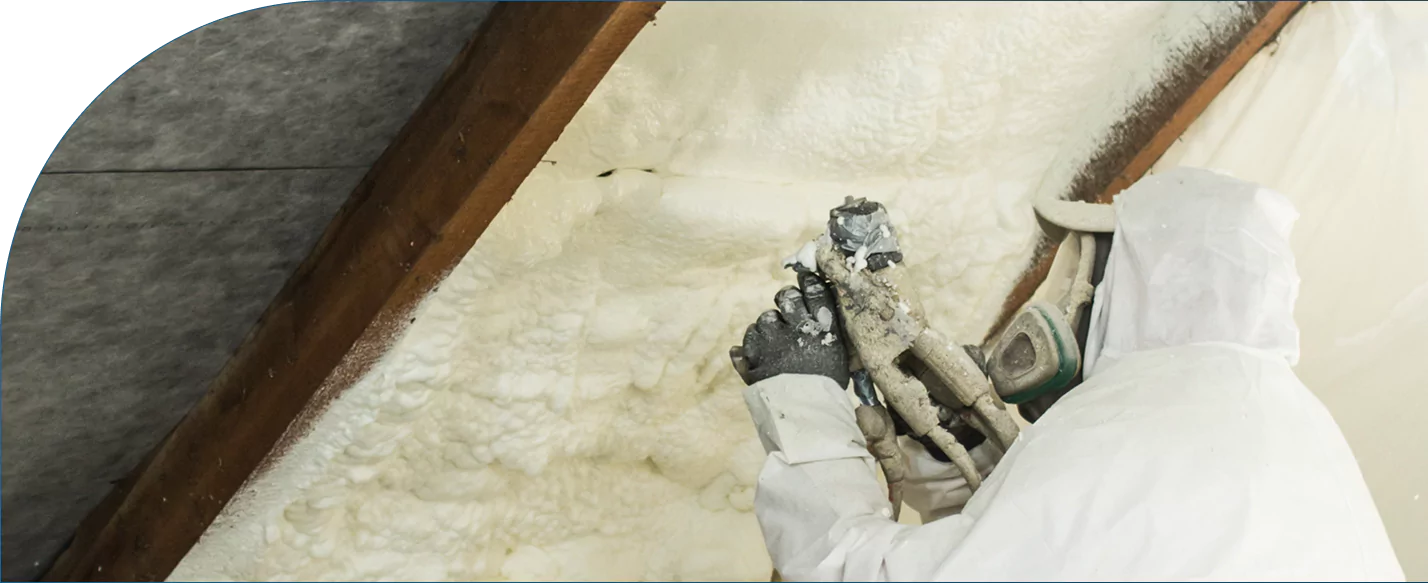
What code requires for an unvented (spray foam) attic
IRC R806.5 allows an unvented attic when all of its conditions are met. The ones that change the price:
- The attic has to be completely inside the building thermal envelope, and there can't be a Class I vapor retarder on the attic floor.
- Zones 5–8: air-impermeable insulation has to be a Class II vapor retarder itself, or carry a Class II coating in direct contact with it. Closed-cell at about 2 inches forms a vapor barrier (ArmorFoam product literature). Open-cell doesn't, so it needs a coating: budget $0.65–$1.00 per sq ft (Angi, Bob Vila).
- Flash-and-batt on the deck needs a minimum R of foam against the sheathing: R-5 in zones 1–3, R-10 in 4C, R-15 in 4A/4B, R-20 in 5, R-25 in 6, R-30 in 7 and R-35 in 8 (Table R806.5).
- The energy code still applies. Very few foam roof decks reach R-49 or R-60 prescriptively. Most are approved through the performance path or a local amendment. Ask which path your quote assumes.
Line items a roof-deck quote should show
Product name and thickness (the IECC wants spray foam thickness and installed R-value on the installer's certificate), board feet, vapor-retarder coating in zones 5–8, sealing of the soffit, ridge and gable vents, removal of old floor insulation if it's coming out, and a thermal or ignition barrier where one is required. Foam in an attic entered only for service can often skip the ignition barrier under IRC R316.5.3's conditions, including "no storage"; our closed-cell spray foam guide walks through them, and they're why a foamed attic full of boxes can become a code problem.
Open-cell or closed-cell on the deck?
Open-cell is cheaper per R and the usual choice in zones 1–4. Closed-cell packs R-6.5 per inch into shallow rafters and handles vapor on its own in cold zones. Our open-cell spray foam guide and open-cell vs closed-cell comparison go deeper. One more thing worth knowing before you sign: foam under the deck hides roof leaks. The water sits between foam and sheathing where nobody sees it, so fix the roof first. More on that in spray foam insulation problems.
Should you insulate the attic floor or the roof deck?
If nothing mechanical lives in the attic and the roof is simple, insulate the floor: air seal it, then blow in insulation. If ducts or an air handler are up there, or the roof is cut up with dormers and knee walls, a spray foam roof deck starts to make sense. Answer eight questions and the tool shows how it weighs each one.
Vented floor or unvented roof deck?
The weighting is ours and it's shown in full. It's a starting point for a conversation with an installer, not a design.
Floor: air seal + blown-in (vented attic)
- Alternative: seal the ducts with mastic or foil tape and insulate them to at least R-6 (ENERGY STAR), then blow in the floor.
- +1 A simple gable or hip roof is straightforward to air-seal and blow from the floor.
- +1 No storage or living space planned, so there’s no reason to condition the attic.
- +2 The existing insulation is dry and clean, so you can blow over it with no removal cost.
Checklist: air seal first, baffle every soffit vent (IECC R402.2.3), keep a 1-inch vent space (IRC R806.3), insulate and weatherstrip the hatch (R402.2.4), depth markers every 300 sq ft.
Roof deck: spray foam (unvented attic)
- +2 Ducts in a vented attic sit outside the house. ENERGY STAR says 20–30% of the air in a typical duct system is lost to leaks.
Checklist (IRC R806.5): attic entirely inside the thermal envelope, no Class I vapor retarder on the attic floor, roof vents sealed. Ask which energy-code path the quote assumes.
Scores are our weighting, shown so you can disagree with it. In our worked example the open-cell deck cost about three times as much as blown-in on the floor. Get a spray foam applicator’s price if the deck comes out ahead.
The middle options people forget
- Seal and insulate the ducts, then blow in the floor. ENERGY STAR's DIY guide says to seal duct joints with mastic or foil tape (not cloth duct tape) and insulate ducts to at least R-6. It's far cheaper than a foam deck and goes after the same duct losses.
- Flash-and-fill. An inch of closed-cell on the attic floor as the air seal, then blown-in on top. It air-seals everything, but it costs more than hand air sealing plus blown-in, and the old insulation has to come out first.
- Insulate above the deck at the next re-roof. Newer code tables list insulation entirely above the roof deck as its own option (R-25 to R-35 continuous by zone in the 2024 IRC table as adopted in Texas). If a new roof is coming anyway, it's worth a price.
Extra attic insulation costs most quotes leave out
Air sealing, baffles, a proper hatch and removal of bad insulation can add $300 to several thousand dollars to an attic job. They're also what make the insulation work. A cheap quote that skips them is buying you R-value you won't fully get.
Removing old insulation
Figure $1–$2 per square foot to vacuum out old insulation (HomeGuide, 2025; Angi says $1–$1.50) and $2–$6 per square foot to remove and replace. A DIY insulation vacuum rents for $200–$350 a day. Contaminated material that needs special handling can run $25 or more per square foot. Only remove what's wet, moldy, rodent-soiled or in the way of foam.
Air sealing the attic floor
Expect $250–$750 for typical attic air sealing (Angi and HomeAdvisor, 2026), and up to $3,000 on bigger or messier jobs (HomeGuide). The DOE's instruction is blunt: "Before insulating, seal any air leaks and make roof and other necessary repairs." The big holes are where walls meet the attic floor, dropped soffits, open chases, plumbing and wiring holes, and around the hatch. ENERGY STAR's guide uses caulk for gaps up to ¼ inch and spray foam from ¼ to 3 inches.
Baffles and ventilation
Blown-in insulation in a vented attic needs an eave baffle at each soffit vent (IECC R402.2.3), and the IRC wants at least a 1-inch air space between the insulation and the roof sheathing at the vent (R806.3). Baffles run about $2–$3 each (HomeGuide); new roof vents $200–$700. The IRC's ventilation minimum is 1 sq ft of net free area per 150 sq ft of attic, or 1 per 300 under the conditions in R806.2. Never cover soffit vents with insulation.
The attic hatch or pull-down stairs
The IECC wants the hatch insulated to the same R-value as the ceiling around it (R402.2.4), with a relaxed rule for pull-down stairs in zones 0–4. Where loose fill is blown, the 2018 edition also called for a dam or retainer around the opening so it doesn't spill into the house. ENERGY STAR's fix is self-stick weatherstripping and rigid foam glued to the back of the hatch. It's a small job, and it's often skipped.
Flues, chimneys and recessed lights
ENERGY STAR notes that codes usually require 1 inch of clearance from metal flues and 2 inches from masonry chimneys to any combustible material, including insulation, so the gap gets sealed with sheet metal and high-temperature caulk and dammed off. Keep insulation 3 inches away from recessed lights unless they're rated IC. Replacing old cans with sealed IC-rated fixtures costs extra but removes a big leak.
Vermiculite: stop and test
Mold, pests and roof leaks
Attic mold removal runs from $1,500 into five figures in published guides, and HomeGuide puts pest cleanup at $600–$1,000 plus the exterminator. Fix the source first: a roof leak, a bathroom fan venting into the attic, or blocked soffits. Then insulate.
Is attic insulation worth the cost?
Usually, yes. ENERGY STAR's modeling puts the average savings from air sealing plus insulating attics, floors over crawl spaces and rim joists at 15% of heating and cooling costs (11% of total energy). The payoff is biggest where the attic has little insulation now and the winters are long. Topping up an attic that already has R-30 pays back slowly.
What will adding attic insulation save where I live?
Heat flow through the ceiling, using NOAA 1991–2020 heating and cooling degree days and EIA's 2025 average energy prices. Efficiency values are assumptions; change them to match your equipment.
Springfield, MO (zone 4A): 4,277 heating and 1,540 cooling degree days. Heating saves about $176 a year and cooling $48. Not counted: air leakage, attic heat above outdoor temperature in summer, and duct losses if ducts run through the attic. Ducts up there? Check the floor-or-deck tool.
How we calculated this: ceiling R = insulation R + 1.67 (air films and ½ in drywall, Colorado Energy table); heat saved = floor area x (1/R before − 1/R after) x 24 x degree days. Gas at $1.48/therm comes from EIA's 2025 residential average of $15.34 per thousand cubic feet at about 1,036 Btu per cubic foot; electricity is EIA's 2025 average of 17.30¢/kWh. Furnace efficiency of 90%, heat pump COP of 2.5 and SEER 14 are our assumptions. Steady-state conduction only: it leaves out air leakage and duct losses (so it understates savings from air sealing), and it treats the attic as outdoor temperature (so it overstates savings for a bare ceiling and understates them in summer, when a sun-baked attic runs well above outdoor air).
| City | HDD65 / CDD65 | Heat saved | Gas furnace + AC | Heat pump + AC | Payback at $2,950 |
|---|---|---|---|---|---|
| Phoenix | 874 / 4,765 | 2.2 MMBtu | $183/yr | $192/yr | 16 yr |
| Houston | 1,266 / 3,288 | 3.2 MMBtu | $154/yr | $166/yr | 19 yr |
| Atlanta | 2,531 / 2,051 | 6.3 MMBtu | $167/yr | $192/yr | 18 yr |
| Springfield, MO | 4,277 / 1,540 | 10.7 MMBtu | $224/yr | $265/yr | 13 yr |
| Chicago | 5,974 / 1,003 | 14.9 MMBtu | $277/yr | $334/yr | 11 yr |
| Minneapolis–St. Paul | 7,399 / 830 | 18.5 MMBtu | $330/yr | $401/yr | 9 yr |
| Duluth | 9,115 / 255 | 22.8 MMBtu | $383/yr | $470/yr | 8 yr |
Two things stand out. First, the jump from nothing to something is enormous, and the jump from R-30 to R-60 is modest, because each added R-point saves less than the one before. Second, the numbers in the south look weak only because a degree-day model can't see what actually happens there: a sun-baked attic, and ducts sitting in it. That's also why the roof-deck question matters most in hot climates.
Tax credits and rebates in 2026
- The federal 25C credit is gone. The IRS says the Energy Efficient Home Improvement Credit "will not be allowed for any property placed in service after December 31, 2025." Guides that still promise 30% back are out of date.
- HEAR rebates can cover up to $1,600 for insulation, air sealing and ventilation for income-qualified households, where the state has launched its program.
- Utility rebates for attic insulation and air sealing are common. Ask your utility before you book, because many require a pre-approved contractor or a before-and-after inspection.
What a good attic insulation quote includes
A good quote states the R-value, the product, the installed depth and the number of bags, and it lists air sealing, baffles, the hatch and any removal as separate lines. If it only says "blow in insulation, $1,800," ask for the rest before you compare it with anything.
R-value, depth and bags
Both the minimum installed depth and the bag count from the manufacturer's chart. Greenfiber's card is explicit that the installer must meet both, or the R-value isn't reached.
Depth markers and a certificate
The IECC (R303.1.1.1) wants depth markers at least one per 300 sq ft, facing the hatch, and an insulation certificate left on site. Our 1,500 sq ft example needs five.
Air sealing, itemized
Top plates, chases, soffits, plumbing and wiring holes, the hatch. Ask what material they use and whether it's included or an add-on.
Baffles and vent clearance
One baffle per rafter bay at every soffit vent, with a 1-inch air space kept at the vent.
Dams and clearances
Around the hatch, metal flues, chimneys and non-IC recessed lights.
For spray foam
Product and data sheet, thickness, board feet, R-value, vapor-retarder coating in zones 5–8, vent sealing, barrier requirements, and the manufacturer's re-entry time in writing.
Red flags
- No R-value or depth in writing. The cheapest way to win a bid is to blow less.
- Air sealing skipped in a leaky attic. Insulation slows heat; it doesn't stop air.
- Soffit vents buried or no baffles planned.
- A radiant barrier laid on top of the floor insulation. DOE strongly recommends against it.
- A roof-deck foam quote with no mention of your ducts, vents or code path.
- Anyone disturbing vermiculite without testing it first.
For a straight comparison of the two main families, see spray foam vs fiberglass insulation. Doing a small section yourself? Our DIY spray foam insulation guide covers kits and their limits.
When spray foam is the right attic answer, and when it isn't
We make spray foam, and we'll still tell you: if your attic is empty, vented and simple, air seal it and blow in cellulose or fiberglass. You'll get more R-value per dollar than anything we sell.
Spray foam belongs in the attic when the attic needs to come inside: ducts or an air handler up there, a bonus room or knee walls, cathedral sections, or a roof too cut up to air-seal from below. That's where an ArmorThane-certified applicator can spray ArmorFoam open-cell or closed-cell on the deck and quote the thickness, board feet and R-value in writing. More on the system on our attic spray foam insulation page.
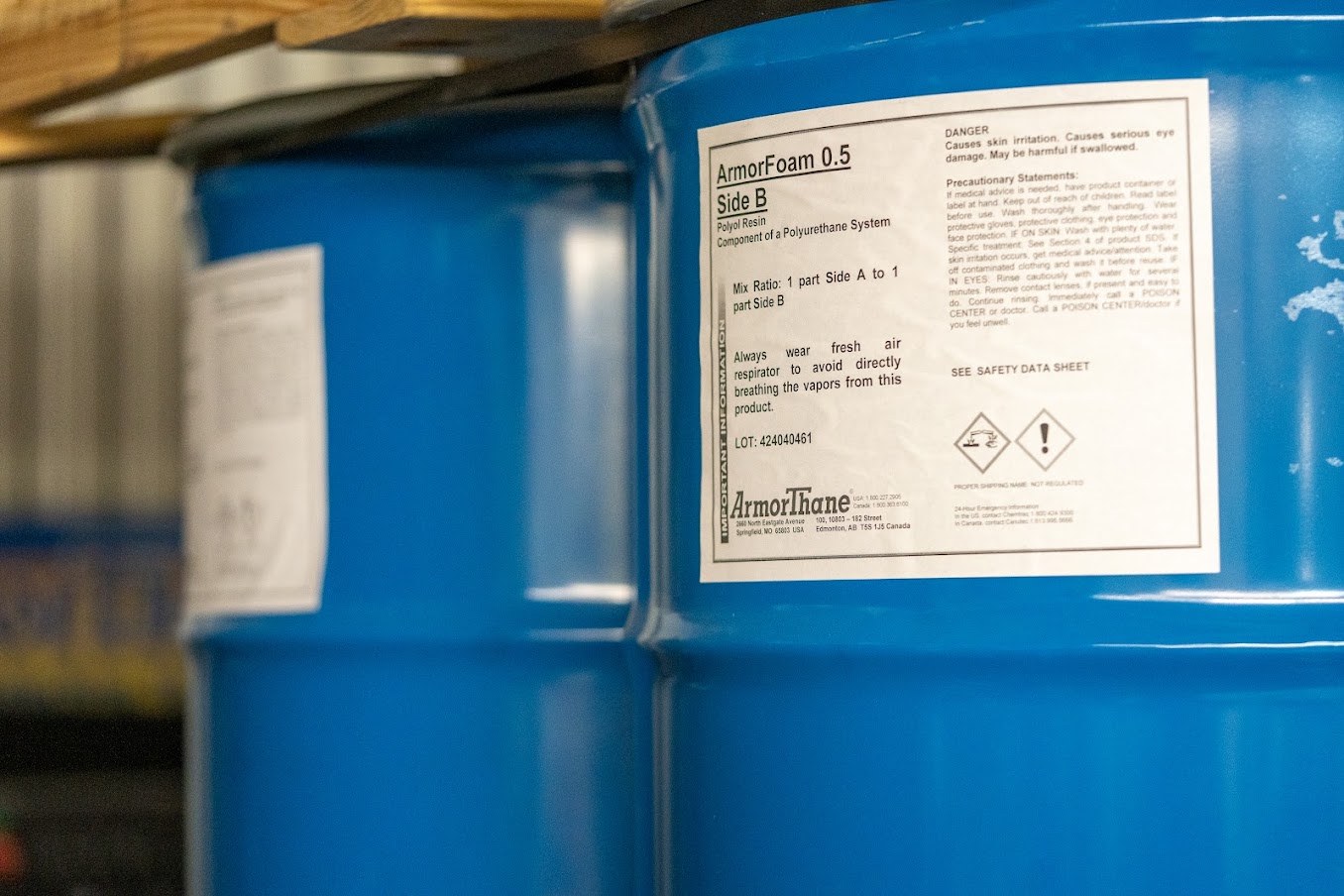
ArmorFoam 0.5 open-cell
Water-blown, 0.5 pcf. R-13.6 at 3.5 in (ASTM C518). About 17,000 board feet per set at perfect yield.
ArmorFoam closed-cell
Aged value. Forms a vapor barrier at about 2 inches, which matters on cold-climate roof decks.
Thickness and R on the quote
The IECC asks for spray foam thickness and installed R-value on the installer's certificate. Ask for it up front.
Attic decks are big jobs. Price them right.
A 1,500 sq ft attic under a 6/12 gable is about 11,400 board feet at 6 inches of open-cell. An ArmorFoam open-cell set is rated at about 17,000 board feet at perfect yield. We supply the foam, build the rigs and train your crew on site. Not a franchise: no franchise fee, no royalties.
See the rigs: mobile spray foam rigs →
Attic insulation cost FAQ
How much does attic insulation cost per square foot?
Most 2026 data puts it at $1–$3 per square foot installed (HomeAdvisor, Angi), or $1–$4 at HomeGuide. The more useful number is per R-value: blown-in runs about 2–4 cents per square foot for every R-point you add, so R-60 over a bare 1,000 sq ft attic costs about $1,400–$2,400 (HomeGuide). Six inches of open-cell spray foam runs about $2.60–$4.40 per square foot.
How much does it cost to insulate a 1,000, 1,500 or 2,000 sq ft attic?
HomeAdvisor puts 1,000 sq ft at $1,000–$3,000 and 1,500 sq ft at $1,500–$4,500; HomeGuide's range for 2,000 sq ft is $2,000–$8,000. By our per-R math, topping up 4 inches of old fiberglass to R-60 costs about $1,100–$2,000 for 1,000 sq ft, $1,650–$3,000 for 1,500 and $2,200–$4,000 for 2,000, before air sealing and baffles.
How much does blown-in insulation cost?
About $1.00–$2.80 per square foot installed for fiberglass and $1.20–$2.80 for cellulose (HomeGuide, 2025); HomeAdvisor's average blown-in project is $1,661. If you do it yourself, bags run roughly $30–$40 each (HomeGuide), and a blower rents for $100–$200 a day or comes free with a large enough purchase at some stores.
How many bags of blown-in insulation do I need?
Per 1,000 sq ft, Owens Corning's AttiCat chart calls for 14.6 bags for R-30, 19 for R-38, 25 for R-49 and 31.5 for R-60. Greenfiber's SANCTUARY cellulose needs 38.6, 52.6, 70.8 and 86 bags. Subtract the R-value you already have first; the bag calculator does that for you.
How many inches of blown-in insulation is R-38 or R-60?
R-38 is about 13½ inches of blown fiberglass (AttiCat) or 10.4 inches of settled cellulose, blown at 11.2 inches. R-60 is about 20½ inches of fiberglass or 16.1 inches of settled cellulose. Brands differ, so follow the chart on your bag.
Can you put new insulation over old attic insulation?
Yes, if the old insulation is dry and free of mold and pests. ENERGY STAR says you don't have to match types: loose fill can go over batts, and batts can go over loose fill as long as they're unfaced. The exception is vermiculite, which the EPA says to leave undisturbed and treat as if it contains asbestos.
Should I remove old attic insulation before adding new?
Only if it's wet, moldy, contaminated by rodents, or in the way of spray foam. Removal runs $1–$2 per square foot (HomeGuide), which can double a blown-in job. Dirty-looking insulation usually just marks an air leak: seal the leak and put the insulation back.
How much does it cost to spray foam an attic?
Published ranges run $1,100–$9,000 (Angi, 2026), and HomeGuide lists $1,500–$9,000 for the rafters or roof deck. A 1,500 sq ft attic under a 6/12 gable has about 1,900 sq ft of deck and gable; 6 inches of open-cell there is about $5,000–$8,300, plus removal of the old floor insulation if it comes out. Our spray foam insulation cost guide has the full pricing.
Is spray foam or blown-in insulation better for an attic?
For an empty, vented attic, blown-in on the floor is about 5 to 8 times cheaper per R-point and reaches R-60 easily. Spray foam on the roof deck makes more sense when ducts or an air handler are in the attic, the roof is cut up with dormers and knee walls, or you plan to use the space. The floor-or-deck tool weighs your situation.
Is blown-in insulation cheaper than batts?
Per square foot they're close: HomeGuide lists $0.80–$2.60 for batts and $1.00–$2.80 for blown-in, while HomeAdvisor lists batts at $2–$4. Blown-in fills around wiring, blocking and odd framing without gaps, which batts struggle to do in a real attic.
Is attic insulation worth it?
Usually. ENERGY STAR's modeling puts the average savings from air sealing plus insulation at 15% of heating and cooling costs. The payoff is largest when you start with little insulation in a cold climate; topping up an attic that's already at R-30 pays back slowly, and air sealing may be the better first dollar.
Is there a tax credit for attic insulation in 2026?
Not the federal one most guides mention. The IRS says the 25C Energy Efficient Home Improvement Credit isn't allowed for property placed in service after December 31, 2025. Income-qualified households may get up to $1,600 through a state HEAR program where it's open, and many utilities offer rebates.
Can I insulate my attic myself?
Yes; blown-in and batts are common DIY jobs. At typical bag prices, DIY material for a big top-up lands near a pro's low bid, so you're mainly saving labor. Air seal first, baffle the soffit vents, dam the hatch, flues and non-IC recessed lights, and wear gloves, safety glasses and a dust mask at minimum, as ENERGY STAR's DIY guide advises.
How long does it take to insulate an attic?
Owens Corning says its AttiCat machine can blow a 1,000 sq ft attic to R-30 in as little as two hours of blowing time. Air sealing and prep usually take longer than the blowing itself. For spray foam, also plan around the manufacturer's re-entry time, and get it in writing.
Written from manufacturer coverage charts, IRC and IECC text, dated 2025–2026 cost data and 35+ years of making spray foam. Last updated September 26, 2026.
Methodology and sources
Published averages are shown as each source states them, with the date it was last updated. Our per-R blown-in band ($0.022–$0.040 per sq ft per R) is derived from HomeGuide's per-1,000-sq-ft R-value table; spray foam bands are the medians from our spray foam cost guide. Depths and bag counts come from the Owens Corning AttiCat and Greenfiber SANCTUARY coverage charts. Code values are from the 2021 IECC and IRC (via DOE/PNNL and UpCodes); your jurisdiction may have amended them. Payback math uses NOAA 1991–2020 normals and EIA 2025 prices. Estimates only; your installer's quote and your code official govern.
- HomeAdvisor, attic insulation cost (Jun. 2026): homeadvisor.com/cost/heating-and-cooling/attic-insulation/
- Angi, attic insulation cost (Jul. 2026): angi.com/articles/how-much-does-attic-insulation-cost.htm
- HomeGuide, attic insulation cost (Jan. 2026): homeguide.com/costs/attic-insulation-cost
- HomeGuide, blown-in insulation cost (Nov. 2025): homeguide.com/costs/blown-in-insulation-cost
- HomeGuide, attic insulation removal cost (Nov. 2025): homeguide.com/costs/attic-insulation-removal-cost
- HomeAdvisor, blown-in insulation cost (Jun. 2026): homeadvisor.com/cost/insulation/install-blown-in-insulation/
- Forbes Home, attic insulation cost (Feb. 2025): forbes.com/home-improvement/insulation/attic-insulation-cost/
- Bob Vila, attic insulation cost (Oct. 2023): bobvila.com/articles/attic-insulation-cost/
- Fixr, attic insulation cost (Sep. 2022): fixr.com/costs/attic-insulation
- Angi, spray foam insulation cost (Sep. 2026): angi.com/articles/spray-foam-insulation-cost.htm
- HomeGuide, spray foam insulation cost (Dec. 2025): homeguide.com/costs/spray-foam-insulation-cost
- This Old House, spray foam insulation cost (Apr. 2026): thisoldhouse.com/roofing/spray-foam-insulation-cost
- Bob Vila, spray foam insulation cost (Jun. 2024): bobvila.com/articles/spray-foam-insulation-cost/
- Owens Corning, AttiCat blown-in fiberglass coverage chart: owenscorning.com/en-us/insulation/products/atticat
- Greenfiber, SANCTUARY attic coverage card, Rev K (PDF): greenfiber.com/uploads/documents/SANCTUARY-Attic-Card_Rev-K.pdf
- Greenfiber, DIY attic installation guide (PDF): greenfiber.com/uploads/documents/DIY-Attic-Install-Guide.pdf
- DOE/PNNL Building America Solution Center, 2009–2021 IECC insulation requirements: basc.pnnl.gov/information/2009-2021-iecc-and-irc-minimum-insulation-re
- ENERGY STAR, recommended home insulation R-values: energystar.gov/saveathome/seal_insulate/identify-problems-you-want-fix
- 2021 IECC R402.2.1–R402.2.4, ceilings with attics, eave baffles, hatches (UpCodes, Utah adoption): up.codes/viewer/utah/iecc-2021/chapter/RE_4/re-residential-energy-effi
- 2021 IRC chapter 8, R806 ventilation and unvented attics, R807 access (UpCodes, Texas adoption): up.codes/viewer/texas/irc-2021/chapter/8/roof-ceiling-construction
- 2024 IRC chapter 11, N1101.10 insulation markers and Table N1102.1.3 (UpCodes, Texas adoption): up.codes/viewer/texas/irc-2024/chapter/11/re-energy-efficiency
- Colorado Energy, R-value table: coloradoenergy.org/procorner/stuff/r-values.htm
- U.S. DOE Energy Saver, where to insulate in a home: energy.gov/energysaver/where-insulate-home
- U.S. DOE Energy Saver, types of insulation: energy.gov/energysaver/types-insulation
- U.S. DOE Energy Saver, radiant barriers: energy.gov/energysaver/radiant-barriers
- ENERGY STAR, seal and insulate savings methodology: energystar.gov/saveathome/seal_insulate/methodology
- ENERGY STAR, duct sealing: energystar.gov/saveathome/heating-cooling/duct-sealing
- ENERGY STAR, A Do-It-Yourself Guide to Sealing and Insulating (PDF): energystar.gov/ia/partners/publications/pubdocs/DIY_Guide_May_2008.pdf
- U.S. EPA, asbestos-contaminated vermiculite insulation (Apr. 2026): epa.gov/asbestos/protect-your-family-asbestos-contaminated-vermiculite
- IRS, FAQs on modifications to 25C and related credits (2025 law): irs.gov/newsroom/faqs-for-modification-of-sections-25c-25d-25e-30c-30d
- 42 U.S.C. 18795a, HEAR rebate program: law.cornell.edu/uscode/text/42/18795a
- U.S. DOE, Home Energy Rebates program: energy.gov/cmei/scep/home-energy-rebates-program
- NOAA NCEI, 1991–2020 annual heating and cooling degree day normals: ncei.noaa.gov/access/services/data/v1?dataset=normals-annualseasonal-1
- U.S. EIA, natural gas prices: eia.gov/dnav/ng/ng_pri_sum_dcu_nus_a.htm
- U.S. EIA, Electric Power Monthly table 5.3: eia.gov/electricity/monthly/epm_table_grapher.php?t=epmt_5_3
- U.S. EIA, British thermal unit conversion factors: eia.gov/energyexplained/units-and-calculators/british-thermal-units.ph
- ArmorThane, spray foam insulation cost: armorthane.com/spray-foam-insulation-cost/
- ArmorThane, ArmorFoam spray foam products: armorthane.com/products/armorfoam-products/
- ArmorThane, ArmorFoam 0.5 open-cell spray foam: armorthane.com/products/armorfoam-products/open-cell-spray-foam/
- ArmorThane, closed-cell spray foam guide: armorthane.com/closed-cell-spray-foam/
Want spray foam on the roof deck priced? Get a quote from a certified applicator.
Tell us about the attic: its size, what's up there now, and whether ducts or an air handler live in it. We'll connect you with an ArmorThane-certified spray foam applicator who will quote thickness, board feet and R-value in writing.
- Unvented roof decks and conditioned attics
- Attics with ducts, air handlers or knee walls
- Thickness, board feet and R-value on the quote
- Contractors: ask about ArmorFoam and spray rigs