









Geomembrane Liner: Materials, Specs and Leak Math
HDPE, LLDPE, PVC, EPDM and polypropylene sheet compared, what a GM13 spec sheet really promises, how seams get tested, and how much a liner leaks through the holes every install leaves behind.
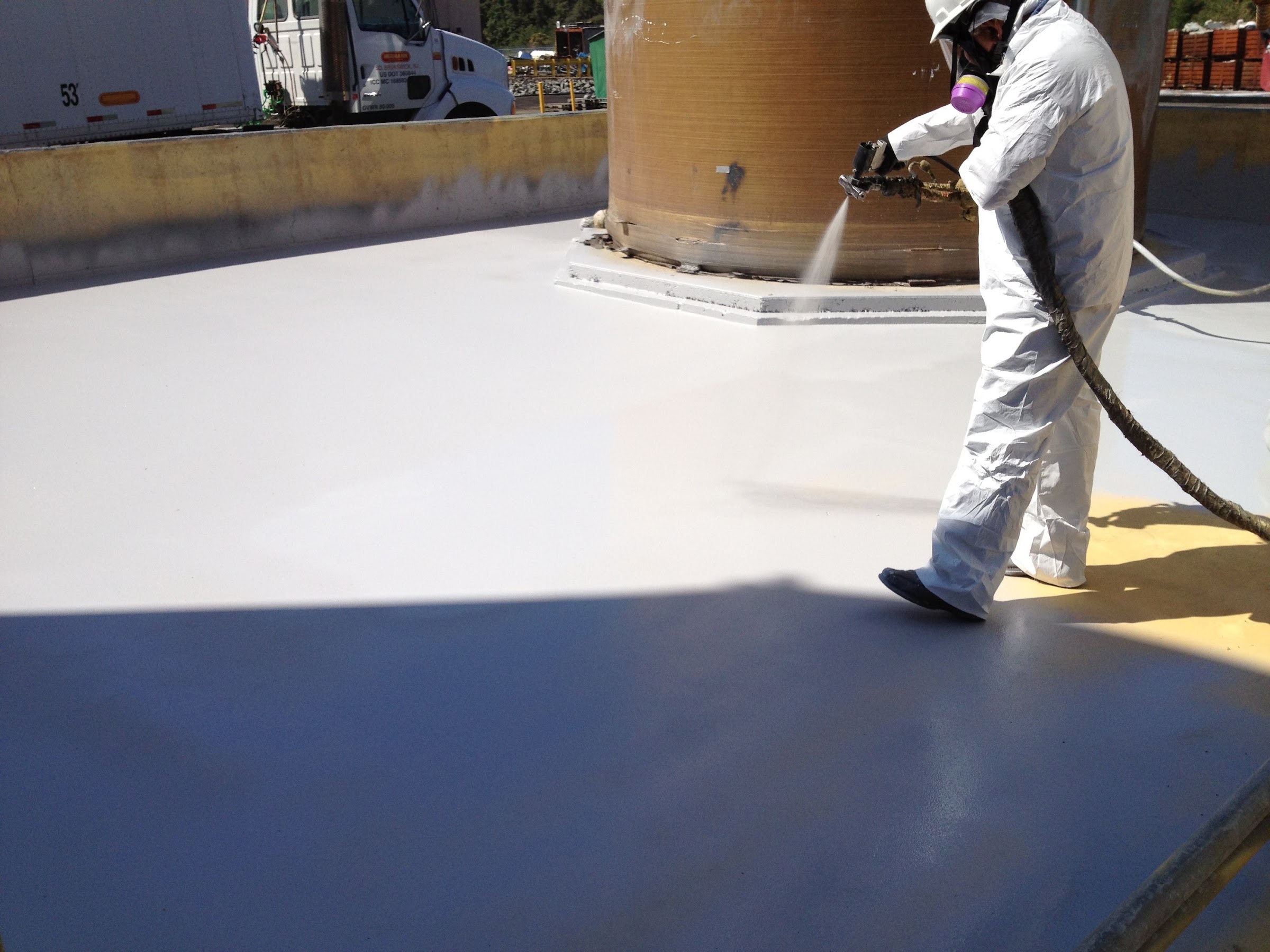
Start a roof coating business
Spray roofs for a living.
ArmorThane sets you up to do this work, and you own the business. We make the chemistry, build the rigs, train you hands-on and answer the phone when a job gets difficult. You pay no franchise fee and no royalties. It has been that way since 1989.




- $0
- franchise fees or royalties
- 35+
- years in business
- 50+
- countries with applicators
- 24/7
- technical support
A geomembrane liner is the thin synthetic layer between a liquid and the dirt under it. It looks simple on a truck: a roll of black plastic. Whether it holds depends on the resin, the thickness, the subgrade and, more than anything, the seams and holes left after the crew drives off.
A geomembrane liner is a low-permeability synthetic membrane that holds liquids or gases in ponds, lagoons, landfills, mine pads, canals and containment areas. Most are HDPE, LLDPE, PVC, EPDM or polypropylene sheet from 20 to 100 mils thick, welded or taped at the seams. Spray polyurea over geotextile is the seamless option. Liners rarely leak through the sheet itself; they leak at holes and seams.
Geomembrane liner materials compared
Five sheet families cover nearly every job, and each has its own Geosynthetic Institute (GRI) or ASTM spec. Stiffness is the trade-off to watch. HDPE resists the widest range of chemicals but fights you on a rough subgrade and wrinkles in the sun. The flexible sheets lay down better and handle settlement, but give up some chemical and UV resistance.
| Material | Common thickness (mils) | Spec | Seaming | Where it fits |
|---|---|---|---|---|
| HDPE | 40–100 | GRI-GM13 | Dual hot wedge, extrusion weld | Landfills, leachate and process ponds, heap leach pads, broad chemical exposure |
| LLDPE | 20–60 | GRI-GM17 | Hot wedge, extrusion weld | Caps and covers, lagoons with settlement, uneven subgrade |
| PVC | 20–40 | ASTM D7176 | Solvent, hot air or wedge | Buried canal and pond liners; needs cover from sun |
| EPDM rubber | 45–60 | GRI-GM21 | Seam tape and primer | Decorative and farm ponds, cold climates, odd shapes |
| fPP / reinforced PP | 30–45 | GRI-GM18 | Hot air or wedge, factory panels | Exposed potable reservoirs, floating covers, prefabricated panels |
| Spray polyurea on geotextile | 80–125 | Product data sheet | None; sprayed monolithic | Containment berms, ponds with pipes and corners, concrete to soil transitions |
For pond-sized jobs and a material-by-material cost view, our pond liner guide goes deeper. Here we stay on the civil and industrial side, where a spec, a CQA plan and a leak budget come with the job.
What a GM13 sheet actually promises
GRI-GM13 is the spec most HDPE gets bought to. Every value in it is a minimum average roll value (MARV), meaning the average of tests on a roll must meet the number. It sets a density of at least 0.940 g/cc and carbon black of 2.0 to 3.0%. Strength scales with thickness, which is why engineers step up gauge on sharp subgrades or under heavy cover.
Light-duty HDPE
Tensile at yield 52 lb/in, puncture 60 lb, tear 33 lb. Common for stormwater, irrigation and secondary liners on a prepared subgrade.
The regulatory baseline
Yield 78 lb/in, puncture 90 lb, tear 50 lb. The minimum HDPE for a municipal solid waste composite liner under federal rules.
Heavy service
Yield 104 lb/in, puncture 120 lb, tear 67 lb. Chosen for mining pads, deep ponds and liners that will carry a lot of fill.
A liner spec that lists only thickness is incomplete. Look for the GRI or ASTM reference, the MARVs, stress crack resistance for HDPE, and who does the conformance testing on delivered rolls.
How much does a liner leak?
Every installed liner has some holes. The question is how much water gets through them, and that depends far more on what sits under the sheet than on the sheet itself. A pinhole over gravel drains freely. The same pinhole pressed tight against compacted clay barely weeps. Plug in your numbers and compare.
Geomembrane leakage estimator
Free flow uses Bernoulli's orifice equation, Q = 0.6·a·√(2gh). Composite liners use Giroud's 1997 equation for circular holes, Q = C·[1 + 0.1(h/t)^0.95]·a^0.1·h^0.9·k^0.74 (SI units), with C = 0.21 for good contact and 1.15 for poor contact, and a 2 ft (0.6 m) clay layer. Benchmarks are the action leakage rates proposed by Peggs and Giroud (2014).
These are screening numbers, not a design. Liners holding regulated waste need an engineer and the permit's own leakage limits. For containment sizing, see our secondary containment guide.
Seams, holes and how they get tested
Ask any liner tech where the leaks are and you will hear the same answer: seams, patches, pipe boots and the spots where a loader turned around on the sheet. Good crews plan for that from the first roll.
Build the subgrade first
Smooth, compacted and free of sharp rock, roots and standing water. A cushion geotextile under the sheet is cheap insurance on stony ground.
Lay out panels on paper
A panel layout keeps seams running up and down slopes, not across them, and keeps them out of corners and sumps where welding is hardest.
Weld in the cool of the day
Polyethylene grows and shrinks with temperature. Seaming in the afternoon heat and backfilling at dawn leaves the sheet in tension, which is how corners bridge and tear.
Test every foot of seam
Nondestructive tests on the full length, plus destructive coupons cut at set intervals and pulled in the field.
Survey for holes before cover
An electrical leak location survey finds the holes visual inspection misses. Holes found now cost a patch. Holes found after cover cost an excavation.
Air channel test
The dual hot wedge leaves an air gap between two welds. The tech pressurizes it and watches the gauge hold, per ASTM D5820.
Vacuum box
Soapy water, a clear box and a vacuum, per ASTM D5641. Bubbles mark the leak. Used on patches, boots and detail welds.
Peel and shear coupons
Samples cut from the seam and pulled in a field tensiometer, per ASTM D6392. Each cut gets patched and vacuum tested.
Electrical leak location
Current flows only through holes. ASTM D7002 covers exposed sheet (water puddle method) and D7007 covers liners under water or soil.
Sheet geomembrane or sprayed polyurea?
We sell spray equipment and polyurea, so take this with that in mind: on a 40 acre landfill cell, welded HDPE is the right answer and nobody should argue with it. Sheet is cheap per square foot on big flat areas, and the regulations were written around it. Sprayed liners earn their place on smaller, busier jobs.
Big, open, regulated
Large cells and ponds with simple geometry, a permit that names GM13 HDPE, and a crew with wedge welders. Cost per square foot is hard to beat once the area gets into acres.
Details and transitions
Containment berms around tanks, pump pads, pipe penetrations, steps and walls, and liners that tie soil to concrete. Polyurea sprayed over a nonwoven geotextile cures in seconds and has no field seams to weld.
- Penetrations: a sprayed membrane wraps a pipe or post as one piece instead of relying on a fabricated boot.
- Repairs: damaged sprayed areas are cut back, prepped and resprayed in the same chemistry.
- Traffic: a thick polyurea lining tolerates foot traffic and equipment better than exposed sheet.
- Chemistry: match the product to the liquid. Our HiChem polyurea is the starting point for harsher chemical exposure.
More on the sprayed route: polyurea liners, polyurea over geotextile for containment, spill containment berms and wastewater coatings.
One membrane, no welds to leak.
A certified ArmorThane applicator can look at your pond, berm or pit and quote a sprayed polyurea liner built to the thickness the job needs.
Contractors: become an ArmorThane applicator
Geomembrane liner questions
What is a geomembrane liner made of?
Most are polymer sheet: high density polyethylene (HDPE), linear low density polyethylene (LLDPE), PVC, EPDM rubber or flexible polypropylene. Some are reinforced with a scrim. Sprayed versions use polyurea over a nonwoven geotextile. HDPE is the most common on landfills and industrial ponds.
How thick should a geomembrane liner be?
Most run 30 to 80 mils. Federal rules for municipal landfills require at least 60 mil HDPE or 30 mil for other flexible membranes. Stormwater and farm ponds often use 30 to 40 mils, while mining pads and deep ponds go to 80 mils or more.
What is the difference between a geomembrane and a geotextile?
A geomembrane is an impermeable barrier meant to stop liquid. A geotextile is a fabric that lets water pass; it cushions, separates and filters. They are often used together, with geotextile under a sheet liner for puncture protection or as the base for a sprayed polyurea liner.
Is HDPE or LLDPE better for a liner?
HDPE has better chemical resistance and is the default for landfills and process ponds. LLDPE is more flexible and stretches more before it breaks, so it handles settlement and rough subgrade better. Caps and covers often use LLDPE; bottom liners under waste usually use HDPE.
How are geomembrane seams tested?
Dual wedge seams get an air pressure test of the channel between the welds (ASTM D5820). Extrusion welds get a vacuum box test (ASTM D5641). Coupons are also cut and pulled to failure (ASTM D6392), and an electrical leak survey checks the whole liner for holes.
Can polyurea be used as a geomembrane?
Yes. Spray polyurea applied over a nonwoven geotextile, concrete or steel forms a seamless membrane, typically 80 to 125 mils thick on containment work. It suits berms, ponds with many penetrations and areas where soil meets concrete. Very large flat cells are usually cheaper in sheet.
Sources
- U.S. eCFR, 40 CFR 258.40 Design criteria for municipal solid waste landfills. ecfr.gov/current/title-40/part-258/section-258.40
- Peggs and Giroud, Action leakage rates for lined reservoirs, 10th International Conference on Geosynthetics (2014). geosyntheticsconference.com/Peggs-Giroud-2014-Berlin-ICG-ALR.pdf
- Foose, Benson and Edil, Predicting leakage through composite landfill liners, Journal of Geotechnical and Geoenvironmental Engineering (2001), via NRC. nrc.gov/docs/ML1821/ML18215A308.pdf
- EFI USA, HDPE geomembrane specifications per GRI-GM13. efiusa.com/specs/hdpe-geomembrane
Contain it, with no seams to fail.
Certified ArmorThane applicators spray polyurea over geotextile, concrete and steel for ponds, berms and containment. Contractors can add liner work with our equipment and training, with no franchise fee and no royalties.
Start your coatings business with ArmorThane.
Tell us what you want to spray and where you are. An ArmorThane specialist will walk you through the equipment, chemicals, training and startup cost for the work you want to do.
- Equipment package matched to your applications
- Hands-on training and applicator certification
- Technical support once you are spraying
Lining a pond, pit or berm? Get it priced both ways.
Send us the size, the liquid and the ground conditions. We will tell you where a sprayed polyurea liner beats sheet, and connect you with a certified ArmorThane applicator.
- What the liner will hold
- Footprint and depth
- Soil, concrete or an old liner underneath
- Exposed or covered after install
More in Guides & resources
 Guides & resourcesSurface Preparation for Coatings
 Guides & resourcesTheme & Prop CoatingsGuides & resourcesTyler Gleckler, Author at ArmorThane
 Guides & resourcesUndercoating Near Me
 Guides & resourcesUrethane vs Polyurethane
 Guides & resourcesAerospace CoatingsGuides & resourcesAnti Slip PaintGuides & resourcesAnti-Graffiti Coating