RV Roof Types Identify Yours Care & Coatings
EPDM, TPO, PVC, fiberglass and aluminum: which rigs use which, how to tell them apart by rig, year and brand, and how to clean, seal and coat each one safely.
Start an RV roof coating business
Spray RV roofs for a living.
ArmorThane sets you up to do this work, and you own the business. We make the chemistry, build the rigs, train you hands-on and answer the phone when a job gets difficult. You pay no franchise fee and no royalties. It has been that way since 1989.




- $0
- franchise fees or royalties
- 35+
- years in business
- 50+
- countries with applicators
- 24/7
- technical support
Every rule for looking after an RV roof, from the cleaner to the sealant and coating, depends on one question: what is the roof made of? Get it wrong and a petroleum cleaner can swell a rubber roof, or a sealant can go on a membrane its maker never listed.
There are five main RV roof types: EPDM rubber (chalky, with black backing; most towables before about 2011), TPO (orange-peel texture, one color through; most newer towables), PVC (smooth, one color), fiberglass (a hard shell on many Class A coaches and some truck campers) and aluminum (Airstream). Membranes run about .027″–.035″ thick. Identify your roof or plan its care.
ArmorThane makes spray polyurea coatings in Springfield, Missouri, and trains the applicators who coat RV roofs. Our RV roof repair guide covers leaks, the wet-rag test and soft spots. This guide goes material by material: who uses which roof, how to tell them apart and how to clean, seal and coat each one.
- 1The five RV roof types at a glance
- 2Roof identifier (interactive)
- 3Which RVs use which roof
- 4EPDM vs TPO vs PVC
- 5Fiberglass and aluminum roofs
- 6Thickness, weight, heat and hail
- 7Cleaning and care by roof type
- 8Roof care planner (interactive)
- 9Coatings, primers and sealants
- 10Lifespan and warranties
- 11RV roof types FAQ
RV roof types at a glance
RV roofs come in two families. Membrane roofs (EPDM, TPO and PVC) are thin single-ply sheets glued over a wood deck; Keystone describes TPO "glued to the roof decking" over trusses, insulation and plywood or OSB. Hard roofs (fiberglass and aluminum) are rigid panels or a riveted metal skin.
| Type | Common products | Thickness | Where you'll find it | Typical life |
|---|---|---|---|---|
| EPDM rubber | Dicor Brite-Ply and EPDM Plus (Dicor credits its EPDM to Carlisle Syntec) | .035″ | Towables built before the industry's move away from rubber around 2011; some re-roofs | 12–20 yrs |
| TPO | Alpha SuperFlex and AlphaPly; Dicor BriteTEK and DiFlex II; fleece-backed TPO | .027″–.030″ (.035″ DiFlex since 2023) | Most towables built since about 2012 | 10–20 yrs |
| PVC | Dicor Tufflex; aftermarket sheet sold by the foot | .027″ (.035″ since 2023) | Replacement roofs, in our sources | 15–20 yrs |
| Fiberglass (FRP) | Filon Flexroof, from VALTO (formerly Crane Composites) | .045″ | Many Class A coaches, some other motorhomes, truck campers such as Northern Lite | 20+ yrs |
| Aluminum | Riveted aluminum skin | Not published | Airstream | 20+ yrs |
The hand tests that separate these are in our repair guide. The identifier below adds rig type, model year and brand.
What kind of roof does my RV have?
Start with the paperwork: Roamly's advice is to "check your owner's manual first," and a roof label or re-roof invoice settles it. Otherwise, answer what you can below.
Which roof material is on my RV?
Leave anything you don't know on "not sure." Clues from Alpha Systems, Keystone, Dicor, etrailer and brand spec pages.
A replaced roof can be any membrane, whatever the rig's year.
Which RVs use which roof?
For towables, the model year does most of the work. Alpha Systems, which supplies roofing to RV makers, says "the industry moved away from rubber roof installations in 2011," and that "a unit manufactured after 2012 with Alpha's membrane would have a TPO roof." Motorhomes and truck campers depend more on the brand.
| Rig | Most likely roof | What points to it | Confirm with |
|---|---|---|---|
| Travel trailer or fifth wheel, 2012 and newer | TPO | Alpha's dates; Keystone glues TPO to the decking | Vent trim ring: one color through, smooth or fleece backing |
| Travel trailer or fifth wheel, 2010 and older | EPDM, unless re-roofed | Built in the rubber-roof era | White or dove top with black backing |
| Class A motorhome | Fiberglass on many | A compiled list: Newmar (all but Bay Star Sport), all Tiffin, Jayco Alante and Precept | Model-year spec sheet; a surface that doesn't flex |
| Class C and other motorhomes | Varies | Forest River motorhomes appear on the same fiberglass list | Spec sheet, then the feel test |
| Truck camper | Varies; fiberglass on some | Northern Lite advertises "two-piece fiberglass construction" | Owner's manual or maker's spec |
| Airstream | Aluminum | "If you have an Airstream, you have an aluminum roof" (etrailer) | Rivets across the roof bows |
| Any re-roofed rig | Whatever went back on | Dicor sells EPDM, TPO and PVC replacement sheet | Re-roof invoice; vent trim ring |
Know whose membrane it is, too
On an Alpha roof, the brand decides what goes on it: Keystone says "Alpha sealants must be used on an RV with the Alpha system." Dicor asks for the model and VIN, production date and bill of sale on warranty claims.
EPDM vs TPO vs PVC RV roofs
All three are thin sheets glued to the roof deck, and from a ladder they can look alike. The differences are in what they're made of, what cleans them and what sticks to them.
| Feature | EPDM | TPO | PVC |
|---|---|---|---|
| What it is | Synthetic rubber | A thermoplastic. Alpha: "TPO is not a rubber, it is a plastic" | Polyvinyl chloride (vinyl) |
| Top surface | "Flat, smooth and very chalky" (Alpha) | "A texture like an orange peel" (Alpha) | "Smooth rather than textured" (etrailer) |
| Through the sheet | White or dove top, black backing | One color; smooth or fleece backing | One color, like TPO |
| Thickness | .035″ (Dicor Brite-Ply) | .030″ (Alpha SuperFlex nominal, Dicor BriteTEK); .027″ (DiFlex II) | .027″ (Dicor Tufflex) |
| Coating | Optional; Alpha says an EPDM coating "will typically last 4-5 years" | "No coatings are necessary" (Alpha) | Dicor's acrylic systems list PVC |
| Sheet warranty | 12-year limited (Dicor EPDM Plus) | 20-year (DiFlex II); limited lifetime material (Alpha) | Lifetime limited (Dicor Tufflex) |
Fleece-backed TPO
Some TPO has a fabric fleece on the underside instead of a smooth back. Keystone notes that TPO "may have a smooth or a fleece backing," and Dicor's 2025 line-up lists a fleece-backed TPO. Fabric under a one-color sheet means TPO rules apply. In 2023 Dicor also added .035″ Tufflex PVC and DiFlex TPO to its .027″ sheets, saying they reduce deck "print-through."
What's under the membrane
For EPDM, Dicor calls for at least 1/8″ luan; 1/4″ is the usual new-unit minimum, 3/8″ is "more prevalent," and 1/2″ plywood is recommended for heavy loads. On a re-roof, Dicor is blunt: "You MUST replace the decking any time a roof replacement is done."
EPDM or TPO: which is better?
Neither wins everywhere. Alpha says TPO needs no coating and claims it is "50% lighter than EPDM and PVC"; Dicor says a maintained EPDM roof "should last a minimum of 20 years." Choosing for a re-roof? Our RV roof replacement cost guide compares them with prices.
Fiberglass and aluminum RV roofs
Hard roofs don't flex like a membrane, and the typical life we use for both is 20 years or more. They fail at edges, penetrations and seals.
A one-piece shell
Filon Flexroof is an "embossed fiberglass reinforced plastic (FRP) panel" made for RV roofs: 0.045″ thick, 0.25 lb per sq ft and up to 108″ wide. It wraps the roof-to-sidewall radius to make one seamless panel. Its maker, Crane Composites, is now VALTO Engineered Materials.
- A "hard, rigid surface that does not flex when pressed"
- UV makes it "yellow, fade, or become chalky"; flexing causes hairline cracks
- Stress cracks start at edges and around vents, skylights and AC units
- Delamination happens when the glue to the substrate fails, most often from moisture
A riveted metal skin
"If you have an Airstream, you have an aluminum roof," etrailer notes, and it's "the only metallic RV roof material." Roamly calls aluminum the heaviest option and says it dents easily; Airstream owners treat hail dents as "unavoidable beauty marks."
- Walk only on the roof bows, where rivets run side to side
- Seal points: vents, skylights, refrigerator vent, tank vent covers, roof racks, awning rails
- Airstream says to check sealants twice a year, spring and fall
Truck campers
Truck campers use both families. Northern Lite advertises "two-piece fiberglass construction"; others may carry a membrane, so check the manual. With every pound riding on the pickup, the weight differences below matter more here.
Thickness, weight, heat and hail
Thickness
RV membranes are thin, which is why the deck under them matters so much. Published sheet thicknesses, thinnest first:
Dicor FAQ (2026), Alpha Systems (nominal), NATDA (2023), VALTO (2025).
Weight
| Roof | Published weight | On an 8′6″ × 30′ roof | Source |
|---|---|---|---|
| Filon Flexroof (fiberglass) | 0.25 lb per sq ft | About 64 lb | VALTO spec sheet (2025) |
| Dicor EPDM | 91 lb per 8′6″ × 30′ roll, about 0.36 lb per sq ft | 91 lb | Dicor EPDM page |
| TPO | "50% lighter than EPDM and PVC" | Not published | Alpha Systems (maker's claim) |
| Aluminum | "The heaviest roofing option" | Not published | Roamly |
Reflective roofs run cooler
The U.S. Department of Energy says "a reflective roof could stay more than 50°F (28°C) cooler," a figure for buildings, not RVs. Roamly notes that "even white EPDM absorbs a lot of heat," and Dicor claims its CoolCoat cuts interior heat transfer "by up to 29%." In the desert, see our Phoenix RV roof replacement page.
Usually an insurance question
Dicor's DiFlex II TPO warranties exclude hail, severe storms and rooftop storage. Aluminum "dents easily," per Roamly, and Airstream owners mostly live with it. Whatever your roof, know what your RV insurance covers, and inspect after any hail.
Cleaning and care by roof type
Each roof maker publishes its own care rules, and they don't always agree. The one rule for every type comes from Keystone: inspect the roof "at least every three months."
| Roof | How often to clean | What to use | Never use | Inspect |
|---|---|---|---|---|
| EPDM | "At least four (4) times annually" (Dicor) | Medium-bristle brush | Petroleum solvents, harsh abrasives, citrus-based cleaners, acetone; "fruity" or "flowery" scents that attract critters | Every 3 months |
| TPO | 3–4 times a year (Alpha) | Dish soap (Alpha); 409, Fantastic or mild detergent (Dicor DiFlex II) | Acetone and petroleum distillates (Alpha); silicone products (Keystone) | Quarterly, in writing (Alpha); seams every 90 days (Keystone) |
| PVC | No schedule in our sources | The sheet maker's care guide | Products not listed for PVC | Every 3 months |
| Fiberglass | Every 3–6 months | Wax once or twice a year | Abrasive pads, steel wool, harsh solvents | Edges and penetrations for stress cracks |
| Aluminum | Wash about every four weeks (Airstream) | Acryl-R, AdSeal Premium or Sikaflex 221 for sealant (Airstream) | Tape over silicone-treated surfaces (EternaBond) | Sealants twice a year, spring and fall |
What normal aging looks like
Dicor says EPDM may oxidize about 10% of its thickness "in a dozen years," and new EPDM carries "a powdery, white talc" that isn't chalking. Petroleum damage shows as "swelling, an uneven thickness" and loose areas. On TPO, Keystone calls bubbles and trapped debris "cosmetic" in most cases.
RV roof care planner
Pick your roof and its age to get a year of washing and inspections from each maker's schedule, what to keep off it, which coatings fit and how much typical life is left.
How should I look after my roof this year?
Schedules from Dicor, Alpha, Keystone, Airstream and fiberglass care guides. Typical life matches our repair guide's ranges.
Which coatings and primers work on which roof
Coating is optional on most RV roofs, and it's where the material matters most: cleaner, primer and coating must all be made for that surface. Dicor's 2025 catalog is the clearest published matrix.
| Roof | Coating options | Prep or primer | Not for this roof |
|---|---|---|---|
| EPDM | Acrylic (listed for EPDM and PVC only) or Signature silicone (EPDM and TPO) | RP-CRP-Q Cleaner/Activator, "EPDM & PVC use only" | TPO primer; Geocel Pro Flex RV sealant |
| TPO | Usually none: "No coatings are necessary" (Alpha). If coated: Signature silicone | RP-TPR-Q Primer, "TPO use only," required under Signature | Acrylic coatings; EPDM cleaner/activator; Geocel Pro Flex RV |
| PVC | Acrylic | RP-CRP-Q Cleaner/Activator | TPO primer |
| Fiberglass | Dicor fiberglass coating | Dicor Clean & Prep | Products labeled for EPDM or TPO only |
| Aluminum and metal | Elastomeric acrylic | Rust Inhibitor Primer | Nothing flagged in our sources |
Before you coat
Dicor says to seal seams two weeks before coating and never coat in direct sun; its Signature silicone covers 1 gallon per 125 sq ft per coat, two coats minimum, at 35–100°F. Keystone, though, tells TPO owners to "avoid using any silicone products on the roof material," so check your RV maker's warranty first. For the chemistry, see our rubber roof coating, silicone roof coating and elastomeric coating guides.
Sealants, in brief
Our RV roof sealant guide has the full chart. Three rules catch most people: Alpha membranes take only Alpha's 1021 or 1010 sealant (no primer, 40°F and above, four hours before rain); Geocel's Pro Flex RV says "Do not use on… TPO, or EPDM"; and Dicor's 501LS lap sealant is listed for EPDM, TPO and PVC and adheres to aluminum and fiberglass.
Spray polyurea
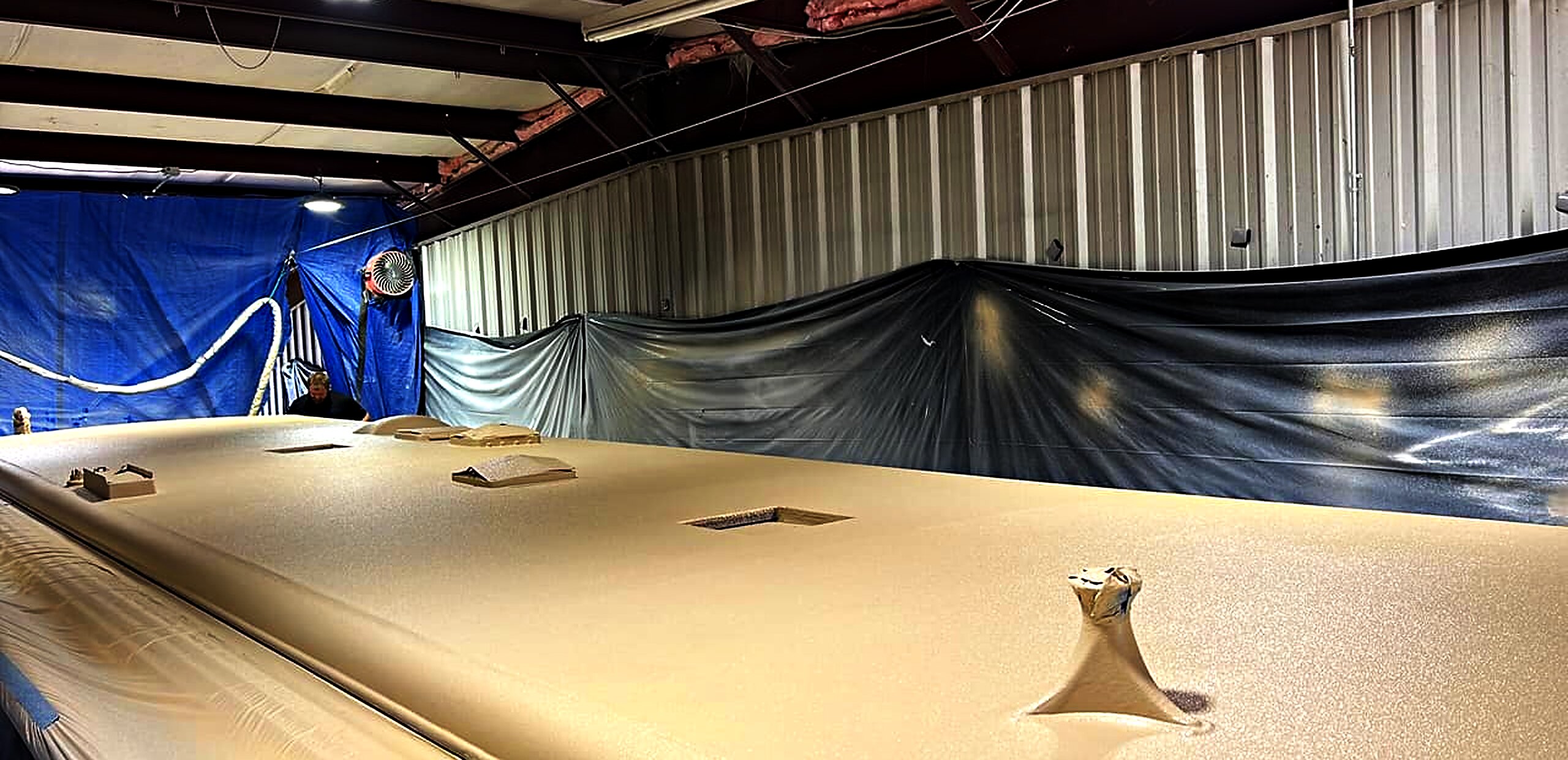
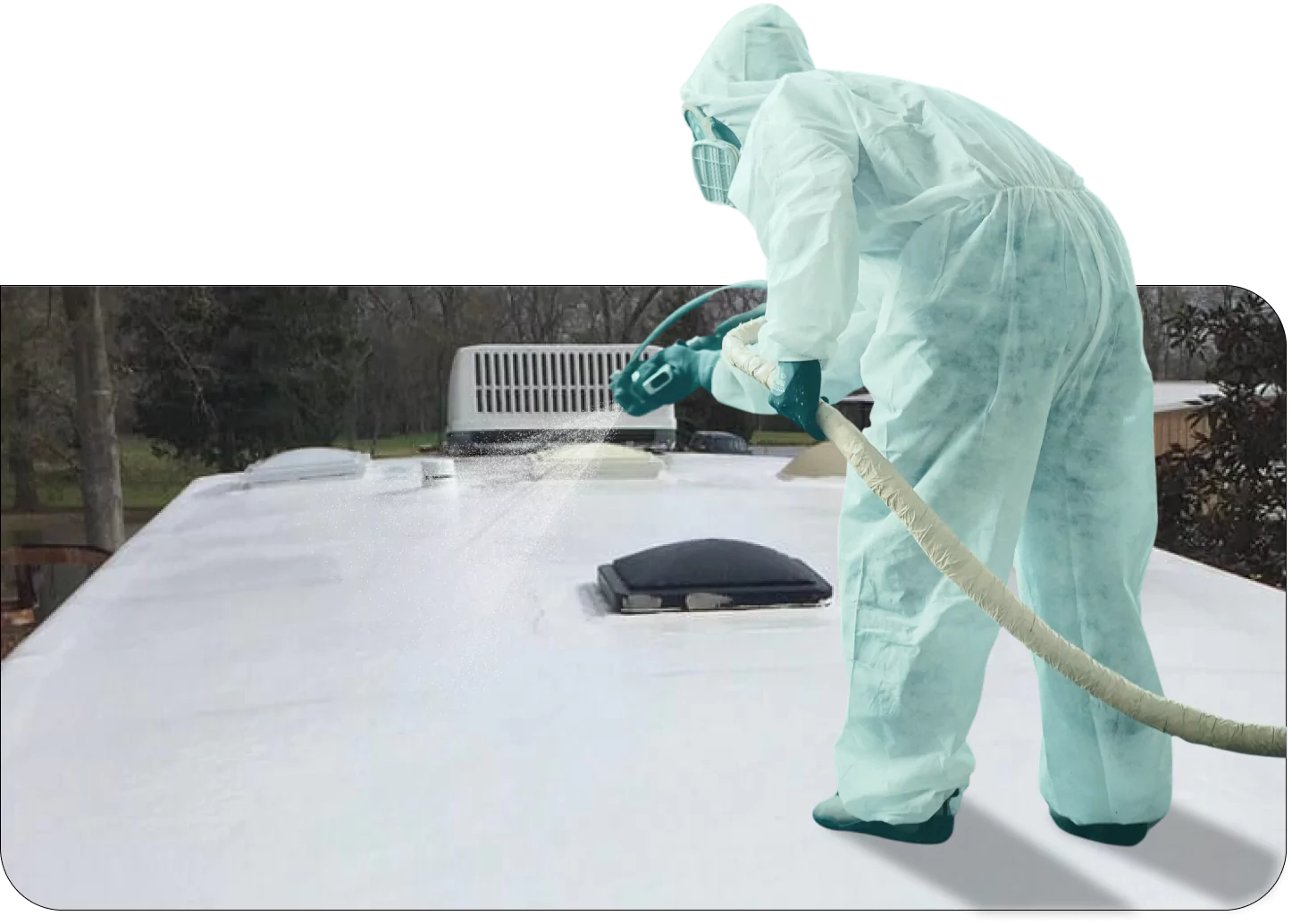
For a sprayed polyurea roof, the prep still follows the substrate. Our RV roof coatings page lays it out: EPDM abraded and primed, TPO sanded and primed, fiberglass sanded (sometimes with a tie-coat) and aluminum degreased, de-rusted and abraded.
How long each roof lasts, and what's warranted
Service life depends on care, climate and the deck, so treat these as ranges. Sheet warranties cover the membrane, labor only in the early years, and not sealants.
| Roof | Typical life | Sheet warranty | Watch for |
|---|---|---|---|
| EPDM | 12–20 yrs; Dicor: "a minimum of 20 years" if maintained | Dicor: 12 years, sheeting only; parts and labor years 1–5, pro-rated material years 6–12; original purchaser; glue, lap sealant and butyl excluded | Cracked lap sealant, lifting edges, vent gaskets and skylight perimeters |
| TPO | 10–20 yrs | DiFlex II: 12 years material plus 2 years labor (OEM), 20 years (aftermarket). Alpha: limited lifetime material; labor 100% for 2 years, pro rata through year 5; sealants excluded | Failed seams, which "need to be welded back together by a shop" |
| PVC | 15–20 yrs | Dicor Tufflex: lifetime limited. RecPro advertises 15 years non-prorated on its .027″ PVC | Compare the terms, not just the length |
| Fiberglass | 20+ yrs | Not in our sources | Stress cracks at edges and penetrations; delamination |
| Aluminum | 20+ yrs | Not in our sources | Sealant around every penetration and rail |
Climate moves the numbers. San Diego RV Center puts fiberglass at "20 to 25 years or more," TPO at "15 to 20 years" and EPDM at "typically 10 to 15 years" in its sunny market. A1 RV Repair finds rotted substrate "in roughly 35 percent of full-reroof jobs" on coaches over 12 years old. At the end, our replacement cost guide prices each type.
One spray roof, four kinds of prep
We make spray polyurea coatings and train the applicators who put them on RV roofs. A certified ArmorThane applicator starts by confirming the roof type, because EPDM, TPO, fiberglass and aluminum each get their own prep.
Where we don't fit: a sound TPO roof mostly needs washing and sealant checks, and a small puncture is often a patch job. If the decking is soft, the fix starts there. More on our RV roof coatings page.
Which roof is it?
The material should be confirmed (vent trim ring, feel test, paperwork) before any cleaner or primer touches it.
How will you prep it?
Abrade and prime EPDM, sand and prime TPO, sand fiberglass, or degrease, de-rust and abrade aluminum.
What about the deck?
Soft spots around vents and fixtures should be repaired before anything goes over them.
Every roof type is a service call.
Most RV owners don't know what's on their roof. A tech who can tell, and knows what each one tolerates, is worth finding. We supply spray polyurea systems and train applicators, with no franchise fee, dealership fee or royalty.
Already coating? Become an ArmorThane applicator →
RV roof types FAQ
What are the different types of RV roofs?
There are five main types. EPDM (rubber), TPO and PVC are thin membranes glued over wood decking. Fiberglass (FRP) roofs are rigid panels, found on many Class A motorhomes and some truck campers, and aluminum roofs are riveted metal skins, found on Airstreams. Membranes run about .027 to .035 inch thick.
What kind of roof does my RV have?
Check the owner's manual, spec sheet or roof label first. Otherwise, use the rig and year: Alpha Systems says the industry moved away from rubber roofs in 2011, so most towables built since are TPO. Airstreams are aluminum, and many Class A coaches are fiberglass. Then confirm by feel: EPDM is chalky, TPO orange-peel textured.
How do I tell if my RV roof is EPDM or TPO?
Remove a vent trim ring and look at the membrane's edge. Keystone says white or dove on top with black backing is likely EPDM, while one color all the way through is likely TPO, which may have a smooth or fleece backing. By touch, EPDM is flat and very chalky; TPO feels like orange peel.
Which RV brands have fiberglass roofs?
One third-party compilation lists Newmar Class A models (all but Bay Star Sport), all Tiffin models, Jayco Alante and Precept, and Forest River motorhomes. Northern Lite truck campers advertise two-piece fiberglass construction. Lists like this can be wrong for a given model year, so confirm on the spec sheet.
Does an Airstream have an aluminum roof, and can you walk on it?
Yes. Airstreams have aluminum roofs, and etrailer calls aluminum the only metallic RV roof material. If you have to go up, the Airstream Club advises walking on the roof bows, where you can see rivets running side to side. Aluminum dents easily, and Airstream recommends checking roof sealants twice a year, in spring and fall.
What is a fleece-backed TPO RV roof?
It's a TPO membrane with a fabric fleece layer underneath instead of a smooth back. Keystone notes that TPO may have a smooth or a fleece backing, and Dicor's 2025 line-up includes a fleece-backed TPO. Fabric under a one-color sheet at a vent trim ring means the roof is TPO, so TPO care and sealant rules apply.
How thick is an RV roof membrane?
Dicor lists its Brite-Ply EPDM at .035 inch, BriteTEK TPO at .030 inch, and DiFlex II TPO and Tufflex PVC at .027 inch; it added .035 inch Tufflex and DiFlex in 2023. Alpha's SuperFlex TPO is a nominal .030 inch. For comparison, Filon's fiberglass Flexroof panel is .045 inch thick.
Can I use Dicor EPDM cleaner/activator on a TPO roof?
No. Dicor's 2025 catalog labels its RP-CRP-Q Cleaner/Activator for EPDM and PVC use only. TPO gets Dicor's RP-TPR-Q primer instead, labeled for TPO use only and required under Dicor's Signature silicone coating on TPO. Dicor's acrylic roof coatings are also listed for EPDM and PVC only.
Does a TPO RV roof need to be coated?
Usually not. Alpha Systems says no coatings are necessary because TPO is a plastic, not a rubber, and Keystone says the membrane needs none, though seams need maintenance every 90 days. If you coat anyway, use a TPO-rated product with its primer and check your RV maker's warranty; Keystone says to avoid silicone products on its roofs.
How do I clean and protect a fiberglass RV roof?
Wash it every three to six months, wax it once or twice a year, and avoid abrasive pads, steel wool and harsh solvents. UV oxidation can make fiberglass yellow, fade or turn chalky, and flexing causes hairline cracks. Check the edges and around vents, skylights and AC units, where stress cracks tend to start.
What is the best RV roof material?
It depends on the rig. Fiberglass and aluminum typically last 20 years or more, but fiberglass costs more to replace and aluminum is the heaviest option. Membranes are lighter, with typical lives of 12 to 20 years for EPDM, 10 to 20 for TPO and 15 to 20 for PVC. Any roof lasts longest when it's cleaned, sealed and inspected regularly.
Can I replace an EPDM roof with TPO or fiberglass?
Yes. A re-roof removes the old membrane, and Dicor says the decking must be replaced too, so you choose what goes back on; Dicor sells EPDM, TPO and PVC sheet for the aftermarket. Fiberglass is a bigger, costlier job. Our replacement cost guide compares prices by type.
Written from roof makers' spec sheets, care guides and warranties, RV brand owner resources and ArmorThane's experience training independent applicators since 1989. Reviewed September 27, 2026.
Methodology and sources
Figures are as published on the dates shown; EPDM weight per sq ft is our arithmetic. Brand matches partly come from a third-party list. Where makers differ, the care planner uses the stricter rule.
- Dicor Products: FAQ (2026, 2022), EPDM page (2019), 2025 catalog, DiFlex II warranties, sealant and coating pages (2024)
- NATDA, Dicor Tufflex PVC and DiFlex TPO release (Mar. 2023)
- Alpha Systems, Roofing and Product Care (Sep. 2026)
- Keystone RV, roof and seal maintenance guides
- VALTO, Filon Flexroof sheet (Sep. 2025); RV PRO (Sep. 2025)
- Travels with Ted, 40 RV Brands with a Fiberglass Roof (Nov. 2025); Northern Lite (Aug. 2026)
- etrailer, RV Roof Types (Jul. 2024)
- San Diego RV Center (Jun. 2026); Roamly (Apr. 2026); A1 RV Repair (May 2026); RV Roofing Solutions (Jul. 2025); Let's RV (Apr. 2026); RV Inspector Pro (2019)
- Airstream Support (2023); Airstream Club; Vintage Airstream
- Jayco; Forest River Towable Limited Warranty 2021–23; Geocel (Jun. 2026); H.B. Fuller EternaBond; RecPro
- U.S. Department of Energy, Energy Saver: Cool Roofs
- ArmorThane: RV Roof Coatings, RV Roof Repair Guide, RV Roof Sealant, RV Roof Replacement Cost (2026)

Not sure what's on your roof, or what to do about it? Get a quote from a certified applicator.
Tell us your rig, its year and what you're seeing up top. We'll connect you with an ArmorThane-certified applicator who can confirm the roof type and quote a repair or a sprayed polyurea roof.
- Roof type confirmed before any prep or primer
- Prep matched to EPDM, TPO, fiberglass or aluminum
- Straight advice when a roof only needs upkeep
- RV techs: ask about becoming an ArmorThane applicator
More to read on RV roofs
Short reads from ArmorThane on Issuu. Tap one to open it right here.