




Dump Truck Bed Liner Options: What Really Works
UHMW sheet, spray-on polyurea, AR steel or rubber: what each does for carryback, abrasion, impact and hot loads, what it costs, and when our own sprayed liner is the wrong call.
Start a spray-on bedliner business
Spray bedliners for a living.
ArmorThane sets you up to do this work, and you own the business. We make the chemistry, build the rigs, train you hands-on and answer the phone when a job gets difficult. You pay no franchise fee and no royalties. It has been that way since 1989.
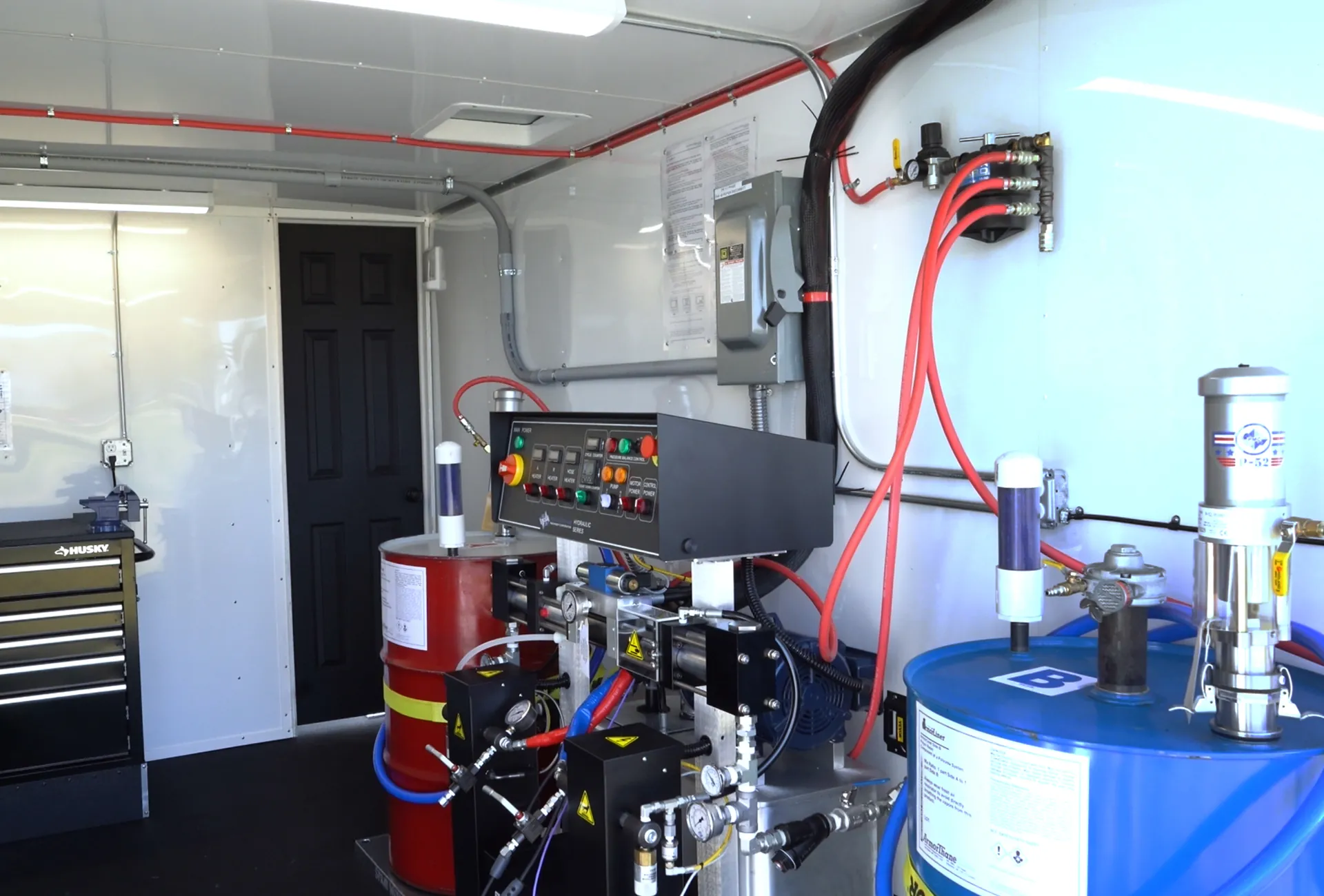
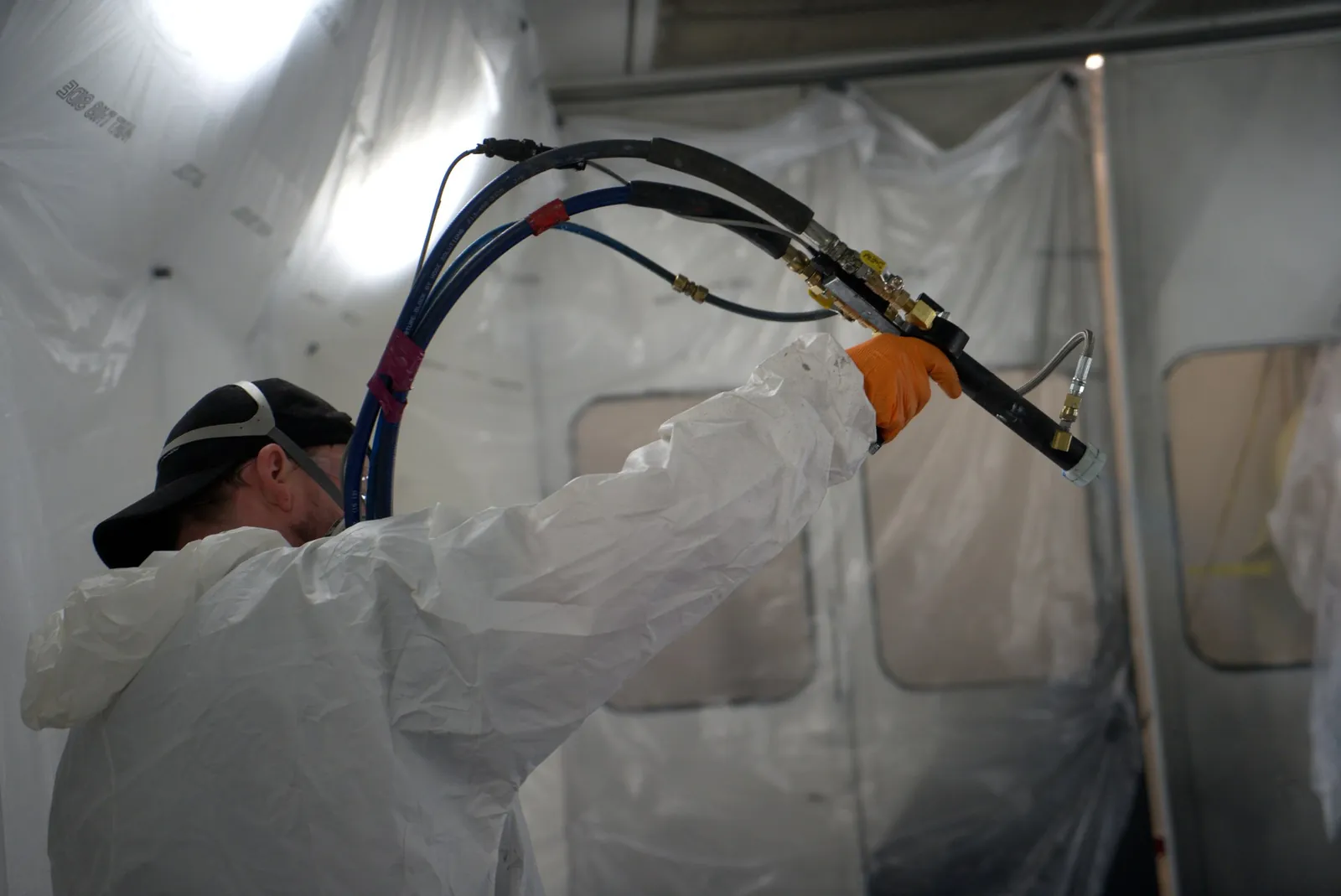
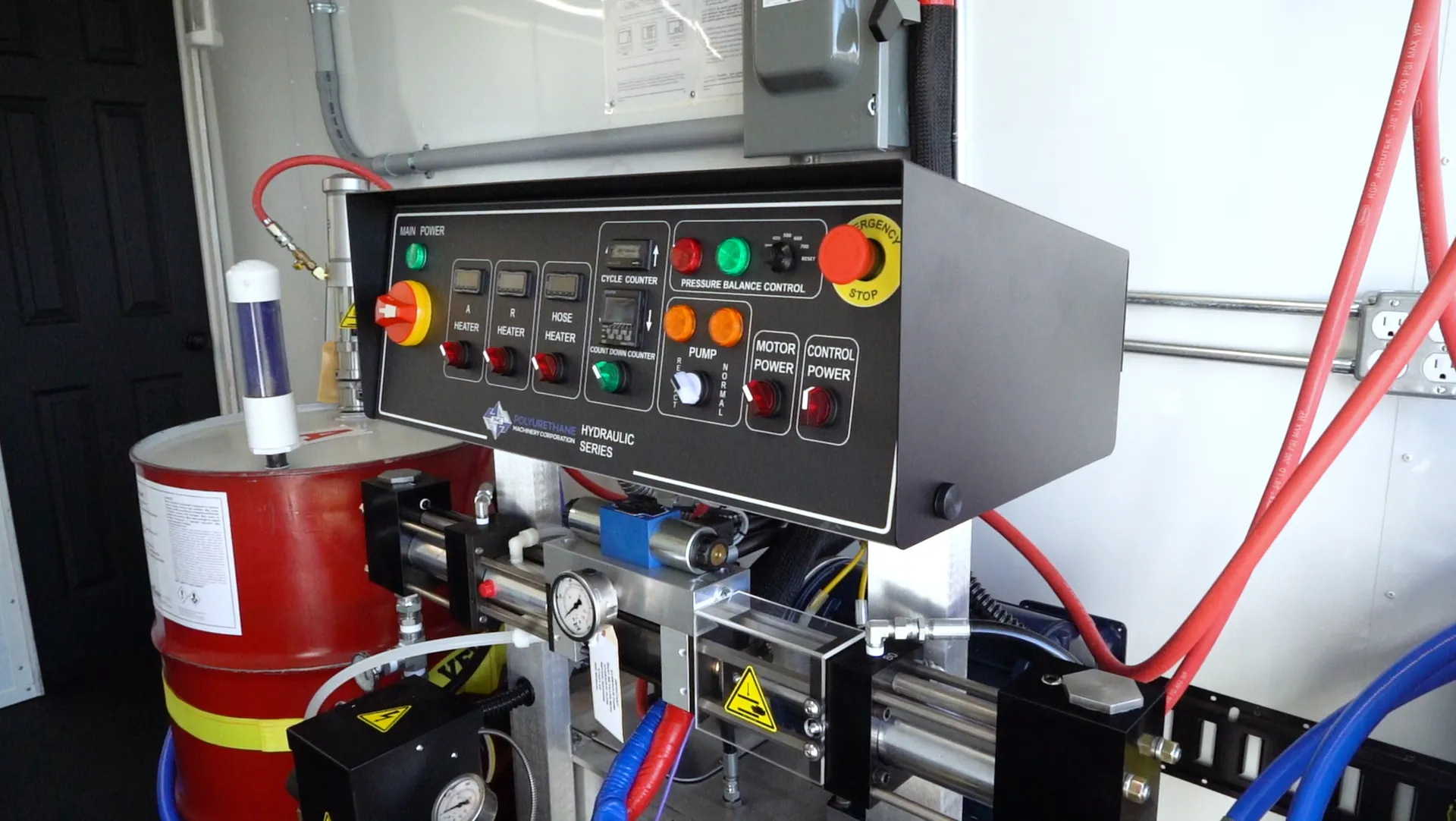
- $0
- franchise fees or royalties
- 35+
- years in business
- 50+
- countries with applicators
- 24/7
- technical support
A dump body lives a hard life. Wet clay welds itself to the floor, frozen gravel hangs up at the nose, rock gouges the plate, and salt eats whatever the rock exposed. A liner is supposed to fix some of that. Which liner fixes which problem is the part most sellers skip.
For release and abrasion on a steel or aluminum dump floor, a UHMW polyethylene sheet liner is the proven choice, typically 3/8 in. thick and about $1,800–$3,200 installed in a dump truck. Hauling hot asphalt? Only a high-temperature UHMW grade (rated around 350°F at 1/2 in.) belongs on that floor. A sprayed polyurea liner is the better fit for corrosion, impact noise, walls, bulkheads, tailgates and small dump trailers, and for sealing a rusty box before a sheet goes in. AR steel is for big rock, demolition and scrap. Match a liner to your loads or price your body.
Almost every page ranking for this topic is a plastic seller's product page. Fair enough; plastic is most of this market. But nobody puts the options side by side, gives the heat limits next to the temperature asphalt actually leaves the plant at, or does the carryback math that decides whether a liner pays for itself. Choosing a dump truck bed liner starts with what you haul. A dump truck bed liner for hot asphalt is different from one for rock or wet clay.
We make spray-on polyurea, including the ArmorLiner we'd put in a dump body, so you'd expect us to push spray. We won't, because on a lot of dump floors it isn't the best answer. We'll show you where it is.
- 1Dump bed liner types compared
- 2Which liner for what you haul (picker)
- 3What a dump truck liner costs (calculator)
- 4Carryback, dump angle and payback
- 5Liners for hot asphalt (heat check)
- 6How a sheet liner is installed
- 7Spray-on bedliner in a dump truck or trailer
- 8AR steel and Hardox vs a liner
- 9Care, winter and repair
- 10Where ArmorThane fits
- 11Dump truck liner FAQ
Dump truck bed liner types: what each one is good at
There are five real choices: a polyethylene sheet (UHMW, its high-temperature version, or cheaper HMW), a sprayed polyurea liner, abrasion-resistant (AR) steel plate, and rubber. Sheets win on release. Steel wins on gouging. Spray wins on sealing and coverage. Rubber wins on impact and noise, mostly at mining scale.
| Liner | Release | Abrasion | Impact | Heat limit | Weight (lb/sq ft) | Published cost | Published life | Best for |
|---|---|---|---|---|---|---|---|---|
| UHMW sheet (3/8 in. typical) | Best (friction 0.10–0.20) | High | Good | 180°F | 1.25 / 1.88 / 2.5 at 1/4, 3/8, 1/2 in. | $1,800–$3,200 per truck installed; $170–$185 per ft of 10-ft roll | 4–7 yr (installer) | Gravel, sand, clay, topsoil, frozen loads |
| High-temp UHMW (1/2 in.) | Best | High | Good | 350°F continuous (Matrox, 1/2 in.) | 2.5 | Highest of the sheet grades (Trison) | 5-yr warranty (Matrox) | Hot-mix asphalt |
| HMW sheet | Good | Moderate | Fair | Not for asphalt | Similar to UHMW | Lowest sheet price | 2–3 yr (installer) | Sticky but gentle loads: topsoil, mulch, manure, grain |
| Sprayed polyurea (ArmorLiner, HighLine 510H) | Better than bare or rusty steel; no published friction figure | High (510H: 20 mg Taber) | Elastomer: deforms and recovers | 250°F (510H service) | ≈0.68 at 125 mils | $5–$12/sq ft installed (general) | Not published for dump floors | Walls, bulkheads, tailgates, corrosion, small trailers, sealing under sheets |
| AR steel plate (Hardox 400–500) | No release benefit | Very high (370–530 HBW) | Very high | Steel | 10.2 at 1/4 in. | Fabrication quote | Depends on wear | Riprap, demolition, scrap, big rock |
| Rubber lining | Moderate | High | Excellent, quiet | Check rating | Not published | Quote | Up to 300% longer than steel lining (Metso claim, mining) | Big mining haul trucks |
UHMW polyethylene sheet liners
Ultra-high molecular weight polyethylene is the slick, heavy-wall plastic most dump liners are made of. Its friction coefficient is 0.10–0.20 and it's self-lubricating, so loads slide instead of sticking. It's also light: 3/8 in. weighs about 1.88 lb per square foot, against 10.2 lb for 1/4-in. steel plate. The catches are heat (180°F continuous for standard grades), thermal expansion, and the fact that a sheet only covers what it covers. It's fastened at the front and floats at the back, so material can creep under the rear edge.
HMW vs UHMW: is the cheaper plastic worth it?
HMW (high molecular weight) costs less and releases well, but it wears faster. One Texas installer puts HMW at 2–3 years and UHMW at 4–7 years when properly installed, and one seller says UHMW is 3–5 times more wear-resistant. Röchling sells its HMW grade for loads that are "primarily sticky and not typically damaging," like topsoil, animal waste and mulch. If you haul gravel daily, pay for UHMW.
High-temperature UHMW for asphalt
A separate grade with heat stabilizers and, in some brands, silicone release additives. Röchling rates its Matrox at 350°F continuous in 1/2 in. (with short spikes to 400°F) but only 200°F in 1/4 and 3/8 in. That thickness detail matters. More in the asphalt section.
Sprayed polyurea liners
A two-component elastomer sprayed 40 to 125 mils thick, with dump floors at the heavy end. It bonds to blasted steel (pull-off adhesion typically over 500 psi on our construction equipment coatings), seals every seam and weld, and covers walls, bulkheads, tailgates and hoist wells a sheet can't. It won't rust underneath because there's no underneath. What it isn't: a proven release surface on the level of UHMW, or a hot-asphalt liner.
AR steel and rubber
AR plate like Hardox doesn't make loads slide. It makes the floor survive rock. Rubber linings are mostly a mining-truck product; Metso says its rubber-lined haul truck body is up to 30% lighter than a conventional steel-lined body and cuts noise in half. For a highway dump truck they're rarely the practical pick. Details in AR steel vs a liner.
Which dump bed liner is best for what you haul?
The best liner is the one rated for your worst load. Hot asphalt rules out standard plastic and polyurea on the floor. Sharp scrap rules out most plastic. Sticky clay favors UHMW. Salt and fertilizer favor a sealed, sprayed box. Tick everything you haul in a normal year and the picker ranks the options and tells you why.
Rank the liner options for your body and loads
Scoring is our judgment built on the published limits in this guide (heat ratings, manufacturers' load lists). Treat it as a shortlist, then check the product's data sheet.
UHMW sheet liner (aggregate grade)
Floor sheet, 3/8 in. typical
- Friction 0.10–0.20: sticky loads slide
- Aggregate is what standard UHMW grades are made for
Hybrid: UHMW floor + sprayed walls, ends and steel
Sheet for release, spray for everything else
- Sheet floor releases; sprayed walls stop sticking on bare metal walls
- UHMW floor for abrasion and release
| Option | Fit | Why |
|---|---|---|
| UHMW sheet liner (aggregate grade) | Strong | Friction 0.10–0.20: sticky loads slide |
| Hybrid: UHMW floor + sprayed walls, ends and steel | Strong | Sheet floor releases; sprayed walls stop sticking on bare metal walls |
| Sprayed polyurea, full box (smooth finish) | Possible | Smooth finish beats rusty steel, but no published friction figure to match UHMW |
| High-temp UHMW sheet (asphalt grade) | Possible | Same slick UHMW, often with silicone release additives |
| HMW sheet liner (economy) | Weak | Röchling sells HMW for sticky, non-damaging loads |
| AR steel floor (Hardox-type) | Weak | No release benefit |
| Rubber lining | Weak | Mostly mining haul trucks |
A shortlist, not a spec. Confirm heat ratings, load exclusions and warranty terms on the product’s data sheet. Ask a certified applicator about the sprayed options.
How much does a dump truck liner cost?
A UHMW sheet liner for a dump truck runs about $1,800–$3,200 installed, and an end dump trailer about $2,500–$4,500, according to one installer's published prices. Material alone is roughly $170–$185 per linear foot of 3/8-in. UHMW on a 10-ft-wide roll. A sprayed polyurea box is priced by the square foot, and a full box has two to three times the floor's area.
Square footage, yardage, cost and added weight for your body
Pick a body or enter inside dimensions. Presets are published manufacturer sizes. Prices are published ranges, not quotes; labor for sheet liners is extra.
| Option | Sq ft | Estimated cost | Weight |
|---|---|---|---|
| UHMW sheet, floor only (3/8 in.) Plus installation (5–8 h). Installed: $1,800–$3,200 per truck, $2,500–$4,500 per end dump (Trison). | 116 | $2,300–$2,480 material | 218 lb |
| UHMW floor + side wall kits Material at the same per-sq-ft rate; wall kit pricing varies. | 260 | $4,750–$5,140 material | 489 lb |
| Sprayed polyurea, full box (125 mils) 29 gal incl. 15% overspray. Blast prep included in a proper quote. | 325 | $1,630–$3,900 installed | 222 lb |
| Hybrid: UHMW floor + sprayed walls and ends Sheet material plus sprayed walls, bulkhead and tailgate. | 325 | $3,350–$4,990 mixed | 361 lb |
| 1/4 in. AR steel floor (reference) Weight of the plate itself, for comparison. | 116 | Fabrication quote (no published price) | 1,183 lb |
Inside dimensions 16.0 ft x 87 in x 54 in. On a truck body the hoist well takes about 1/2 yd³ (Ox Bodies), and a curved-side body loses a little more. UHMW material is our per-sq-ft math from a 10-ft-wide roll priced by the linear foot; if you’re billed for the full roll width, this floor runs up to $3,050–$3,290. Narrower rolls cost less. Estimates only. Get a sprayed-liner quote from a certified applicator.
How we calculated this: floor = length x width; sides = 2 x length x height; ends = 2 x width x height. Capacity = L x W x H ÷ 27 (Ox Bodies' method; a hoist well takes about 1/2 yd³). UHMW material = area x $17.00–$18.50 per sq ft (Rhodes Works' $170–$185 per linear foot for 3/8 in. x 10 ft, 2026), plus aluminum retaining strips at $82.50 per 10 ft (Higgs Parts). Polyurea = area x $5–$12 per sq ft installed, ArmorThane's published general range; gallons = sq ft x mils ÷ 1,604, plus 15% overspray. Weight uses 8.75 lb per gallon (the density listed for our HiChem polyurea).
Published dump liner prices
| Item | Published price | Date | Source |
|---|---|---|---|
| Plastic liner, dump truck, installed | $1,800–$3,200 | 2026 | Trison Tarps (Paris, TX) |
| Plastic liner, end dump trailer, installed | $2,500–$4,500 | 2026 | Trison Tarps |
| UHMW 3/8 in. x 10 ft roll, cut to length | $185 per linear ft (8 ft = $1,480) | 2026 | Rhodes Works (DURAPRO) |
| UHMW 3/8 in. x 10 ft, house brand | $170 per linear ft | 2026 | Rhodes Works |
| HMW end-of-roll remnant, 21 ft of 3/8 in. x 10 ft | $1,150 plus $150–$300 freight | 2025–26 | Warner Plastics |
| Aluminum retaining strip, 10 ft | $82.50 | 2026 | Higgs Parts |
| Sprayed polyurea, installed (general industrial) | $5–$12 per sq ft | 2026 | ArmorThane |
| Pickup spray-in bedliner (for scale) | $525–$700 per full-size bed | 2026 | Our spray-in bedliner cost guide |
What moves the price
- Grade. HMW, then standard UHMW, then high-temperature UHMW, in rising order (Trison's grade table).
- Width and thickness. Liners are sold by the linear foot of a roll width (8 to 16 ft). Thicker is heavier and costs more.
- Walls, nose and tailgate. A floor-only liner is the base price. Wall kits, nosewraps, tailgate kits and "thick tail" rear sections are extra.
- Old liner removal. Trison says a 5–8 hour install gets longer when an old liner and cover strips come out first.
- Prep for spray. A sprayed liner on steel needs abrasive blasting. Rust, oil and pitting all add hours.
Is a dump truck liner worth it? Carryback, dump angle and payback
Usually, if you haul sticky or frozen material. Carryback is the load that doesn't come out: it rides back to the pit, costs you payload on the next trip, and gets shoveled out by someone you're paying. Röchling says "hundreds of pounds of material can get stuck" in an unlined bed. The calculator turns your numbers into dollars per year, months to payback and cost per cubic yard hauled.
Dump angle and rollover risk
A load that hangs up at the nose makes drivers raise the body higher. That's when trucks and trailers tip. Röchling claims its liners cut the dump angle needed for release by up to 50% and shows a trailer dumping gravel on the third of five hoist stages. RRR Supply says its customers raise the hoist about one-half to two-thirds of the way. Those are sellers' claims, but the physics is plain: the less the load sticks, the lower you dump.
What sticking costs, and what a liner costs per yard
Defaults are example inputs, not measurements. Use your own ticket weights, rates and cleanout times.
| Liner | Cost | Life | Cost per year | Per yd³ hauled | Payback |
|---|---|---|---|---|---|
| Liner A | $3,000 | 5.5 yr | $545 | 2.2¢ | 5.0 mo |
| Liner B | $2,750 | Unknown | — | — | 4.6 mo |
Break-even Liner B has to last 5.0 years to match liner A’s cost per cubic yard. Ask the seller for a written warranty or a track record on bodies like yours.
1,760 loads a year; 264 tons carried back ($3,168) and 59 truck hours lost ($6,453). Liner A’s cost over its life works out to $0.31 per load. These are example inputs until you enter yours; they leave out fuel, brakes and hoist wear.
How we calculated this: loads per year = loads per day x days; tons lost = loads x carryback lb ÷ 2,000; carryback cost = tons lost x $/ton + loads x minutes ÷ 60 x $/hr; savings = carryback cost x share fixed. Cost per cubic yard = liner cost ÷ (loads per year x yd³ per load x life). Break-even life for liner B = B's cost ÷ A's cost x A's life. Our calculation; it ignores fuel, brake and hoist wear, which only make the case stronger.
Notice what the example says. A few hundred pounds of sticking, repeated over 1,760 loads a year, costs more than the liner does. That's why the real decision isn't "liner or no liner." It's which liner, and whether its cost per yard beats the next option over its actual life. When a seller can't give you a life figure or a warranty in writing, the break-even line tells you what it would have to last.
Dump truck bed liners for hot asphalt
Hot-mix asphalt is usually loaded at 250–350°F (Pavement Interactive). Standard UHMW is rated to 180°F continuous, and one installer says hot asphalt "will melt and destroy" standard HMW and UHMW liners. You need a high-temperature grade in the thickness it's rated for: Röchling rates Matrox at 350°F continuous in 1/2 in., but only 200°F in 1/4 and 3/8 in. Other sellers list 400°F and 450°F asphalt grades; get the rating in writing for your thickness.
Release agents: what to use and what to skip
Even with a liner, asphalt haulers use a release agent. Pavement Interactive says beds should be lubricated with non-petroleum products such as lime water, soapy water or commercial release agents, and that diesel fuel should not be used because it's an environmental problem and breaks down the asphalt binder. One UHMW maker adds a wrinkle: it recommends citrus- or soy-based agents with its liner and warns that soap-based agents can dry out the plastic over time. Check your liner maker's list and your DOT spec before you pick one.
Heat and expansion: the other thing plastic does
UHMW grows and shrinks a lot with temperature: 11.1 x 10⁻⁵ in. per inch per °F (Curbell). A 16-ft liner installed at 75°F is about 1.6 in. shorter at 0°F. That's why sheet liners are bolted at the front and float at the back, and why installers cut them short of the tailgate. The check below does that math and compares your hottest load with the liner's rating.
Will the liner handle your hottest load, and how much will it move?
Expansion uses Curbell's generic UHMW coefficient; your product's data sheet may differ slightly. Tailgate cutback figures are one liner maker's install chart.
Within rating Hottest load 150°F vs 180°F for standard UHMW/HMW. Total movement across your temperature range: 2.56 in. over 16.0 ft. This is why sheets are fastened at the front and float at the back under cover strips.
How a dump truck liner is installed
A continuous-length sheet liner is a two-person, one-day job: installers quote 5–8 hours, longer if an old liner comes out. It can be done in your shop with a kit, but it needs heat, a welder or bolts for the edge strips, and a body that's in decent shape. Here's the sequence from one liner maker's installation manual (American Made Liner Systems), condensed.
Check and fix the body
The body should be structurally sound. Dents between the ribs of 3/4 in. or deeper get pounded up or patched, holes and rips get patched, and anything bolted to the floor or walls comes off or gets ground down.
Protect the steel under the sheet
The manual says steel bodies should be coated with rust-preventive paint or a tar-based undercoating before the liner goes in, because the sheet doesn't seal the floor. Aluminum bodies need no extra prep unless you haul corrosive loads. That's a job a sprayed coating does well, and it's the reason we suggest the hybrid below.
Warm the plastic
Unroll the liner 2–3 hours ahead and work at 75°F or warmer. In winter that means a heated bay, or a tarp and a heater over the body. Cold plastic fights you and bubbles later.
Cut the nose and fit the doghouse
Template the front with cardboard, cut the hoist doghouse opening 1/4–1/2 in. oversize for expansion, and run silicone around the front of the body only. Never at the rear.
Fasten the front, let the back float
Fasteners go around the doghouse and front, in staggered rows ahead of the doghouse, countersunk so 3/16–1/4 in. of plastic stays under the head. The rear is left free to move.
Cut back from the tailgate
Trim the liner short of the tailgate: about 1.5 in. for bodies up to 20 ft, 2.5 in. for 21–34 ft, and 3 in. for 35–40 ft, per the manual's chart.
Install the edge protectors
Metal cover strips are welded or bolted over the liner edges so material can't pack under them. Leave room for the sheet to slide. Too tight and it kinks; too loose and it pops out.
Can you spray a bedliner in a dump truck or dump trailer?
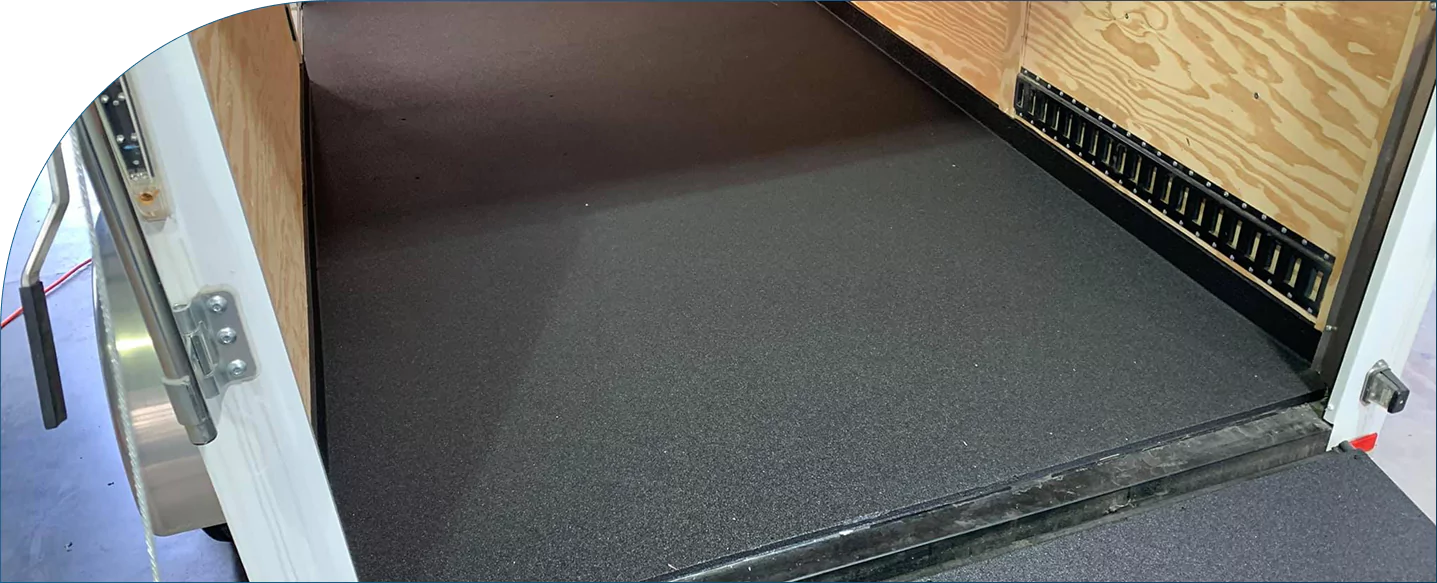
Yes, and on the right body it's the better liner. A sprayed polyurea liner covers the whole box, walls, bulkhead, tailgate and seams included, bonds to blasted steel so nothing gets underneath, and repairs in the field. It isn't the right floor for hot asphalt, and if release is your number one problem, a UHMW sheet is the proven answer.
Where a sprayed dump bed liner wins
- Rust and corrosive loads. Salt, fertilizer and lime attack steel. A seamless film with no edges is the whole point.
- Walls, bulkheads and tailgates. Spray follows ribs, radii and hinges that sheets skip.
- Small and landscape dump trailers. Irregular boxes, stake pockets and short floors are easy to spray and fiddly to sheet.
- Impact and noise. An elastomer "deforms and comes back"; a brittle film chips at the impact site and then unzips from the edge.
- Under or around a sheet liner. Seal the steel first, then drop the UHMW floor in.
Where it's the wrong call
Hot-mix asphalt floors, because the service rating is below the load temperature. Maximum release of sticky clay, because nobody, us included, publishes a friction figure for sprayed polyurea to put next to UHMW's 0.10–0.20, and pickup bedliner textures are designed to grip cargo, not shed it. Our spray-on liners can be sprayed "sleek, easy-to-clean" or with a "rough, non-slip grip," so specify smooth for a dump floor. Sharp scrap and demolition, where AR steel belongs.
Prep and thickness
Dump bodies have spent their lives full of mud, oil and rust, so prep decides everything. Our polyurea guide calls for abrasive blasting steel to SSPC-SP6 or SP10 with a 2–4 mil anchor profile. Our construction-equipment coatings go on 40 to 125 mils depending on the part, and dump body floors belong at the heavy end. Ask your applicator to spray a contrasting-color base coat: when that color starts showing through the topcoat, it's time to respray the wear zone, and it makes thin spots obvious on day one.
Which of our products, and which not
- ArmorLiner is the workhorse we list for dump beds: a 1:1 pure polyurea for metals with a balance of tensile, tear and abrasion resistance.
- HighLine 510H is the harder version for floor plate and high-abrasion zones: 55 Shore D, 2,800 psi tensile, 400% elongation, 400 pli tear, 20 mg Taber loss, and it sprays down to 20°F.
- UltraTech is our most wear-resistant system and "forms a very smooth, slick surface." It needs a primer on steel and is mostly used in mining.
- HardCoat is our rigid hybrid, built to stiffen wood and foam. It's not what we'd spray on a steel dump floor that takes rock drops; rigid films chip. Ask us before using it on a wood-decked trailer.
The same chemistry covers the rest of the truck, from the frame to the undercoating. See trailer coatings and commercial vehicle coatings for other work vehicles, and our spray-on bedliners page for pickups.
AR steel and Hardox vs a dump bed liner
AR steel is a body or floor material, not a liner in the release sense. It's the right answer when rock, riprap, demolition or scrap would cut a plastic or sprayed liner, and it does nothing for sticking. Many owners end up with both: an AR floor for gouging and a UHMW sheet or smooth coating for release.
- Hardness. SSAB lists Hardox 400 at 370–430 HBW and Hardox 500 at 470–530 HBW; Hardox 450 carries "an extra 50 HBW hardness over AR 400 grades."
- Weight. Harder plate lets builders go thinner. SSAB says moving from 6 mm to 5 mm plate cuts weight 17%. Steel is still heavy: 1/4-in. plate is about 10.2 lb per sq ft, five times a 3/8-in. UHMW sheet.
- Where it's standard. Ox Bodies builds its Stampede body for "large rock, construction riprap, and demolition" from 1/4-in. AR450 Hardox.
- What it doesn't do. Release sticky loads or stop corrosion. Bare AR plate still rusts, which is why the outside, the frame and the underside still need a coating.
What about rubber?
Rubber shines under heavy impact and noise. Metso's figures for its rubber-lined mining haul-truck body: up to 30% lighter than a conventional steel-lined body, a lining that lasts up to 300% longer than steel lining, and noise cut in half. Those are mining-scale trucks and a manufacturer's claims. For a tandem or tri-axle on the highway, rubber is rarely offered, and we couldn't find a published price.
Dump liner care, winter hauling and repair
Most liner failures are installation or abuse, not the material. A sheet needs room to move and a clean underside. A sprayed liner needs the right thickness in the wear zones and a quick touch-up when the base color shows. Neither likes being hammered with a loader bucket.
Clean under the rear
A front-mounted sheet can let material creep under the back. Clean it out regularly; trapped material wears holes from below.
Winter "wear-in"
A new plastic liner installed in cold weather may need a release agent (release foam or calcium chloride) for its first few weeks, until it wears slicker.
Summer lifting
Some lifting in hot weather is normal expansion. A liner that jams under its strips or pops out needs its cover strips reset.
Respect the limits
RE-PRO-type liners exclude loads over 180°F and sharp scrap; economy liners like E-Z exclude rock, loads over 120°F and daily abrasive hauls.
Repairing a sheet liner
Sheet makers repair or replace sections; measure the damaged area and call them. "Combo" and thick-tail liners put extra thickness at the rear, where liners wear first.
Repairing a sprayed liner
Cut back to a sound edge, feather it, prep the exposed steel and respray. Polyurea bonds to itself well when the old surface is abraded and clean.
Rust already in the floor? Fix it before any liner goes in. Our guide to repairing truck bed rust is written for pickups, but the order is the same: cut out rotted metal, weld, blast, then coat. For how polyurea compares with epoxy, paint and rubber in general, see polyurea vs other coatings.
Dump body coatings: where we fit, and where we don't
We make polyurea in Springfield, Missouri, and have for 35+ years. On dump equipment, independent ArmorThane-certified applicators spray the parts sheets and plate don't protect: walls, bulkheads, tailgates, hoist wells, frames and undersides, and whole boxes on small dump trailers. On steel bodies getting a sheet liner, they can seal the floor first.
What we'll tell any fleet: if you haul hot mix, put a rated high-temperature UHMW on the floor. If big rock and scrap are your day, the floor is AR steel. If clay sticks, a UHMW sheet releases it. Then let us protect everything else. More on our construction equipment coatings page.
Film build
By part; dump floors at the heavy end. Enamel is about 3–5 mils.
Pull-off adhesion
Typical on properly prepared steel. Nearly all peeling failures are prep failures.
HighLine 510H elongation
With 2,800 psi tensile. Moves with a flexing body instead of cracking at the welds.
Dump bodies are big, repeat work. Spray them in-house.
A 16-ft dump box has three to four pickup beds' worth of square footage, and a fleet has more than one truck. We sell the polyurea, build the rigs and train your crew, with no franchise fee and no royalties. Startup packages begin at $25,000.
See the rigs: polyurea spray rigs →
Dump truck bed liner FAQ
What is the best dump truck bed liner material?
For release and abrasion on the floor, UHMW polyethylene sheet, usually 3/8 in. thick; its friction coefficient is 0.10–0.20, so loads slide. For hot asphalt, only a high-temperature UHMW grade rated for your thickness. For big rock and scrap, AR steel. For corrosion, walls, tailgates and small trailers, a sprayed polyurea liner. The picker ranks them for your loads.
How much does a dump truck liner cost?
One installer publishes $1,800–$3,200 installed for a plastic liner in a dump truck. Material alone is about $170–$185 per linear foot of 3/8-in. UHMW on a 10-ft roll, plus cover strips. A sprayed polyurea box is priced by the square foot, roughly $5–$12 installed, and a 16-ft body has about 325 sq ft inside.
How much is a dump trailer liner?
The same installer lists $2,500–$4,500 for an end dump trailer liner, depending on width, length and thickness. Small bumper-pull dump trailers have much less floor: a 10 ft x 60 in. trailer is 50 sq ft of floor and about 100 sq ft for the whole box, so it's often a good candidate for a sprayed liner. Use the calculator for your size.
Is UHMW or HMW better for a dump liner?
UHMW, if you haul abrasive material. One Texas installer puts HMW at 2–3 years and UHMW at 4–7 years when properly installed, and one seller says UHMW is 3–5 times more wear-resistant. HMW is the budget choice for sticky, gentle loads like topsoil, mulch and manure.
Can you put a spray-in bedliner in a dump trailer?
Yes. A sprayed polyurea liner bonds to blasted steel, seals seams and covers walls, bulkhead and tailgate, which suits small and landscape dump trailers and corrosive loads. Ask for a smooth finish, 80–125 mils on the floor, and blast prep in writing. It's not the right floor for hot asphalt or sharp scrap.
What liner can haul hot asphalt?
Only a high-temperature UHMW grade. Hot mix is loaded at 250–350°F, standard UHMW is rated 180°F, and our HighLine 510H polyurea is rated to 250°F. Röchling rates its Matrox at 350°F continuous in 1/2 in. but only 200°F in 1/4 and 3/8 in., so the thickness matters. Don't use diesel as a release agent.
How thick should a dump truck liner be?
For UHMW sheet, 3/8 in. is the common default, 1/2 in. for hot asphalt and heavy abrasion, and 1/4 in. for light duty; some makers sell thicker rear sections because liners wear out at the back first. For a sprayed polyurea liner, dump floors belong at the heavy end of 40–125 mils.
How long does a dump bed liner last?
Installer figures: HMW 2–3 years and UHMW 4–7 years when properly installed. Röchling's warranties run from 1 year (HMW) to 5 years (its premium UHMW grades). Nobody publishes a service life for sprayed polyurea on dump floors; it depends on thickness, prep and what you haul, so get warranty terms in writing.
How much weight does a dump liner add?
UHMW weighs about 1.25, 1.88 and 2.5 lb per sq ft at 1/4, 3/8 and 1/2 in., so a 3/8-in. floor in a 16-ft body adds roughly 220 lb. Sprayed polyurea at 125 mils is about 0.68 lb per sq ft by our math. For comparison, 1/4-in. steel plate weighs about 10.2 lb per sq ft.
Can I install a dump liner myself?
Yes, kits come pre-cut with fasteners and edge protectors, but plan on two people, a heated bay at 75°F or warmer, and a welder or bolts for the cover strips. The body has to be sound, with holes and deep dents repaired first. Installers quote 5–8 hours.
Can a dump truck liner be repaired?
Sheet liners can be repaired in sections; measure the damage and call the maker. A sprayed polyurea liner is repaired by cutting back to a sound edge, feathering, prepping the steel and respraying. A contrasting base-coat color shows you when a wear zone is getting thin.
Is Hardox better than a dump liner?
It solves a different problem. Hardox and other AR steels resist gouging from rock, riprap, demolition and scrap (Hardox 400–500 runs 370–530 HBW), but they don't make loads slide and they still rust. Many haulers pair an AR floor with a UHMW sheet or a smooth coating for release.
Written from liner makers' data sheets and install manuals, published price lists, our own product data and 35+ years of making polyurea and supporting applicators. Last updated September 26, 2026.
Methodology and sources
Prices are sellers' and installers' published figures, dated where the page gave a date, and fetched in September 2026; they are not quotes. Material properties come from the manufacturers' own pages and data sheets. Weights, areas, expansion and payback are our calculations from those figures. Service-life numbers are sellers' statements, not independent tests. ArmorThane product values are from our published product pages and data sheets.
- Röchling, dump truck bed liners (2026): roechling.com/us/industrial/vehicle-construction/high-performance-solu
- Röchling, plastic products for the heavy duty truck market (brochure, Feb. 2025, PDF): roechling.com/fileadmin/media/Roechling-Industrial/_US_Media/Dumpliner
- Röchling, Polystone lining systems (Mar. 2022, PDF): roechling.com/fileadmin/media/Roechling-Industrial/_US_Media/Dumpliner
- American Made Liner Systems, heavy-duty RE-PRO liners: linersystems.com/heavy-duty-liner.php
- American Made Liner Systems, installation instructions (PDF): linersystems.com/pdf/RP-EZ-Install-06-07-2016.pdf
- American Made Liner Systems, care and maintenance (PDF): linersystems.com/pdf/care-maintenance-RP-EZ.pdf
- Trison Tarps, Rockhard dump liners: prices, life and install time (2026): trisontarps.com/rockhard-liners/
- Rhodes Works, DURAPRO UHMW 3/8 in. x 10 ft liner, per-foot price (2026): rhodes-works.com/DURAPRO-Liner-UHMW-38-Thick-x-10-Wide-x-Custom-Length
- Linings Inc., QuickSilver dump truck liners: liningsinc.com/products/quicksilver
- Warner Plastics, liner products and roll weights: warnerplastics.com/products.html
- Warner Plastics, end-of-roll prices: warnerplastics.com/bargain_area.html
- Higgs Parts, Avalanche dump liners and retaining strips: higgsparts.com/collections/dump-liners
- RRR Supply, dump truck poly liners: rrrsupply.com/
- Curbell Plastics, UHMW properties (Oct. 2025): curbellplastics.com/materials/plastics/uhmw/
- Pavement Interactive, HMA transport: pavementinteractive.org/reference-desk/construction/transportation/hma
- SSAB, Hardox product program: ssab.com/en/brands-and-products/hardox/product-program
- SSAB, Hardox wear plate: ssab.com/en/brands-and-products/hardox
- Ox Bodies, Stampede dump body: oxbodies.com/products/stampede/
- Ox Bodies, how to choose the right dump truck body size: oxbodies.com/how-to-choose-the-right-dump-truck-body-size/
- Big Tex Trailers, 14LP-14 dump trailer: bigtextrailers.com/trailer/14lp/14lp-14/
- Big Tex Trailers, 70SR-10 dump trailer: bigtextrailers.com/trailer/70sr/70sr-10-5wdd/
- Metso, rubber-lined truck body (May 2021): metso.com/corporate/media/news/2021/5/enabling-mines-and-quarries-to-h
- Engineering ToolBox, metal and alloy densities: engineeringtoolbox.com/metal-alloys-densities-d_50.html
- ArmorThane, construction equipment coatings: armorthane.com/protective-coatings/construction-equipment/
- ArmorThane, HighLine 510H properties (foundation waterproofing guide): armorthane.com/foundation-waterproofing/
- ArmorThane, HiChem polyurea data: armorthane.com/products/armorline-products/high-pressure/hichem-polyur
- ArmorThane, polyurea vs other coatings: armorthane.com/polyurea-vs-other-coatings/


Start your coatings business with ArmorThane.
Tell us what you want to spray and where you are. An ArmorThane specialist will walk you through the equipment, chemicals, training and startup cost for the work you want to do.
- Equipment package matched to your applications
- Hands-on training and applicator certification
- Technical support once you are spraying
Lining a dump truck or dump trailer? Talk to a certified applicator.
Tell us what you haul and the body size. We'll connect you with an independent ArmorThane-certified applicator who can spray walls, floors and tailgates, and who'll tell you straight when a sheet liner is the better floor.
- Dump trucks, end dumps and dump trailers
- Sprayed walls, bulkheads, tailgates and frames
- Blast prep and thickness in writing
- Fleets and shops: ask about spraying in-house
More to read on bedliners and vehicles
Short reads from ArmorThane on Issuu. Tap one to open it right here.