

Rust Converter: How It Works & When It Fails
The chemistry behind rust converters, the rust types they cannot touch, how they compare with encapsulators and blasting, and tools to decide and plan your job.
Start a containment coating business
Line containment for a living.
ArmorThane sets you up to do this work, and you own the business. We make the chemistry, build the rigs, train you hands-on and answer the phone when a job gets difficult. You pay no franchise fee and no royalties. It has been that way since 1989.
- $0
- franchise fees or royalties
- 35+
- years in business
- 50+
- countries with applicators
- 24/7
- technical support
A rust converter is a primer that reacts with rust instead of asking you to remove all of it. Tannic acid or phosphoric acid in the liquid turns reddish iron oxide into a dark, stable compound, and a polymer binder seals that layer so you can paint over it. We see rust converter used well on trailers, frames, fences and old equipment, and we see it fail when it is asked to do a blast cleaner's job. This guide explains the chemistry in plain terms, where converters work and where they do not, how they compare to encapsulators and blasting, and gives you two tools: one to decide whether to convert at all, and one to work out how much product you need and whether today's weather will let you apply it.
Use a rust converter on tight, adherent rust on steel you cannot practically blast, such as a frame, trailer, gate or the underside of a vehicle. Wash it, knock off every loose flake with a wire brush or power tool, apply one or two thin coats, wait about 24 hours, then topcoat. Do not use it on clean steel, galvanized steel, deep salt-pitted metal you can blast instead, or anything that will sit in water. For long-term protection under a heavy coating such as polyurea undercoating, mechanical prep to bare metal plus the coating maker's primer beats any converter.
How a rust converter actually works
Most rust converters have two working parts. The first is an acid that reacts with iron oxide. Tannic acid is the classic one: it turns red-brown rust into bluish-black ferric tannate, the same chemistry conservators have used on archaeological iron for decades. Industrial research on tannin solutions as rust primers goes back to the 1950s. Some formulas add phosphoric acid, which converts part of the oxide into an iron phosphate layer. The second part is an organic polymer, usually an acrylic or latex emulsion, that binds the converted layer and gives the next coat something to grab.
That color change is the tell. When a converter goes on milky or tan and dries to a uniform black or dark purple within an hour or so, the reaction happened. Where it stays brown or tan, either there was no rust to react with or the rust was too thick for the liquid to reach through it.
Three things a converter is not
- It is not a rust remover. Removers dissolve rust so you can rinse it off. A converter leaves the rust in place and changes it. You end up with a thin primer film, not clean steel.
- It is not a finish coat. The film is thin and the binder is not built for years of UV and abrasion. Rust-Oleum's own data sheet for Stops Rust Rust Reformer tells you to apply a topcoat after 24 hours, and Corroseal's sheet lists enamels, acrylics and urethanes as topcoats.
- It is not for clean metal. The acid needs iron oxide to react with. Rust-Oleum says plainly not to use Rust Reformer on non-rusted surfaces. On bright steel you are better off with a real metal primer.
Where rust converter works, and where it fails
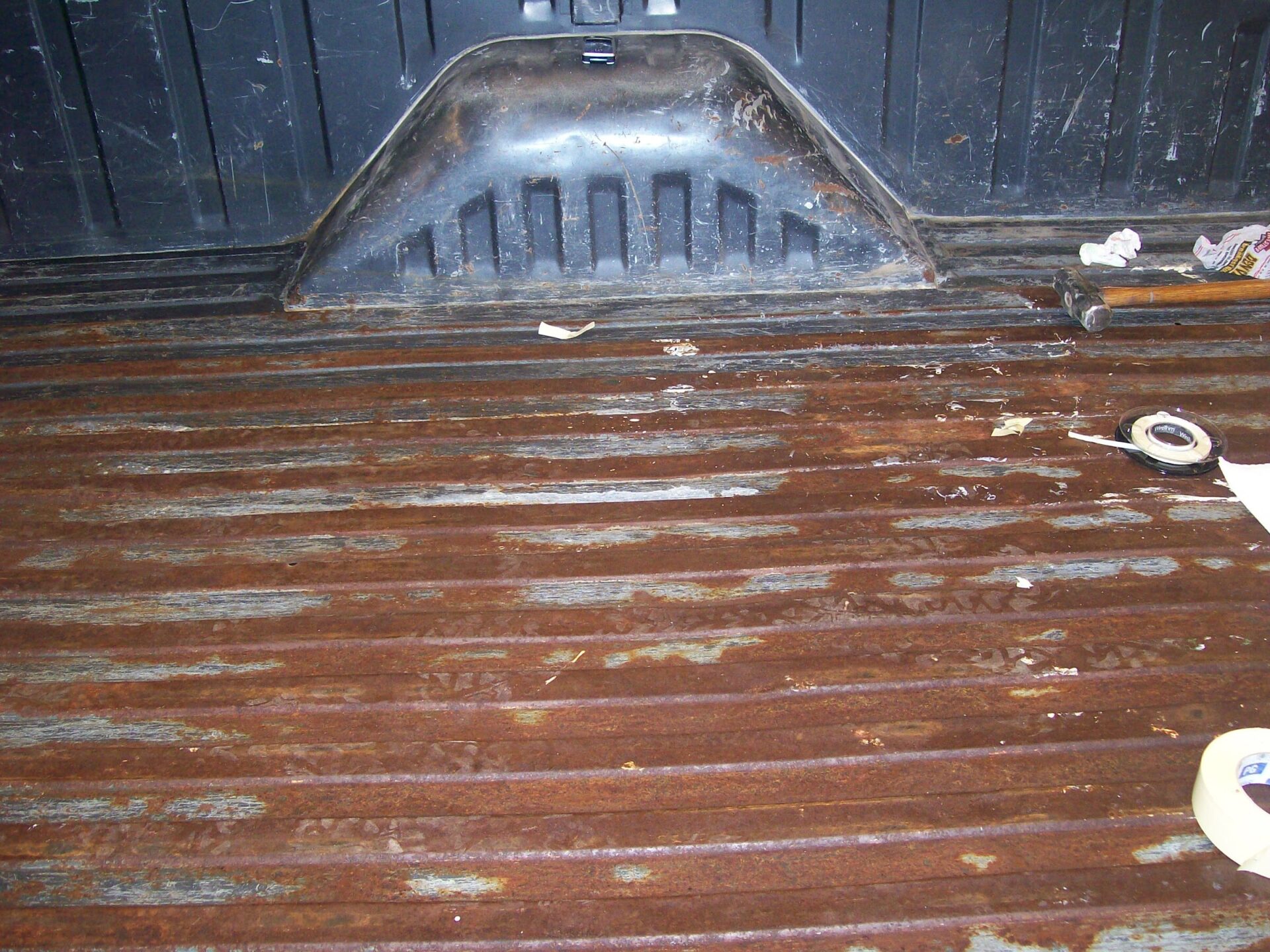
Rust is not one material. Depending on how and where steel corrodes, the scale is a mix of different iron oxides and oxyhydroxides, and converters do not handle them equally. A 2019 review in Progress in Organic Coatings reported that spinel-type oxides converted at roughly 90%, goethite at about 30%, and akaganeite resisted conversion. That matters on vehicles and trailers, because akaganeite is the chloride-bearing rust that forms where salt is present, the most frequently encountered chloride corrosion product on steel in marine conditions. In plain terms, the rust you most want to stop, salt-belt rust in pits and seams, is the rust a converter is least able to change.
There is also a dosing problem. Corrosion-doctors.org points out that you cannot accurately match a converter to the thickness and makeup of a rust film, and that converters are not permitted in many areas of steel construction for exactly that reason. Too little product over thick rust leaves unconverted oxide underneath. Too much over thin rust leaves unreacted acid and a soft film.
Tight surface rust you cannot blast
Frame rails, trailer crossmembers, fence and railing, implements, the inside of channels. Wire brush off what is loose and convert the rest.
Spot repairs on painted parts
Rust blooming through chips on a painted part. Feather the edges, convert the rusty spots, prime and topcoat to match.
Heavy flaking scale
Converters cannot react through thick layered scale. Remove it to tight rust first with a needle scaler, wire wheel or scraper, then convert.
Deep salt pitting
Chlorides sit in the bottom of pits and keep corrosion going under the film. Blast or grind clean where you can, and wash with fresh water first.
Immersion or standing water
Corroseal's data sheet says it is not recommended for underwater hulls, immersion or standing water. Tanks and troughs need blasting and a lining.
Galvanized or clean steel
Rust-Oleum lists galvanized steel and non-rusted surfaces as do-not-use. White rust on zinc is a different problem with a different fix.
Should you use a rust converter on this job?
Answer four questions about the part. The tool gives you a verdict, the minimum surface prep we would accept (using the SSPC / AMPP surface preparation standards), and the primer route that fits. It is built from the manufacturer limitations and studies cited on this page, not from a sales script.
Convert, encapsulate or blast?
Rust condition and exposure set the verdict. Galvanized steel, immersion and holes rule a converter out. Salt exposure and pitting push you toward mechanical prep. The planned topcoat sets the minimum prep standard.
The prep standards the tool refers to
- SSPC-SP 2 and SP 3 (hand and power tool cleaning) remove loose rust, mill scale and paint. Tight rust stays. SP 3 does not require any surface profile. This is the normal prep before a converter.
- SSPC-SP 11 (power tool cleaning to bare metal) removes everything visible and leaves a profile of at least 1 mil (25 microns). It is the practical choice for frames and axles where blasting is not an option.
- SSPC-SP 10 / NACE No. 2 (near-white blast) allows staining on no more than 5% of each 3 in. by 3 in. area. This is what we want under heavy coatings in salt or immersion service.
Rust converter vs. encapsulator vs. blasting
These are the main ways to deal with rust before paint. Click a column header to sort. Prep effort runs from 1 (wash and wire brush) to 5 (abrasive blast). Film and coverage figures come straight from the data sheets listed under the table.
| Approach | How it works | Prep effort (1-5) | Film per coat | Coverage, sq ft/gal | Topcoat needed? | Salt-belt durability |
|---|---|---|---|---|---|---|
| Tannin converter, brush-on (Rust Reformer type) | Reacts with rust, latex binder | 2: SP 2 / SP 3 | Thin, not specified | 192–320 (from 12–20 per 8 oz) | Yes, after 24 hr | Fair |
| Converter-primer (Corroseal type) | Converts rust, latex primer film | 2: SP 2 / SP 3 | 1.8–2.9 mils DFT | 502 at 1 mil (theoretical) | Yes, within 30 days | Fair |
| Rust encapsulator (POR-15 type) | Seals rust off, moisture-curing film | 2–3: clean, etch, dry | 6–7 mils in 2–3 coats | 250–450 | Only if exposed to sun | Good |
| Rust encapsulator (KBS RustSeal type) | Seals rust off, moisture-curing film | 2–3: clean, etch, dry | 3–5 mils in 2–3 coats | 400 at 2 mils | For UV exposure | Good |
| Power tool to bare metal + primer | Removes rust, primer bonds to steel | 4: SSPC-SP 11 | Per primer TDS | Per primer TDS | Yes | Very good |
| Blast + primer + polyurea / polyurethane | Removes rust, thick elastomer barrier | 5: SSPC-SP 10 | Tens of mils (system spec) | Per system spec | Aliphatic topcoat if UV | Best |
Rust converter coverage and weather check
Rusty steel is rough and thirsty, so we plan from the low end of a manufacturer's coverage range on pitted metal and the high end on light, tight rust. Put in the area and today's conditions. The tool tells you how much to buy and whether the air and steel are inside the application window.
How much rust converter, and can you apply it today?
Coverage per coat comes from each product's data sheet. Dew point is calculated from air temperature and humidity (Magnus formula). Steel must be at least 5°F above the dew point and humidity at or under 85% (ASTM D3276 guidance as summarized by DeFelsko), and Rust Reformer adds its own 50–90°F and under-65% humidity limits.
How to apply rust converter so it lasts
Most converter failures we get called about are prep failures. The product did its chemistry on top of grease, salt or loose scale, and the whole layer let go a season later. This is the sequence we teach.
Wash first, then wash again
Degrease with a detergent or cleaner, then rinse with plenty of fresh water. On anything that has seen road salt or the coast, the rinse matters as much as the scrubbing: chlorides left in pits keep corrosion going under any coating. Let it dry completely.
Take off everything loose
Wire brush, scraper, needle scaler or a wire wheel, to SSPC-SP 2 or SP 3. The goal is tight, adherent rust. If a putty knife lifts it, it comes off. Do not chase every speck to bright metal; the converter needs some rust to react with.
Blow off and wipe down
Remove dust with compressed air and a clean rag. Most water-based converters can tolerate slight dampness from rinsing, but not puddles, oil or dust.
Apply thin, even coats
Brush, roll or spray per the label. Corroseal calls for 8–10 mils wet to reach 1.8–2.9 mils dry. Heavy coats run, stay soft and trap unreacted acid. Work it into seams and pits with a brush.
Check the color change
After the dry-to-touch time (20–40 minutes for Rust Reformer, 30 minutes for Corroseal at 77°F) the treated area should be uniformly dark. Brown or tan spots got too little product or had too much rust. Give them a second coat.
Wait, then topcoat inside the window
Both data sheets call for about 24 hours before topcoating. Corroseal gives you up to 30 days at 70°F; after that you have to sand and clean before topcoating. Plan the job so the topcoat goes on in that window.
Topcoats over rust converter
A converted surface is a primer, so treat it like one. Corroseal lists enamels, acrylics and urethanes as topcoats and notes that some water-based coatings need an oil-based stain-blocking coat in between. Rust-Oleum's brush-on automotive version allows an oil-based paint sooner than a lacquer. Always read both labels; the topcoat maker gets the last word on what it will bond to.
Enamel or urethane paint
The normal route for fences, trailers, implements and small parts. Two coats of a quality enamel or 2K urethane over a converted surface is a sound, cheap system in dry and moderate climates.
Rubberized undercoating
Asphalt and rubber undercoatings go over a sound primer. See our rubberized undercoating guide for which types hold up and which trap moisture.
Polyurea or polyurethane
For spray-applied elastomers we do not build on a converter film. We want SSPC-SP 11 or a blast, then a primer such as ArmorPrime UltraPrime, which is formulated to perform even on marginally prepared steel and recoats within 2 hours.
Truck and frame undercoating
If the goal is a vehicle that lasts another decade in the salt belt, read our truck undercoating guide before you buy a converter.
Why the caution under heavy coatings? A spray-applied polyurea is only as strong as the weakest layer under it. A converter film is a thin latex-bound layer sitting on converted rust, and if water or chlorides get under it, the whole system lifts as one sheet. For the full picture on steel, read our metal coating guide and the corrosion prevention overview.
Done converting the same frame every spring?
Send us photos of the rust, what the steel is (frame, trailer, equipment, tank) and how it is used. A certified ArmorThane applicator near you can quote prep to bare metal and a spray-applied coating that stays put.
Contractors: become an applicator →
Rust converter questions
Does rust converter really work?
Yes, within limits. Tannic and phosphoric acid do convert iron oxide into more stable iron tannate and iron phosphate, and a converted surface takes paint well. But conversion is incomplete on some rust types: lab work reported about 90% conversion of spinel oxides, about 30% of goethite, and little effect on chloride-bearing akaganeite. On tight rust in moderate conditions it works well. On salt-pitted steel it buys time rather than solving the problem.
Is it better to remove rust or use a rust converter?
Removing rust to bare metal and priming is always the more durable job. A converter makes sense when full removal is impractical, such as inside frame channels, on large fences, or on equipment you cannot blast. If the part can be blasted or taken to bare metal with power tools, do that.
Can you put rust converter on bare metal?
Not usefully. The active ingredients need iron oxide to react with, and Rust-Oleum's data sheet says not to use its Rust Reformer on non-rusted surfaces. On clean steel, use a primer made for metal. Where a part has both bare and rusty areas, prime the bare areas and convert only the rusty ones, or use a primer the maker rates for both.
How long does rust converter take to dry before painting?
It is dry to the touch in roughly 20 to 40 minutes, but both Rust-Oleum and Corroseal call for about 24 hours before recoating or topcoating at around 70 to 77°F and 50% humidity. Cooler or damper weather takes longer. Corroseal can be topcoated for up to 30 days; after that, sand and clean first.
Can you use rust converter on a truck frame?
Yes, and it is one of the better uses because frames are hard to blast on the vehicle. Pressure wash, scrape and wire wheel off all loose scale, rinse off salt, let it dry, then convert and topcoat. For a frame that has to survive salt for years, power tool cleaning to bare metal and a heavy coating will last longer.
Can you put undercoating or bedliner over rust converter?
Paint and many rubberized undercoatings can go over a cured converter if the undercoating maker allows it. For spray polyurea or polyurethane bedliner and undercoating, we do not recommend it: those coatings need a sound, profiled substrate, so we prep to bare metal and use the coating maker's primer instead.
What is the difference between a rust converter and a rust encapsulator?
A converter reacts chemically with the rust and leaves a thin primer film. An encapsulator is a thicker, usually moisture-curing coating that soaks into and seals the rust off from air and water. POR-15, for example, is applied at 6 to 7 mils dry in two or three coats and must be topcoated if it will see sunlight.
Can rust converter be used on galvanized steel or aluminum?
No. Rust-Oleum lists galvanized steel as a do-not-use surface, and aluminum does not form iron oxide for the converter to react with. White corrosion on galvanized steel and oxidation on aluminum need cleaning and a primer rated for those metals.
Will rust converter stop rust permanently?
No coating stops rust permanently. A converter followed by a good topcoat slows it down considerably in dry or moderate service. In salt exposure, inspect every year and touch up chips before they spread. Industry studies estimate that using available corrosion control practices could save 15 to 35% of the cost of corrosion, which is mostly a matter of good prep and maintenance.
Sources
- NACE International, IMPACT study, economic impact of corrosion: impact.nace.org/economic-impact.aspx
- Saji, V.S., Progress in rust converters, Progress in Organic Coatings 127 (2019) 88-99: sciencedirect.com/science/article/abs/pii/S0300944018305848
- Remazeilles and Refait, On the formation of akaganeite in chloride-containing environments, Corrosion Science (2007): sciencedirect.com/science/article/abs/pii/S0010938X06001909
- Rust-Oleum, Stops Rust Rust Reformer technical data SRT-14: assets.unilogcorp.com (Rust-Oleum TDS PDF)
- Rodda Paint, Corroseal Rust Converting Metal Primer 82331 technical data: roddapaint.com (Corroseal TDS PDF)
- POR-15, Rust Preventive Coating technical data: qr.por15.com (TDS PDF)
- KBS Coatings, RustSeal technical data: kbs-coatings.com/rustseal-technical-data.html
- Corrosion Doctors, rust converters: corrosion-doctors.org/MetalCoatings/rust-converter.htm
- Belzona, guide to ISO and SSPC/NACE surface preparation standards: blog.belzona.com
- DeFelsko, measuring environmental conditions (dew point and humidity limits): defelsko.com/resources/measuring-environmental-conditions
Start your coatings business with ArmorThane.
Tell us what you want to spray and where you are. An ArmorThane specialist will walk you through the equipment, chemicals, training and startup cost for the work you want to do.
- Equipment package matched to your applications
- Hands-on training and applicator certification
- Technical support once you are spraying
Rust coming back every year? Stop it at the steel.
Tell us what the steel is, how bad the rust is, and how it is used. We will connect you with a certified ArmorThane applicator who can prep it properly and coat it.
- Frame, trailer, equipment or tank
- Photos of the worst rust
- Salt, water or chemical exposure
- Your timeline