
Car Wash Floor Coating: Acids, Salt, Water and Downtime
What wash chemistry and winter salt do to a bay slab, which coating systems hold up, the drain, slope and grip details that decide success, and a calculator that adds lost wash revenue to the coating bid.
Coat floors for a living.
ArmorThane is the one-stop shop for applicators. We make the chemistry, build the equipment, train you hands-on and back you with technical support, with no franchise fees and no royalties. Applicators have come first here since 1989.
- $0franchise fees or royalties
- 35+years in business
- 50+countries with applicators
- 24/7technical support
A car wash floor coating lives in the worst conditions any floor sees outside a chemical plant. It is wet most of the day, it gets sprayed with strong acids and alkalis, it carries road salt every winter, and it has to stay grippy for customers in flip-flops holding a pressure wand. Bare concrete loses that fight within a few seasons.
The best car wash floor coating is a thick, textured, chemical-resistant system: urethane cement, or a polyaspartic or polyurea build with broadcast aggregate, over a slab that has been ground, repaired and sloped to drain. Thin epoxy paints fail fast in wash bays. Plan for acid and salt resistance, real slip texture and a short bay closure.
What a wash bay does to concrete
Wash bay slabs rarely fail from one thing. Acid etches the paste, salt and freeze-thaw pop the surface, water sits in low spots, and every tire turn grinds the loose sand out. A coating has to stop all of it at once.
Wheel and low-pH presoaks
Some wash products contain hydrofluoric acid or ammonium bifluoride, which turns into HF in water. Acids dissolve cement paste and attack many coatings.
High-pH detergents
Strong presoaks and degreasers run as high as pH 12. Alternating acid and alkali steps is hard on any surface.
Road salt and freeze-thaw
Chloride-laden slush melts in the bay, soaks the slab and refreezes overnight in unheated bays. That is how surface scaling starts.
Constant wetting
Low spots hold water and chemistry for hours. Any coating with pinholes or a weak bond line gets undercut from there.
Tires and turning
Wet grit under turning tires acts like sandpaper. Entry aprons and the area around the wand boom wear first.
Slips
Soap film on a smooth surface is slick. Customers walk the bay in every kind of footwear, so texture is not optional.
If your slab is already scaling or spalling, it needs repair before any coating; our spalled concrete repair guide covers the patch materials.
Car wash floor coating systems compared
We would not put a 10 mil epoxy in a car wash bay. It looks great for a season, then the acids and salt find every thin spot and it peels in sheets. The systems that last are thick, textured and either very chemical resistant or very fast to put back in service.
| System | Typical build | Installed $/sq ft | Typical bay closure | Acid and salt | Our take |
|---|---|---|---|---|---|
| Penetrating silane or siloxane sealer | Soaks in, no film | Low | Hours | Slows salt; no acid protection | Fine for new aprons, not for the bay floor |
| Thin epoxy paint | 5–10 mils | Low | 2–3 days | Poor | Avoid |
| Epoxy with quartz broadcast and topcoat | 1/16 in and up | $5–8 | About 3 days | Fair to good with a rated topcoat | Workable in heated, indoor bays |
| Polyaspartic or polyurea with aggregate | 20–40 mils plus grit | $5–9 | About 1 day | Good; check acid data | Best when closure time is the constraint |
| Urethane cement | 1/8–3/8 in | $7–15 | 1–3 days | Very good | Toughest choice for hard chemistry and hot water |
One combination we like for busy self-serve sites is a urethane cement base with a broadcast aggregate and a polyaspartic topcoat, which gets the chemical backbone of the cement and the color and gloss of the topcoat. For the resin trade-offs, see polyaspartic vs epoxy and our polyaspartic floor coating guide.
Coating cost plus lost wash revenue
The cheapest car wash floor coating bid is not always the cheapest job. A bay that is closed for three days instead of one costs you washes. Pick a system to load typical price and closure, then enter your bays and traffic.
Bay coating and downtime estimator
Coating = bays × length × width × $/sq ft. Lost revenue = bays × closed days × washes per bay per day × average ticket × (1 − share of customers who use another open bay). Defaults are typical: polyaspartic $7 and 1 day, epoxy broadcast $6.50 and 3 days, urethane cement $10 and 2 days. Use your own bids.
Comparing floors for other parts of the site, like the equipment room or detail shop? See our commercial floor coating guide.
Details that decide whether it lasts
Fix the slope and the low spots
Water should run to the trench drain, not sit by the wand. Build pitch with a mortar or slurry before the finish goes on; no coating survives a permanent puddle.
Grind or shot blast past the damage
Remove scaled, salt-soaked and acid-etched concrete down to sound material, then patch. Our surface preparation guide covers profiles.
Key in every edge
Saw-cut anchor grooves along trench drains, door thresholds and the bay exit so water cannot get under the coating edge and lift it.
Turn it up the curb and wall
Carry the floor system up curbs and 4 to 6 inches onto the wall. Walls themselves can be sprayed with polyurea; see coating floors and walls with ArmorThane.
Build real texture
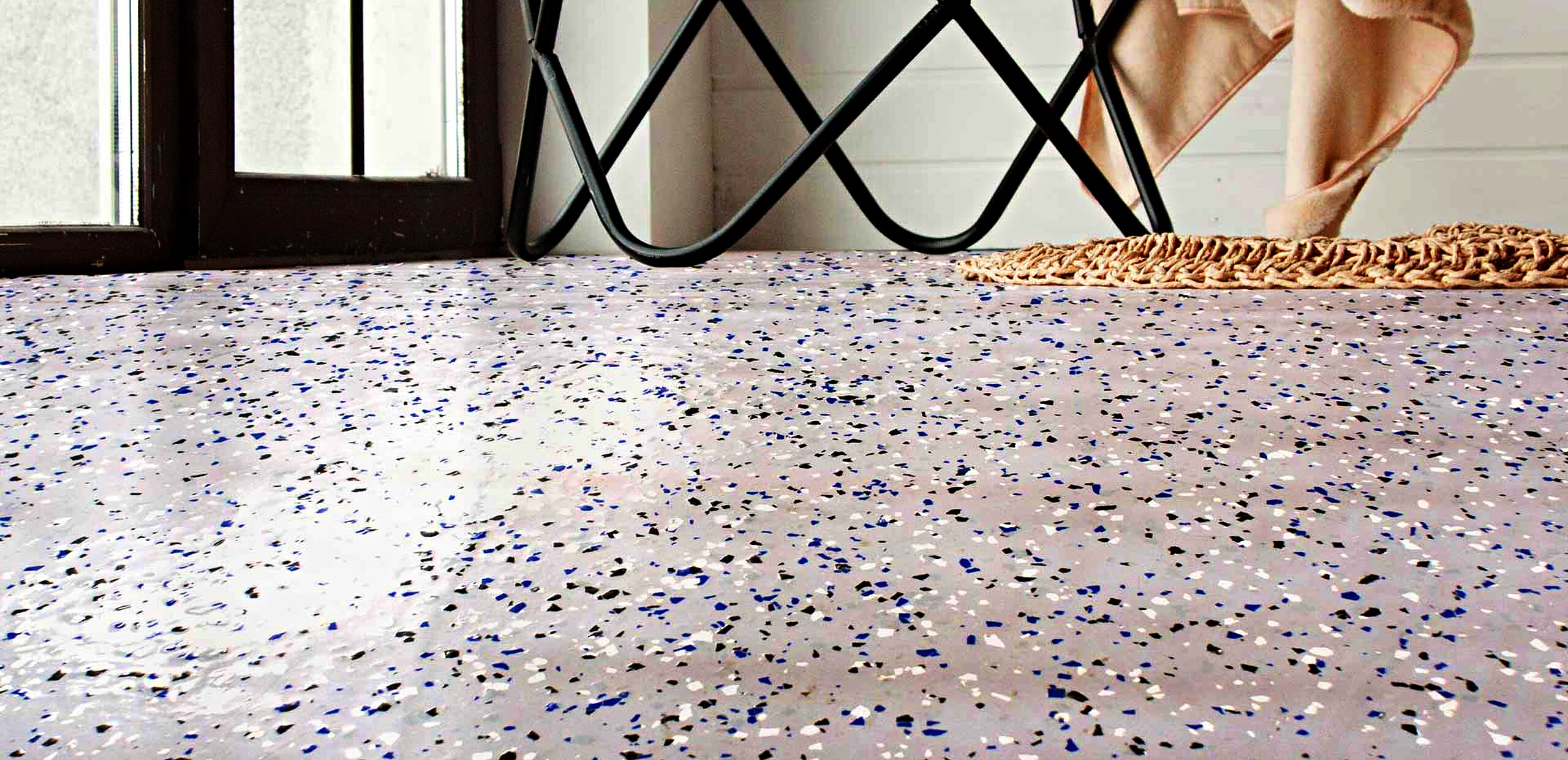
Broadcast quartz or aluminum oxide into the body coat and lock it in with the topcoat. Heavier in the walking paths around the boom, lighter where tires run. ArmorThane non-slip polyurea coatings are built for this.
Pick a light color
Light gray or tan bays look cleaner, show the bay lighting off at night and make dirt easier for staff to see.
Care and recoats
Rinse, squeegee, look
Rinse acid products off the floor instead of letting them dry on. Keep trench drains clear so the bay does not flood. Walk each bay weekly looking for edge lifts and chips; a small repair this month saves a bay closure next spring.
Re-texture and topcoat
Texture wears down in the tire paths first. A light abrade and fresh topcoat with new grit restores grip and color without removing the whole system, as long as the base is still bonded.
Exterior aprons and vacuum islands see salt and sun but not wash chemistry. A penetrating concrete sealer is often enough out there, saving the heavy system for inside the bays.
Close a bay once. Get years of grip.
A certified ArmorThane applicator can repair the slab, coat and texture your bays, and plan the work so the rest of the site keeps washing.
Contractors: become an ArmorThane applicator
Car wash floor coating questions
What is the best car wash floor coating?
For bays with strong acids, hot water or heavy salt, urethane cement is the toughest option. When closure time matters most, a polyaspartic or polyurea system with broadcast aggregate is usually back in service in about a day. Either needs a sound, sloped slab and real slip texture.
Can you epoxy a car wash floor?
Thin epoxy paint does not last in wash bays. A thick, broadcast epoxy system with a chemical-resistant topcoat can work in heated indoor bays, but it usually needs about three days before vehicles and holds up less well to acids and freeze-thaw than urethane cement or polyaspartic systems.
How much does it cost to coat a car wash bay?
Typical installed pricing runs about $5 to $9 per sq ft for epoxy or polyaspartic systems and $7 to $15 for urethane cement. A 16 by 30 ft bay is 480 sq ft, so roughly $2,400 to $7,200 per bay before major slab repair, plus lost washes while it is closed.
How long does a car wash bay have to be closed for coating?
Polyaspartic and polyurea systems often reopen in about a day. Urethane cement typically takes one to three days depending on thickness, and epoxy systems about three days before vehicles. Cold or damp slabs add time, and heavy repairs add a day or more.
How do you make a car wash floor less slippery?
Broadcast quartz or aluminum oxide into the coating and seal it in with the topcoat, using a heavier texture in walking areas. Keep water from ponding with proper slope and clear drains, and rinse soap film off the floor. Smooth glossy coatings are a liability in a wash bay.
Can car wash walls be coated too?
Yes. Spray polyurea bonds to block, concrete and metal walls and stands up to constant spray and chemicals. Carrying the floor system up the wall as a cove, then coating the walls, seals the corner where water usually gets in.
Sources
- U.S. Centers for Disease Control and Prevention, MMWR: Occupational Hydrofluoric Acid Injury from Car and Truck Washing. cdc.gov/mmwr/preview/mmwrhtml/mm6432a4.htm
- Professional Carwashing & Detailing, The chemistry of clean: Understanding pH in carwash chemistry. carwash.com/ph-balance-carwash-chemistry
- Duraamen, Urethane Cement Floor Installation in a California Car Wash Bay. duraamen.com/blog/urethane-cement-floor-car-wash
- CustomCrete, Cost of Urethane Cement (installed pricing). customcrete.net/blog/cost-of-urethane-cement-chicago-illinois
- D and G Flooring, Epoxy Flooring Cost in 2026 by Type. dgfloors.com/epoxy-flooring-cost
Brighter bays, better footing.
Owners get a certified ArmorThane applicator who preps, coats and textures wash bays with a closure plan that keeps the site earning. Contractors can add polyurea and floor work with our equipment and training, with no franchise fee and no royalties.
Start your coatings business with ArmorThane.
Tell us what you want to spray and where you are. An ArmorThane specialist will walk you through the equipment, chemicals, training and startup cost for the work you want to do.
- Equipment package matched to your applications
- Hands-on training and applicator certification
- Technical support once you are spraying
Bays chipping and slick? Fix them in one closure.
Tell us how many bays you run, what chemistry you use and how long a bay can close. We will connect you with an ArmorThane applicator who can repair the slab and quote a textured, chemical-resistant floor.
- Number of bays and their size
- Self-serve, in-bay automatic or tunnel
- Presoaks, wheel acids and winter salt load
- Heated slab, trench drains or curbs
More in Automotive & marine
Automotive & marineEquipment/Commercial Vehicle Coatings
Automotive & marineHow to Start an RV Roof Business
Automotive & marineJeep Bedliners and Off-Road Vehicle Coatings
Automotive & marineJon Boat Floor
Automotive & marineMarine Coatings
Automotive & marineMarine/Shipping Corrosion
Automotive & marineMilitary Vehicles
Automotive & marineOverland Trailer Coatings