Epoxy Flakes Sizes & Coverage Calculator
How many pounds a garage takes, 1/4 vs 1/8 vs 1/16 inch flake, full vs partial broadcast, what a 40 lb box covers, what it costs and why the clear coat matters.
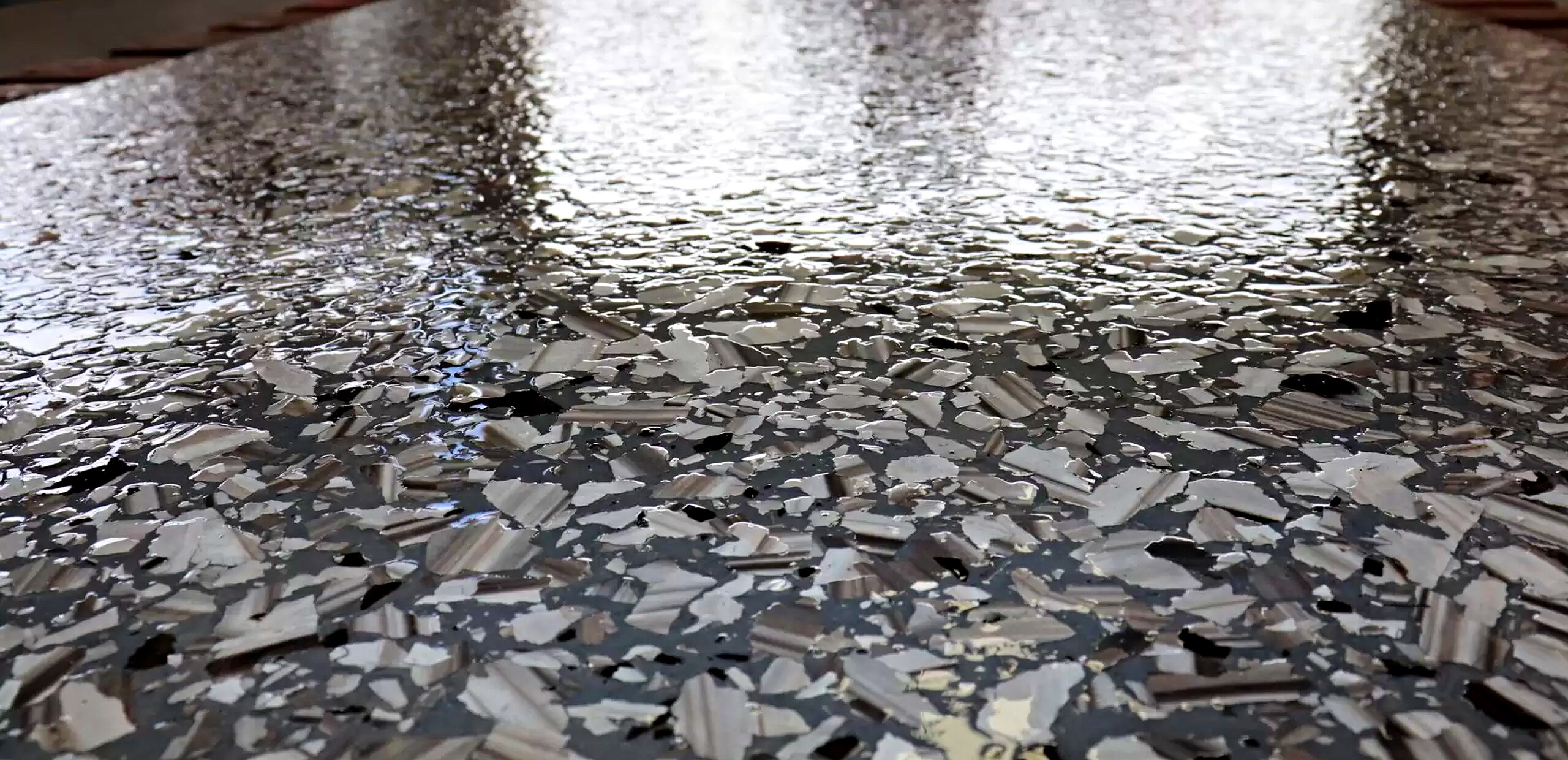
Start a floor coating business
Coat floors for a living.
ArmorThane sets you up to do this work, and you own the business. We make the chemistry, build the rigs, train you hands-on and answer the phone when a job gets difficult. You pay no franchise fee and no royalties. It has been that way since 1989.




- $0
- franchise fees or royalties
- 35+
- years in business
- 50+
- countries with applicators
- 24/7
- technical support
Epoxy flakes are the part of a garage floor everyone notices and nobody budgets for. A kit that says "flakes included" might put a pound on 500 square feet. A professional full-broadcast floor puts down 50 pounds or more on the same garage. Same word, very different floors.
Epoxy flakes (also called chips) are colored vinyl flakes broadcast into a wet basecoat, then sealed under a clear topcoat. 1/4 inch is the garage standard. For a full broadcast, where flakes cover the whole floor, plan on about 0.10–0.15 lb per sq ft of 1/4" flake, so a 400 sq ft 2-car garage takes roughly 40–60 lb, one or two 40 lb boxes. A light, speckled "partial" broadcast uses as little as 1 lb per 100 sq ft. Torginol 40 lb boxes sell for about $105–$115. Full broadcast floors need scraping and a clear coat, ideally polyaspartic, which resists yellowing. Calculate your flakes.
The trouble with flake coverage numbers is that every supplier publishes a different one, and they don't say which look they mean. We gathered the published rates, showed where they disagree, and built a calculator that lets you pick the source and the look.
A word about who's writing. ArmorThane makes ArmorFloor polyaspartic and polyurea floor coatings in Springfield, Missouri, and trains the applicators who install full-broadcast flake floors with them. We don't make the flakes.
- 1Flake calculator (interactive)
- 2Flake sizes: 1/4, 1/8, 1/16 inch
- 3Full vs partial broadcast
- 4Published broadcast rates compared
- 5How many pounds for a 1-, 2- or 3-car garage
- 6How a full broadcast is done
- 7Clear coats: polyaspartic, epoxy or urethane
- 8Are flake floors slippery?
- 9What flakes cost
- 10Epoxy flakes FAQ
Epoxy flake calculator
Enter the floor, choose a flake size and a look, and pick whose coverage rate to use. The calculator gives pounds, 40 lb boxes, flake cost and the clear coat you'll need to seal a full broadcast.
How much flake do I need?
Rates from Torginol's coverage calculator, Simiron's system guides, All Garage Floors and Concrete Floor Supply. Pros typically order 10–20% extra.
Flake sizes: 1/4, 1/8 or 1/16 inch?
Flakes come from about 1 inch down to 1/32 inch across, according to All Garage Floors, and 1/4 inch is the industry standard for garages. Smaller flakes give a finer, more granite-like look but take more pounds to cover the same floor, because more small pieces are needed to hide the basecoat.
| Size | Look | Full-broadcast rate (Torginol calculator) | Typical use |
|---|---|---|---|
| 1 inch and hybrid blends | "Big and dramatic" (Garage Floor Flake) | Not published | Statement floors |
| 1/4 inch | "The workhorse. Bold, high coverage" | 8 sq ft per lb (about 320 sq ft per 40 lb box) | Most garages; Simiron's epoxy flake system |
| 1/8 inch | "Still plenty of coverage" | 7 sq ft per lb (about 280 sq ft per box) | Simiron recommends it for its polyurea flake system |
| 1/16 inch | "Subtle and refined" | 4 sq ft per lb (about 160 sq ft per box) | Finer, subtler floors |
| 1/32 inch (micro) | Fine speckle | Not published | Specialty blends |
One practical warning from All Garage Floors: in a workshop where you drop screws and small parts, a busy flake pattern camouflages them. A tighter blend or a lighter broadcast is easier to live with there. Flakes themselves are vinyl; one distributor quotes Torginol describing them as "specially formulated paint aggregates," and blends number in the hundreds. Legacy Industrial alone offers 139 Torginol blends, and custom blends usually come in 40-pound increments and can't be returned.
Full vs partial broadcast
"Broadcast" just means throwing flakes into the wet basecoat. How much you throw decides the look, the texture and a good share of the durability.
Flake to refusal
Flakes go down until the basecoat can't accept any more and no gaps remain ("to refusal"). Concrete Floor Supply calls a full "rejection coat" the recommended approach. The flakes then get scraped and sealed under a clear coat. This is what most professional installers sell.
- Hides the basecoat and minor slab flaws
- Adds body and texture under the clear coat
- Needs 0.10–0.15 lb per sq ft of 1/4" flake
A speckle over a solid color
A light scatter over a colored basecoat. All Garage Floors gives rates of about 0.002 lb per sq ft for light, 0.01 for medium and 0.04 for heavy. One reseller's rule of thumb for a random look is 1 lb per 100 sq ft.
- Far less flake
- The basecoat color shows, so UV yellowing shows too
- What most DIY kits include
What kits actually include
Gorilla's 2.5-car kit covers 550 sq ft and includes 1.1 lb of flakes. Epoxy-Coat's 500 sq ft kit includes 2 lb of 1/4" flakes. ArmorGarage's Armor Chip kit uses 6 lb for "70–75% flake coverage," and its Armor Granite version about 18 lb for 95%. Rust-Oleum's 1 lb chip pouches cover "up to 250 sq. ft.," or 125 sq ft in a heavy pattern. So a kit's "flakes included" usually means a light speckle, not the floor in the showroom photo.
That's also why cost guides disagree. HomeAdvisor and Angi price decorative flakes at about $0.04 per sq ft (a 1 lb bag over 250 sq ft). At full broadcast rates and September 2026 retail prices, flake alone works out to about $0.33–$0.43 per sq ft, roughly ten times more.
Published broadcast rates, compared
If two suppliers give you different flake quantities for the same garage, this is why. Their full-broadcast rates for 1/4 inch flake differ by about 50%.
| Source | 1/4" full broadcast | Other sizes | 40 lb box covers |
|---|---|---|---|
| Torginol coverage calculator | 8 sq ft/lb (0.125 lb/sq ft) | 1/8": 7 sq ft/lb; 1/16": 4 sq ft/lb | About 320 sq ft (1/4") |
| Simiron system guides (2024) | 6 sq ft/lb | Same rate for 1/8" | 240 sq ft |
| Garage Flooring LLC | 6–7 sq ft/lb | Random look: 1 lb per 100 sq ft | 240–280 sq ft |
| Clean Pro Supply, ResinForce | 5–7 sq ft/lb | One box per 400–2,000 sq ft partial | About 200–250 sq ft |
| All Garage Floors (2019), Spartan Epoxies | 0.15 lb/sq ft | 1/16": sq ft ÷ 6 = lb (Spartan) | About 267 sq ft |
| Concrete Floor Supply calculator | 0.10 lb/sq ft | 1/8" or hybrid: 0.20 lb/sq ft | 400 sq ft |
How many pounds for a 1-, 2- or 3-car garage?
| Rate used | 1-car (288 sq ft) | 2-car (400 sq ft) | Large 2-car (576 sq ft) | 3-car (864 sq ft) |
|---|---|---|---|---|
| Torginol 1/4" full | 36 lb (1 box) | 50 lb (2 boxes) | 72 lb (2) | 108 lb (3) |
| Torginol 1/8" full | 41 lb (2) | 57 lb (2) | 82 lb (3) | 123 lb (4) |
| Simiron full (6 sq ft/lb) | 48 lb (2) | 67 lb (2) | 96 lb (3) | 144 lb (4) |
| 0.15 lb/sq ft full | 43 lb (2) | 60 lb (2) | 86 lb (3) | 130 lb (4) |
| Concrete Floor Supply 1/4" full | 29 lb (1) | 40 lb (1) | 58 lb (2) | 86 lb (3) |
| Heavy partial (0.04 lb/sq ft) | 11.5 lb | 16 lb | 23 lb | 35 lb |
| Medium partial (0.01 lb/sq ft) | 2.9 lb | 4 lb | 5.8 lb | 8.6 lb |
How a full broadcast is done
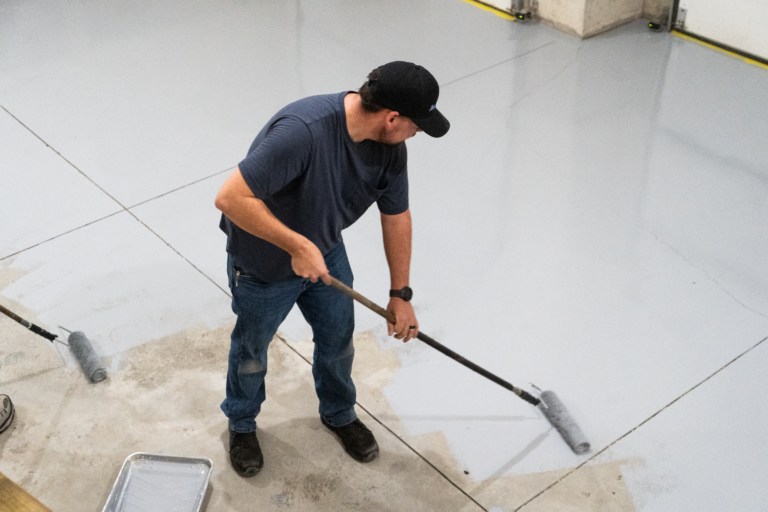
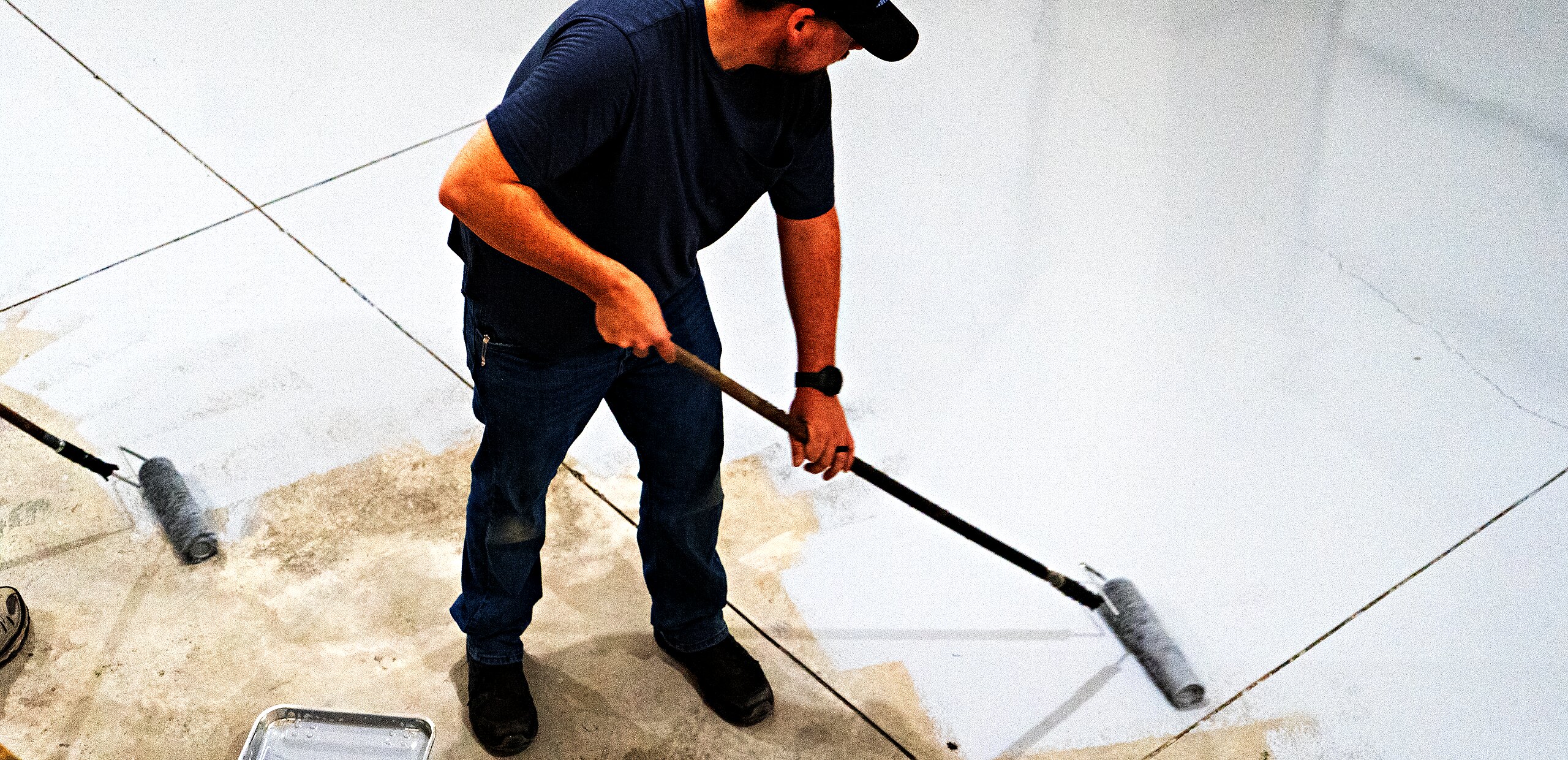
Prep and basecoat
The slab is ground, repaired and moisture-tested, then the basecoat goes down in sections. See what the prep should look like.
Broadcast while it's wet
Simiron's guide says to toss flakes up so they fall flat, and "Do not dump or allow the chip flakes to pile." Keep going until the basecoat is covered to refusal.
Let it set, then scrape
Once the basecoat can take foot traffic (about 1.5 hours in Simiron's polyurea system), "scrape and remove loose/extra flake." All Garage Floors uses a drywall knife to knock off flakes that stand up, then vacuums.
Seal the broadcast
A clear coat locks the flakes in. Simiron specifies polyaspartic at 10–16 wet mils (9–14 dry), about 100–160 sq ft per gallon. ArmorGarage: "It's imperative that you protect them with a clear topcoat."
Add grip if needed
An anti-skid additive in the final coat makes a wet floor safer. See below.
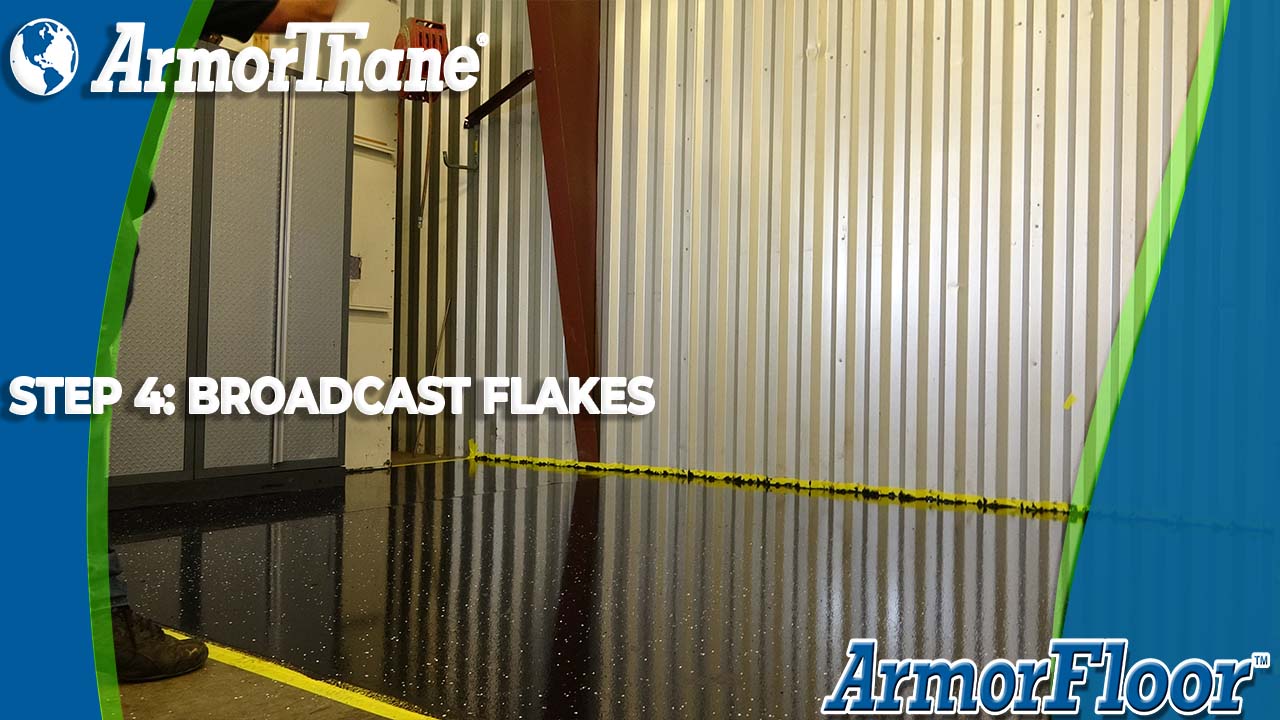
Specialty flakes need extra steps: Garage Flooring LLC notes glitter flakes must be sanded and quartz needs multiple clear coats.
Clear coats: polyaspartic, epoxy or urethane?
The clear coat does two jobs: it locks the flakes in, and it takes the wear and the sunlight. Chemistry matters most for the second one. Simiron's system guides are blunt about basecoats: polyurea "will yellow over time, so spots not covered by flake will discolor," and it gives the same warning for its epoxy basecoat. That's one more reason full broadcast plus a UV-stable clear coat is the professional default.
| Clear coat | UV and yellowing | Published data | Notes |
|---|---|---|---|
| Polyaspartic | Excellent (HomeGuide) | Simiron: 87–89 gloss after 1,000 h QUV (ASTM G154); Taber 30 mg; adhesion over 400 psi. CHEMTEC CHEM1000 PG: aliphatic, 80% solids, vehicles at 24 h | Short pot life (10–20 minutes for CHEM1000 PG); installer skill matters |
| Epoxy | Poor to fair (HomeGuide) | Rust-Oleum's EpoxyShield Premium Clear kit is $185 (90 oz) at Home Depot | Fine indoors away from sun; yellows with UV exposure |
| Polyurethane | Depends on type | Sherwin-Williams markets its ArmorSeal HS polyurethane for exterior color and gloss retention | Aliphatic grades are the UV-stable ones; check the data sheet |
Warranties reflect the difference: Penntek's residential warranty says its polyaspartic topcoat "will not discolor due to ultraviolet (UV) exposure from the sun," apart from normal weathering. ArmorThane's own ArmorFloor TopCoat is an aliphatic polyaspartic applied at about 14 dry mils per coat. For a deeper comparison, see polyaspartic vs epoxy and our polyaspartic floor coating guide.
Are flake floors slippery?
They can be when wet. ArmorGarage says flatly that "all epoxy finishes are slippery when wet," and Rust-Oleum's EpoxyShield data sheet warns coated concrete "can become slippery when wet" and recommends its anti-skid additive. Flake texture helps less than people expect: All Garage Floors says the texture under a thin topcoat "will not increase the anti-slip properties much more than what a smooth surface provides."
The one tested number we found comes from Simiron, whose flake systems with a polyaspartic topcoat measured a wet DCOF (dynamic coefficient of friction) of 0.65 under ANSI A326.3. If slip resistance matters (steps, entries, a floor you hose down), ask for an anti-skid additive in the final coat. Many kits include one: Epoxy-Coat ships 0.25 lb of aluminum oxide, Legacy offers fine and soft-grip additives, and ArmorGarage includes a nonslip additive with its topcoats. ArmorThane also makes non-slip additives.
What epoxy flakes cost
| Seller | Product | Price | Per lb |
|---|---|---|---|
| GranQuartz | Torginol 1/4" 40 lb | $105.00 | $2.63 |
| Clean Pro Supply | Torginol 40 lb (1/4" or 1/8") | $108.00 | $2.70 |
| Epoxy Warehouse USA | Torginol Signature 40 lb, 1/4" / 1/8" | $110.00 / $115.00 | $2.75 / $2.88 |
| Garage Flooring LLC | Torginol 1/4", 5 lb or 40 lb | $38.99–$219.99 | Varies by blend |
| Spartan Epoxies | Flake, 5 lb to 450 lb | +$35 to +$2,015 | About $7.00 down to $4.48 |
| ArmorGarage | Chips per lb, 15 lb minimum | $7.99/lb | $7.99 |
Installed, a flake epoxy floor runs about $5–$8 per sq ft in The Garage Guide's 2026 figures, or $2,000–$3,200 for a 400 sq ft garage. Polyaspartic and polyurea flake systems run higher. Our garage floor coating cost calculator prices the whole system, and our epoxy garage floor kit comparison covers the DIY side.
Full-flake floors with ArmorFloor polyaspartic
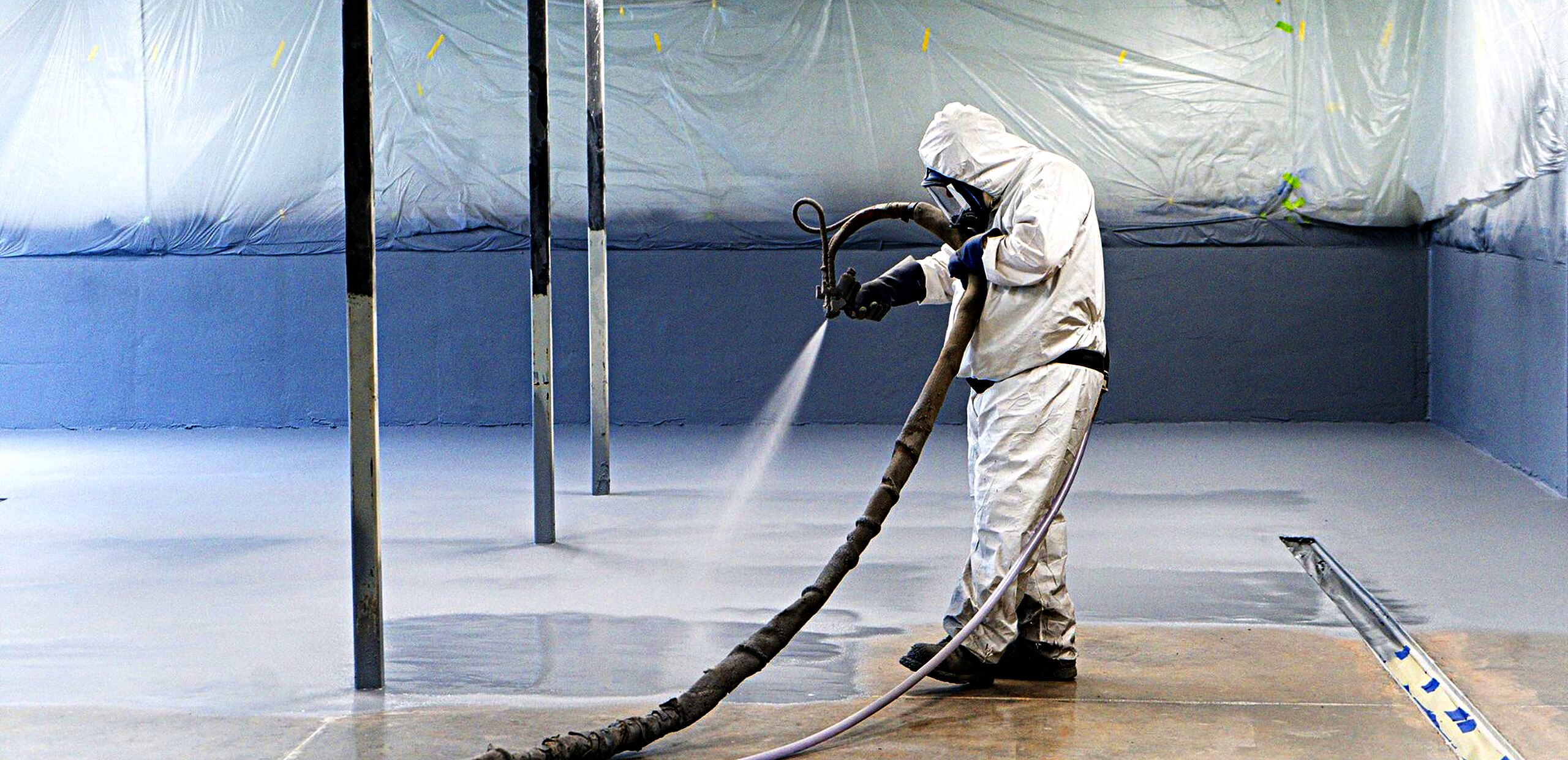
ArmorFloor Aliphatic Polyaspartic accepts color quartz or decorative chips, and ArmorFloor TopCoat is an aliphatic polyaspartic applied at about 14 dry mils per coat. ArmorThane-certified applicators use them to install full-broadcast flake floors: ground, repaired, moisture-tested, broadcast to refusal, scraped and sealed.
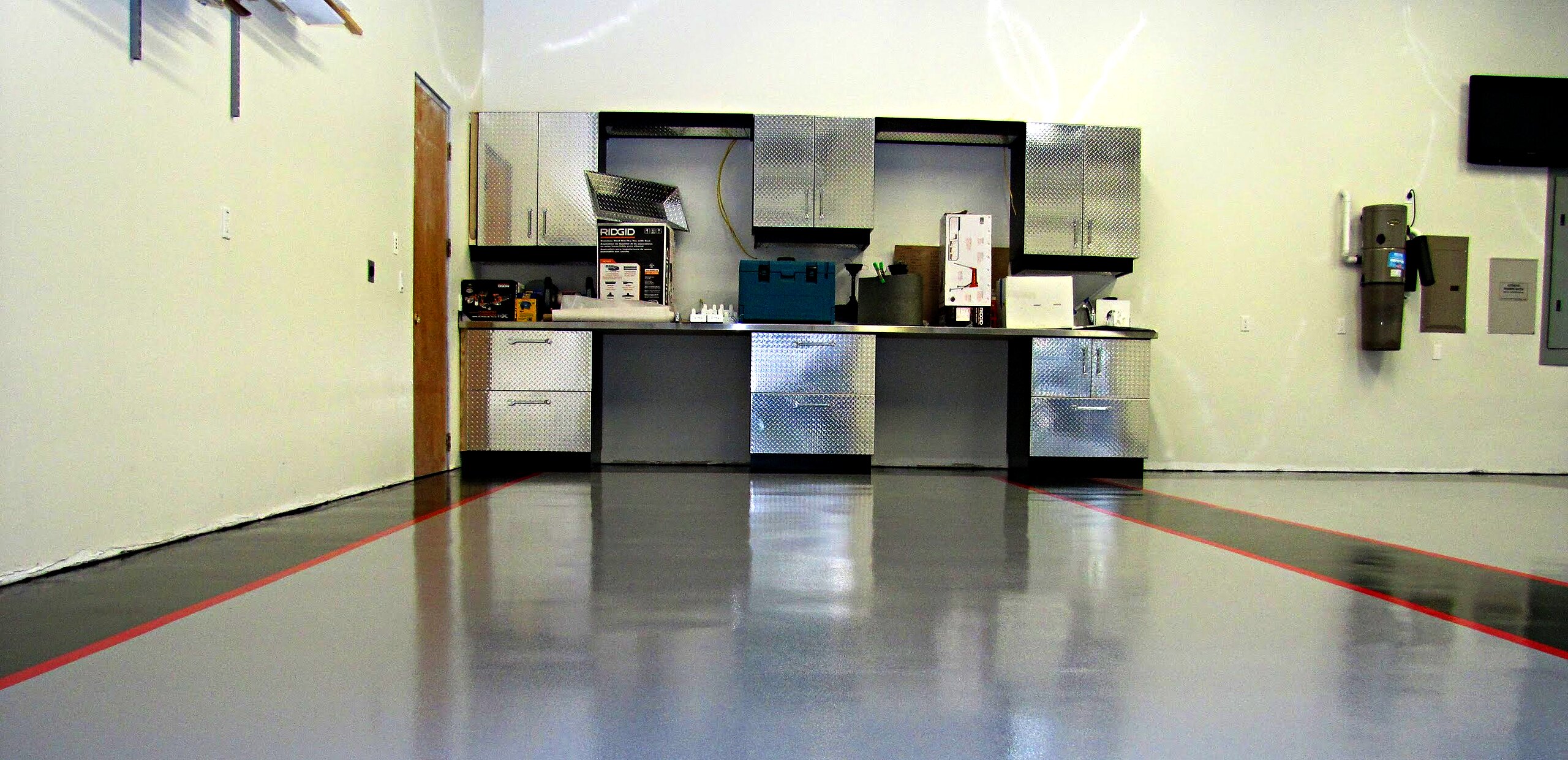
If you want a light speckle on a storage floor, a kit and a bag of chips may be all you need. If you want the floor in the photo, that's a full system.
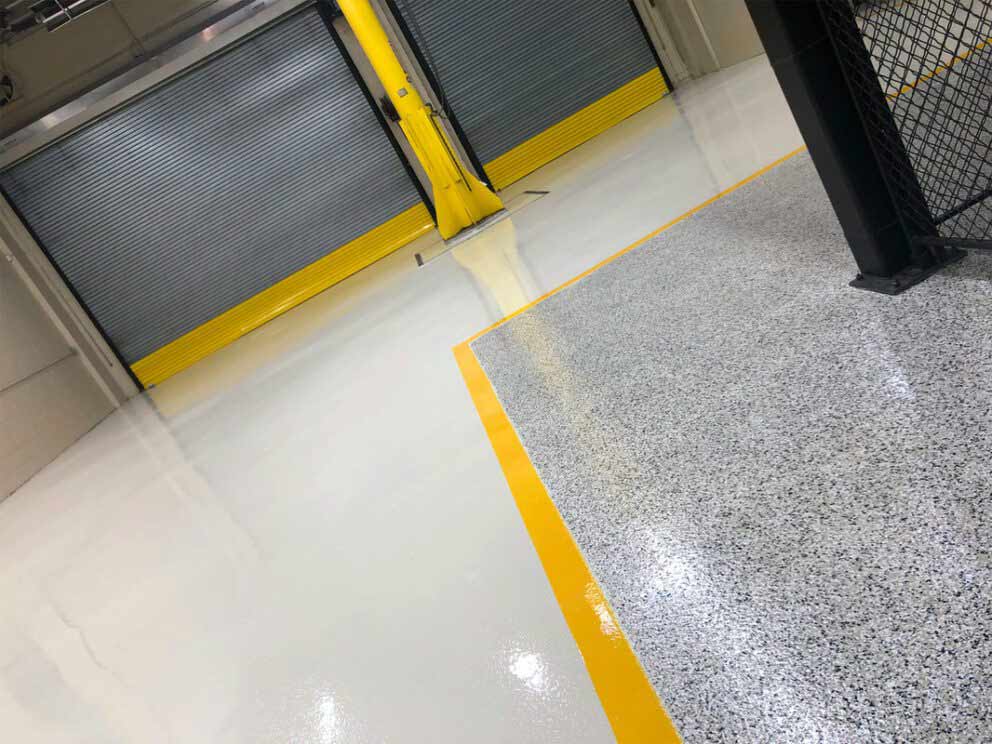
Sell the floor, not the flake.
Flake floors are one of the most visual jobs in coatings: customers see the result and tell their neighbors. We supply ArmorFloor polyaspartic and polyurea systems and train your crew to install them. Not a franchise: no franchise fee, no royalties.
Epoxy flakes FAQ
How many pounds of flakes do I need for a 2-car garage?
For a full broadcast of 1/4 inch flake on a 400 sq ft 2-car garage, published rates work out to about 40–67 lb, so one or two 40 lb boxes. A heavy partial broadcast uses about 16 lb, and a medium speckle about 4 lb. Add 10–20% if it's your first flake floor.
What size epoxy flakes are best for a garage floor?
1/4 inch is the industry standard for garages. 1/8 inch gives a finer look and still covers well; Simiron recommends it for its polyurea flake system. 1/16 inch is subtle but takes more pounds per square foot. In workshops where small parts get dropped, a busy flake pattern can hide them.
What is the difference between full and partial broadcast?
A full broadcast covers the basecoat completely (to refusal), then gets scraped and sealed with a clear coat. A partial broadcast is a light scatter over a colored basecoat. Full broadcast takes roughly 0.10–0.15 lb of 1/4 inch flake per sq ft; a medium partial about 0.01 lb per sq ft.
How much does a 40 lb box of floor flakes cover?
For a full broadcast of 1/4 inch flake, published figures range from about 200–250 sq ft (several resellers and Simiron's 240) to about 320 sq ft (Torginol's calculator rate). For a partial broadcast, one box can cover 400–2,000 sq ft depending on density.
Do you need a clear topcoat over epoxy flakes?
For a full broadcast, yes. The clear coat locks the flakes in, smooths the surface and takes the wear. ArmorGarage calls a clear topcoat imperative. Light-speckle DIY kits sometimes skip it, but a clear coat still makes the floor tougher and easier to clean.
Why do you scrape flakes after broadcasting?
Once the basecoat sets, some flakes stand up or sit loose. Scraping (often with a drywall knife or floor scraper) knocks them down and removes the excess so the clear coat goes on smooth. Simiron's guide says to scrape once the basecoat can take foot traffic, about 1.5 hours in its polyurea system.
Will a flake floor turn yellow in the sun?
The basecoat can. Simiron warns that polyurea and epoxy basecoats yellow over time where flake doesn't cover them. A full broadcast hides the basecoat, and a polyaspartic clear coat, rated excellent for UV by HomeGuide, resists yellowing better than an epoxy clear coat.
Is a polyaspartic or epoxy clear coat better over flakes?
Polyaspartic is usually better where sunlight reaches the floor, because it's UV-stable and cures fast; one polyaspartic data sheet allows vehicles after 24 hours. Epoxy clear coats are cheaper and fine indoors away from sun, but they yellow with UV exposure.
Are flake garage floors slippery when wet?
They can be. Flake texture under a clear coat adds little grip, and coating makers warn that coated floors can be slippery when wet. Ask for an anti-skid additive in the final coat. One manufacturer's flake system with a polyaspartic topcoat tested at a wet DCOF of 0.65 under ANSI A326.3.
How much do epoxy floor flakes cost?
Torginol 40 lb boxes sold for about $105–$115 in September 2026, or roughly $2.63–$2.88 per pound. Small bags cost more per pound, often $7–$8. At full broadcast rates, flake alone costs about $0.33–$0.43 per sq ft.
Can I add flakes to a DIY epoxy kit?
Yes. Most kits include a small bag for a light speckle, and you can buy more for a heavier look. A full broadcast needs a basecoat thick enough to hold the flakes, plus a clear coat on top, so check that your kit is designed for it.
What are epoxy flakes made of?
They're colored vinyl flakes, sold in single colors and blends. One distributor quotes Torginol describing its flakes as specially formulated paint aggregates. They're called epoxy flakes because they're often used in epoxy floors, but they're used in polyurea and polyaspartic systems too.
Written from flake suppliers' published coverage rates, manufacturer system guides and data sheets, retail listings read September 27, 2026 and decades of making floor coatings. Last updated September 27, 2026.
Methodology and sources
Coverage rates are shown as each source publishes them; garage totals and per-pound prices are our arithmetic on those figures. The calculator's partial-broadcast rates come from All Garage Floors (light 0.002, medium 0.01, heavy 0.04 lb per sq ft); its 1/8 and 1/16 inch full-broadcast rates use Torginol's calculator unless you pick another source, where we apply the size ratios from Torginol. Retail prices change often.
- Torginol, Coverage Calculator: torginol.com
- Simiron, SimFlake SB 1-Day Polyurea System Guide (Jul. 2024) and Epoxy System Guide (Jan. 2024): simiron.com (PDF)
- All Garage Floors, How to Choose and Apply Color Flakes (Aug. 2019): allgaragefloors.com
- Garage Floor Flake, The Complete Guide to Colors, Sizes and Coverage (Sep. 2026): garagefloorflake.com
- Spartan Epoxies, Best Selling Flake Systems: spartanepoxies.com
- Concrete Floor Supply, Epoxy Flake Calculator: concretefloorsupply.com
- Garage Flooring LLC, Torginol Color Flake: garageflooringllc.com
- Clean Pro Supply, Torginol 40 lb box: cleanprosupply.com
- ResinForce, Torginol 1/4" 40 lb box: resinforce.com
- GranQuartz, Torginol ColorFlakes 1/4" 40 lb: granquartz.com
- Epoxy Warehouse USA, Torginol Signature Flake Blends: epoxywhse.com
- ArmorGarage, Premium Color Floor Flakes and Armor Chip kits: armorgarage.com
- Legacy Industrial, Nohr-S Polyurea Full Flake Kit: legacyindustrial.co
- Home Depot, Rust-Oleum 1 lb Decorative Color Chips: homedepot.com
- CHEMTEC Coatings, CHEM1000 PG Polyaspartic TDS (Mar. 2025): PDF
- Rust-Oleum, EpoxyShield TDS ESH-09: rustoleum.com
- HomeGuide, Polyaspartic Floor Coating Cost (Nov. 2024) and Garage Floor Coating Cost (Dec. 2024): homeguide.com
- HomeAdvisor, Concrete Coating Cost (Jun. 2026): homeadvisor.com
- This Old House, Epoxy Floor Cost (Mar. 2026): thisoldhouse.com
- The Garage Guide, Garage Floor Coating Cost 2026: thegarage.guide
- Penntek Industrial Coatings, Limited Lifetime Residential Warranty (2025): PDF
- Sherwin-Williams, ArmorSeal HS Polyurethane Floor Enamel: sherwin-williams.com
- ArmorThane, ArmorFloor TopCoat and ArmorFloor Aliphatic Polyaspartic: armorthane.com
Want a full-flake floor without the guesswork? Get a quote from a certified applicator.
Tell us the floor size and the look you want. We'll connect you with an ArmorThane-certified applicator who grinds, broadcasts flake to refusal and seals it with a UV-stable polyaspartic topcoat.
- Full broadcast, scraped and sealed
- Polyaspartic clear coat that won't yellow in the sun
- Anti-slip options for wet floors
- Contractors: ask about ArmorFloor systems