Seawall Repair Causes, Methods & Costs
Why seawalls leak, sink and lean, which repair fits each symptom, what foam injection, cap work, tiebacks and replacement cost per foot, and the permits involved.
Start a marine coating business
Coat boats and docks for a living.
ArmorThane sets you up to do this work, and you own the business. We make the chemistry, build the rigs, train you hands-on and answer the phone when a job gets difficult. You pay no franchise fee and no royalties. It has been that way since 1989.




- $0
- franchise fees or royalties
- 35+
- years in business
- 50+
- countries with applicators
- 24/7
- technical support
A sinkhole behind a seawall is rarely a lawn problem. It's soil that has left through the wall, one tide at a time. Caught early, most of that damage is repaired in place for a fraction of what a new wall costs. Left alone, it ends with a leaning cap and a replacement quote.
Most seawall repairs start with soil washing out through open panel joints, clogged weep holes or a scoured toe, which shows up as sinkholes behind the wall. Caught early, joint sealing and polyurethane void injection typically run $100–$300 per linear foot. Cap work runs about $60–$350, anchors and tiebacks $225–$600 and a new wall $100–$800 or more (2026 cost guides). A leaning wall needs an engineer first. Diagnose your wall or estimate a repair.
We're ArmorThane, a Springfield, Missouri maker of polyurea coatings and polyurethane foams, and we train the independent applicators who apply them. We don't build seawalls, so this guide draws on city seawall manuals, Florida statute, Army Corps permit text, resin data sheets and dated cost guides, and says where our products fit and where they don't.
- 1How a seawall is built
- 2How seawalls fail
- 3Symptom checker (interactive)
- 4Repair methods by problem
- 5Polyurethane foam injection
- 6Cost per linear foot
- 7Void-fill and budget estimator (interactive)
- 8Repair or replace?
- 9Where coatings fit
- 10Permits: city, state, Army Corps
- 11Hiring a contractor
- 12Seawall repair FAQ
How a seawall is built
Many Gulf Coast canal seawalls are a row of concrete panels 6 inches thick, 5 to 8 feet wide and 10 to 16 feet long, per the City of Holmes Beach seawall manual. Others are vinyl, composite or steel sheet piling. Either way, the wall stands up because of what's tied to it and what's under it.
- Cap: reinforced concrete that ties the panels together.
- Panels or sheet piles: the wall itself.
- Tie rod: steel bar from the cap to an anchor.
- Deadman: concrete anchor block, often about 15 ft back.
- Weep hole: lets groundwater drain out.
- Drain stone and filter fabric: pass water, hold soil.
- Toe and berm: support the bottom of the wall.
- Void and sinkhole: where lost soil shows up.
Component descriptions from the City of Holmes Beach and City of Belleair Beach seawall manuals. Not to scale.
How seawalls fail
Seawalls rarely fail all at once. The Marco Island, Belleair Beach and Holmes Beach manuals describe the same sequence: water gets trapped behind the wall, soil leaves through the weakest point, and the wall loses its support. Water pushes sideways at 0.433 psi per foot of depth, so drainage isn't optional.
Water can't get out
Rain, sprinklers and falling tides leave groundwater behind the wall. When weep holes clog "with sediment, debris, or marine growth" (Crocker Marine) or filter fabric degrades, it leaves through joints or under the toe.
Soil leaves with it
Look for "visible back-fill mounds in the water near seawall joints" (Belleair Beach) or muddy water at the joints at low tide.
Voids and sinkholes form
Hollow pockets form behind the panels, then sinkholes in the yard, often near joints.
The wall loses support
Panels sag or go wavy. Salt water reaching the cap steel and tie rods causes "upper rotation, cracking or crumbling of the concrete cap" (Belleair Beach).
Structural failure
A rotating cap, broken tie rods or a washed-out toe lets the wall lean. Repair now means anchors, a new cap, new panels or a new wall.
| What you see | What it usually means |
|---|---|
| Sinkholes or low spots behind the wall | Soil washing out through joints or under the toe |
| Soil mounds in the water at joints | Active loss of backfill through a separated joint |
| Water ponding behind the wall after rain | Clogged weep holes or failed drainage |
| Horizontal crack at the waterline with rust | Corroding reinforcing steel in the panels |
| Cracked, spalled or rust-stained cap | Corroding cap steel or tie-rod connection |
| Wavy or sagging panels, leaning cap | Lost berm, failing tie rods or anchors |
Seawall symptom checker
Tick what you can see from the yard and from the water at low tide. The checker places your wall in the failure chain and lists the matching repairs with their published per-foot prices.
What stage is my seawall in, and what fixes it?
Stages follow the city seawall manuals. Per-foot costs from Angi, Pearce Marine and JKT Marine (2026). A guide, not an inspection.
Look at the joints from the water at low tide. That's where soil loss shows first.
- Seal the leaking joints. Seal the seams and restore filter fabric (Belleair Beach), or inject polyurethane behind the joints. Joint grouting: $100–$125 per ft (Angi).
- Fill the voids and stabilize the soil. Probe first, then inject polyurethane grout behind the wall. Void and soil work: $120–$300 per ft (Pearce; Angi lists $120–$270).
Stage 3 of 5: voids and soil washout. Soil is already leaving through the wall. Fill the voids and fix the path the soil takes out, or the holes come back. Ask for probing before a price: one Florida marina job probed and investigated the subsurface before any injection. Your wall is 25 years old. HomeGuide puts concrete seawall life at 30–50 years.
Seawall repair methods, by problem
The city manuals list the same toolbox. Use the method that fits your stage: filling a sinkhole with topsoil treats the symptom, and the next high tide takes it back out.
Drainage and weep holes
Clear weep holes, maintain or add a French drain ($10–$35 per foot, HomeGuide) and aim sprinklers away from the wall.
Joint and crack sealing
Seal separated seams and reinstall filter fabric, or inject resin. Angi: joint grouting $100–$125 per foot, small cracks $100–$180. See crack injection.
Polyurethane void fill
Water-reactive polyurethane injected through small probes fills voids and binds loose sand. Pearce: $120–$300 per foot. How it works.
Cap repair or replacement
For spalled, rust-stained or rotating caps. JKT Marine, South Florida: $60–$120 per foot partial, $100–$200 full.
Tiebacks and walers
New tie rods, a waler about 2 ft below the cap, or helical tiebacks driven 14–21 ft deep (Holmes Beach). $300–$600 per foot (Pearce, Helicon).
Toe and berm
Rebuild the berm with riprap or bags of dry concrete mix. Angi: toe berm failure $300–$600 per foot; Pearce: toe scour armor $140–$350.
Panel replacement
Angi lists cracked panels at $450–$600 per foot; a Sarasota contractor quotes $5,000–$25,000 per panel.
Protective coatings
Protect a sound cap or splash-zone steel. They don't stop soil loss. Where coatings fit.
New wall
In the same spot or just waterward of it. Angi: $100–$800 per foot, up to $1,000 on complex jobs.
How foam injection works
Foam seawall repair means injecting liquid polyurethane through small probes behind the wall. The resin reacts with water in the soil, expands into voids and permeates loose sand, binding it into a watertight mass. Holes are typically about 5/8 inch, versus 1.5 to 2 inches for cement mudjacking.
Two Prime Resins case studies show real jobs. At Lake Park Marina, Florida, crews injected Prime Flex 920 about 12 feet deep through 1/2 inch probes in five or six phases a week apart, using 500–600 gallons in all. In Delray Beach, grout went 12 to 13 feet deep, at about two-thirds the cost of an excavation repair quoted near $150,000; full replacement had been quoted at $350,000–$500,000.
| Product | Type | Published data | Seawall use stated |
|---|---|---|---|
| Prime Flex 920 (Prime Resins) | One-component, hydrophobic, water-reactive | Up to 2,900% free rise; 35–50 cP; NSF/ANSI 61 | "Seawalls and retaining walls" |
| Prime Flex SWF (Prime Resins) | Two-component | Stronger, slower-reacting for deeper injection | Voids and soil behind seawalls |
| AP Soil 600 (Alchemy-Spetec) | One-component, hydrophobic soil grout | 38 cP; grouted sand 1,300 psi | Loose sand, sinkholes |
| AP Fill 700 (Alchemy-Spetec) | One-component, water-activated | 110–130 cps; sets in under 10 minutes | Leaking panel joints (marina case study) |
Light, fast, follows the water
- Follows water paths 10–15 ft from the injection point (Alchemy-Spetec)
- Light: a 2.5 pcf foam such as ArmorFoam LIFT 200 weighs a small fraction of grout
- Small holes, no excavation
Cheap by volume, heavy
- Mudjacking grout weighs 100–125 lb per cubic foot
- "More weight on a weak/failing wall could make matters worse" (Alchemy-Spetec)
- Slow to cure in wet soil
Two details make injection last. Investigation: at the Riviera Beach marina, contractors probed for soil loss before injecting. Drainage: that job finished with venting "to relieve hydrostatic pressure." Seal every path without giving the water a new one and pressure builds again. Our mudjacking vs polyjacking comparison covers the trade-offs, and foam concrete lifting fixes the pool deck or patio that settles next to a failing wall, as one did in the Delray Beach case.
Seawall repair cost per linear foot
Angi's August 2026 guide puts professional seawall repair at $100–$250 per linear foot, with labor 25–40% of the bill. By repair type, the spread is wider.
| Repair | Angi (Aug. 2026) | Other 2026 guides | Fixes |
|---|---|---|---|
| Joint grouting | $100–$125 | Crack and joint repair $100–$250 (Helicon) | Leaking seams |
| Small cracks | $100–$180 | Fractures and spalling $100–$180 (Pearce) | Cracks, minor spalls |
| Soil stabilization | $120–$270 | Polyurethane deep soil injection $120–$300 (Pearce) | Voids, sinkholes |
| Concrete caps and tiebacks | $125–$230 | Cap: $60–$120 partial, $100–$200 full (JKT); $150–$350 replacement (Pearce) | Spalled or rotating caps |
| Secondary anchors | $225–$300 | Helical tiebacks $300–$600 (Pearce, Helicon) | Leaning, failed tie rods |
| Leaning walls | $200–$600 | — | Rotation, bowing |
| Joint separation | $250–$500 | — | Wide-open seams |
| Toe berm failure | $300–$600 | Toe scour armor $140–$350 (Pearce) | Undermined base |
| Cracked panels | $450–$600 | $5,000–$25,000 per panel (Sarasota) | Broken panels |
What a whole job costs
Angi's examples run from $3,000–$7,500 for 30 feet to $10,000–$25,000 for 100 feet. Pearce puts a 50-foot repair section at roughly $6,000–$20,000; Helicon calls $15,000–$60,000 typical for a residential project. Outside the per-foot price: inspection ($200–$600 per HomeGuide, $300–$800 in Sarasota), engineering ($2,000–$5,000) and permits ($800–$3,000) in JKT Marine's examples.
Get new seawall and waterfront guides and price updates by email: join the ArmorThane newsletter.
Void-fill and budget estimator
Estimate how much foam a void would take, what injection might cost and how that compares with a new wall of the same length. A probe rod pushed into the soil behind the wall gives a rough idea of the void's size.
How much foam, and repair or replace?
Foam pounds = cubic feet × density (ArmorThane's pour-foam yield rule). Costs use 2026 per-foot guides. Your contractor's probing sets the real numbers.
40 ft × 2 ft × 3 ft × 50% open ≈ 120 ft³, or 3 ft³ per foot of wall. At 2.5 pcf plus a 20% allowance that’s about 360 lb of foam. The same void filled with cement grout at 100–125 lb per ft³ would add 12,000–15,000 lb behind a wall that has already lost support. The repair range uses $120–$300 per ft (Pearce Marine, void and soil injection); the new-wall range uses $250–$400 per ft for a concrete panel wall (JKT Marine) plus $2,800–$8,000 for engineering and permits (JKT Marine’s examples). Repair comes to roughly 38–50% of replacing this stretch, before any cap, anchor or toe work the wall may also need. Water-reactive seawall grouts also permeate the soil (one Florida marina used 100–120 gallons per section), so treat the pounds as a floor, not a quote.
Repair or replace?
Repair makes sense while the wall is sound: straight panels, a cap that isn't rotating, tie rods that hold. Replacement makes sense near the end of the design life, with repairs stacking up. Many Marco Island walls were designed for 30 years.
HomeGuide lifespans (Apr. 2023); bars show midpoints. Angi says 30–70 years, about 50 on average.
- Repair when soil loss is the main problem and the wall is straight.
- Anchor when the cap is rotating or tie rods have failed but panels are intact.
- Replace when panels are broken along the waterline, several problems appear at once or the wall is past its design life. Ask for both prices.
| New wall material | HomeGuide (2023) | Pearce (2026) | JKT, S. Florida (2026) |
|---|---|---|---|
| Concrete | $200–$600 | $150–$400 poured | $250–$400 panel |
| Vinyl sheet pile | $200–$550 | $100–$250 | $175–$275 |
| Steel sheet pile | $200–$600 | $175–$450 | — |
| Wood | $150–$500 | $80–$220 | — |
| Riprap | $50–$200 | $100–$250 as reinforcement | — |
Where coatings fit
A coating is a barrier: it keeps salt water, oxygen and abrasion off what it covers. On a seawall that's useful in two places and useless in a third.
Steel in the splash zone
The splash zone is "the most aggressive exposure band on any marine structure." Our marine guide specifies thick-film aromatic polyurea over correctly blasted steel there.
Sound concrete caps and bulkheads
Polyurea is used on docks, pilings and bulkheads, over concrete blasted or ground to remove laitance. Repair spalls and corroded steel first.
Soil loss and leaning
A coating on the face does nothing about soil leaving below the waterline. Fix voids, drainage and anchors first.
Two cautions from our marine coatings guide: "Surface preparation is the single largest predictor of how long a marine coating lasts," and polyurea is a barrier coating, not antifouling. ArmorShield polyurea is tack-free in under 60 seconds. See also polyurea on flood control infrastructure and our guides to concrete waterproofing, retaining walls and foundation crack repair.
Permits: city, state and Army Corps
Seawall work can involve three levels of government. Rules vary by state; this is general information, not legal advice, so have your contractor or engineer confirm what your project needs.
Usually the first stop
Belleair Beach: "Many seawall repairs and all seawall replacements require a permit from the City," with a plan by a Florida-registered engineer or design professional.
Florida's 18-inch rule
Florida Statutes 403.813(1)(e) exempts from DEP permitting "the restoration of seawalls at their previous locations or upland of, or within 18 inches waterward of, their previous locations." Chapter 161 coastal rules still apply. Other states have their own agency.
U.S. Army Corps of Engineers
Nationwide Permit 3 covers repair or replacement of "previously authorized, currently serviceable" structures; NWP 13 covers bank stabilization, including bulkheads, with limits such as 500 ft of length. The 2026 permits run to March 15, 2031.
UF/IFAS notes that many projects exempt under Florida DEP rules "may be eligible for expedited permitting" by the Corps, which isn't the same as no federal review. Method matters too: one Delray Beach owner chose grouting partly because excavation meant 6–8 months of permitting. Trimming mangroves to reach the wall needs its own state permit (section 403.9327, per Holmes Beach).
Hiring a seawall repair contractor
Searching "seawall repair near me" turns up marine builders, foundation companies and concrete lifters. They're not interchangeable. Florida added marine specialty contractor categories in 2024, including seawall and bulkhead work, so ask which license covers the job. Then ask:
How will you find the voids?
Good contractors probe for soil loss before pricing injection.
Where will the water go afterward?
Weep holes, vents or a French drain belong in the plan.
Who pulls permits, and who's the engineer?
Get it in writing, especially for cap, anchor and panel work.
How will you contain resin in the water?
At Lake Park, floating barriers caught grout that flowed through the wall.
What's excluded from the per-foot price?
Inspection, engineering, permits and cleanup.
Foam and polyurea, applied by certified pros
Founded in 1989, ArmorThane makes polyurea coatings used on docks, pilings and bulkheads and polyurethane foams used to lift and stabilize concrete, and trains certified applicators in more than 50 countries. An applicator can look at your wall, quote the coating or foam work that fits, and say plainly when it's a job for a marine contractor and engineer.
Use the applicator finder to find one near your waterfront, or request a quote at the top of this page. Not ready yet? Get new guides like this one through the ArmorThane newsletter.
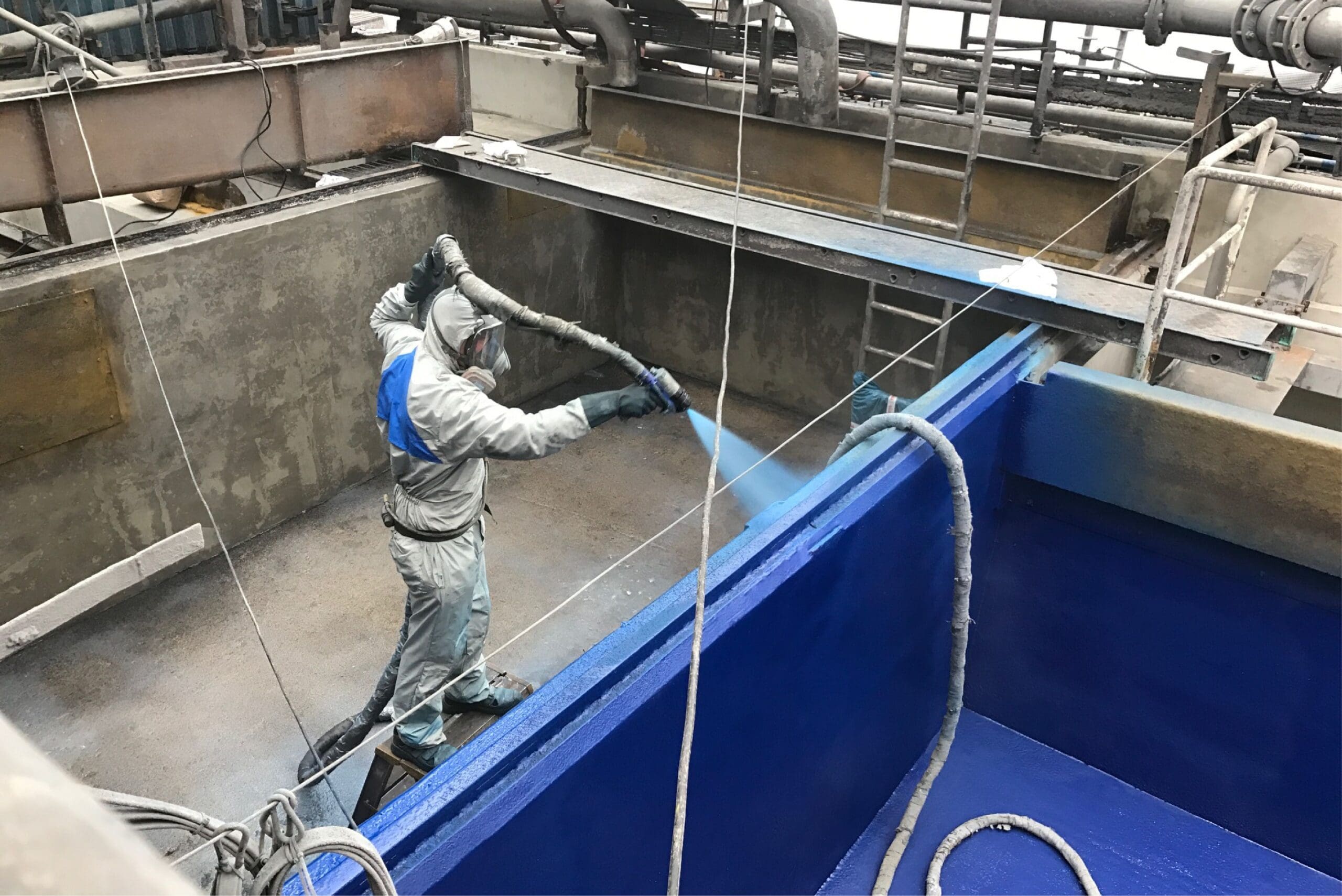
Aging infrastructure needs repair. Build a business on it.
Seawalls, docks, bridges, tanks and wastewater structures all need protecting. ArmorThane supplies polyurea and polyurethane foam systems and trains you to apply them, with no franchise fee, dealership fee or royalty. Turnkey applicator systems start at $25,000 with equipment, training, first chemical and safety gear; third-party financing is available.
Already lifting concrete? See our pour foam guide →
Seawall repair FAQ
How much does seawall repair cost per linear foot?
Angi's August 2026 guide puts professional seawall repair at $100–$250 per linear foot. By type: joint grouting $100–$125, small cracks $100–$180, soil stabilization $120–$270, caps and tiebacks $125–$230, leaning walls $200–$600 and cracked panels $450–$600. Inspections, engineering and permits are usually extra.
What causes sinkholes behind a seawall?
Soil washing out through the wall. When weep holes clog or filter fabric fails, groundwater leaves through open panel joints or under the toe and carries sand with it. Soil mounds in the water near joints confirm it. Filling the hole with topsoil doesn't fix it; the exit path has to be sealed.
Does polyurethane foam injection work on seawalls?
For voids, loose soil and leaking joints, yes. Water-reactive polyurethane is injected through small probes behind the wall, where it expands and binds sand into a watertight mass, about 12 to 13 feet deep in two Florida case studies. It doesn't fix a leaning wall, failed tie rods or a crumbling cap.
Is it cheaper to repair or replace a seawall?
Usually repair, while the wall is straight and sound. Repairs typically run $100–$300 per foot; new walls run $100–$800 in Angi's data and $500–$1,200 in one Sarasota contractor's pricing. In a Delray Beach case, grouting cost about two-thirds of an excavation repair, against a $350,000–$500,000 replacement quote.
How long does a seawall last?
HomeGuide lists concrete at 30–50 years, vinyl at 50–60, steel at 25–35 and wood at 10–40. Angi says seawalls typically last 30–70 years, about 50 on average, and many Marco Island, Florida walls were designed for 30. Drainage upkeep and early joint repair help any wall reach the upper end.
Do I need a permit to repair a seawall?
Often. Belleair Beach, Florida, for example, requires a city permit for many repairs and all replacements. Florida statute 403.813(1)(e) exempts restoring a seawall in place or within 18 inches waterward from state DEP permitting, but local and U.S. Army Corps of Engineers rules still apply. Confirm before work starts.
Why is my seawall cap cracking?
Usually corroding steel. Salt water reaches the cap's rebar and tie-rod connections, and rust takes up more volume than steel, cracking and spalling the concrete. Watch for rust stains, exposed rebar and rotation. JKT Marine's South Florida pricing: partial cap repair $60–$120 per foot, full replacement $100–$200.
What is the difference between a seawall and a bulkhead?
The terms overlap: both are vertical walls holding soil back from water, and cost guides such as HomeGuide price bulkheads and lake seawalls together. Helicon lists bulkhead replacement at $150–$600 per linear foot. The same failure modes apply, and Army Corps Nationwide Permit 13 names bulkheads among its bank stabilization activities.
Can a leaning seawall be saved?
Sometimes. If the panels are intact, anchors can stabilize it: new tie rods, a waler beam about 2 feet below the cap, or helical tiebacks driven 14–21 feet deep (Holmes Beach manual). Angi lists leaning wall repairs at $200–$600 per foot. Have an engineer assess it before any work.
Can polyurea coatings protect a seawall?
They protect what they cover. Polyurea is used on docks, pilings, bulkheads and splash-zone steel, applied over blasted steel or ground concrete. It's a barrier coating, not antifouling, and it can't stop soil loss below the waterline or straighten a leaning wall. Fix the structure and drainage first.
Written from city seawall manuals, Florida statute, U.S. Army Corps of Engineers permit text, resin manufacturers' data sheets and case studies, cost guides read September 27, 2026 and decades of making polyurea and polyurethane foam. Reviewed September 27, 2026.
Methodology and sources
Costs are shown as each source publishes them, per linear foot unless noted; HomeGuide's data is dated April 2023. The checker's stages follow the city manuals' failure sequence. The estimator multiplies void volume by foam density and wall length by published per-foot ranges; the loss allowance is an assumption you can change. Permit notes are general information, not legal advice. LIFT foam densities are shown for comparison only; those products are sold for slab lifting.
- City of Marco Island, Seawall Owner's Manual (2014): naplesgov.com
- City of Belleair Beach, Seawall Manual: cityofbelleairbeach.com
- City of Holmes Beach, Seawall Manual: revize.com (PDF)
- Florida Statutes 403.813 (2024): flsenate.gov
- UF/IFAS EDIS SG187, Living Shoreline Permit Exemption (2023): ufl.edu
- USACE Nationwide Permit 3 (2017 text): NCDOT copy; Nationwide Permit 13: AZDOT copy
- Federal Register, Reissuance of Nationwide Permits (Jan. 2026): federalregister.gov
- Fla. Admin. Code 61G4-15.100 (2024): law.cornell.edu
- Prime Resins, Prime Flex 920 TDS (2018), Prime Flex SWF, Lake Park and Delray Beach case studies: primeresins.com
- Alchemy-Spetec, AP Soil 600 TDS (2026) and seawall articles (2018–2020): alchatek.com
- Angi, Seawall Repair Cost (Aug. 2026): angi.com
- HomeGuide, Seawall Cost (Apr. 2023): homeguide.com
- Pearce Marine Construction (Sep. 2026): pearcemarine.com
- JKT Marine, South Florida 2026: jktmarine.com
- Team Renick, Sarasota (Sep. 2026): teamrenick.com
- Helicon (Aug. 2026): heliconusa.com
- Adams Seawall Repair (Jan. 2026): adamsseawallrepair.com
- Crocker Marine (May 2026): crockermarine.com
- Alpha Foundations (Oct. 2025): alphafoundations.com
- ArmorThane, Marine Coatings, Retaining Wall Waterproofing, Mudjacking vs Polyjacking, Two-Part Pour Foam, LIFT 200 and LIFT 300: armorthane.com

Start your coatings business with ArmorThane.
Tell us what you want to spray and where you are. An ArmorThane specialist will walk you through the equipment, chemicals, training and startup cost for the work you want to do.
- Equipment package matched to your applications
- Hands-on training and applicator certification
- Technical support once you are spraying
More to read on concrete repair
Short reads from ArmorThane on Issuu. Tap one to open it right here.