


Warehouse Floor Marking: OSHA Rules, Colors & Costs
What OSHA actually requires, the 5S color scheme, and how paint, epoxy, polyaspartic and tape hold up under forklift traffic, with a footage-and-cost estimator and an aisle width checker.
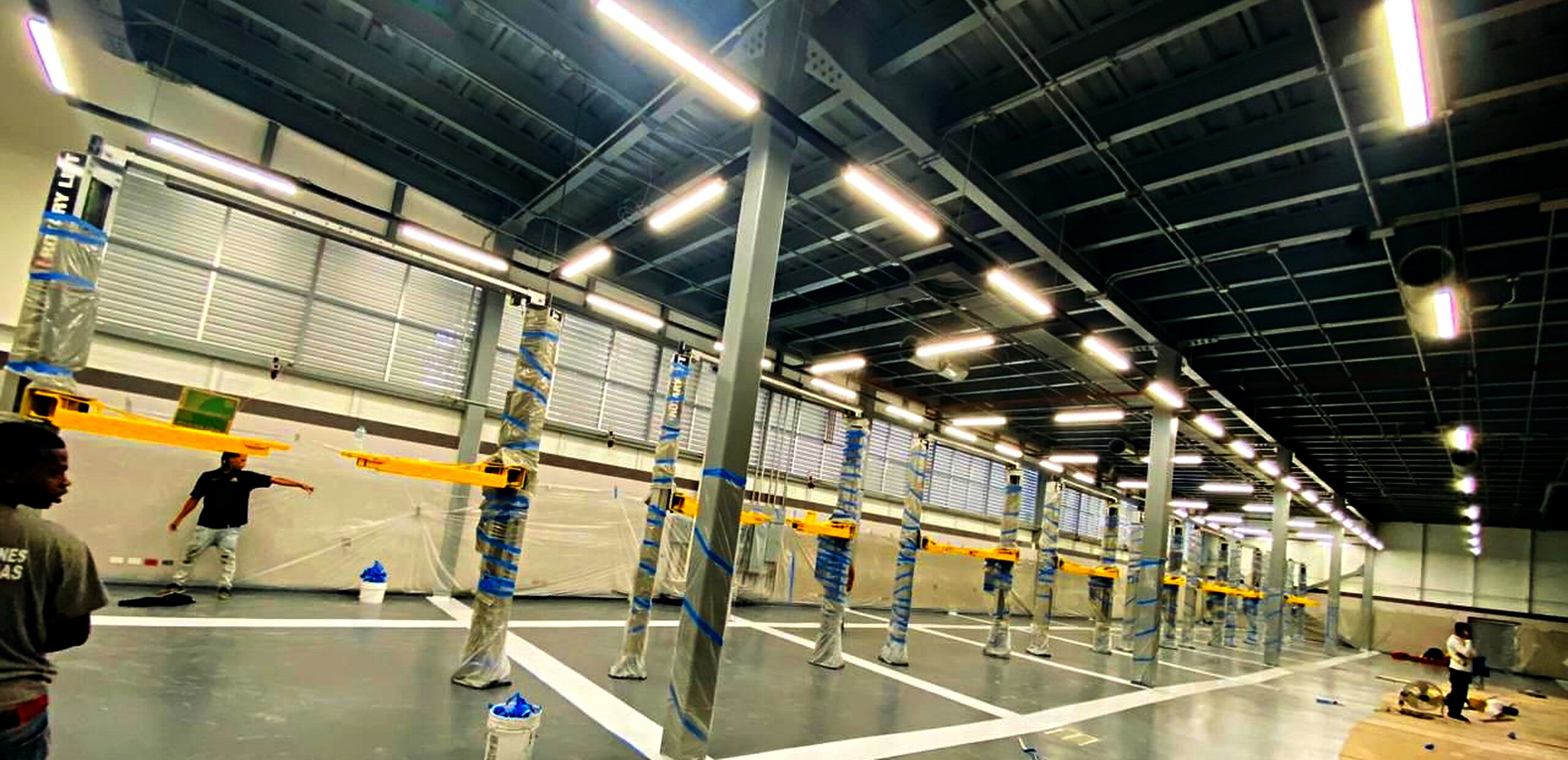
Start a floor coating business
Coat floors for a living.
ArmorThane sets you up to do this work, and you own the business. We make the chemistry, build the rigs, train you hands-on and answer the phone when a job gets difficult. You pay no franchise fee and no royalties. It has been that way since 1989.
- $0
- franchise fees or royalties
- 35+
- years in business
- 50+
- countries with applicators
- 24/7
- technical support
Warehouse floor marking is the cheapest safety system in your building, and also the one most likely to be worn off by the next quarter. We coat concrete for a living, and we see the same pattern in plant after plant: lines get rolled on in a weekend, forklifts pivot on them for six months, and the yellow turns to a gray smear. This guide covers what OSHA actually requires, which color means what, how paint, epoxy, polyaspartic and tape compare under real forklift traffic, and two calculators to size your job and check your aisle widths before anyone opens a can.
OSHA requires permanent aisles to be marked (29 CFR 1910.176) and accepts any line 2 inches wide or more, in any color, as long as it clearly defines the aisle. Most plants use 3 to 4 inch yellow lines for aisles and follow a 5S color scheme for everything else. For forklift areas, a two-component polyaspartic or epoxy line on ground concrete lasts years, not months. Tape wins where layouts change often. Plain latex traffic paint is the cheapest to install and the most expensive to keep.
What OSHA requires for warehouse floor marking
There is less federal text on floor marking than most people expect. The core requirement is one sentence in 29 CFR 1910.176(a): where mechanical handling equipment is used, permanent aisles and passageways "shall be appropriately marked." The general walking-working surfaces rule, 1910.22(a), adds that floors and passageways must be kept clean, orderly and, as far as feasible, dry. That is it for the regulation itself.
The details come from OSHA's 1972 letter of interpretation on aisle marking, which is still the reference inspectors and safety managers use:
- Line width: recommended widths run from 2 to 6 inches, so "any width 2 inches or more is considered acceptable."
- Aisle width: at least 3 feet wider than the largest equipment that uses the aisle, or a minimum of 4 feet.
- Color and form: any color works as long as it clearly marks the aisle, and lines can be dots, squares, strips or continuous.
Color rules for hazards come from 1910.144: red identifies fire protection equipment and stop devices, yellow marks caution and physical hazards. Exit routes fall under 1910.35, which points to NFPA 101 or the International Fire Code. Nothing in the federal standard dictates blue for raw material or orange for inspection holds. Those come from 5S and lean practice, which most plants adopt because a consistent scheme is easier to train.
Warehouse floor marking color codes
This is the scheme published by Brady, one of the largest floor-marking suppliers, and it lines up with what we see in most US plants. Pick one scheme, write it down, post it at the dock door, and stick to it.
| Color | Typical use | Basis |
|---|---|---|
| Yellow | Aisles, traffic lanes, work cells | OSHA 1910.144 (caution) + 5S practice |
| White | Equipment, workstations, carts, racks | 5S practice |
| Blue / green / black | Raw materials, work in progress, finished goods | 5S practice |
| Orange | Material held for inspection | 5S practice |
| Red | Defects, scrap, rework; fire equipment | OSHA 1910.144 (fire) + 5S practice |
| Red / white stripe | Keep clear: fire extinguishers, eyewash, electrical panels | 5S practice |
| Black / white stripe | Operational keep-clear areas | 5S practice |
| Yellow / black stripe | Physical or health hazards | 5S practice |
| Photoluminescent | Emergency egress routes | Egress practice; see NFPA 101 / IFC |
Floor marking footage and 5-year cost estimator
Most marking quotes are priced per linear foot, so the first job is counting feet. Enter your aisle runs and outlines below. The tool totals the footage, works out how much two-component coating or how many tape rolls you need, and compares what each option costs over five years once you count how often it has to be redone.
How many feet of line, and what will it really cost?
Footage = aisle length x lines per aisle + walkway edges + outlines x perimeter. Coating volume uses 1 US gallon = 1,604 sq ft at 1 mil. Five-year cost uses the published life ranges in the comparison table below.
Paint vs. epoxy vs. polyaspartic vs. tape for warehouse floor marking
There is no single best product. There is a best product for a floor that never changes layout and sees 40 forklift passes an hour, and a different best product for a flex area that gets re-racked every quarter. Here is how the options compare, using published figures where they exist.
| Material | Life in forklift traffic | Back in service | Installed cost | Best fit |
|---|---|---|---|---|
| Water-based traffic paint | 6–12 months in high-traffic staging | Foot traffic ~2 hours | Low end of $1.50–$5.50/lf | Light traffic, short-term layouts, budget lines |
| Two-part epoxy line coating | 5–7 years | 12–24 hours before heavy forklifts | High end of $1.50–$5.50/lf | Fixed aisles, interior, ground concrete |
| Two-part polyaspartic (aliphatic) | Similar class to epoxy; no single published figure | Foot 4–20 hrs; heavy traffic 48–72 hrs (Simiron data) | High tier | Docks, cold areas, lines exposed to daylight (color stays put) |
| Light-duty vinyl tape (6–10 mil) | Not for forklift zones | Immediate | Varies by brand | Offices, labs, temporary events |
| Heavy-duty tape (30–50 mil) | 12–18 months in heavy forklift zones; 3–5 years moderate | Immediate | About $1.37/ft for 2 in, per one supplier example | Layouts that change, sealed or polished floors |
Why plain paint fails so fast
Single-component traffic paint is designed for asphalt parking lots, where tires roll straight. Inside a warehouse the damage comes from forklift pivots: a loaded truck turning on a polyurethane drive tire puts a twisting shear load on the line. One tape maker puts it bluntly, saying a 10,000-pound forklift pivot can destroy standard adhesive in under three seconds. Thin paint on unprepared, slick concrete has no chance. Two-component coatings bond chemically into a ground surface, and that bond is what you are paying for.
Epoxy or polyaspartic?
Both are two-part, high-build coatings, and both outlast single-component paint by years when the floor is prepped. Epoxy is the economical choice for interior lines with a full overnight shutdown. Aliphatic polyaspartics cure faster and hold color under UV, so they make sense at dock doors, under skylights, and anywhere you cannot close an aisle for a full day. On a floor that already has a coating system, we stripe with a compatible two-part material so the lines bond into the floor coat rather than sitting on top of it.
When tape is the right call
We are a coatings company, and we still tell people to use tape in some places. If your layout changes more than once a year, if the floor is polished or densified so hard a coating cannot bond, or if you cannot shut an aisle at all, heavy-duty tape with beveled edges is the practical answer. The trade-off is that it gets peeled up in turning zones and has to be cut out and replaced.
Fixed layout, heavy traffic
Aisles that will not move for years, forklift turning zones, wet or washed floors, cold storage docks. Two-part epoxy or polyaspartic on ground concrete.
Changing layout, light traffic
Kitting areas, flexible staging, leased space you will hand back, polished floors. Heavy-duty 30 to 50 mil tape where forklifts cross.
Is your aisle wide enough?
Before you stripe, check that the aisle you are about to make permanent actually fits your trucks. OSHA's recommendation is your widest piece of equipment plus 3 feet, never less than 4 feet. For stacking aisles, the forklift's right-angle stack figure on its spec sheet often governs instead.
Recommended minimum aisle width
Uses OSHA's 1972 guidance (largest equipment + 3 ft, 4 ft minimum). Two-way traffic applies the same 3 ft margin to two vehicles side by side, which is our rule of thumb, not a federal number.
How we install lines that last
Ninety percent of line failures we get called to look at are prep failures. The coating was fine. It just never bonded to anything but dust and curing compound.
Lay out and photograph
Snap chalk lines, walk the layout with the forklift drivers, and check turning radii at every aisle end. Moving a line on paper is free; moving a cured epoxy line means grinding it out. StripeGuys estimates line removal at 50% more than the original striping.
Test the concrete
Tape down an 18 inch square of plastic sheet for at least 16 hours (ASTM D4263). Darkened concrete or condensation under the sheet means moisture is coming up through the slab and you need a moisture-tolerant primer or a different plan. New slabs should be about 30 days old before coating.
Grind, do not just clean
We diamond-grind each line path a little wider than the finished line to remove sealers, curing compounds and oil, and to open the surface. Acid etching and a mop are not enough for forklift lanes.
Vacuum and mask
HEPA vacuum, then mask both edges with a sharp, solvent-resistant tape. Clean edges look professional and resist chipping because there is no feathered lip for a tire to catch.
Apply two-component coating at full film
Roll or spray at the thickness on the data sheet, typically 10 to 16 wet mils per coat for high-solids systems. Thin coats are the second most common failure we see.
Pull tape, protect, and wait
Pull masking while the coating is still wet. Keep forklifts off until the data sheet says heavy traffic is allowed, which for many polyaspartics is 48 to 72 hours, and 12 to 24 hours for many epoxies.
Where ArmorThane fits, and where it does not
Full-floor coating with built-in safety colors
If the whole floor is due for a coating, put the lines into the system. Our industrial flooring applicators lay walkways and aisles in contrasting color as part of the floor coat, and an aliphatic polyaspartic like ArmorFloor keeps colors from yellowing near dock doors.
Slip-resistant walkways and docks
Pedestrian lanes at wash-down areas and dock plates benefit from a textured topcoat. SureGrip and broadcast aggregate add traction where a smooth line gets slick.
Lines only, on bare concrete
A certified applicator can stripe lines alone, but on a small job the mobilization may cost more than the lines. Get a quote for both lines only and full floor.
Layouts that change every few months
Use tape. A permanent coating is the wrong tool for a layout you plan to rip up.
Tired of repainting aisles every spring?
Send us your square footage, a rough layout and your forklift traffic. A certified ArmorThane applicator near you can quote lines only or a complete floor system with the safety colors built in.
Contractors: become an applicator →
More specialty floor and below-grade guides
Basketball court paint and sport court coating
Court dimensions, acrylic coverage rates and a paint quantity calculator for driveways, gyms and multi-use slabs.
Barn floor coating
Traction, acid resistance and wash-down for dairy, horse and equipment barns.
Basement wall sealer
Penetrating, cementitious and crystalline sealers compared, with a sealer selector.
Crawl space waterproofing
Drainage, sump sizing and wall coatings, the steps that come before encapsulation.
Coating the whole floor instead? Start with our epoxy floor coating guide and the concrete coatings overview.
Warehouse floor marking questions
Does OSHA require yellow aisle lines?
No. OSHA's 1972 interpretation says any color is acceptable as long as it clearly marks the aisle. Yellow is the industry habit because 1910.144 assigns yellow to caution and physical hazards, and most 5S schemes use it for aisles. Pick a scheme and use it consistently.
How wide do warehouse floor lines need to be?
OSHA accepts any line 2 inches wide or more, and notes recommended widths of 2 to 6 inches. Most distribution centers use 3 or 4 inch lines because they stay visible longer as the edges wear.
How wide should a forklift aisle be?
OSHA's guidance is at least 3 feet wider than the largest equipment using the aisle, with a 4 foot minimum. For aisles where trucks turn 90 degrees to put away pallets, check the right-angle stacking figure on the forklift's spec sheet, which is often larger.
Is floor tape or paint cheaper?
Paint is cheaper to install and usually more expensive to own. In one supplier example, painting 30,000 feet cost about $12,000 while 2 inch tape would have cost about $41,000, but the paint needed touch-ups within months. A two-part epoxy or polyaspartic line on a ground floor sits between the two on first cost and lasts years.
How long does epoxy floor marking last?
Published figures for multi-part epoxy line systems are 5 to 7 years, compared with 6 to 12 months for water-based paint in high-traffic staging. Real life depends on prep, film thickness and how hard forklifts pivot on the line.
Can you paint lines on a sealed or polished floor?
Not without grinding the line path. Sealers, densifiers and a polished surface leave nothing for a coating to grip. If grinding is not an option, heavy-duty tape is the better choice.
How long before forklifts can drive on new lines?
Follow the product data sheet. As examples, published figures are 12 to 24 hours for many epoxy line systems and 48 to 72 hours of heavy-traffic cure for one polyaspartic, even though foot traffic is allowed much sooner.
What color is used for emergency exit routes?
Many facilities mark egress paths with photoluminescent material so they stay visible during a power failure. Exit routes are governed by OSHA 1910.35, which refers to NFPA 101 or the International Fire Code, so check with your fire marshal for local requirements.
Sources
- OSHA, interpretation on marking and width of aisles (1972): osha.gov/laws-regs/standardinterpretations/1972-05-15
- OSHA 29 CFR 1910.22, walking-working surfaces: osha.gov/laws-regs/regulations/standardnumber/1910/1910.22
- Brady, floor marking color code guide (OSHA 1910.176, 1910.144, 1910.35 references): bradyid.com/applications/floor-marking-standards
- StripeGuys, warehouse floor striping cost per linear foot (2026): alotofstriping.com/warehouse-floor-striping-cost-per-linear-foot-2026…
- StripeGuys, how much does it cost to stripe a warehouse (2026): alotofstriping.com/how-much-does-it-cost-to-stripe-a-warehouse…
- StripeGuys, warehouse floor marking tape selection guide (2026): alotofstriping.com/warehouse-floor-marking-tape…
- Simiron Polyaspartic HS sell sheet (coverage, traffic times): simiron.com/…/SIM_POLYASPARTIC-HS_SELLSHEET…pdf
- 5S Warehouse, can you afford to paint floor lines: 5swarehouse.com/blogs/floor-tape-blog/can-you-afford-to-paint-floor-lines
- Shield and Supply, industrial floor marking tape vs. paint: shieldandsupply.com/a/feeds/blog/industrial-floor-marking-comparison
- ASTM D4263 plastic sheet moisture test summary: astmd4263.com
Stop repainting the same aisle every six months.
Facility managers get a certified ArmorThane applicator who preps the concrete properly and uses two-component coatings built for forklift traffic. Contractors can add floor coatings to their services with no franchise fee and no royalties.
 Read it
Commercial & Industrial Floor Coatings
Flip through the whole brochure right here, or open it full screen on Issuu to share it.
Start your coatings business with ArmorThane.
Tell us what you want to spray and where you are. An ArmorThane specialist will walk you through the equipment, chemicals, training and startup cost for the work you want to do.
- Equipment package matched to your applications
- Hands-on training and applicator certification
- Technical support once you are spraying
Aisles that need restriping? Get lines that last.
Tell us roughly how many square feet, how many aisles, and what kind of forklift traffic you run. We will connect you with a certified applicator who can quote lines only or a full floor system.
- Square footage and layout
- Forklift type and traffic
- Bare, sealed or coated floor
- Shutdown window available
More to read on floors and decks
Short reads from ArmorThane on Issuu. Tap one to open it right here.



More in Floors & concrete
 Floors & concreteGarage Floor Tiles
 Floors & concreteGarage Insulation
 Floors & concreteGrow Room Floor Coatings
 Floors & concreteHorse Stall Flooring
 Floors & concreteHow to Remove Paint from Concrete: Methods, Tools & Safety
 Floors & concreteIndustrial Flooring
 Floors & concreteMetallic Epoxy Floor
 Floors & concretePatio Coating