










Barn Floor Coating: What Works for Stalls, Aisles & Wash Racks
Why manure and silage acids eat barn concrete, which areas to coat and which to mat, how much slope you need, and what each surface costs.
Start an agricultural coating business
Coat farms and ranches for a living.
ArmorThane sets you up to do this work, and you own the business. We make the chemistry, build the rigs, train you hands-on and answer the phone when a job gets difficult. You pay no franchise fee and no royalties. It has been that way since 1989.




- $0
- franchise fees or royalties
- 35+
- years in business
- 50+
- countries with applicators
- 24/7
- technical support
A barn floor coating has a harder job than almost any floor we coat. It sits under urine, manure and silage juice that slowly dissolve concrete, it gets pressure-washed, scraped and driven on, and it has to give a 1,200 pound animal secure footing when it is wet. We have been spraying polyurea and polyurethane on farm equipment, troughs and floors for decades, and this guide covers what actually works in horse barns, dairy and livestock barns, and equipment barns, where a coating is the wrong answer, and two tools to check your floor's drainage slope and compare surface costs.
Coat barn floors where the job is chemical resistance, easy cleaning and sealing the concrete: wash racks, aisles, feed rooms, tack rooms, milk rooms, equipment bays and manure or effluent areas. Use a textured, slip-resistant polyurea or polyurethane system with aggregate, not a smooth epoxy. In horse stalls and cow resting areas, cushioning matters more than a coating, so use rubber mats or bedding over well-drained concrete. Fix slope and drainage first; no coating survives standing urine for long. Milk rooms are the one zone with an inspector attached, so check the food grade coating rules for what a surface near milk handling has to be and what the bulk tank lining itself has to document.
Why barn concrete wears out
Concrete is alkaline, and almost everything that comes out of an animal or a silo is acidic. Researchers studying agricultural concrete describe the organic acids in liquid manure and silage effluent (acetic, propionic, butyric and lactic) as "a severe chemical threat" to the concrete in farm structures. In their tests at pH 4, the attacked zone of cement paste was almost totally decalcified, and lactic acid, which shows up in silage effluent, was the most aggressive.
In the barn, that shows up as three problems:
- Surface loss. Acid eats the cement paste, the sand and stone stand proud, and the floor turns rough enough to wear hooves. Dairy research cited by eXtension notes rough floors can speed hoof wear by up to 20%.
- Slick spots. Where traffic polishes the concrete smooth, wet manure turns it into ice. Smooth concrete "does not offer sufficient traction" for cattle.
- Absorption and odor. Bare concrete soaks up urine, holds ammonia and bacteria, and never really comes clean, even after a pressure wash.
A sealed, seamless coating stops the absorption and puts a chemical-resistant layer between the acid and the cement. It does not replace good drainage, and in some areas it creates its own traction problem, which is why the zone matters.
Barn floor coating by area of the barn
We rarely coat a whole barn the same way. Here is how we think about each area.
Wash racks and grooming stalls
Constant water, shampoo and hoof traffic. A seamless textured polyurea with aggregate cleans easily and stays grippy. Slope it to the drain first.
Aisles, feed rooms, tack rooms
Sweeping and scraping is easier on a sealed floor, and spilled feed and liniment do not soak in. Use a slip-resistant topcoat where horses are led.
Milk rooms, equipment bays, shops
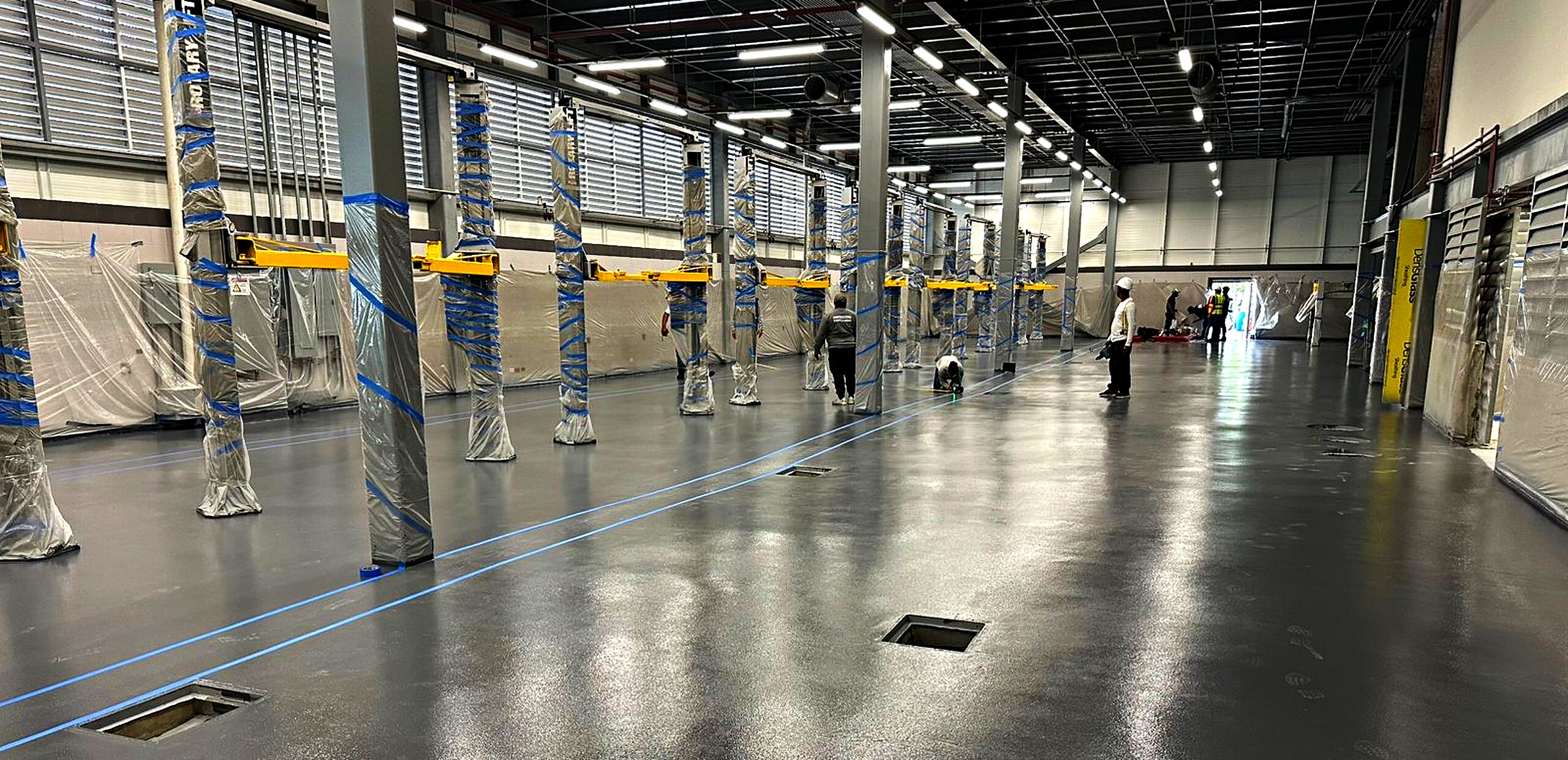
Chemical resistance, washdown and vehicle traffic. This is standard industrial floor work; see our industrial flooring page.
Manure pits, effluent and containment
Lining concrete that holds manure, silage effluent, fuel or fertilizer is a containment job. See secondary containment coatings and EnviroThane.
Horse stalls
Concrete is hard on legs and cold. Penn State recommends a solid rubber mat or more bedding over concrete. Coating under mats can seal the slab, but the mat does the cushioning.
Dairy alleys and holding pens
Cattle traction comes from grooves and texture. Any coating has to keep that texture or it will be slippery. Many dairies are better off regrooving.
Barn floor slope and drainage checker
A coating on a flat floor just gives urine a smoother place to puddle. Check the fall from the high point to the drain or door before you plan anything else.
Does your barn floor drain?
Slope % = drop / run x 100. Compared with Penn State's 1.5 to 2% for horse stalls and the dairy floor slopes in Gooch's flooring guidance (1.5% parlor, 1.5 to 3% alleys, 3% flushed alleys, 6% maximum for transfer lanes).
Barn floor coating vs. mats and bare concrete
Here is how the common barn floor surfaces stack up. Prices are installed for coatings and material-only for mats, from 2026 published sources.
| Surface | Cost per sq ft | Cushion | Cleanability | Acid resistance | Best barn zones |
|---|---|---|---|---|---|
| Bare broom-finished concrete | Already there | None | Absorbs urine | Attacked by manure acids | Equipment bays with light use |
| Textured polyurea coating | $5–$10 installed (HomeGuide) | Slight | Seamless, washable | Good; check the data sheet for specific chemicals | Wash racks, aisles, feed and milk rooms, pits |
| Epoxy floor coating | $4–$10 installed (HomeGuide) | None | Seamless | Good indoors; brittle under impact and cold | Heated tack and feed rooms |
| 3/4 in smooth rubber stall mats | About $3 material (Greatmats) | Good | Urine gets under seams | Rubber unaffected | Stalls, standing areas |
| 3/4 in cobblestone-top mats | About $2.50 material (Greatmats) | Good | Texture holds dirt | Rubber unaffected | Stalls, trailers |
| Interlocking rubber pavers (1.25 in) | About $8.90 material (Greatmats) | Good | Many joints | Rubber unaffected | Aisles where horses are led |
Combining a coating with mats
One setup we like for horse barns: coat the stall slab, slope it properly, then lay mats on top. The coating stops urine that gets under the mat from soaking into the concrete, which is where most stall odor lives. Penn State notes rubber mats come mostly in 1/2 to 3/4 inch thicknesses, often with 10-year-plus warranties, and should have a rippled or bumped top for traction. For stall mats, bedding and footing in more depth, see our horse stall flooring guide.
Equipment barns and pole barn shops
The equipment side of a farm is a different job. Tractors, skid steers and trucks bring in mud, hydraulic oil, diesel and fertilizer, and the floor gets scraped by buckets and chains. Here the coating is doing what it does in any heavy-duty shop: sealing out oil, resisting chemicals and taking impact. Polyurea's flexibility is an advantage in an unheated pole barn where the slab moves with temperature swings and a brittle coating would crack. Add aggregate near doors where snow and mud come in, and mark walkways and equipment parking with contrasting color so people stay out of the way of moving machines.
Keeping a coated floor in shape
A coated barn floor is only easier to keep clean if you actually clean it. Scrape and rinse daily in wash racks and aisles, pressure wash on a schedule, and check the cove at the wall base, drains and any saw cuts for edges that are starting to lift. Small repairs are easy when caught early: an applicator grinds back to sound coating and patches. Ignore them and urine gets under the edge and spreads. Recoat high-wear lanes when the aggregate starts to wear smooth, before the coating itself wears through.
Barn floor coating cost comparison
Enter the area and the zone, and the tool compares coatings, mats and combinations side by side, then flags the option we would usually pick for that zone.
What will it cost to surface this part of the barn?
Cost = area x published per-square-foot range. Coatings are installed prices (HomeGuide 2026); mats are material only (Greatmats), so add your own labor and any concrete repair.
How we coat a barn floor
Strip, scrape and degrease
Remove all bedding, manure and feed, then pressure wash. Manure and fat residue in the pores will stop any coating from bonding, so we use a degreaser and rinse twice.
Let it dry out, then test
Barn slabs are often wet from below. Tape down plastic sheets for at least 16 hours (the ASTM D4263 method) and check for darkening before coating. New concrete needs its full cure first.
Mechanically profile the concrete
Shot blast or diamond grind to remove the acid-damaged, weak top layer and open the surface. Acid etching an already acid-damaged floor is not the answer.
Repair and re-slope
Fill spalls and potholes, and correct flat spots so the finished floor drains. This is the time to fix slope, not after.
Prime and spray the system
Apply a primer suited to the slab moisture, such as an ArmorPrime primer, then spray the polyurea or polyurethane coat. Run the coating up the walls a few inches as a cove so urine cannot get under the edge.
Build in traction
Broadcast texturing aggregate into the wet coat or use a textured product such as SureGrip. On a sample board, it should feel like coarse sandpaper when wet.
Cure before animals return
Follow the data sheet. HomeGuide notes polyurea floors are usually ready for light foot traffic within 24 hours and full vehicle traffic within 72 hours.
Wash rack, aisle or pit that never comes clean?
Send us the areas, square footage, what the floor sees every day, and photos of the worst spots. A certified ArmorThane applicator near you can quote a slip-resistant spray-applied system.
Contractors: become an applicator →
More for the farm and shop
Basketball court paint
Putting a court in the pole barn? Traction and coverage numbers here.
Crawl space waterproofing
Drainage and sump sizing, the same water-first logic as a barn floor.
Insulating the barn too? See metal building insulation for pole barns and steel buildings.
Barn floor coating questions
What is the best coating for a barn floor?
For wash racks, aisles, feed rooms and equipment bays, a textured polyurea or polyurethane system with aggregate is the toughest choice: seamless, washable, flexible in cold and resistant to manure acids. Smooth epoxy is cheaper but more brittle and slipperier. In stalls and cow resting areas, rubber mats or bedding over well-drained concrete matter more than the coating.
Is epoxy good for horse stalls?
Not on its own. Epoxy is hard and smooth, and horses need cushioning and traction in a stall. If you want to seal the slab, coat it with a textured system and put rubber mats on top.
Will a coating stop barn floor odor?
It helps a lot. Most lingering ammonia smell comes from urine soaked into bare concrete. A sealed floor with proper slope lets urine drain and wash away instead of soaking in. Ventilation and bedding management still matter.
Why is my barn concrete crumbling?
Organic acids in manure and silage effluent dissolve the cement paste in concrete. Lab work at pH 4 showed the attacked zone almost completely decalcified, with lactic acid from silage the most aggressive. Freeze-thaw and scraping finish the job. Grind off the damaged layer before any coating.
How much does it cost to coat a barn floor?
HomeGuide puts installed polyurea floor coating at $5 to $10 per sq ft and epoxy at $4 to $10. Barn floors often cost more at the start because of cleaning, grinding and repairing acid-damaged concrete. Rubber stall mats run about $2.50 to $3 per sq ft in material.
How much slope does a barn floor need?
Penn State recommends 1.5 to 2% for horse stalls, about 1/4 inch per foot, which drains urine without the horse noticing. Dairy guidance runs 1.5% for parlor decks, 1.5 to 3% for alleys and 3% for flushed alleys, with 6% as the maximum for transfer lanes.
Can you coat a dairy barn floor?
Milk rooms, parlor wash areas, manure pits and equipment areas are good candidates. Alleys where cows walk are tricky: traction depends on grooves and texture, and a coating must not fill or round them. Talk to your nutritionist and hoof trimmer about lameness before changing alley surfaces.
How soon can animals go back on a coated floor?
Follow the product data sheet. As a general figure, HomeGuide says polyurea floors are usually ready for light foot traffic within 24 hours and fully cured for vehicles within 72 hours. We wait for full cure before heavy livestock traffic.
Sources
- Penn State Extension, horse stable flooring materials and drainage: extension.psu.edu/horse-stable-flooring-materials-and-drainage
- eXtension (Gooch), flooring considerations for dairy cows: dairy-cattle.extension.org/flooring-considerations-for-dairy-cows
- Attack of cement pastes exposed to organic acids in manure, Cement and Concrete Composites (2005): sciencedirect.com/science/article/abs/pii/S0958946505000752
- HomeGuide, polyurea garage floor coating cost (2026): homeguide.com/costs/polyurea-garage-floor-coating-cost
- Greatmats, pricing and costs of horse stall mats: greatmats.com/cost-of-horse-stall-mats.php
- ASTM D4263 plastic sheet test summary: astmd4263.com
Tough floors for hard-working barns.
Farm and ranch owners get a certified ArmorThane applicator who preps acid-damaged concrete and builds traction into every coat. Contractors can add agricultural coatings with no franchise fee and no royalties.
 Read it
Commercial & Industrial Floor Coatings
Flip through the whole brochure right here, or open it full screen on Issuu to share it.
Start your coatings business with ArmorThane.
Tell us what you want to spray and where you are. An ArmorThane specialist will walk you through the equipment, chemicals, training and startup cost for the work you want to do.
- Equipment package matched to your applications
- Hands-on training and applicator certification
- Technical support once you are spraying
Barn floor that never comes clean? Seal it for good.
Tell us which areas of the barn, the square footage, what animals or equipment use them, and the condition of the concrete. We will connect you with a certified applicator near you.
- Areas and square footage
- Horses, cattle or equipment
- Concrete age and damage
- Drains and slope today
More to read on floors and decks
Short reads from ArmorThane on Issuu. Tap one to open it right here.



More in Floors & concrete
 Floors & concreteConcrete Resurfacing: Cost, Options & When to Replace
 Floors & concreteConcrete Sealer
 Floors & concreteConcrete Stain
 Floors & concreteConcrete Step Repair
 Floors & concreteConstruction Flooring
 Floors & concreteCool Deck Coating
 Floors & concreteDeck Joist Protection
 Floors & concreteDog Kennel Flooring