
Patio Coating: What Lasts & What It Costs
Sealers, paint, overlays, epoxy, polyaspartic and polyurea, compared for sun, freeze-thaw, grip and price. We make several of these systems, so we’ll also tell you when a gallon of sealer is the better buy.
Coat decks and pools for a living.
ArmorThane is the one-stop shop for applicators. We make the chemistry, build the equipment, train you hands-on and back you with technical support, with no franchise fees and no royalties. Applicators have come first here since 1989.
- $0franchise fees or royalties
- 35+years in business
- 50+countries with applicators
- 24/7technical support
A patio is the hardest slab on the property to coat. It takes full sun from above and ground moisture from below, freezes and thaws in half the country, and gets grills, planters and bare feet in between. Plenty of coatings that do fine in a garage were never built for that.
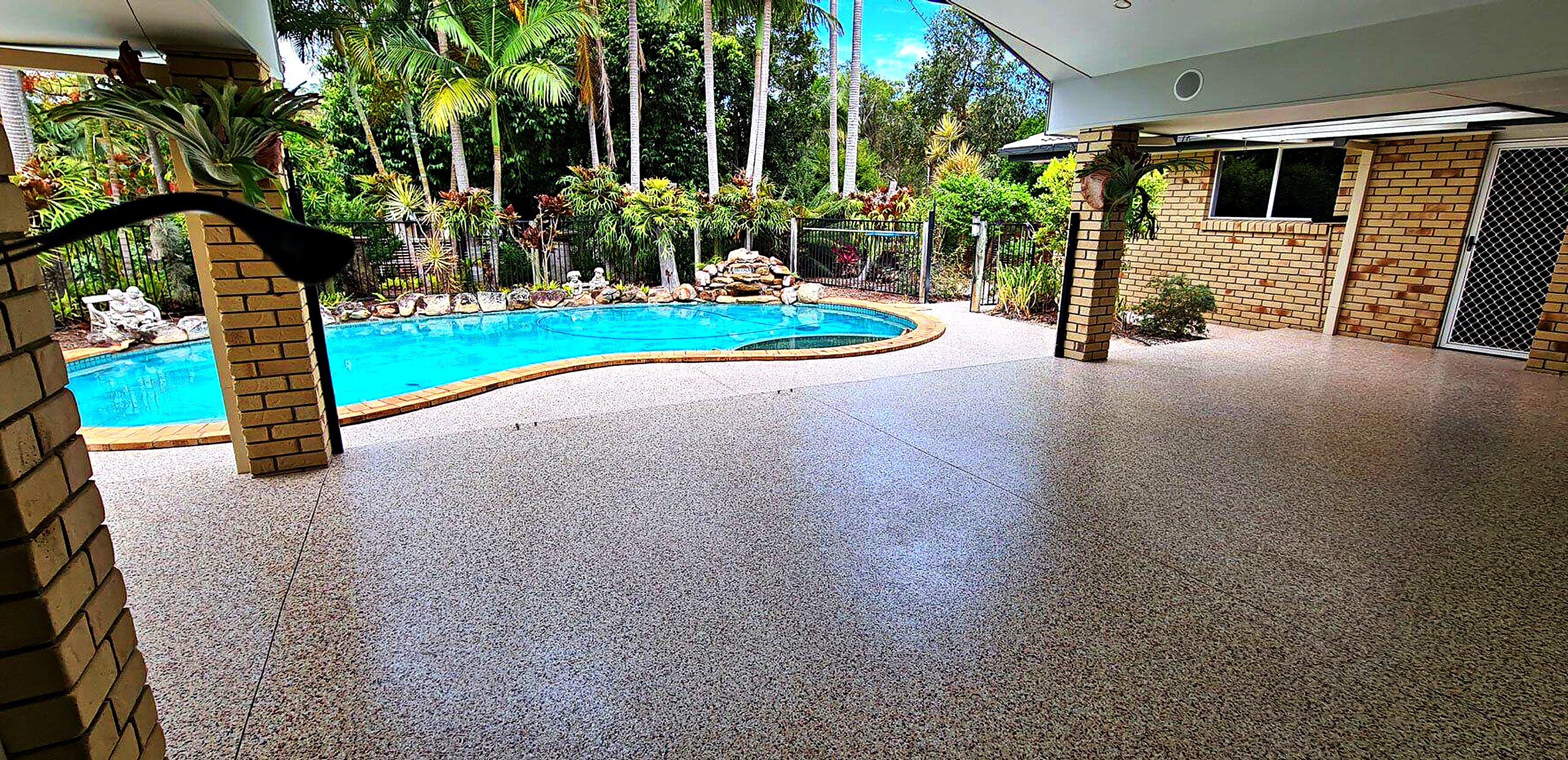
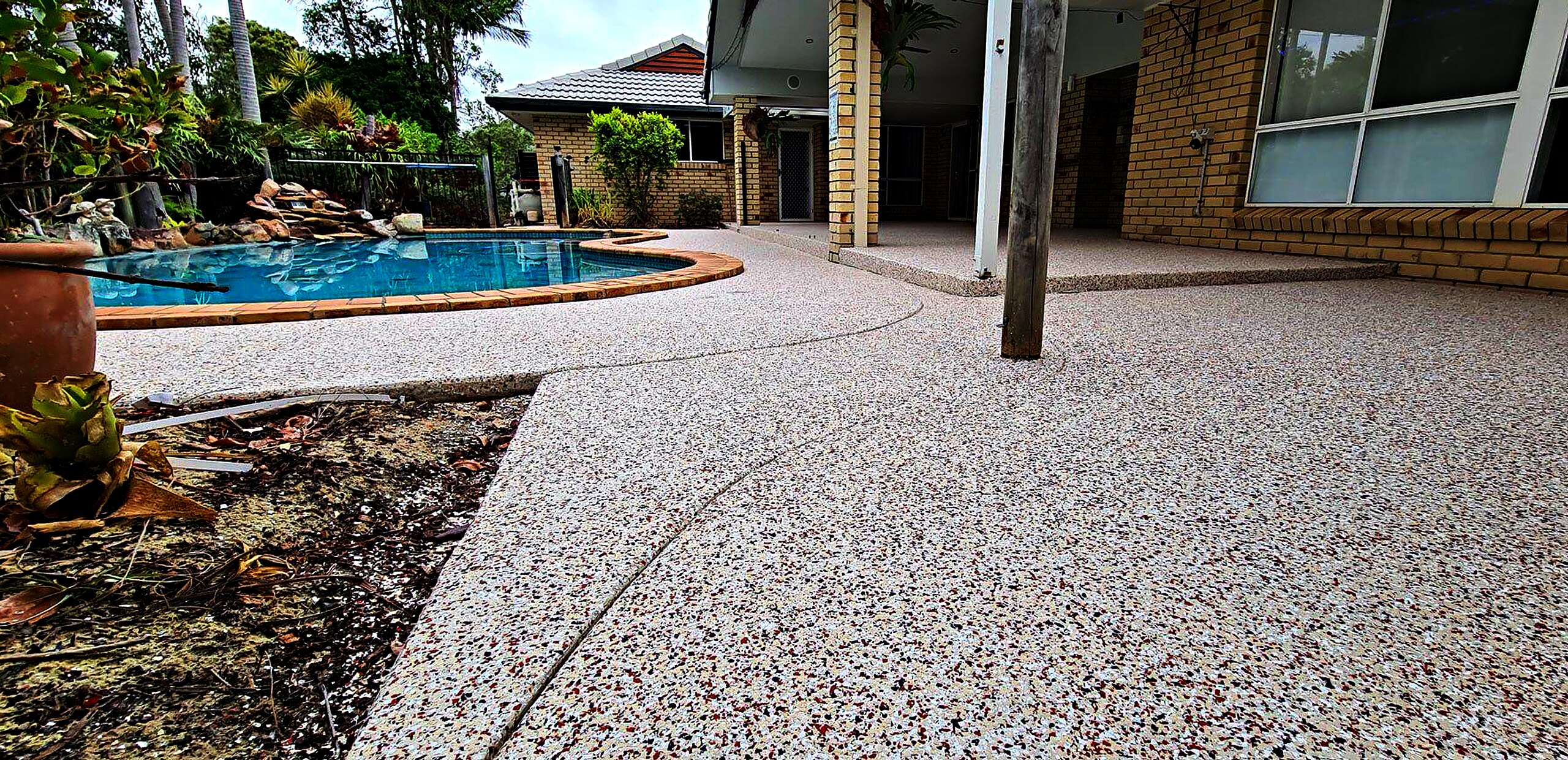
For a sound patio you just want to protect, use a breathable penetrating sealer (silane or siloxane), about $1–$3 per sq ft installed. For a new look that holds up in full sun, a professionally installed aliphatic polyaspartic or polyurea system with flake or aggregate ($5–$12 per sq ft) lasts longest, if the slab passes a moisture test. Flaking or patched concrete needs a cementitious overlay first ($3–$7). Heaved or broken slabs need leveling or replacement. And skip epoxy as the top coat outside: its own data sheets warn it discolors in sunlight. Jump to the patio coating finder or the cost calculator.
Most pages on this topic come from an installer selling one system, so every patio gets the same answer. We make several of these systems (polyurea, polyaspartic and the ArmorDeck membrane) in Springfield, Missouri, and we've supplied and trained applicators for more than 35 years. That puts us in a good spot to say which coatings belong outside and which don't.
So here it is with the numbers: installed prices with dates, the limits printed on the data sheets, and the moisture and freeze-thaw rules that decide whether a coating stays stuck. Including the cases where the right answer is a gallon of sealer and not us.
- 1The best coating for your patio, by situation
- 2Patio coating options compared
- 3Which coating fits your patio? (finder)
- 4Can you epoxy a patio?
- 5Sun, water and freeze-thaw
- 6Are patio coatings slippery when wet?
- 7What it costs (calculator)
- 8Patio resurfacing and overlays
- 9Is your patio ready to coat? (check)
- 10DIY patio coating (materials calculator)
- 11How a pro installs it
- 12Pool decks, porches and covered patios
- 13Common problems and fixes
- 14Where ArmorThane fits
- 15Patio coating FAQ
What is the best coating for a concrete patio?
There isn't one best patio coating; there's a best one for your slab, your sun and your winter. Sound concrete you like the look of gets a penetrating sealer. A new color in full sun calls for an aliphatic polyaspartic or polyurea system. Worn, scaled concrete needs an overlay. And a slab that has sunk or broken up needs fixing before anything goes on it.
| Your patio | Best fit | Why | Installed cost |
|---|---|---|---|
| Sound, bare, and you like how it looks | Penetrating silane or siloxane sealer | Breathable, no film to peel. The sealer type NRMCA recommends for freeze-thaw exposure | $1–$3/sq ft |
| Sound, you want color, tight budget | Porch paint, solid stain or a DIY stone coating | Cheap and easy to redo; plan on recoats | Materials only (DIY calculator) |
| New look that lasts, full sun | Aliphatic polyaspartic flake system | UV-stable, one-day install, textured. Needs a dry slab | $5–$12/sq ft |
| Hairline cracks, pool deck, or you want it waterproof | Sprayed polyurea base, aggregate, aliphatic top | Flexible membrane bridges hairline cracks; aggregate for grip | $6–$12/sq ft |
| Flaking, scaling, patched or stained | Cementitious overlay or spray-knockdown | A new bonded surface, 1/32 in. to 2 in. thick | $3–$10/sq ft |
| You want a stone or brick pattern | Stamped overlay | Pattern without pouring new concrete; reseal every 2–3 years | $7–$20/sq ft |
| Sunken, heaved, crumbling, or cracks ¼ in. and wider | Level or replace first | No coating fixes a slab that moves | Leveling $3–$25; new plain $4–$12 |
| Fully covered porch, no sun | Epoxy becomes an option | Out of UV, but still needs a dry slab | $4–$10/sq ft |
Where do the installer pages go wrong? Two places. A few still sell epoxy for sunny patios, which the epoxy makers' own data sheets argue against. And most push a film coating onto every slab without asking whether moisture is coming up from the ground, the first thing every film-coating data sheet we checked tells you to test. We'll cover both below.
Patio coating options compared
Patio coatings fall into three groups: penetrating sealers that soak in and leave no film, film coatings that sit on top (sealers, paints, epoxy, polyaspartic, polyurea), and cementitious overlays that build a new surface. Films change the look most and demand the driest slab. Click a column header to sort.
| Option | Type | Full sun | Freeze-thaw | Wet grip | DIY? | Installed $/sq ft | Typical life |
|---|---|---|---|---|---|---|---|
| Penetrating silane/siloxane sealer | Soaks in, no film | No film to yellow | Recommended by NRMCA | Same as bare concrete | Yes | $1–$3 | Per label |
| Acrylic sealer | Thin film | Wears; reseal | Reseal often | Can get slick; add grit | Yes | $1–$2 | 1–3 yr |
| Porch paint or solid stain | Film | Recoats | Recoats | Textured versions exist | Yes | DIY cost | 1–3 yr (our estimate) |
| DIY stone coating kit | Thick textured film | Maker says yes | Maker says yes | Textured | Yes | DIY cost | Not published |
| Epoxy | Film | Discolors (maker data) | Not recommended (Sika) | Needs grit | Kits | $4–$10 | 3–7 yr outdoors (our estimate) |
| Aliphatic polyaspartic flake | Film system | UV-stable | Dry slab required | 0.63 wet DCOF, full flake | Pro | $5–$12 | 10–20+ yr |
| Sprayed polyurea + aliphatic top (ArmorDeck-type) | Membrane | With aliphatic top | Flexible | With aggregate | Pro | $6–$12 | 15–20+ yr (our estimate) |
| Cementitious overlay or spray-knockdown | Bonded cement layer | Seal it | NRMCA's scaled-slab repair | Textured | Some | $3–$10 | 8–15 yr |
| Stamped overlay | Bonded layer + sealer | Reseal 2–3 yr | Reseal | Depends on sealer | Pro | $7–$20 | 8–15 yr |
| Kool Deck–type texture | Textured cement coat | – | – | Non-slip texture | Pro | $4 | Not published |
| Replace the slab | New concrete | – | Air-entrained, 4,000 psi where salted | Broom finish | Pro | $4–$12 plain | 30–50 yr |
Penetrating sealers (silane, siloxane, silicate)
These soak into the pores and make the concrete shed water without leaving a film on top. Nothing to peel, nothing to yellow, and the patio still looks like concrete. They won't hide stains or change the color. For freeze-thaw country they're the default: NRMCA's guidance on scaling says to apply "a commercially available silane or siloxane-based breathable concrete sealer" on a reasonably dry slab, and names late summer, after a few dry days, as the ideal time. HomeGuide puts professional penetrating sealing at $1–$3 per sq ft.
Acrylic sealers (clear, wet-look and tinted)
A thin film that adds sheen, darkens the color or carries a tint. It's the cheapest way to make a patio look fresh: $1–$2 per sq ft installed, or $30–$60 a gallon to roll it yourself at 200–500 sq ft per gallon (HomeGuide). The catch is life. HomeGuide says acrylic sealers "last 1 to 3 years on average," and glossy films get slick when wet unless you add grit.
Porch paint and solid stain
Acrylic porch and floor paint changes the color completely for the price of a few gallons. Home Depot's guide puts coverage at up to 400 sq ft per gallon. Paint is a film, so it needs clean, dry, etched or profiled concrete to stick, and it's the option you'll be redoing soonest. Pick a textured or anti-slip version for anywhere that gets wet. Stain goes further (up to 600 sq ft per gallon) and changes color without hiding texture.
DIY stone and textured coatings
The products in the shopping carousel for this search, such as Daich's SpreadRock and RollerRock kits, are thick textured coatings rolled or troweled over a primer and finished with two coats of sealer. The maker lists patios, pool decks and steps among the uses and says they stand up to sun, salting and snow shoveling. SpreadRock covers 50 sq ft per gallon per coat and takes two coats. It's the DIY route to a new surface that hides stains. We don't have independent life data on these.
Epoxy
Hard, glossy, cheap per square foot, and the wrong top coat for a sunny patio. More on why in the epoxy section below.
Polyaspartic flake systems
Polyaspartic is an aliphatic polyurea slowed down enough to roll. It's the chemistry behind most "one-day" flake floors, and it's aliphatic, so it holds its color in sun. One maker's data sheet lists "Exterior or Areas Exposed to UV" as a use and shows 87–89 gloss units retained after 1,000 hours of accelerated UV (ASTM G154). A typical patio system is a base coat, a full broadcast of vinyl flake, then one or two clear polyaspartic top coats. HomeGuide puts it at $5–$12 per sq ft installed and 10–20+ years. The limit is moisture: that same product allows no more than 3 lb per 1,000 sq ft per 24 hours (ASTM F1869) or 75% RH in the slab (ASTM F2170). Our polyaspartic floor coating guide covers cure times and specs.
Sprayed polyurea and ArmorDeck-type membranes
Where a patio has hairline cracks, sits over something you want dry, or doubles as a pool deck, a thicker, flexible membrane makes more sense than a thin film. Sprayed polyurea goes on at 60–80 mils on pool decks, per our pool deck resurfacing guide, with aggregate broadcast into it and a UV-stable aliphatic top coat over that. ArmorDeck does the same job with a troweled, moisture-cured base and an aliphatic top. We price sprayed systems at $6–$12 per sq ft.
Cementitious overlays, spray-knockdown and Kool Deck
Overlays are a new, thin concrete surface bonded to the old one: micro-toppings from 1/32 to 3/16 in., spray-knockdown finishes around 1/8 in., and self-leveling toppings from 1/4 to 2 in. (HomeGuide). They're the fix for a patio that's already flaking, patched or badly stained. HomeGuide puts basic patio resurfacing at $3–$7 per sq ft, decorative overlays at $6–$10, and a Kool Deck coating at $4. Seal overlays afterward.
Stamped overlays
A stamped overlay presses a stone, brick or slate pattern into a fresh overlay: $7–$15 per sq ft for a single pattern and $15–$20 for complex designs (HomeGuide). It looks like stamped concrete for less than tearing out and repouring, but it inherits stamped concrete's upkeep: a sealer every 2–3 years.
When replacing beats coating
HomeGuide's line is a good one. Resurface when the problems are minor flaking or cracks under ¼ in. Replace when there are "large cracks, crumbling, spalling, or structural problems," or when the repair needs a layer more than 2 in. thick. A new plain patio runs $4–$12 per sq ft and lasts 30–50 years. If the slab is sound but has sunk, lifting it may be all it needs; see our concrete leveling cost guide.
Which patio coating fits your patio?
Answer nine questions. The finder scores ten options against your goal, sun, winter, slab condition, existing finish, use, budget and a quick moisture test, then shows the best fit, two alternatives and what to skip, with the reason for each.
What should go on this patio?
Not sure about moisture? Tape a 2 ft x 2 ft plastic sheet to the bare slab for 24 hours. Droplets or darker concrete under it means damp.
Aliphatic polyaspartic flake system
$5–$12/sq ft installed
UV-stable, one-day installs, full flake gives grip (0.63 wet DCOF on one maker’s data sheet). Needs a dry slab: ≤3 lb MVER and ≤75% RH for that product.
- Big change in color and texture that holds up in sun
Sprayed polyurea or ArmorDeck-type membrane, aliphatic top
$6–$12/sq ft installed
Flexible, thicker membrane (60–80 mils on pool decks) with broadcast aggregate and a UV-stable top coat. Bridges hairline cracks.
- Sprayed membranes bridge cracks under 1/16 in. after cleaning
Cementitious overlay or spray-knockdown
$3–$10/sq ft installed
Rebuilds a worn surface from 1/32 in. to 2 in. thick. NRMCA lists bonded cementitious resurfacing for scaled slabs. Seal it afterward.
Not for this patio
- Epoxy system: Discolors in sunlight (Sika-261 data sheet); only under a UV-stable top coat.
- Cracks over 1/16 in. get filled and taped before any film goes on; control joints stay open with backer rod and flexible sealant.
- Do the 24-hour plastic-sheet test before any film coating. Patios usually have no vapor barrier under them.
Rules from NRMCA CIP 2, Sika, Rust-Oleum and Simiron data sheets, HomeGuide cost data and ArmorThane application specs. A screening tool: a certified applicator should test the slab before quoting a film system. Find one near you.
Can you epoxy a patio?
Not as the top coat if the sun reaches it. Standard epoxies are aromatic, and aromatic coatings yellow and chalk in UV. That's not an installer's opinion; it's printed on epoxy data sheets. On a fully covered porch, or as a base under a UV-stable top coat, epoxy can work.
Here's what the makers say. Sika's Sikafloor-261 data sheet: the product "will discolour over time when exposed to sunlight (UV)," and it's "typically not recommended for exterior slabs on grade where freeze/thaw conditions may exist." Rust-Oleum describes its water-based EpoxyShield kit as "designed for finishing concrete garage floors." Our own polyurea vs epoxy page says the same thing from the other side: epoxy "ambers, chalks and dulls under UV."
Epoxy's other outdoor problem is that it's rigid. A patio slab moves with temperature and freeze-thaw, and a stiff film over a moving crack tends to crack with it. And it's a film, so everything in the moisture section applies.
When epoxy is fine
- Covered porches and screened patios that never see direct sun, on a slab that passes a moisture test.
- As a base coat or primer under an aliphatic polyaspartic or polyurethane top coat, which is how many flake systems are built. The top coat takes the UV. Our polyaspartic vs epoxy comparison explains that stack.
What sun, water and freeze-thaw do to a patio coating
Three things end patio coatings early: sunlight on the wrong chemistry, moisture pushing up from the ground under a film, and freeze-thaw damage to the concrete itself. Heat matters too, mostly for bare feet. Each one has a simple test or rule, and none of them shows up on the installer pages we reviewed.
Sunlight: aliphatic vs aromatic
Coatings come in two chemical families. Aromatic ones (most epoxies, most sprayed polyureas, the ArmorDeck base coat) are tough and economical but amber in sunlight. Aliphatic ones (polyaspartic, aliphatic polyurethanes, and aliphatic polyureas such as our HighLine 410 and ArmorFlex UV) hold their color. That's why good outdoor systems stack an aromatic base under an aliphatic top coat: the base does the heavy lifting, the top takes the UV. Aromatic polyurea "will also amber in sunlight," as our polyurea vs epoxy page puts it, "which is why exterior work should specify an aliphatic formulation or an aliphatic topcoat." Ask any installer which layer of their system is aliphatic.
Water from below: patios have no vapor barrier
Indoor slabs are poured over a plastic vapor retarder. Patios aren't. The building code requires a 6-mil vapor retarder under floor slabs but exempts "driveways, walks, patios and other flatwork that will not be enclosed at a later date" (IBC 1907.4, 2024 edition as adopted). So ground moisture can move up through a patio slab, and a film on top can trap it at the bond line.
That's why every film-coating data sheet we checked demands a moisture check first. The DIY version is the plastic-sheet test: tape a 2 ft x 2 ft sheet down for 24 hours; droplets or darker concrete mean moisture (Rust-Oleum). If it's damp, RockSolid's instructions say to allow 10–14 more days and retest. Pro systems use measured tests: the polyaspartic above allows no more than 3 lb per 1,000 sq ft per 24 hours (ASTM F1869) or 75% relative humidity (ASTM F2170). Penetrating sealers leave no film, which is a big part of why NRMCA calls them "breathable" and recommends them outside.
Freeze-thaw and deicing salt
Scaling is the flaking you see on older patios and walks. NRMCA explains it simply: concrete saturated with water, then frozen, cracks at the surface as the ice expands, and "deicing chemicals exacerbate this." Moderate scaling can take ⅛ to ⅜ in. of surface mortar with it. The concrete industry's answers are good concrete (air-entrained, 6% air, and 4,000 psi where deicers are used) and good habits. From NRMCA's CIP 2:
- Seal it: a breathable silane or siloxane sealer on a reasonably dry slab, ideally late summer.
- No deicers the first winter on new concrete; use clean sand for traction.
- Acceptable deicers: calcium chloride and sodium chloride (rock salt), in moderate amounts.
- Never: ammonium sulfate, ammonium nitrate or magnesium-based salts. NRMCA calls them "chemically aggressive."
- Drain it: salt solutions sitting in low spots make scaling worse. Hose off salt when you can.
Heat: dark coatings in full sun
Color and reflectance drive how hot a patio gets. EPA notes that conventional paving such as asphalt "can reach surface temperatures up to 152°F at mid-day," and in the study it cites, cooler reflective pavements stayed 10 to 16°F cooler. On a patio or pool deck where people walk barefoot, pick light colors and a textured finish, or a Kool Deck–type texture made for that job. A charcoal flake floor that looks great in the showroom will be hot at 3 p.m. in July.
Are patio coatings slippery when wet?
Smooth, glossy ones can be. Bare broom-finished concrete has built-in texture, and a clear film fills it in. HomeGuide flags polyaspartic sealers as "slippery when wet," and our own texturing page says roll-on coatings "are glossy and may become slick when wet." The fix is texture: flake, aggregate or a textured top coat. Built right, a coated patio grips well.
The number to ask for: wet DCOF
Slip resistance is measured as the dynamic coefficient of friction (DCOF). ANSI A326.3 says hard floors in level interior spaces "expected to be walked on when wet with water shall have a measured wet DCOF value of 0.42 or greater." Its exterior-wet class is manufacturer-declared and typically 0.55 or higher, per Sherwin-Williams' summary. Neither OSHA nor the ADA sets a number. For reference, one polyaspartic over a full flake broadcast tested at 0.63 wet DCOF. Ask your installer for the tested wet DCOF of the exact system and finish they're quoting, and ask to see a sample board.
Aggregate, and the bare-foot trade-off
- What goes in: ArmorDeck's base coat takes "washed sand, garnet abrasive, tennis ball, or rubber crumb, approximately 16 or 20 mesh, depending on skid resistance requirements." Resin-flooring makers use aluminum oxide in grits like #54, #36 and #24; coarser grips harder.
- Where it goes: broadcast into the wet base, or mixed into the top coat, or both. Flake systems get their grip from the flake itself plus any grit in the top coat.
- The trade-off: coarse grit is hard on bare feet and harder to sweep. Our non-slip coatings page notes that where bare feet are common, "aggregate can cause more problems than it solves," and suggests a textured spray finish instead. Pool decks and kids' play areas want fine grit or texture, not sandpaper.
How much does it cost to coat a patio?
Installed, patio coatings run from about $1 per sq ft for a clear acrylic seal to $20 for a complex stamped overlay. Most pro flake and membrane systems land at $5–$12. For a 16x20 patio (320 sq ft), that's roughly $320–$640 to seal and $1,600–$3,840 for polyaspartic flake, before prep and repairs.
| Option | Installed $/sq ft | Typical life | Source (date) |
|---|---|---|---|
| Acrylic sealer | $1.00–$2.00 | 1–3 years | HomeGuide sealing (Nov 2025) |
| Penetrating sealer (siloxane, silicate) | $1.00–$3.00 | Per product | HomeGuide sealing (Nov 2025) |
| Polyurethane sealer | $1.25–$3.00 | 5–15 years (epoxy or urethane sealers) | HomeGuide sealing (Nov 2025) |
| Basic resurfacing, patio or walkway | $3–$7 | 8–15 years | HomeGuide resurfacing (Feb 2026) |
| Decorative overlay | $6–$10 | 8–15 years | HomeGuide resurfacing (Feb 2026) |
| Stamped overlay | $7–$15 single pattern; $15–$20 complex | 8–15 years; reseal every 2–3 | HomeGuide (Feb 2026; Nov 2025) |
| Kool Deck coating | $4 | Not published | HomeGuide resurfacing (Feb 2026) |
| Epoxy | $4–$10 (patio 200–400 sq ft: $800–$4,000) | 3–7 years outdoors (our estimate) | HomeGuide epoxy (Feb 2026) |
| Polyaspartic flake system | $5–$12 | 10–20+ years | HomeGuide polyaspartic (Nov 2024) |
| Sprayed polyurea, aggregate, aliphatic top | $6–$12 | 15–20+ years (our estimate) | ArmorThane pool deck guide (2026) |
| New plain concrete patio | $4–$12 | 30–50 years | HomeGuide patio (Jul 2025) |
| New stamped or stained patio | $8–$30 | 30–50 years | HomeGuide patio (Jul 2025) |
| Patio size | Acrylic seal | Basic resurfacing | Polyaspartic flake | Sprayed polyurea | Stamped overlay |
|---|---|---|---|---|---|
| 10x10 (100 sq ft) | $150–$300* | $300–$700 | $500–$1,200 | $600–$1,200 | $700–$2,000 |
| 12x16 (192 sq ft) | $190–$380 | $580–$1,340 | $960–$2,300 | $1,150–$2,300 | $1,340–$3,840 |
| 16x20 (320 sq ft) | $320–$640 | $960–$2,240 | $1,600–$3,840 | $1,920–$3,840 | $2,240–$6,400 |
| 20x24 (480 sq ft) | $480–$960 | $1,440–$3,360 | $2,400–$5,760 | $2,880–$5,760 | $3,360–$9,600 |
What will my patio cost, and what does it cost per year?
L-shaped patio? Enter the second leg as another rectangle. Steps are added at 1.5 sq ft per foot of step width (tread plus riser).
Polyaspartic flake system at $5.00–$12.00/sq ft installed; your level uses $8.50. Area: 320 sq ft + 18 sq ft of steps (1.5 sq ft per foot of step width, our tread-plus-riser assumption). Add-ons in this estimate: $391. Sources: HomeGuide cost guides (2024–2026) and the ArmorThane pool deck guide for sprayed polyurea. Estimates only; get written quotes.
Cost per year of life, every system at your size
| System | Typical life | Installs in 20 yr | Total | Per year |
|---|---|---|---|---|
| Replace with plain concrete | 30–50 yr | 1 | $2,700 | $135 |
| Cementitious resurfacing, basic | 8–15 yr | 2 | $3,810 | $191 |
| Decorative or spray-knockdown overlay | 8–15 yr | 2 | $5,840 | $292 |
| Replace with stamped or stained concrete | 30–50 yr | 1 | $6,420 | $321 |
| Polyaspartic flake system | 10–20+ yr | 2 | $6,530 | $326 |
| Sprayed polyurea, aggregate + aliphatic top | 15–20+ yr | 2 | $6,870 | $343 |
| Acrylic sealer (clean & seal) | 1–3 yr | 10 | $7,230 | $361 |
| Epoxy flake system | 3–7 yr | 4 | $11,030 | $551 |
| Stamped overlay | 8–15 yr | 2 | $12,600 | $630 |
Costs most patio quotes leave out
- Cleaning: pressure washing runs $0.35–$0.77 per sq ft (HomeGuide).
- Cracks and spalls: $0.50–$3 per linear ft of crack; HomeGuide adds $1–$5 per sq ft for extensive repairs under polyaspartic.
- Moisture and hardness testing: $50–$300 (HomeGuide). Worth every dollar on a slab with no vapor barrier.
- Custom flakes or colors: +$0.50–$2.00 per sq ft.
- Leveling a sunken slab: $3–$6 per sq ft mudjacked or $5–$25 foam-lifted (HomeGuide); our concrete leveling cost guide breaks it down.
- Minimums: small sealing jobs hit HomeGuide's $150–$300 minimum service fee.
The per-year view is the one that changes minds. A cheap acrylic seal redone every couple of years adds up to about what a flake system costs over two decades, and it never looks as good. Replacement often comes out cheapest per year, because new concrete lasts 30–50 years, but that buys plain concrete rather than a finish, and demolition isn't in the number.
Concrete patio resurfacing: overlays, stamped and spray-knockdown
Resurfacing bonds a new cementitious layer, from 1/32 in. to 2 in. thick, over the old slab. It's the right move when the concrete is structurally sound but the surface is flaking, patched, pitted or stained beyond what a sealer or stain can hide. HomeGuide prices basic patio resurfacing at $3–$7 per sq ft and says it lasts 8–15 years.
| Overlay | Thickness | Look | Installed $/sq ft |
|---|---|---|---|
| Micro-topping | 1/32–3/16 in. | Smooth or troweled, colored | Part of $3–$7 basic / $6–$10 decorative |
| Spray-knockdown | ≈1/8 in. | Splatter or shallow texture; solid, stenciled or patterned color | $6–$10 decorative |
| Stamped overlay | Thicker, stamped while fresh | Stone, brick, slate, wood plank | $7–$15 single pattern; $15–$20 complex |
| Self-leveling topping | 1/4–2 in. | Flat; fixes low spots | $3–$7 basic |
| Kool Deck | Textured coat | Cool, non-slip pool-deck texture | $4 |
Resurface, coat or replace?
- Resurface for "minor flaking or cracks less than 1/4" wide" (HomeGuide) and for scaled surfaces, where NRMCA lists portland-cement, latex-modified and polymer-modified bonded resurfacing as the repair.
- Coat when the surface is sound and you want protection, color or grip. You can also coat after resurfacing.
- Replace with "large cracks, crumbling, spalling, or structural problems," or if the repair would need a layer more than 2 in. thick (HomeGuide).
- Lift a sound slab that has sunk or tipped toward the house. We make Lift 200 and Lift 300 polyurethane lifting foam that applicators inject for this; see foam concrete lifting.
Two cautions. First, an overlay is only as strong as the surface it's bonded to: NRMCA says the base must be sound and free of dirt, oil and paint, with everything loose removed. Second, overlays are cement, so they still need sealing. Stamped work in particular needs a fresh sealer every 2–3 years, according to HomeGuide, which is part of its real cost.
Is your patio ready to coat?
Most coating failures are decided before the first coat goes on. Check slab age, old sealers, moisture, old coatings, cracks and the weather, including how close the slab is to the dew point. The check below runs those tests against the data-sheet rules for the product you plan to use.
Can I coat this patio today?
Measure the surface temperature with an infrared thermometer, in the spot you'll start. Air temperature and humidity come from your weather app.
Passed
- Slab age: 3,650 days, past the 28–30 day cure the kit makers require.
- Water drop soaks in: no active sealer on the surface.
- Plastic-sheet test dry after 24 hours. A screening test only; pros should measure.
- Hairline cracks: cracks under 1/16 in. can be bridged by a sprayed membrane after cleaning and abrading; tape them if unsure (ArmorThane prep guide).
- Temperature: inside the 35°F–85°F window (Simiron Polyaspartic HS data sheet, air temperature).
- Dew point: surface is 12.6°F above the 57.4°F dew point (5°F minimum).
- Rain window: 48 h clears the ~4 h walk-on time (Simiron: foot traffic in 4–6 h, fast cure).
Dew point by the Magnus formula. Rules from Rust-Oleum, Sika, Simiron and Daich data sheets, NRMCA CIP 2 and ArmorThane application specs. Screening only; the product label wins.
The prep checklist, in order
Let new concrete cure
Rust-Oleum's kits call for 28 days (EpoxyShield) to 30 days (RockSolid) before coating. Keep deicers off it the first winter (NRMCA).
Check for old sealer
Sprinkle water. If it soaks in, you're clear. If it beads, a sealer is still there, and film coatings need it removed or the surface abraded and tested.
Test for moisture
Tape a 2 ft x 2 ft plastic sheet down for 24 hours. Droplets or darker concrete mean moisture is coming up. Pros measure it (ASTM F1869 or F2170) against the product's limit.
Tape-test any old coating
Cut an X through it, press duct tape over the cut and rip it off. Rust-Oleum's limits: strip it if more than 10% (RockSolid) or 25% (EpoxyShield) comes off.
Treat cracks and joints
Our crack prep guide: under 1/16 in., clean and abrade, and a sprayed membrane can bridge it (tape it if unsure). Wider cracks get a urethane or polyurea filler and mesh tape. Control joints stay open with backer rod and flexible sealant.
Profile the surface
Film coatings need tooth. DIY kits use an etch (Rust-Oleum supplies a citric-acid etch). Pro systems shot-blast or diamond-grind to ICRI CSP 3–4, which also removes old sealer.
Pick the weather window
Stay inside the product's temperature range, keep the slab at least 5°F above the dew point (Sika, Rust-Oleum), and leave enough dry hours for it to reach foot-traffic cure.
DIY patio coating: what's realistic
Sealers, stains, porch paint, stone-coating kits and bagged resurfacers are all reasonable weekend projects. Sprayed polyurea isn't, and flake systems with fast-curing polyaspartic are tough for a first-timer. The calculator shows how much to buy and what it costs for the DIY options.
How much do I buy, and what will it cost?
Coverage and prices come from the makers and HomeGuide. Enter your shelf price to override.
Also buy 3 gal primer (160 sq ft/gal) and 3 gal sealer (350 sq ft/gal per coat, 2 coats); they’re sold separately and aren’t in the cost shown. Stone coat: 50 sq ft/gal per coat, 2 coats plus Daich’s 15% allowance, priced at $54.48 (1 gal) to $149.95 (3 gal). Daich asks you to call before coating broom-finished concrete. Waste allowance on primer and sealer: 10% (our planning default). Buy whole containers; material only, no tools, etch or crack filler.
A DIY coating that lasts: the steps that matter
- Clean hard. Degrease oil and grill spots, then pressure-wash and let the slab dry fully.
- Test before you buy. Water drop for old sealer, 24-hour plastic sheet for moisture. Use the ready-to-coat check.
- Etch or profile. Film products need tooth. Follow the kit's etch step, and rinse well.
- Fix cracks and flaking first. Paint and sealers don't fill cracks or rebuild scaled concrete.
- Thin coats, right weather. Stay inside the label's temperature range and 5°F above the dew point. Plan around the dry time before rain.
- Add grit if it'll get wet. Especially on steps and near a pool.
Where DIY runs out
Past a few hundred square feet, or when the slab needs grinding, crack routing or a moisture-tolerant primer, a pro's equipment is the difference. The same goes for any system you want to last a decade in full sun. A certified applicator can also give you a written thickness and a measured moisture reading, which a weekend kit can't. Find concrete coating applicators near you.
How a professional patio coating goes on
A pro flake or membrane install on a typical patio is usually a one- or two-day job, and most of the first day is prep. Here's the sequence our applicators follow for polyurea and polyaspartic systems, so you can hold any quote against it.
Inspect and test
Moisture, cracks, old coatings, contamination and drainage. The results decide the prep and whether a moisture-tolerant primer is needed.
Grind or shot-blast
Mechanical prep to ICRI CSP 3–4 removes old sealers and weak surface paste and gives the coating something to grip. An installer who only acid-etches is skipping the step that matters most.
Repair
Route and fill cracks, patch spalls, and keep control joints working with backer rod and flexible sealant.
Prime and base coat
A penetrating primer where the slab calls for it, then the base: rolled polyaspartic or polyurea, troweled ArmorDeck base, or sprayed polyurea at 60–80 mils for pool decks.
Broadcast flake or aggregate
Into the wet base, to full rejection for flake systems. Loose material is scraped and blown off once it cures.
UV-stable top coat
One or two aliphatic top coats lock in the broadcast. Grit goes into the top coat if you want more grip.
Cure
One fast polyaspartic allows foot traffic in 4–6 hours at 72°F and heavy traffic in 24 hours; sprayed polyurea is usually walkable in 1–2 hours. Furniture and grills go back per the installer's written times.
For more on polyaspartic cure times, film thickness and system choices, see our polyaspartic floor coating guide.
Pool decks, porches, steps and covered patios
The same chemistry covers all of these, but each one changes the priorities: grip and heat around a pool, edges and nosings on steps, UV on a covered porch, and waterproofing when there's a room underneath.
Porches and steps
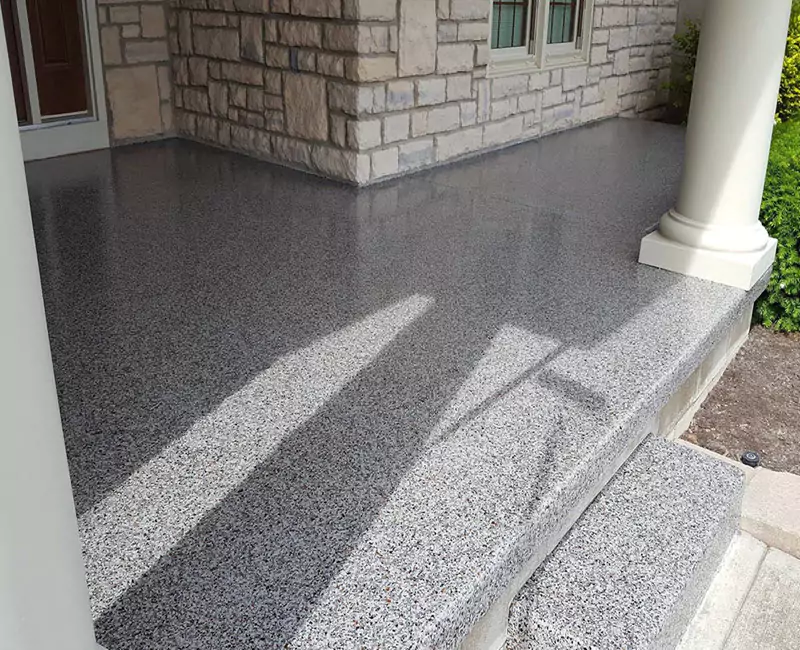
Porches are usually covered, so UV is less of a problem than on an open patio, but steps are where people slip. Carry the coating over the nosing, add grit to treads, and make sure the installer wraps the edge rather than stopping at it. If you're pricing steps, the calculator counts about 1.5 sq ft per foot of step width.
Covered patios and screened porches
With no direct sun, epoxy flake systems become an option again, and they're cheaper. The slab still has no vapor barrier under it, so the moisture test still applies.
Pool decks
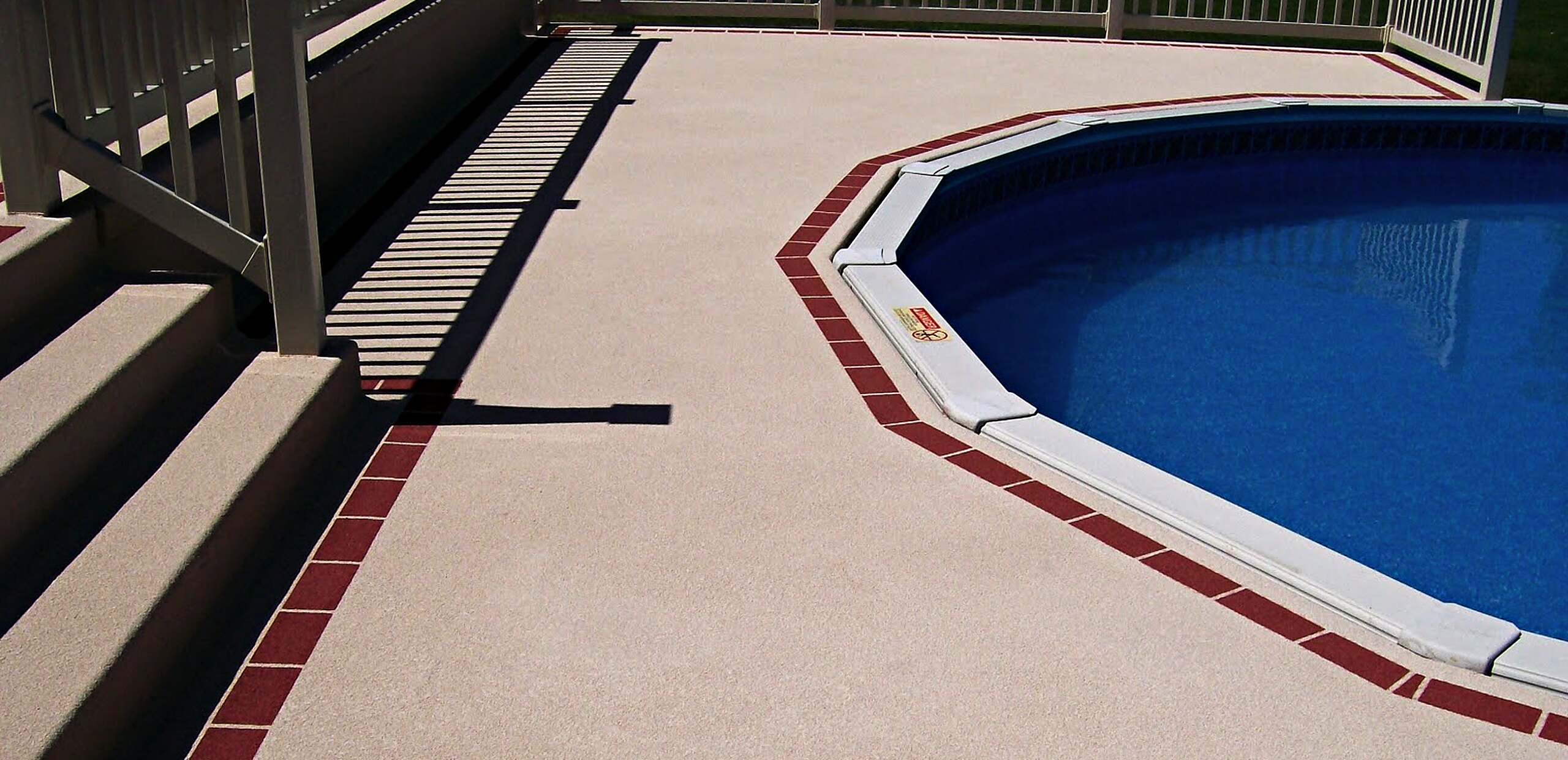
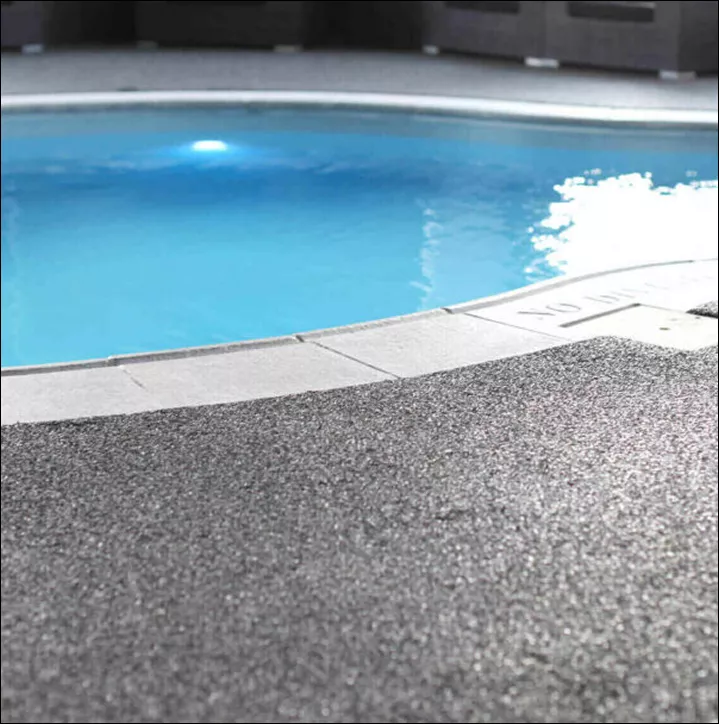
Grip, pool chemicals and bare-foot heat drive the choice: textured cement coats like Kool Deck ($4/sq ft, HomeGuide) or a sprayed polyurea system with fine aggregate and an aliphatic top. Our pool deck resurfacing guide covers it in depth.
Patios over a room or garage
A patio over living space is a roof. It needs a waterproofing membrane with slope, flashing and drains, not a decorative finish. See our deck waterproofing guide and plaza deck waterproofing.
Stamped and colored patios
Usually kept up with a sealer rather than coated over. HomeGuide says stamped concrete needs sealing every 2–3 years. A flake or paint system would cover the pattern you paid for.
Walkways and driveway aprons
Same rules as a patio, plus vehicle traffic on aprons. Paint and thin sealers wear fastest there. For whole driveways, see our concrete coatings overview.
Common patio coating problems and how to fix them
Most of the problems below trace back to three things: moisture under a film, the wrong chemistry in sun, and prep that skipped the grinder. Pick a symptom to filter the table.
| What you see | Most likely cause | Fix |
|---|---|---|
| Coating lifts in sheets; concrete underneath is dark or damp | Moisture coming up through a slab with no vapor barrier | Remove loose coating, fix drainage, measure moisture. Go back with a breathable sealer, or a system rated for the measured moisture. |
| New coating won't stick; peels easily in spots | An old sealer or curing compound still on the surface (water beads) | Grind to bare concrete, or abrade and adhesion-test per the product's instructions. |
| Peeling along cracks and joints | Moving cracks under a rigid film, or joints coated shut | Route and fill cracks, keep joints open with backer rod and flexible sealant, use a flexible membrane. |
| Yellowed, amber or chalky finish | Aromatic chemistry in sunlight (epoxy, aromatic polyurea) | Abrade, test adhesion, and top-coat with an aliphatic polyaspartic or polyurethane. |
| Cloudy, milky or blotchy right after install | Applied too close to the dew point ("blushing") | Sand and recoat per the maker. Next time keep the slab 5°F or more above the dew point (Sika). |
| Tiny pinholes or bubbles | Air whipped in while mixing, or coats applied too thick | Mix at medium speed without whipping air in (ArmorFloor instructions); sand and recoat thinner. |
| Slippery when wet | Smooth clear film with no grit or flake | Add a top coat with grit, or aggregate in a new broadcast. Ask for tested wet DCOF. |
| Too hot to walk on barefoot | Dark color in full sun | Top-coat in a lighter color, or use a textured cool-deck finish around pools. |
| Concrete flaking at the edges or beside the coating | Freeze-thaw scaling, made worse by deicers and ponding | Remove loose concrete, resurface, seal. Switch deicers (never ammonium or magnesium salts, per NRMCA). |
| Slab has sunk or tipped toward the house | Soil settlement or washout | Lift or level it before recoating. |
Where ArmorThane fits on a patio, and where it doesn't
We make three kinds of patio systems, all installed by trained applicators rather than sold as weekend kits. ArmorDeck is a two-step system for exterior concrete decks, patios and walkways: a troweled, moisture-cured aromatic urethane polyurea base with 16–20 mesh aggregate broadcast into it, then an aliphatic top coat for UV, applied within 48 hours. ArmorFloor is a two-component aliphatic polyaspartic for indoor and outdoor floors, used for flake and quartz systems on porch slabs and patios. For a thicker, color-stable sprayed membrane, ArmorFlex UV is an aliphatic polyurea that stays relatively insensitive to moisture during application.
Now the honest part. If your patio is sound and you like how it looks, a penetrating sealer at $1–$3 per sq ft is the better buy, and none of our systems belongs on it. If it's scaled, it needs an overlay before any coating. If it has sunk, lift or replace it first. And if you want a weekend project, our systems aren't sold that way. Where we fit is a patio that needs to look new for a long time in full sun, a pool deck that needs grip, or a slab with hairline cracks that a thin film won't ride over.
ArmorDeck
Aromatic polyurea base, 16–20 mesh aggregate, aliphatic top. Apply above 60°F; top-coat within 16–48 hours.
ArmorFloor
Aliphatic polyaspartic, dry film per coat on the ArmorFloor TopCoat sheet. Color Quartz or abrasives for grip.
ArmorFlex UV
1:1, 100% solids, fast-set sprayed polyurea formulated to be color-stable, for pedestrian decks and membranes.
Patios, porches and pool decks: add them to your rig.
Outdoor concrete uses the same grinders, much of the same material and the same crew skills as garage floors. We make the polyurea, polyaspartic and ArmorDeck systems, build the spray rigs and train crews at your location. Not a franchise: no franchise fee and no royalties, with startup packages from $25,000.
Questions first? Call (417) 831-5090, or 780-444-6200 in Canada.
Patio coating FAQ
What is the best coating for a concrete patio?
It depends on the slab and the goal. For sound concrete you want to protect without changing its look, a breathable silane or siloxane penetrating sealer is the right call, and it's what NRMCA recommends for exterior slabs in freeze-thaw country. For a new look in full sun, an aliphatic polyaspartic or polyurea system with flake or aggregate lasts longest. Flaking concrete needs an overlay first, and heaved or badly cracked slabs need leveling or replacement. The patio coating finder sorts it for your patio.
How much does it cost to coat a patio?
About $1–$2 per sq ft for a clear acrylic seal, $1–$3 for a penetrating sealer, $3–$7 for basic resurfacing, $5–$12 for a polyaspartic flake system and $7–$20 for a stamped overlay (HomeGuide, 2024–2026). A 16x20 patio (320 sq ft) runs roughly $320–$640 to seal and $1,600–$3,840 for polyaspartic flake before prep. Use the cost calculator for your size and add-ons.
Can you epoxy a patio?
Not as the top coat if the sun reaches it. Sika's epoxy data sheet says the product "will discolour over time when exposed to sunlight" and is typically not recommended for exterior slabs on grade where freeze-thaw occurs. Epoxy can work on a fully covered porch or as a base under a UV-stable aliphatic topcoat. More in our polyaspartic vs epoxy comparison.
Is polyaspartic good for outdoor patios? Is it slippery?
Aliphatic polyaspartic is one of the better outdoor choices: one maker's data sheet lists exterior use and 87–89 gloss units retained after 1,000 hours of accelerated UV (ASTM G154). A smooth clear coat can be slippery when wet, which HomeGuide flags. Installed over a full flake broadcast, the same product tested at 0.63 wet DCOF, above the 0.42 ANSI A326.3 threshold for wet interior floors.
What is the cheapest way to cover a concrete patio?
A clear sealer is cheapest: about $1–$2 per sq ft installed for acrylic or $1–$3 for penetrating, and less if you roll it yourself at $30–$65 a gallon covering 200–500 sq ft (HomeGuide). Solid-color porch paint is next on material cost. Both need regular recoats; HomeGuide puts acrylic sealer life at 1–3 years.
What can I put on my concrete patio to make it look better?
A stain or tinted sealer changes color while keeping concrete's texture. A flake polyaspartic system gives a speckled, stone-like finish. Cementitious overlays and spray-knockdown finishes hide patches and stains, and stamped overlays add a stone or brick pattern for $7–$20 per sq ft (HomeGuide). DIY stone coatings are the budget version of that look.
What are the common problems with patio coatings?
Peeling from moisture coming up through the slab, yellowing from sunlight on epoxy and other aromatic coatings, cloudy blush from coating too close to the dew point, slick surfaces with no grit, and cracks returning through a rigid film. Most trace back to skipped testing or the wrong chemistry for full sun. The problem table lists causes and fixes.
How long does a patio coating last?
Acrylic sealers last about 1–3 years and resurfacing overlays 8–15 years (HomeGuide). HomeGuide quotes polyaspartic systems at 10–20+ years, and we estimate 15–20+ years for sprayed polyurea systems with an aliphatic top coat, given good prep. Epoxy used outdoors is the short one: we estimate 3–7 years. New concrete lasts 30–50 years (HomeGuide).
Should I seal my concrete patio?
Usually, yes, if you live where it freezes. NRMCA recommends a breathable silane or siloxane sealer for exterior concrete exposed to freeze-thaw, applied when the slab is reasonably dry, ideally in late summer. In a mild climate, sealing mostly helps with stains and water soaking in; it's a lower priority there.
Can you coat a cracked patio?
Yes, if the cracks aren't moving. Hairline cracks under 1/16 inch can be bridged by a sprayed polyurea membrane after cleaning and abrading; wider cracks get filled and taped first, and control joints stay open with backer rod and flexible sealant. HomeGuide's rule of thumb: resurface when cracks are under 1/4 inch, replace when the slab is crumbling, spalled or structurally cracked. Sunken slabs should be leveled before any coating.
How long before I can walk on a coated patio?
It depends on the product. One fast polyaspartic allows foot traffic in 4–6 hours at 72°F, and sprayed polyurea is typically walkable in 1–2 hours. Rust-Oleum's DIY kits list 8–10 hours (RockSolid) and 12–16 hours for light foot traffic (EpoxyShield). Sealers vary from 12 to 48+ hours (HomeGuide).
Can I coat a new concrete patio?
Not right away. Rust-Oleum's kit instructions call for new concrete to cure 28 to 30 days before coating, and then a 24-hour plastic-sheet test for moisture. NRMCA also advises keeping deicing salt off new concrete through its first winter.
Will a coating make my patio hotter?
Dark colors in full sun will. EPA notes conventional paving like asphalt can reach 152°F at midday, while cooler reflective pavements in one study stayed 10–16°F cooler. Choose light colors and a textured finish for patios and pool decks where people go barefoot.
Written from manufacturer data sheets, concrete-industry guidance and 35+ years of making and supporting protective coatings. Last updated September 26, 2026.
Methodology and sources
Installed prices are HomeGuide's published ranges (dated in each table) and ArmorThane's own pool-deck pricing for sprayed polyurea; lifespans are published estimates, not field studies. Product limits come from the named manufacturers' data sheets, freeze-thaw guidance from NRMCA's CIP 2, and slip-resistance thresholds from ANSI A326.3 as summarized by Sherwin-Williams. Calculators are screening tools. The product label and your applicator's measured tests govern.
- HomeGuide, concrete sealing cost (Nov. 2025): homeguide.com/costs/concrete-sealing-cost
- HomeGuide, concrete resurfacing cost (Feb. 2026): homeguide.com/costs/concrete-resurfacing-cost
- HomeGuide, epoxy flooring cost (Feb. 2026): homeguide.com/costs/epoxy-flooring-cost
- HomeGuide, polyaspartic floor coating cost (Nov. 2024): homeguide.com/costs/polyaspartic-floor-coating-cost
- HomeGuide, concrete patio cost (Jul. 2025): homeguide.com/costs/concrete-patio-cost
- NRMCA, CIP 2 Scaling Concrete Surfaces (PDF): nrmca.org/wp-content/uploads/2021/01/02pr.pdf
- IBC 2024 §1907.4 vapor retarder, as adopted (UpCodes): up.codes/s/vapor-retarder
- Sherwin-Williams, guide to slip resistance in resinous flooring (ANSI A326.3): industrial.sherwin-williams.com/na/us/en/resin-flooring/media-center/a
- U.S. EPA, using cool pavements to reduce heat islands: epa.gov/heatislands/using-cool-pavements-reduce-heat-islands
- Sikafloor-261 CA product data sheet (PDF): cdn.shopify.com/s/files/1/0579/9483/8195/files/sikafloor-261-CA__Produ
- Simiron Polyaspartic HS product data sheet (PDF): simiron.com/wp-content/uploads/2020/09/SIM_Polyaspartic-HS_ProductData
- Rust-Oleum EpoxyShield water-based epoxy TDS (ESH-09): rustoleum.com/~/media/DigitalEncyclopedia/Documents/RustoleumUSA/TDS/E
- Rust-Oleum RockSolid Polycuramine TDS (RSD-01): rustoleum.com/~/media/DigitalEncyclopedia/Documents/RustoleumUSA/TDS/E
- Daich, SpreadRock granite coating (Sep. 2026): daichcoatings.com/shop/spreadrock-granite-coating/
- Daich, RollerRock rollable stone coating (Sep. 2026): daichcoatings.com/shop/rollerrock-rollable-stone-coating/
- The Home Depot, best outdoor paint for concrete and patios: homedepot.com/c/ab/best-outdoor-paint-for-concrete-and-patios/9ba68360
- ArmorThane, ArmorDeck system: armorthane.com/products/armorflooring-product-page/armordeck/
- ArmorThane, ArmorDeck BaseCoat: armorthane.com/products/armorflooring-product-page/armordeck-basecoat/
- ArmorThane, ArmorFloor aliphatic polyaspartic: armorthane.com/products/armorflooring-product-page/armorfloor-aliphati
- ArmorThane, ArmorFlex UV aliphatic polyurea: armorthane.com/products/armorline-products/high-pressure/armorflex-uv/
- ArmorThane, pool deck resurfacing guide: armorthane.com/knowledge-center/pool-deck-resurfacing-guide/
- ArmorThane, polyurea vs epoxy floor coatings: armorthane.com/polyurea-vs-epoxy-floor-coatings-which-is-better/
- ArmorThane, coating concrete surfaces: prep and crack repair: armorthane.com/coating-concrete-surfaces-prepping-for-spraying/
- ArmorThane, texturing aggregate: armorthane.com/products/texturing-aggregate/
- ArmorThane, non-slip coatings: armorthane.com/products/non-slip/
Want it done right the first time? Get a quote from a certified applicator.
Tell us about your patio: size, sun, what's wrong with it now and what you want it to look like. We'll connect you with an ArmorThane-certified applicator who will test the slab and quote the system, thickness and texture in writing.
- Patios, porches, steps and walkways
- Pool decks and textured, non-slip finishes
- Moisture test and crack repair spelled out on the quote
- Contractors: ask about ArmorDeck and ArmorFloor systems