










Spray Foam Removal: Methods, Safety & Real 2026 Costs
When removing spray foam insulation is worth it, the tools that work on open-cell and closed-cell foam, the safety rules crews follow, and what it costs.

Start a spray foam business
Spray foam for a living.
ArmorThane sets you up to do this work, and you own the business. We make the chemistry, build the rigs, train you hands-on and answer the phone when a job gets difficult. You pay no franchise fee and no royalties. It has been that way since 1989.




- $0
- franchise fees or royalties
- 35+
- years in business
- 50+
- countries with applicators
- 24/7
- technical support
Spray foam removal is slow, dusty and expensive, and it is the one part of the spray foam business nobody advertises. We manufacture spray foam, so we see the removal side too: off-ratio jobs that never cured right, foam that has to come out for a renovation, roof decks hiding a leak, and buyers nervous about foam in a house they want. This guide covers when spray foam removal is actually worth it, the tools and methods that work on open-cell and closed-cell foam, the safety rules the industry publishes for removal crews, what it costs in 2026 and how to plan the re-insulation. Two calculators estimate your budget and how much debris you will be hauling out.
Spray foam removal means cutting and scraping cured foam off framing and sheathing. Open-cell foam comes off with long serrated knives, drywall saws and scrapers; closed-cell foam usually needs reciprocating or circular saws, spud bars and power scrapers because it bonds hard to the substrate. Do it inside plastic containment under negative pressure, with respirators, eye protection, gloves and coveralls, and never use heat or grinding. Expect roughly $3 to $8 per square foot for open-cell and $5 to $12 for closed-cell in 2026, before repairs and new insulation.
When spray foam removal is worth it
Removal destroys the foam and usually some of the surface it is stuck to, so it should be the answer to a real problem, not to a vague worry. The Spray Foam Coalition's removal guidance lists building modifications and foam damaged by fire, flood or mold as the main reasons. In our experience these are the cases that justify it:
Foam that never cured properly
Off-ratio foam can stay soft, sticky, crumbly or smell fishy or chemical long after the job. It does not get better with time. Remove the affected areas and have the cause identified before anyone re-sprays.
Hidden leaks, rot or mold
Closed-cell foam on a roof deck can hide a slow leak for years. You have to cut back to sound, dry wood, repair the leak and the sheathing, then re-insulate that area.
Renovation and building changes
Moving walls, rewiring, adding windows or replacing sheathing. Remove only what the new work requires and patch with matching foam.
Gaps, shrinkage or thin spots
Pulled-away edges, voids and low thickness can almost always be fixed by sealing and adding foam. Tearing out good foam to fix a gap is money thrown away.
Our spray foam insulation problems guide has a symptom checker for deciding between removal and repair. If odor or poor cure is the issue, get the original manufacturer and installer involved first: most manufacturers have a process for investigating a bad job, and you want that evidence before the foam goes into a dumpster.
Spray foam removal methods compared
How foam comes off depends mostly on whether it is open-cell or closed-cell. Open-cell foam is soft and tears; closed-cell foam is rigid, roughly four times denser and grips wood like glue. The Center for the Polyurethanes Industry (CPI) removal guidance recommends hand tools for open-cell foam and power saws plus prying and scraping tools for closed-cell. It does not recommend heat, hot wires or grinding, and the EPA says maintenance workers should not heat or grind spray foam at all. Click a column heading to sort.
| Method | Best for | Speed | Dust and fume risk | Industry position |
|---|---|---|---|---|
| Long serrated trowel, drywall saw, wide putty knife | Open-cell between studs and rafters | Fast on open-cell | Low: coarse chunks | Recommended (CPI) |
| Hand scraper or powered wire brush | Open-cell residue on framing | Moderate | Moderate: fine dust | Recommended for residue (CPI) |
| Reciprocating or circular saw | Cutting closed-cell free of framing | Moderate | Moderate: saw dust | Recommended (CPI) |
| Spud bar or sidewalk ice scraper | Prying closed-cell off sheathing | Slow, physical | Low | Recommended (CPI) |
| Hand-held electric power scraper | Closed-cell bonded to wood or concrete | Moderate | Moderate | Recommended where needed (CPI) |
| Grinding or sanding | Not recommended | Varies | High: fine dust, heat | EPA: do not grind |
| Heat, torches, hot wire or hot knife | Not recommended | Varies | Very high: decomposition gases, fire | EPA: do not heat |
The EPA lists isocyanates, amines, carbon monoxide, hydrogen cyanide and nitrogen oxides among the chemicals that drilling, welding, grinding, sawing or sanding on or near foam can release. That is why we keep crews on cutting and scraping and keep anything that makes heat off the foam. If hot work is unavoidable nearby, ACC fire safety guidance says to move combustibles at least 35 feet away when possible and to follow NFPA 51B.
Spray foam removal cost calculator
Removal is only part of the bill. Most jobs also need new insulation and often drywall or ceiling repair. Published 2026 removal ranges vary a lot; Fixr reports most removal jobs at $1.50 to $3 per square foot, closer to $5 when a lot of hand chipping is needed, while Dropcurb's 2026 guide puts open-cell at $3 to $8 and closed-cell at $5 to $12. The calculator uses the type-specific ranges.
What will spray foam removal cost?
Removal: open-cell $3–$8/sq ft, closed-cell $5–$12/sq ft (Dropcurb 2026). New spray foam: open-cell $1.50–$3.50, closed-cell $3–$5 per sq ft installed (HomeGuide 2026). Drywall hang and finish $1.50–$3.50 per sq ft (HomeGuide 2025).
Safety rules for spray foam removal crews
Fully cured spray foam is relatively inert, which is how the EPA describes it according to CPI's guidance. Removal still creates two hazards: respirable dust from cutting and scraping, and chemical exposure if the foam is not fully cured or if anything heats it. CPI's removal guidance calls for a competent person to assess the site and the condition of the foam before work starts, because the right technique is often product-dependent.
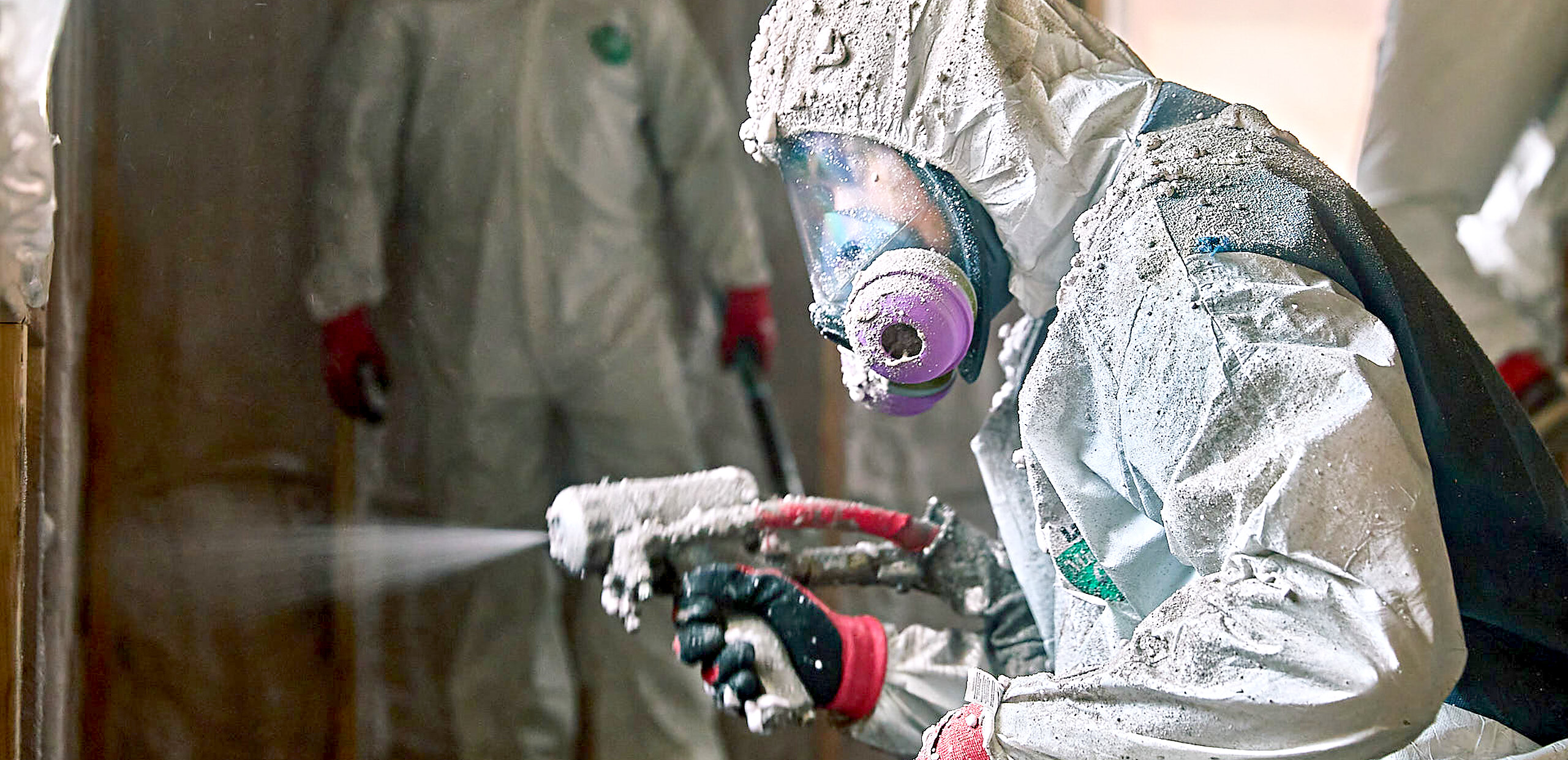
What CPI recommends removal workers wear
- Respiratory protection: an air-purifying respirator with an N95 particulate filter for nuisance dust plus a chemical vapor cartridge, or a supplied-air respirator with a full-face mask or hood in enclosed spaces.
- Eyes: safety glasses with side shields or safety goggles.
- Hands: leather work gloves or fabric gloves coated with chemical-resistant material. CPI discourages thin disposable gloves for this work.
- Body: disposable coveralls, plus hearing protection, hard hat and safety shoes as the job requires.
Any employer requiring respirators has to run an OSHA respiratory protection program: medical evaluation before fit testing, fit testing before first use and at least annually for tight-fitting facepieces, and a cartridge change schedule. Our spray foam training guide covers the safety courses crews should have, and our spray foam PPE guide goes deeper on respirator selection and fit testing.
The spray foam removal process, step by step
This is how a professional removal job should run, based on CPI's guidance and how we coach applicators who take on tear-outs.
Assess and document
Identify the product if possible, note open-cell or closed-cell, measure thickness, photograph everything and check whether the foam is fully cured. Decide how much really has to come out.
Contain the area
Build plastic sheeting containment, block local ventilation grates and registers, and set up exhaust ventilation so the work zone stays under negative pressure. Shut down HVAC equipment that serves the space.
Suit up and restrict access
Everyone inside the containment wears the PPE above. Keep occupants and other trades out until cleanup is done.
Cut, then pry and scrape
Score open-cell foam along framing and pull it out in blocks. Cut closed-cell foam free of rafters and studs with a saw, then pry and scrape it off the sheathing. Avoid cutting into wiring, plumbing and the sheathing itself.
Clean with HEPA
Pick up chunks by hand, then use a shop vacuum and a HEPA-filtered vacuum for residual dust. Bag debris in heavy-gauge plastic bags.
Inspect the substrate
Check sheathing and framing for moisture, rot, mold and fastener damage. Fix leaks and replace damaged wood before anything new goes on.
Dispose properly
Take the foam off the property and dispose of it under federal, state and local rules. CPI notes SPF components are generally not hazardous waste, but the waste generator still has to make the hazardous waste determination under 40 CFR 262.11.
Spray foam removal debris calculator
Crews routinely underestimate how much foam comes out of an attic. Enter the area and average thickness to see the volume, weight and bag count, and which dumpster size you are looking at.
How much foam are you hauling out?
Volume = area x thickness. Weight uses 0.5 lb/ft³ for open-cell and 1.9 lb/ft³ for closed-cell (ArmorFoam data). A 42-gallon contractor bag holds about 5.6 ft³. Board feet = sq ft x inches. Loose chunks take more room than solid foam, so round the bag count up.
Re-insulating after spray foam removal
Once the foam is out and the substrate is dry and repaired, the space needs insulation again, and the reason for the removal should drive the choice:
- After a bad cure: use a different crew or have the original installer prove the cause was fixed: ratio, temperature, pass thickness or moisture. Ask for daily logs on the new job.
- After a roof leak: fix the roof first. If you go back with foam on the deck, closed-cell spray foam adds a vapor retarder and racking strength; open-cell is more forgiving of future leaks because water drains through and shows up sooner.
- After a renovation: match the existing foam type so the R-value and vapor behavior stay consistent. Our spray foam R-value guide covers thickness targets.
- Code: the new foam needs the same thermal or ignition barrier protection the code requires for that space.
For budgeting the new insulation, see our spray foam insulation cost guide. If your foam came out because of asbestos-era materials found underneath, read our asbestos insulation guide before anyone goes further.
Foam problem? Get a straight answer.
A certified ArmorThane applicator can tell you whether your foam needs to come out or can be fixed in place, and re-insulate it properly if it does.
Contractors: become an applicator →
Spray foam removal questions
How much does spray foam removal cost?
2026 guides put open-cell spray foam removal at about $3 to $8 per square foot and closed-cell at $5 to $12, with a 1,000 square foot space running roughly $3,000 to $8,000 for open-cell and $5,000 to $12,000 for closed-cell. Fixr reports lower figures for easy jobs, $1.50 to $3 per square foot. New insulation, drywall and any rot or leak repair are extra.
Can you remove spray foam insulation yourself?
Small areas of fully cured open-cell foam can be cut out with hand tools by a careful homeowner wearing a respirator, eye protection, gloves and coveralls. Closed-cell foam, large areas, roof decks and any foam that is not fully cured are jobs for a professional with containment, HEPA cleanup and a respiratory protection program. Never use heat, torches or grinders.
Is spray foam removal dangerous?
Cured foam produces nuisance dust when it is cut and scraped, which calls for respiratory and eye protection. The bigger hazards are heating the foam, which the EPA says can release isocyanates, hydrogen cyanide and other gases, and cutting foam that never cured, which can expose workers to unreacted chemicals.
How long does spray foam removal take?
Dropcurb's 2026 guide puts typical removal at two to five days depending on thickness and area. Closed-cell foam on a roof deck is the slowest work. Add time for substrate repairs, drying and re-insulation.
Does removing spray foam damage the roof deck?
It can. Closed-cell foam bonds tightly to wood, and saws, spud bars and power scrapers can gouge sheathing and pull fasteners. If the roof is being replaced anyway, it is sometimes cleaner to replace the foamed sheathing from above than to scrape it from below. Inspect every square foot once the foam is off.
How do you dispose of removed spray foam?
Bag it in heavy-gauge plastic bags, take it off the property and dispose of it under federal, state and local rules. CPI's guidance says SPF components are generally not considered hazardous waste, but the waste generator is still responsible for the hazardous waste determination under 40 CFR 262.11. Check with your landfill or hauler before the job.
Can bad spray foam be fixed without removing it?
Gaps, shrinkage and thin spots usually can: seal the edges and add foam. Foam that never cured properly, stays sticky or keeps smelling generally cannot, and the affected areas need to come out. Damp open-cell foam in an attic is often a humidity problem that can be fixed in place if the sheathing is still sound.
When is it safe to go back into the house after removal?
Once the work area has been HEPA-cleaned, containment is down and the crew has confirmed the area is clean. If new foam is sprayed afterward, follow that manufacturer's reoccupancy time. CPI notes many manufacturers suggest 24 hours after high-pressure spray foam with recommended ventilation.
Sources
- ACC Center for the Polyurethanes Industry / Spray Foam Coalition, Guidance on the Removal and Disposal of High-Pressure SPF Insulation: spraypolyurethane.org/…/Guidance-On-The-Removal-And-Disposal-Of-High-Pressure-SPF-Insulation.pdf
- US EPA, potential chemical exposures from spray polyurethane foam: archive.epa.gov/epa/saferchoice/potential-chemical-exposures-spray-polyurethane-foam.html
- ACC, Fire Safety Guidance: Working with Polyurethane Foam Products During New Construction, Retrofit and Repair: americanchemistry.com/…/Fire-Safety-Guidance-Working-with-Polyurethane-Foam-Products.pdf
- CPI, information sheet on reentry and reoccupancy times: spraypolyurethane.org/…/Info-Sheet-on-Reentry-and-Reoccupancy-Times.pdf
- OSHA, 29 CFR 1910.134 respiratory protection: osha.gov/laws-regs/regulations/standardnumber/1910/1910.134
- Dropcurb, insulation removal cost (2026): dropcurb.com/blog/insulation-removal-cost
- Fixr, spray foam insulation cost (removal): fixr.com/costs/spray-foam-insulation
- HomeGuide, spray foam insulation cost (2026): homeguide.com/costs/spray-foam-insulation-cost
- HomeGuide, drywall installation cost: homeguide.com/costs/drywall-installation-cost
Spray foam done right the first time.
Homeowners get a certified ArmorThane applicator to assess problem foam and re-insulate properly. Contractors can add spray foam with no franchise fee and no royalties.
Start your coatings business with ArmorThane.
Tell us what you want to spray and where you are. An ArmorThane specialist will walk you through the equipment, chemicals, training and startup cost for the work you want to do.
- Equipment package matched to your applications
- Hands-on training and applicator certification
- Technical support once you are spraying
Foam that has to go? Or can it be fixed?
Tell us where the foam is, open or closed cell, how old it is and what is wrong with it. We will connect you with a certified applicator who can assess, repair or re-insulate.
- Location and square footage
- Open-cell or closed-cell
- Odor, gaps, leaks or renovation
- Original installer, if known
More to read on spray foam
Short reads from ArmorThane on Issuu. Tap one to open it right here.


More in Spray foam & insulation
 Spray foam & insulationSpray Foam Insulation Cost
 Spray foam & insulationSpray Foam Insulation Near Me
 Spray foam & insulationSpray Foam Insulation Problems
 Spray foam & insulationSpray Foam Insulation Training
 Spray foam & insulationSpray Foam Machine
 Spray foam & insulationSpray Foam PPE
 Spray foam & insulationSpray Foam ProportionerSpray foam & insulationSpray Foam R-Value Guide