
AquaSafe
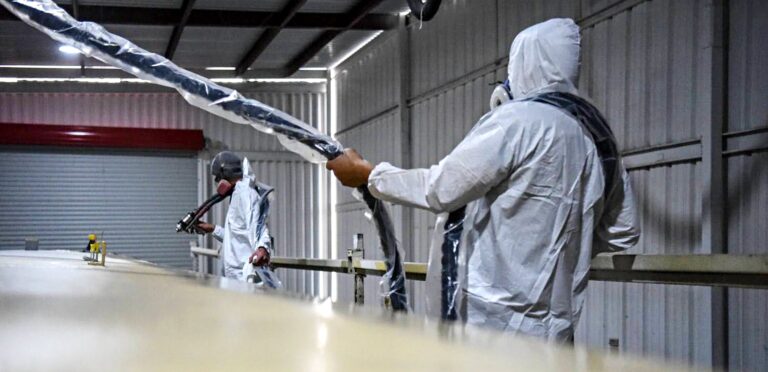
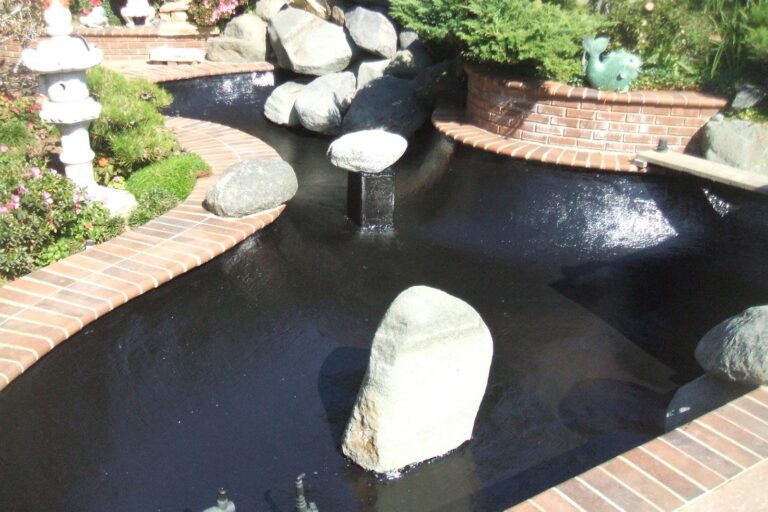
The water one. A pure polyurea built to sit against drinking water and against everything a clean room throws at a floor — stretchy, seamless, zero VOC, and tack free in well under a minute. It goes in potable water tanks and pipe, and it goes in buildings where the floor has to be washed down every day.
- 100% solids pure polyurea
- Zero VOC
- Tested to NSF/ANSI 61
- Made by ArmorThane
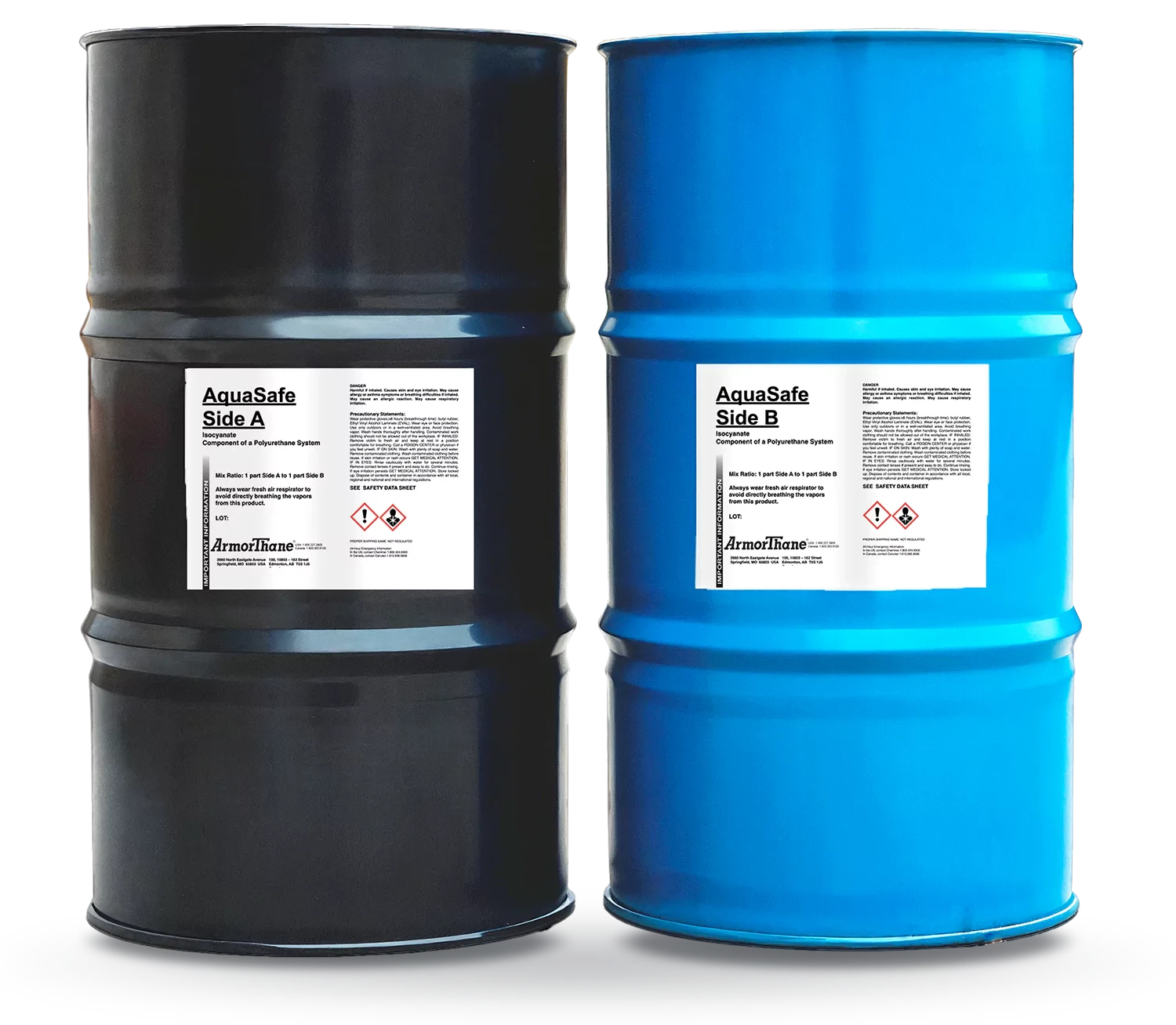
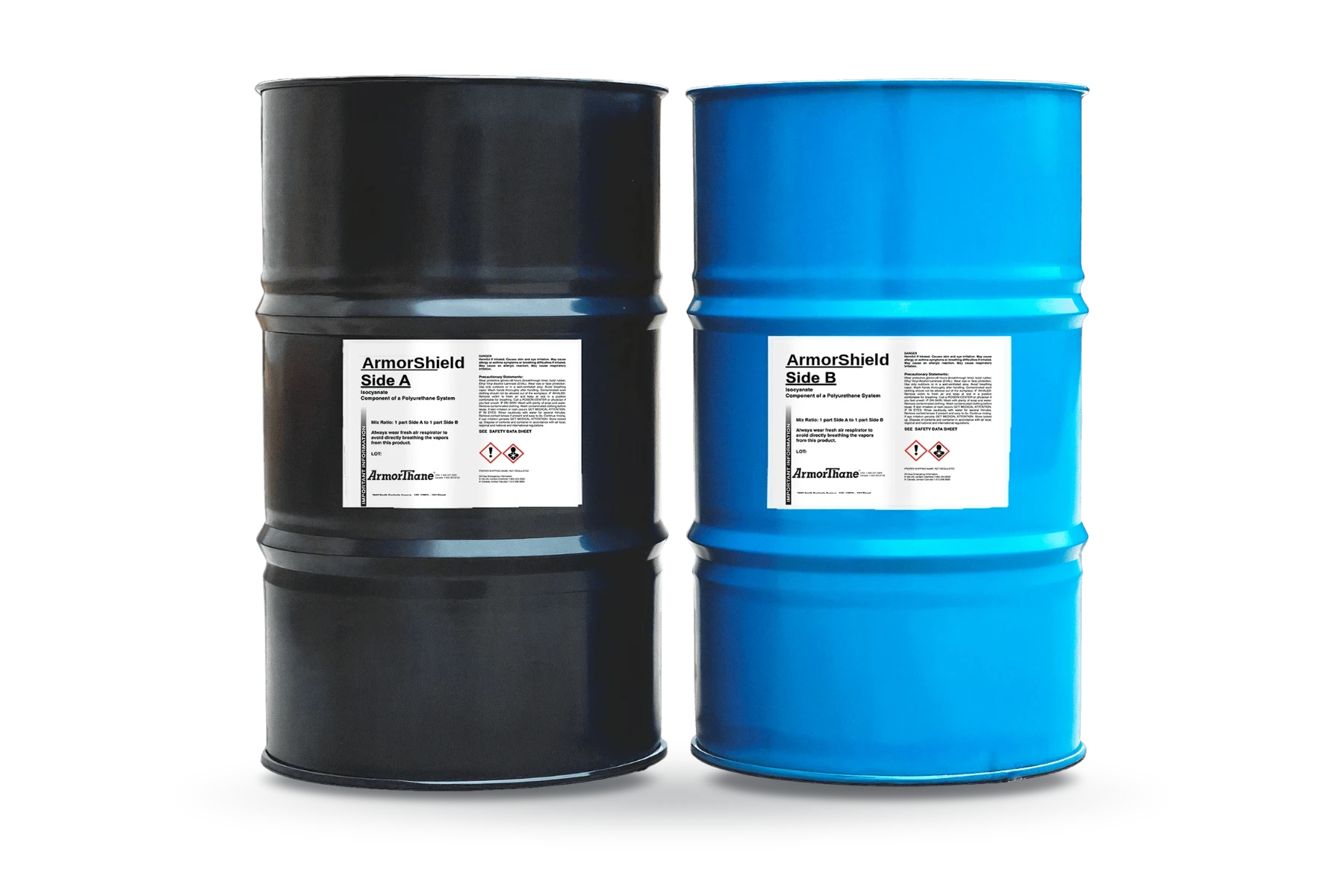
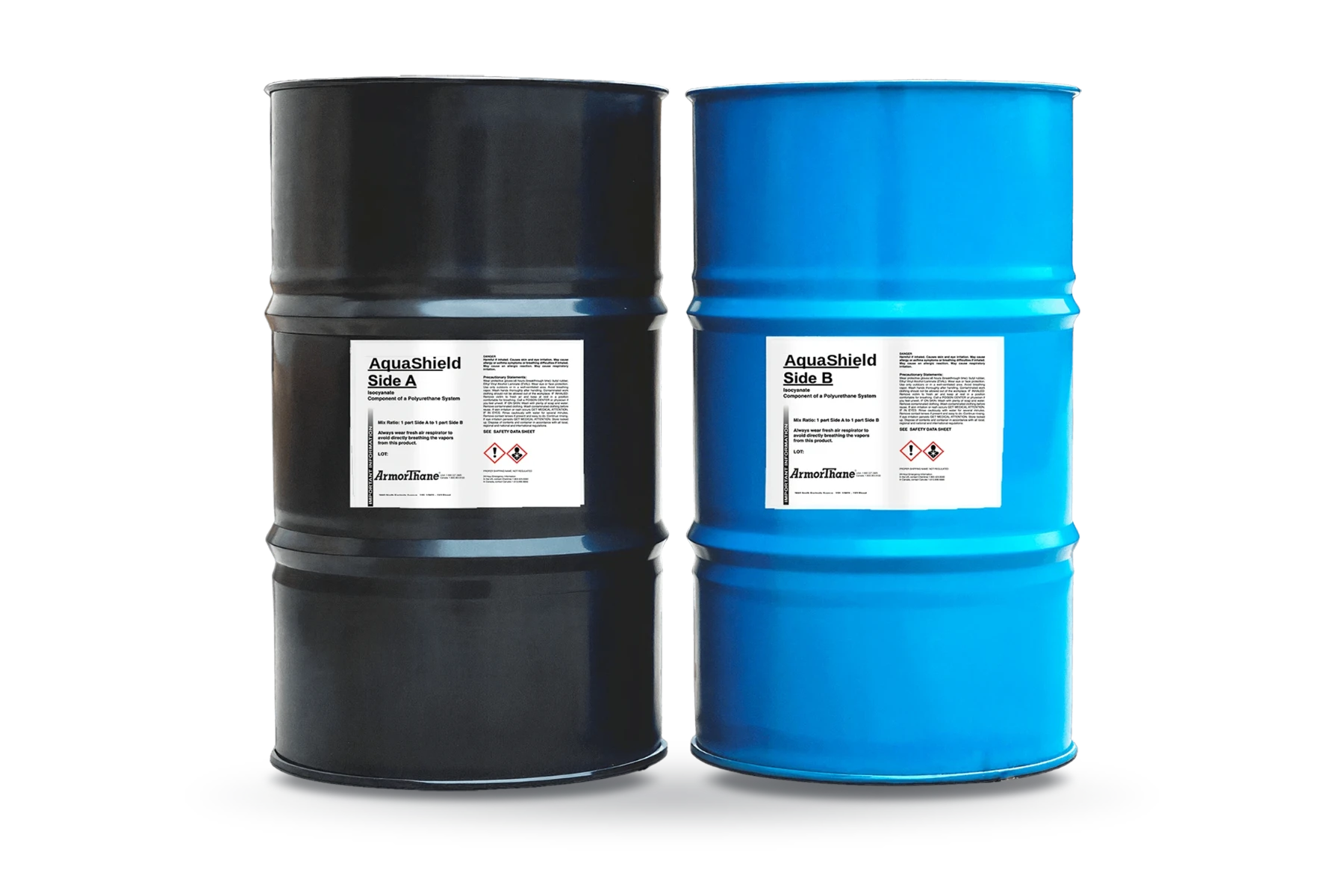
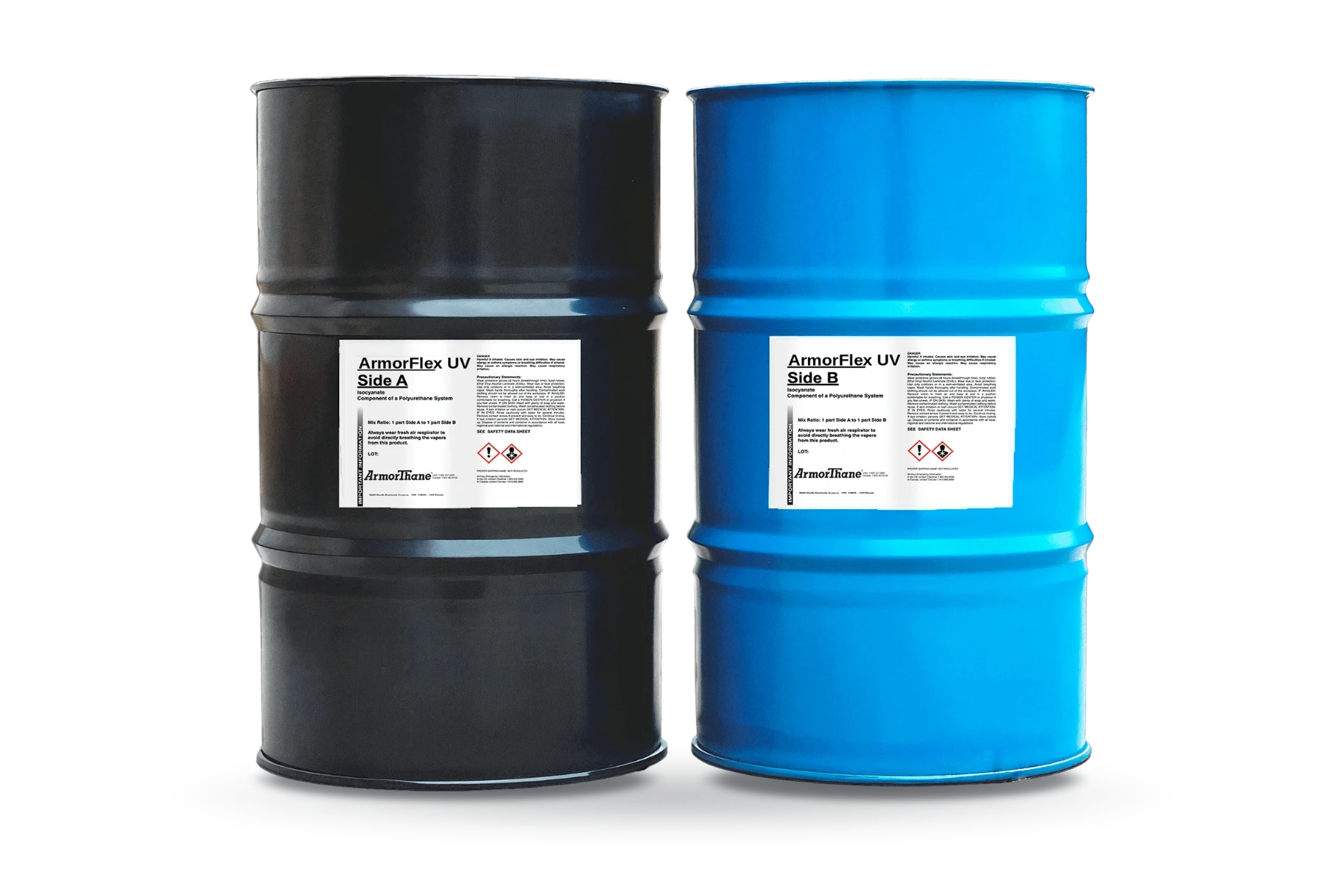
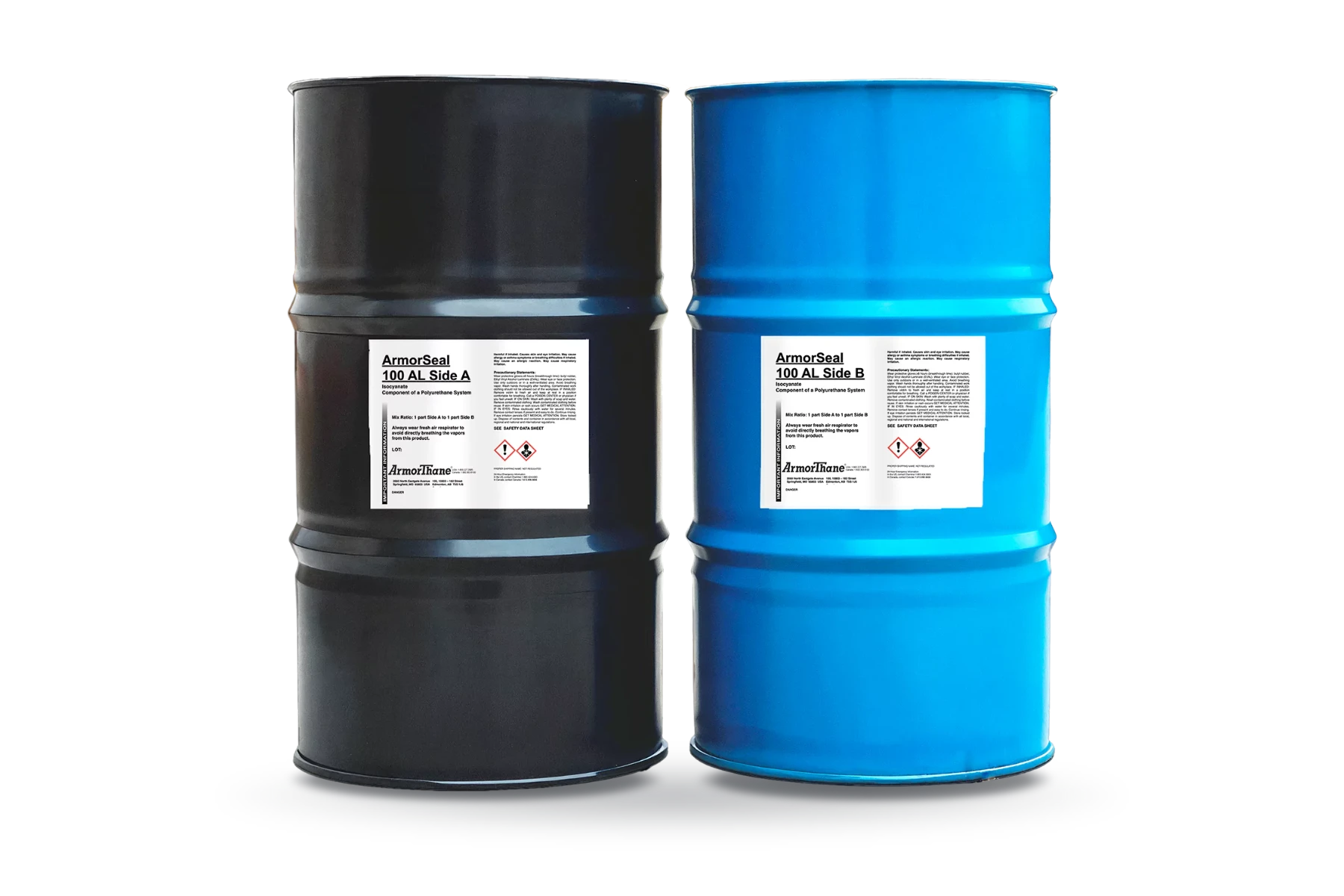
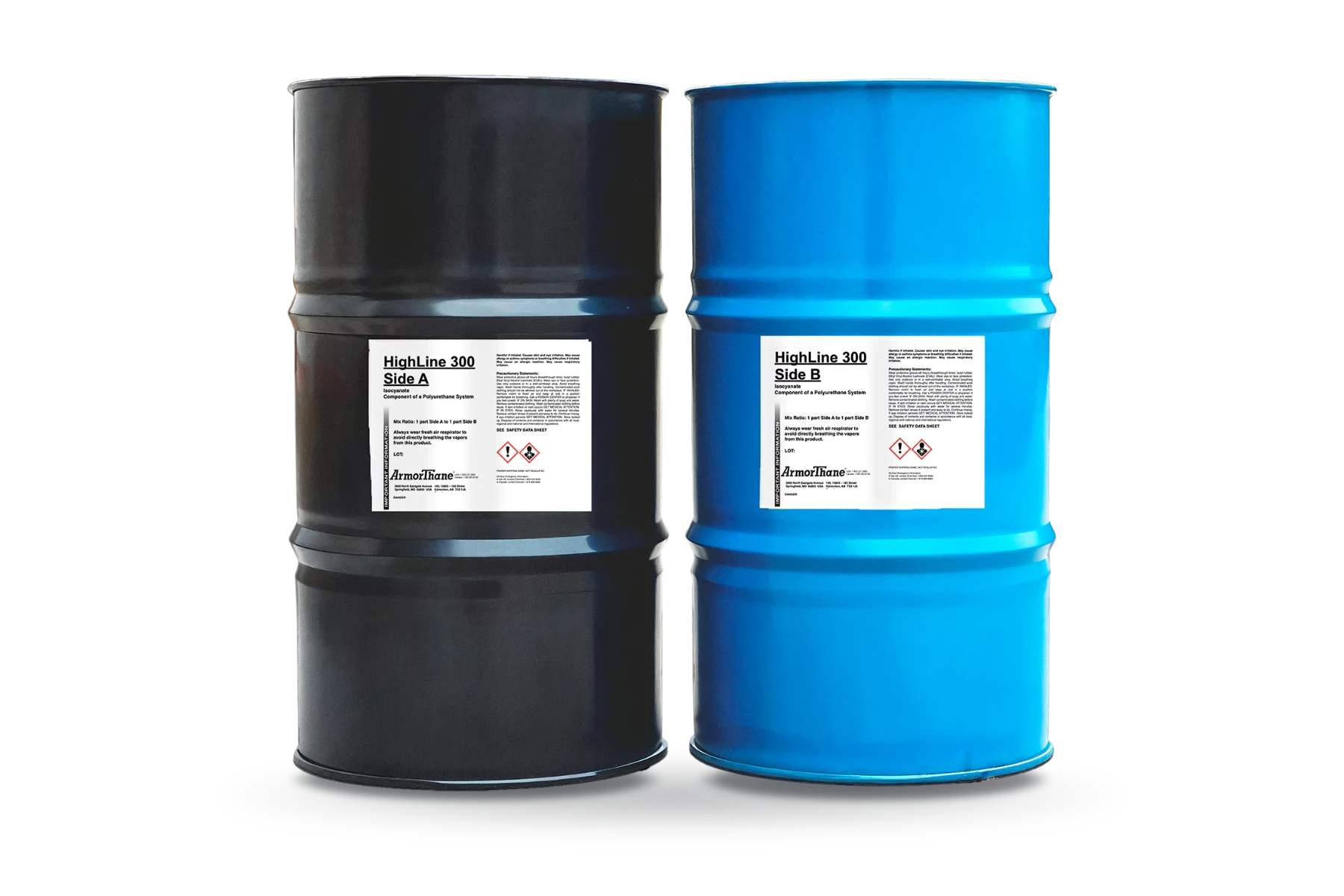
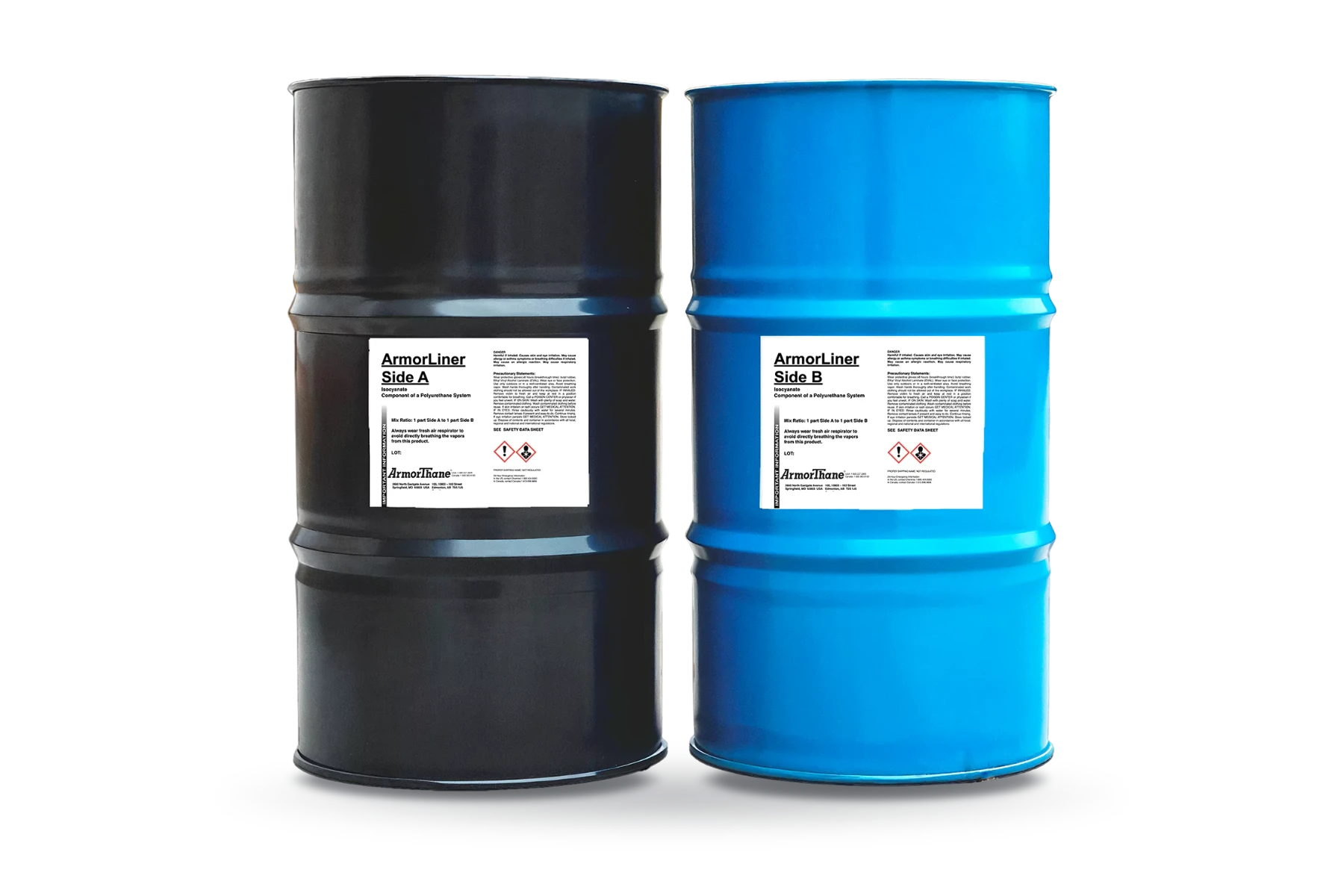
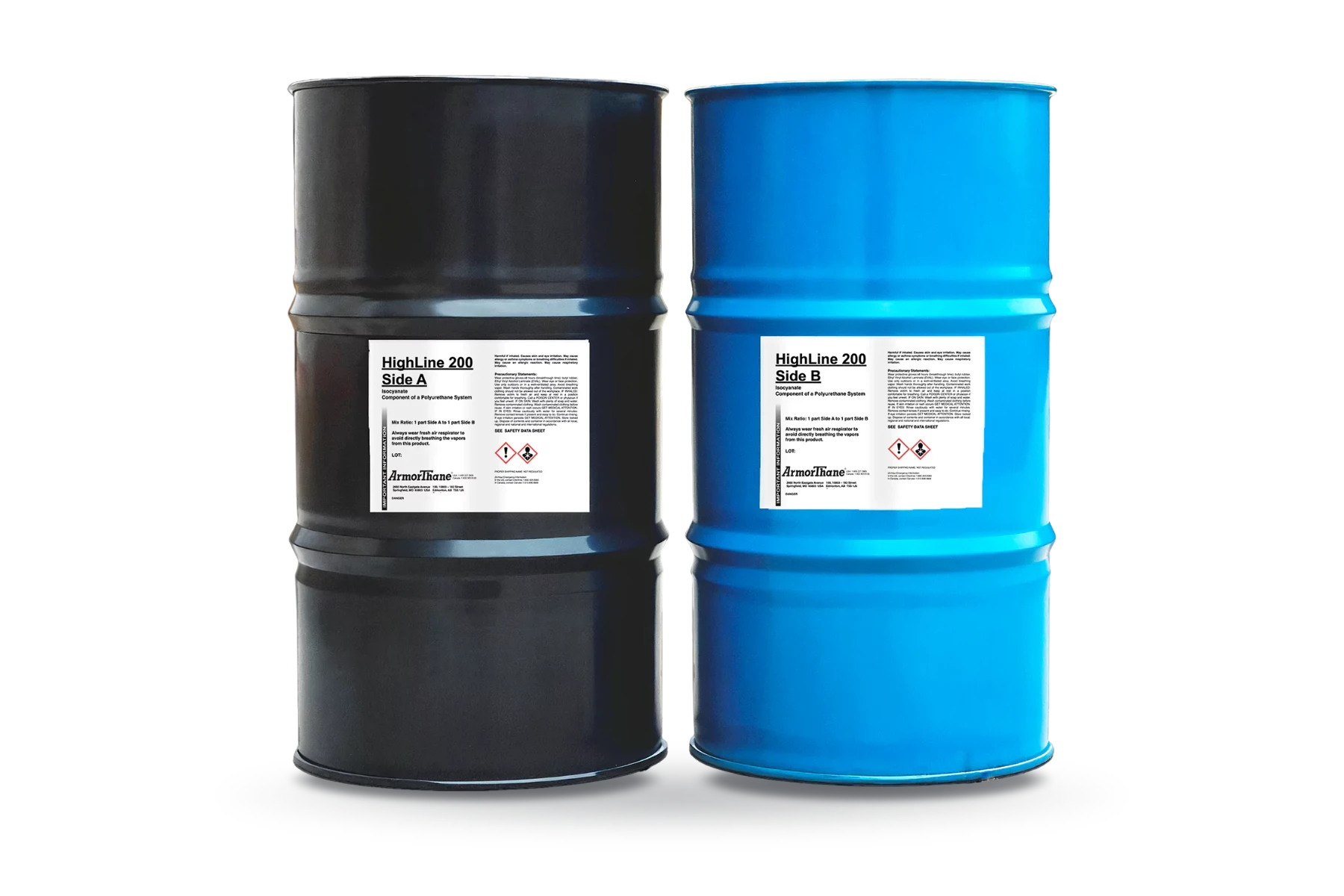
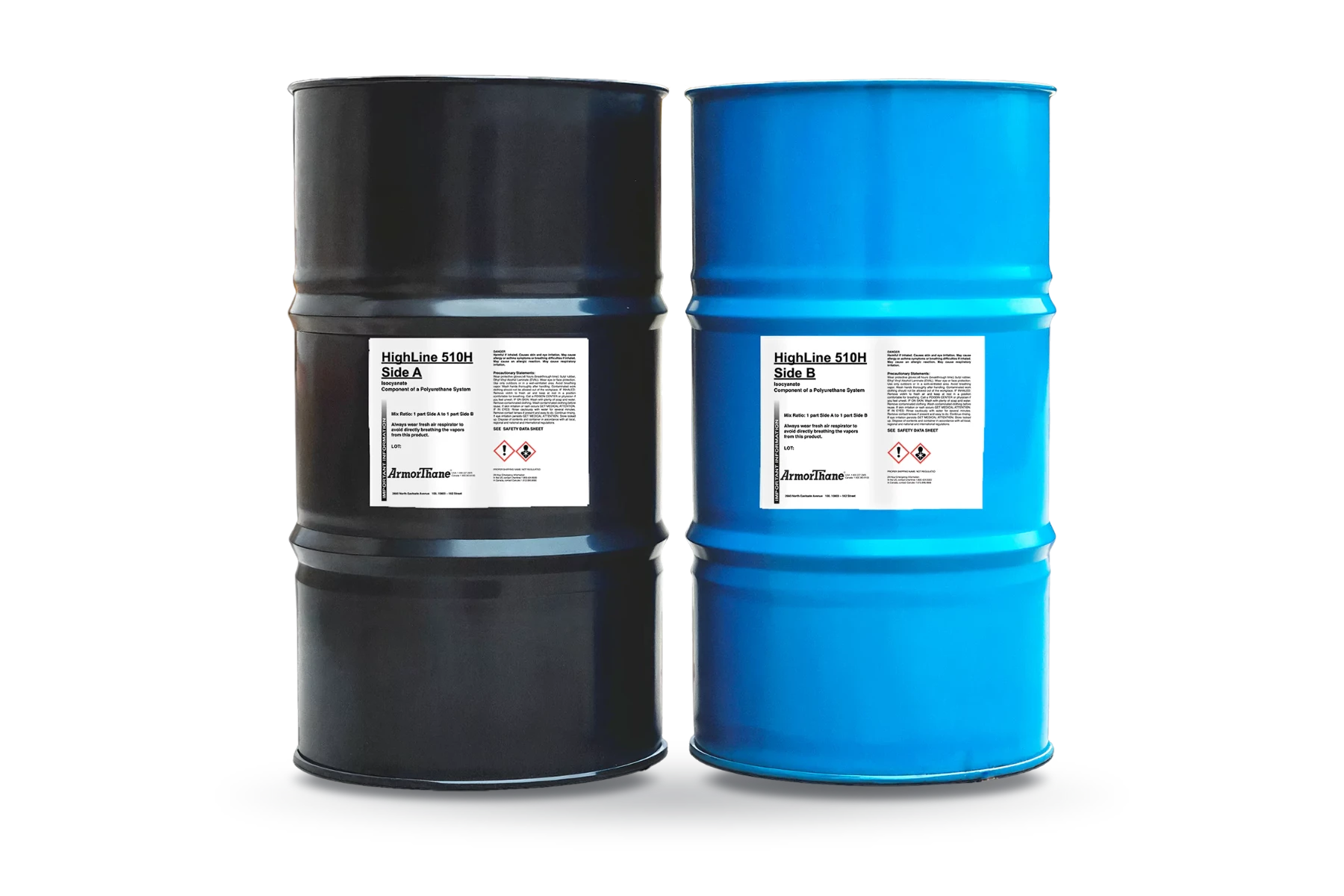
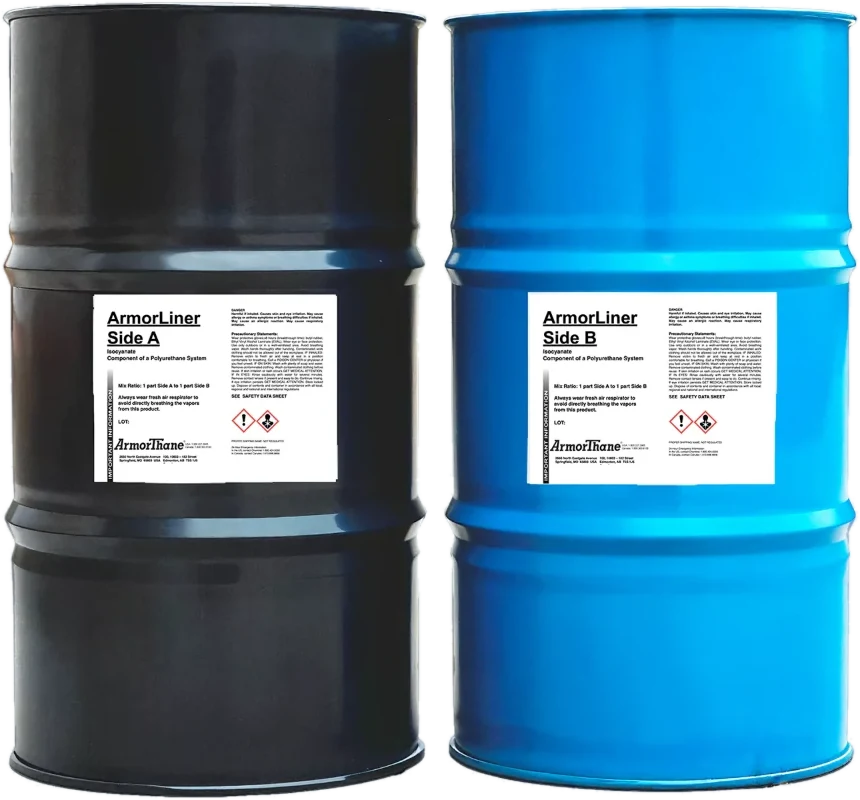
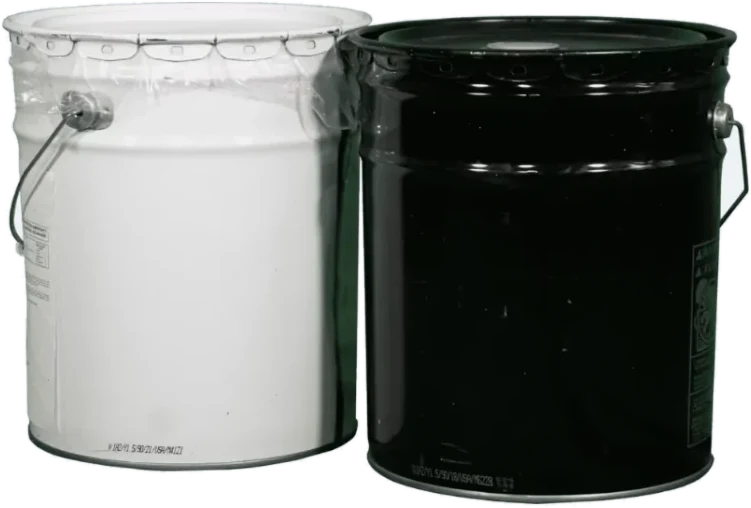
One kit is 100 gallons — 50 gallons of Side A and 50 gallons of Side B, metered 1:1 by volume. Both drums carry a desiccant device while they are open, because this chemistry does not tolerate moisture getting into the drum.
Side A is the isocyanate. No agitation needed — but it must run with a desiccant device fitted, and it ships unregulated.
Side B is the polyol resin — many components in one drum, so it gets power-agitated to a uniform color before it goes anywhere near the rig. Unlike Side A, it ships as a corrosive.
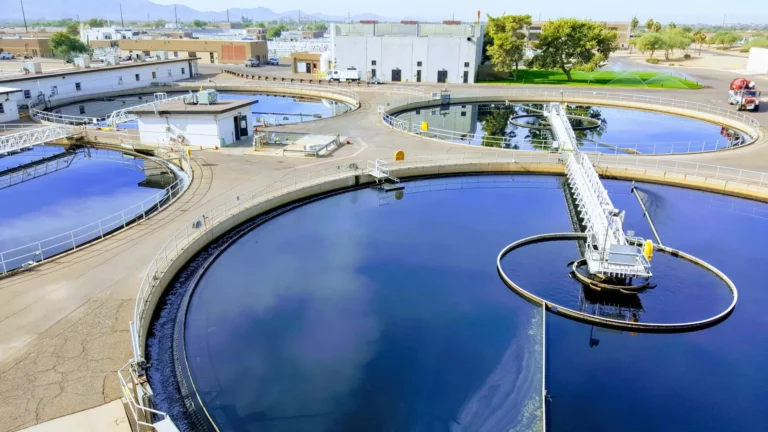
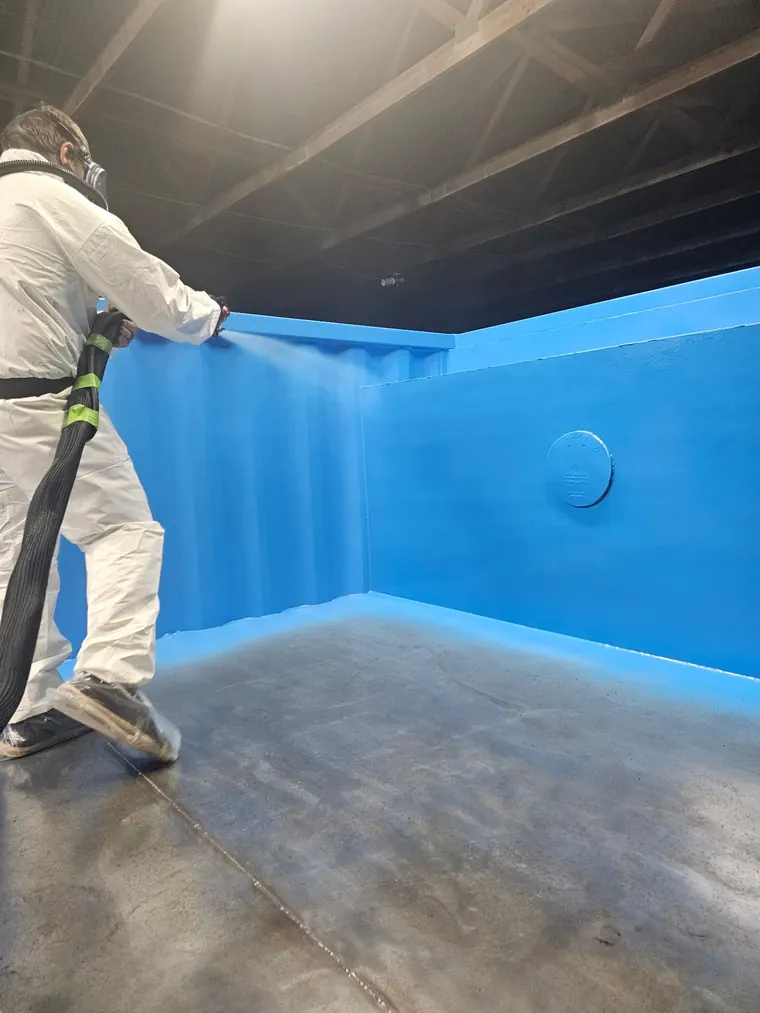
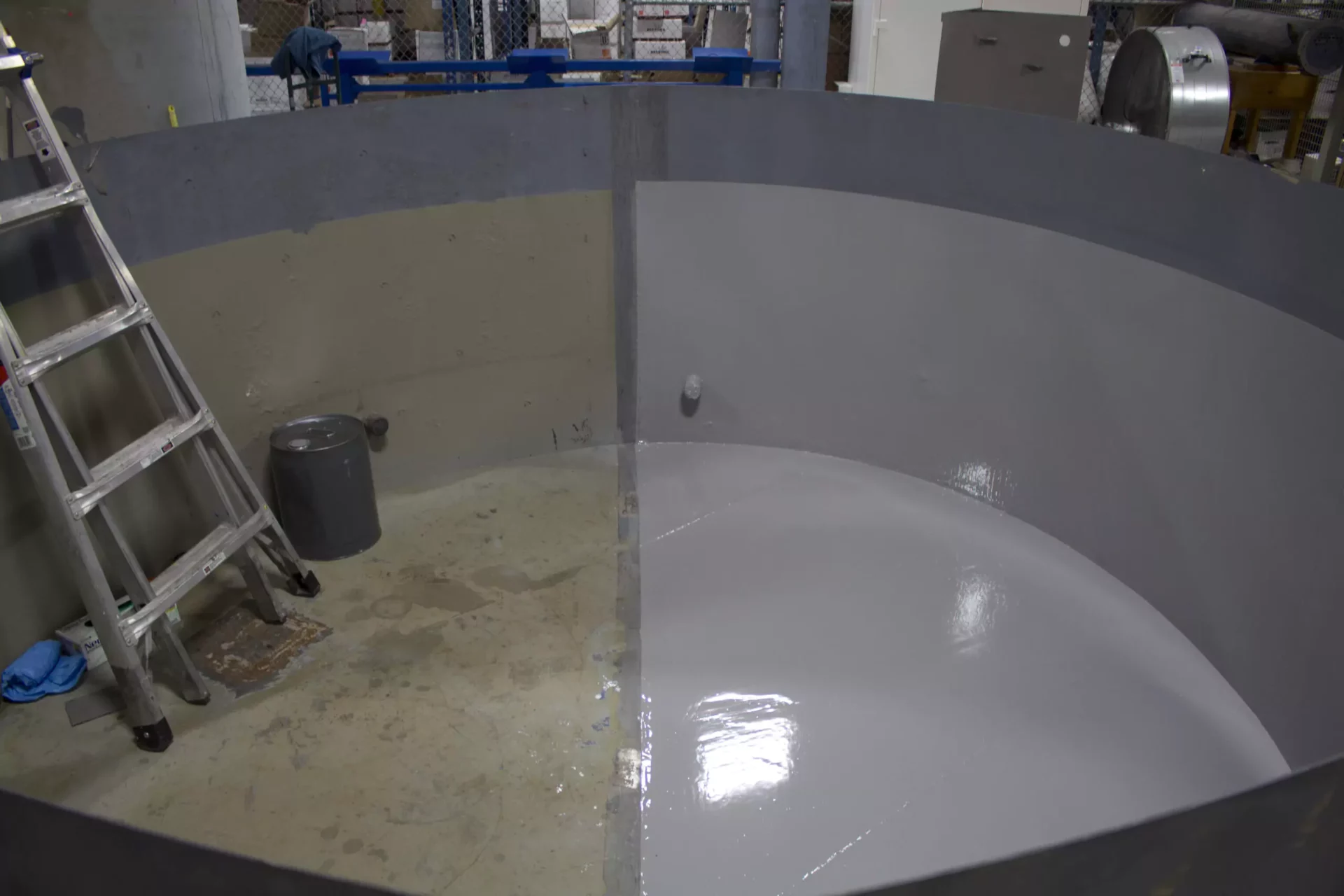
The job it was formulated for: the inside of potable water tanks and reservoirs, concrete or steel, lined in one seamless pass with nothing for water to get behind.
And the job it keeps getting pulled into: floors and coved wall bases in buildings that get hosed and disinfected daily. No grout, no seams, nothing to trap what you are trying to wash away.
Formulated in-house for water contact.
AquaSafe is an ArmorThane formulation, part of the ArmorLine series. We have developed and manufactured our own polyurea and polyurethane chemistry since 1989, and AquaSafe is the one we built specifically to be put against drinking water.
Built for water, not adapted to it
Most coatings that end up in a water tank were designed for something else first. AquaSafe was formulated for this job: a 100% solids, zero-VOC, odorless film that bonds to concrete and steel and gives water nothing to migrate through. Water vapor permeability lands around 0.36 perm-inch and water absorption stays under half a percent.
Zero VOC · no toxic vapors · meets USDA criteria
What the water-safety paperwork actually says
Representative samples of AquaSafe were evaluated by UL Solutions against NSF/ANSI/CAN 61 (drinking water health effects) and NSF/ANSI/CAN 372 (lead content) in June 2024. Separately, AquaSafe passed AS/NZS 4020 testing at the Australian Water Quality Centre. We say tested to those standards rather than certified, because UL's own document is clear that only product carrying the UL Mark counts as UL Certified. If your specification needs the mark or the full report, ask and we will send you what we hold.
UL Solutions report MH67085-20240621 · AWQC certificate 4007/92.1060
Our own formulation, not a repackaged blend
AquaSafe sits in the ArmorLine range alongside the HighLine products, developed in-house rather than bought in and relabelled. Because the formulation is ours, we can adjust it for a particular job instead of asking a customer to live with a catalog product.
More than 200 ArmorThane formulations across the ArmorLine, ArmorFoam, ArmorFlooring, ArmorPrime and ArmorCoat families
Fast enough to work around people
Pot life is measured in seconds and it is tack free in well under a minute, so a tank or a wing of a building can be coated and handed back inside a shift. The same speed is what lets it go on vertical walls in multiple passes without appreciable sagging.
Tack free under a minute · foot traffic in a few hours · full service in about a day
Soft enough to move, hard enough to clean
Around 50 on the Shore D scale with roughly 450% elongation — it stretches with a structure that moves and bridges a crack at well below freezing, while still shrugging off daily scrubbing. Taber abrasion loss is in the region of 6 mg, which is where this formulation really separates from a general-purpose coating.
Crack bridging passes ASTM C836 · passes a 1/8-inch mandrel bend
Backed by the people who make it
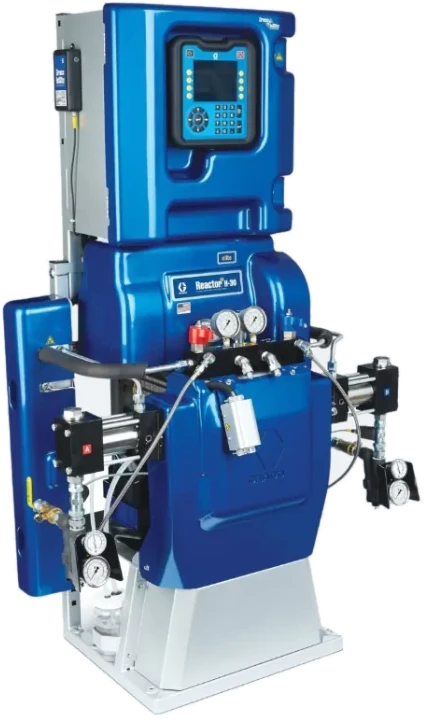
Buying AquaSafe means buying the chemistry, the plural-component rig that sprays it, the hands-on training that certifies the crew, and technical support for as long as you spray it. There are no franchise fees and no royalties on any of it.
$0 franchise fees · hands-on applicator training · support for the life of the business
The jobs AquaSafe is genuinely the right answer for.
Each of these traces back to a published test method — the figures below are rounded.
Lining potable water storage
Concrete or steel tanks, reservoirs and pipe nine inches in diameter and up. Seamless, odorless and tested to NSF/ANSI 61 and 372 by UL Solutions, with an AS/NZS 4020 pass behind it as well.
Floors that get washed down daily
Veterinary clinics, food processing, kennels and animal habitats. The film runs up the wall as a coved base, so there is no joint at the floor line for bacteria, hair or waste water to sit in.
Staying put while the structure moves
Roughly 450% elongation and a crack-bridging pass at ASTM C836 well below freezing. A tank that flexes or a slab that cracks does not take the lining with it.
Wear that comes from cleaning, not traffic
Around 6 mg lost on a Taber CS17 wheel over 1,000 cycles under a 1 kg load — notably lower than general-purpose polyurea. That matters where the floor meets a scrubber and a disinfectant every single day.
Getting the room back fast
Tack free in under a minute, recoatable for several hours, foot traffic within a few hours and full service in about a day. On an occupied building that is usually the deciding factor.
Bonding without a primer on steel
Over 900 psi to steel at a 75 to 100 micron blast profile with no primer. On primed or shot-blasted concrete the bond test takes the concrete instead of the coating, at over 500 psi.
The one that goes where the drinking water is.
A potable water tank is an unforgiving place to put a coating. It is wet all the time, it has to be cleanable, it cannot give anything back to the water, and taking the tank out of service costs real money every day it is down. AquaSafe was formulated around those four constraints rather than retrofitted to them.
- Tested to NSF/ANSI/CAN 61 and 372 by UL Solutions, and passed AS/NZS 4020 at the Australian Water Quality Centre
- Concrete or metal tanks, reservoirs and pipe nine inches in diameter and larger
- 100% solids and zero VOC — no solvent going into a confined space with your crew
- Sprayable down to around 30°F, so a shutdown does not have to wait for the weather
Eight thousand square feet, and not one seam.
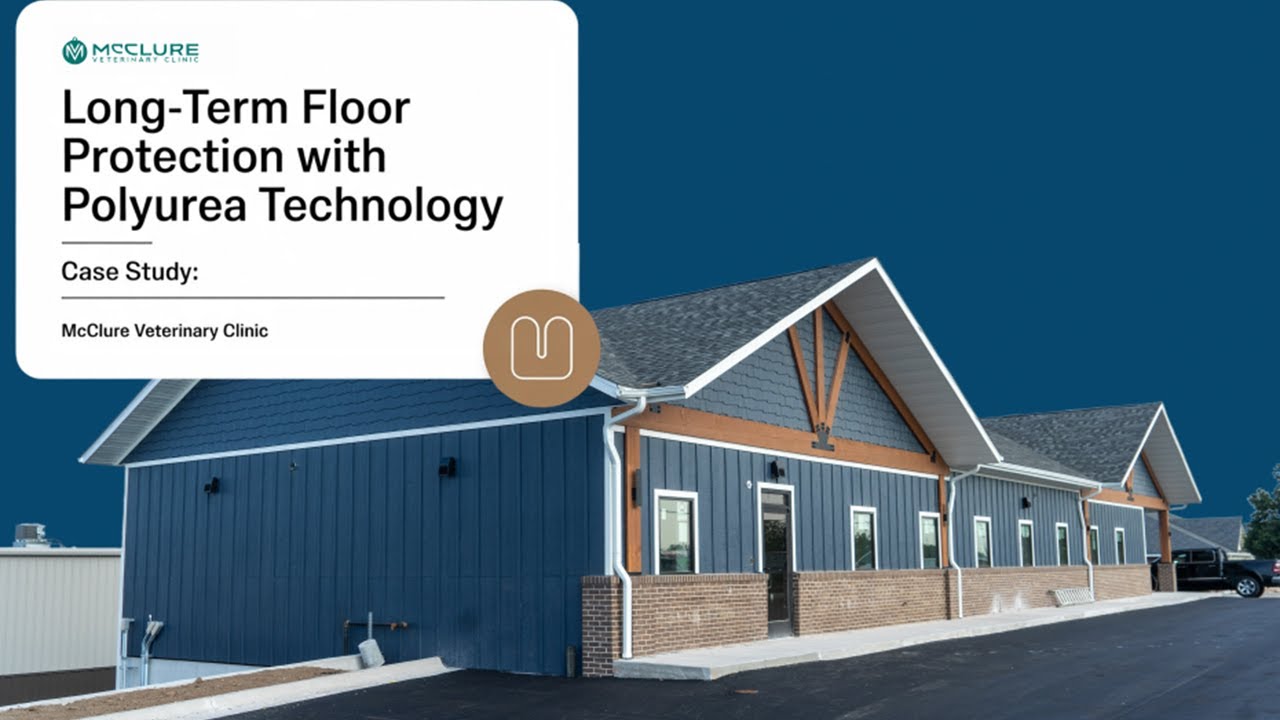
When McClure Veterinary Clinic moved from a 1,500 square foot leased space into a purpose-built facility of roughly 10,000 square feet, the floor was not an afterthought. ArmorThane installed more than 8,000 square feet of AquaSafe across most of the clinic's flooring, and up the walls in the basement area where grooming and boarding happen. The building opened in October 2025, with Williams Construction Co. as general contractor.
- More than 8,000 square feet of AquaSafe polyurea flooring installed
- Floors throughout, plus wall coving in the grooming and boarding areas
- Seamless from floor to wall — no grout lines, no transition strips, nothing to trap waste
- Sprayed in a working construction schedule, with the building opening on time
How a clinic floor goes in.
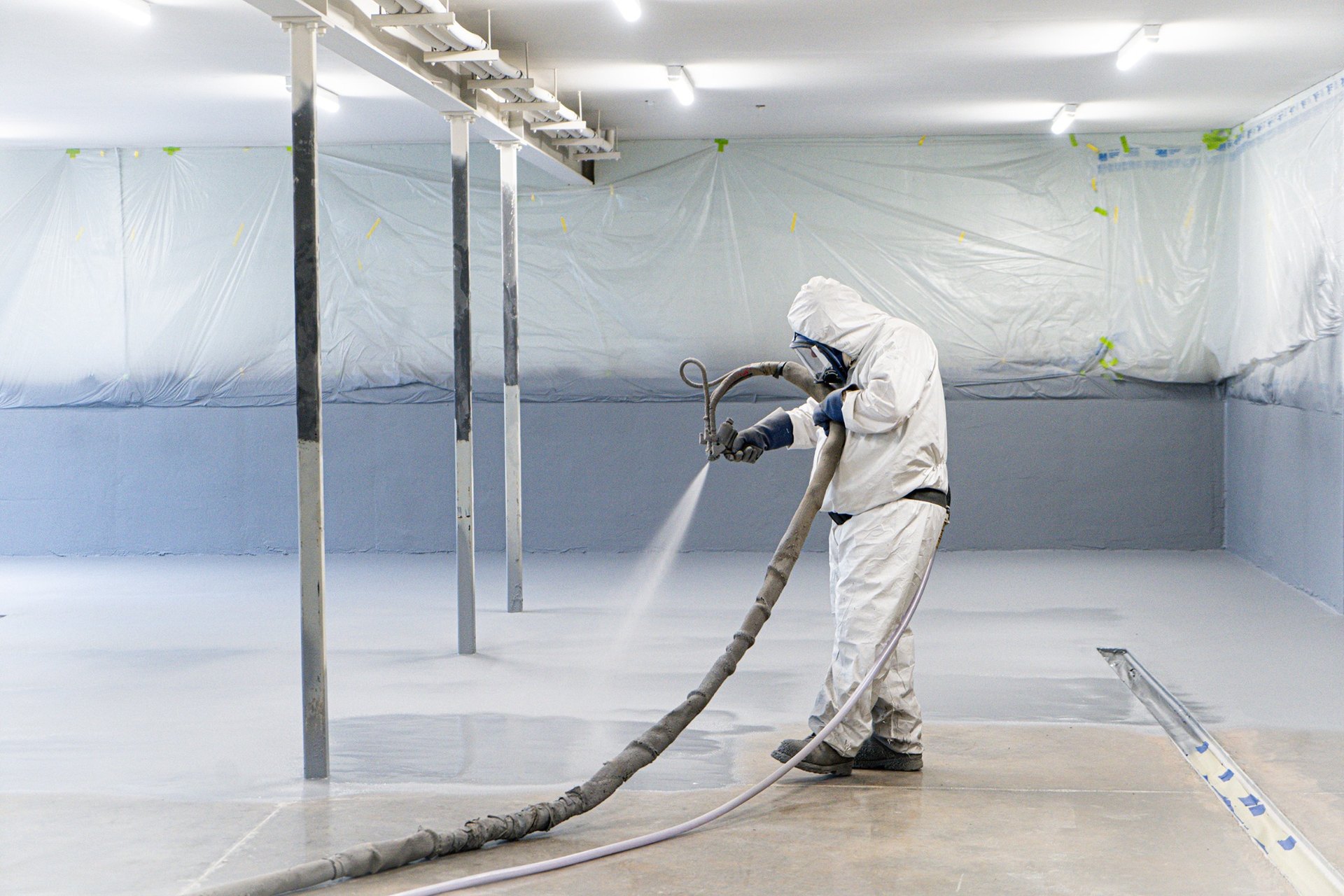
Mask everything that is not getting coated, spray the walls and coving, then lay the floor down in one continuous pass.
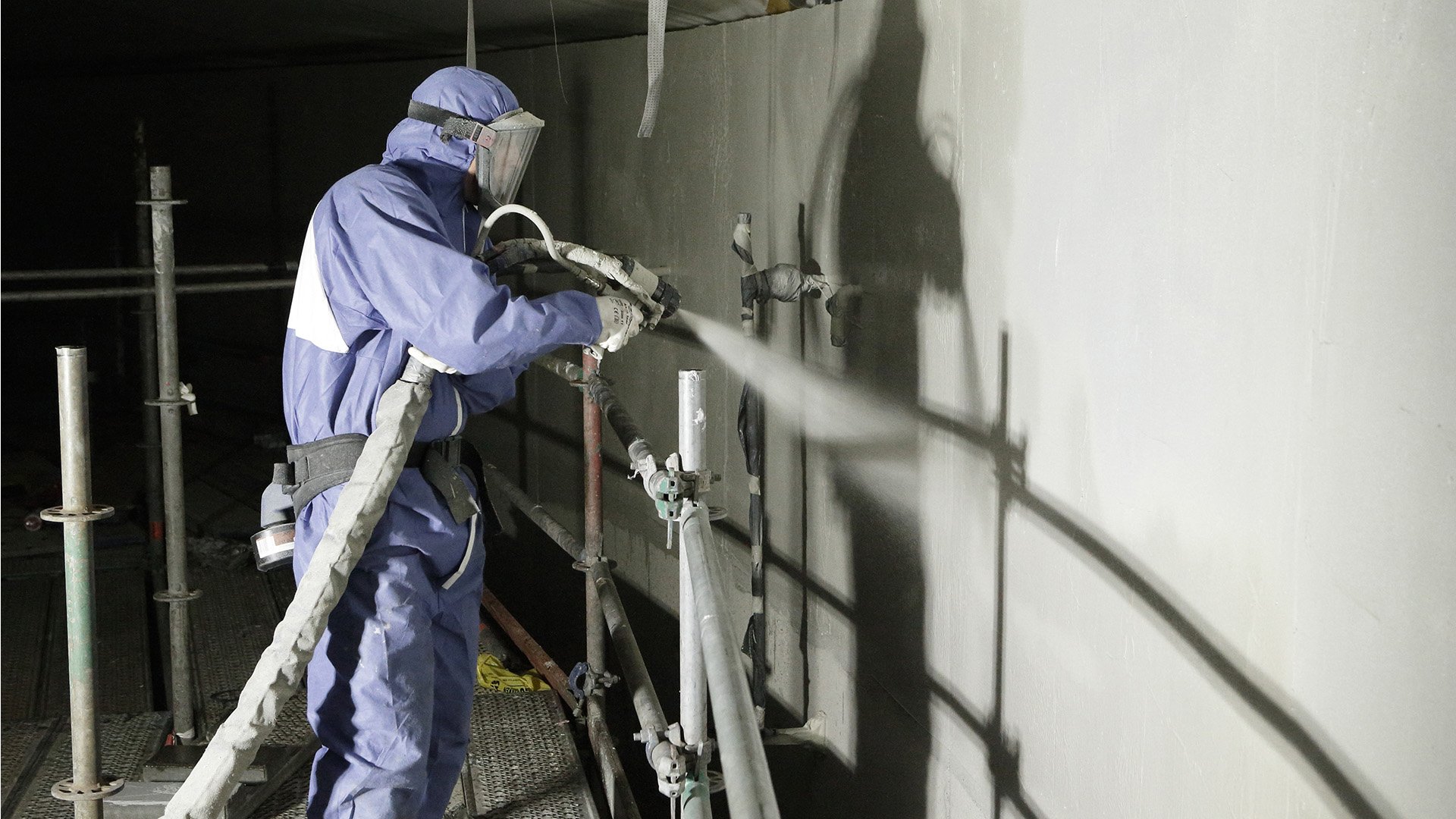
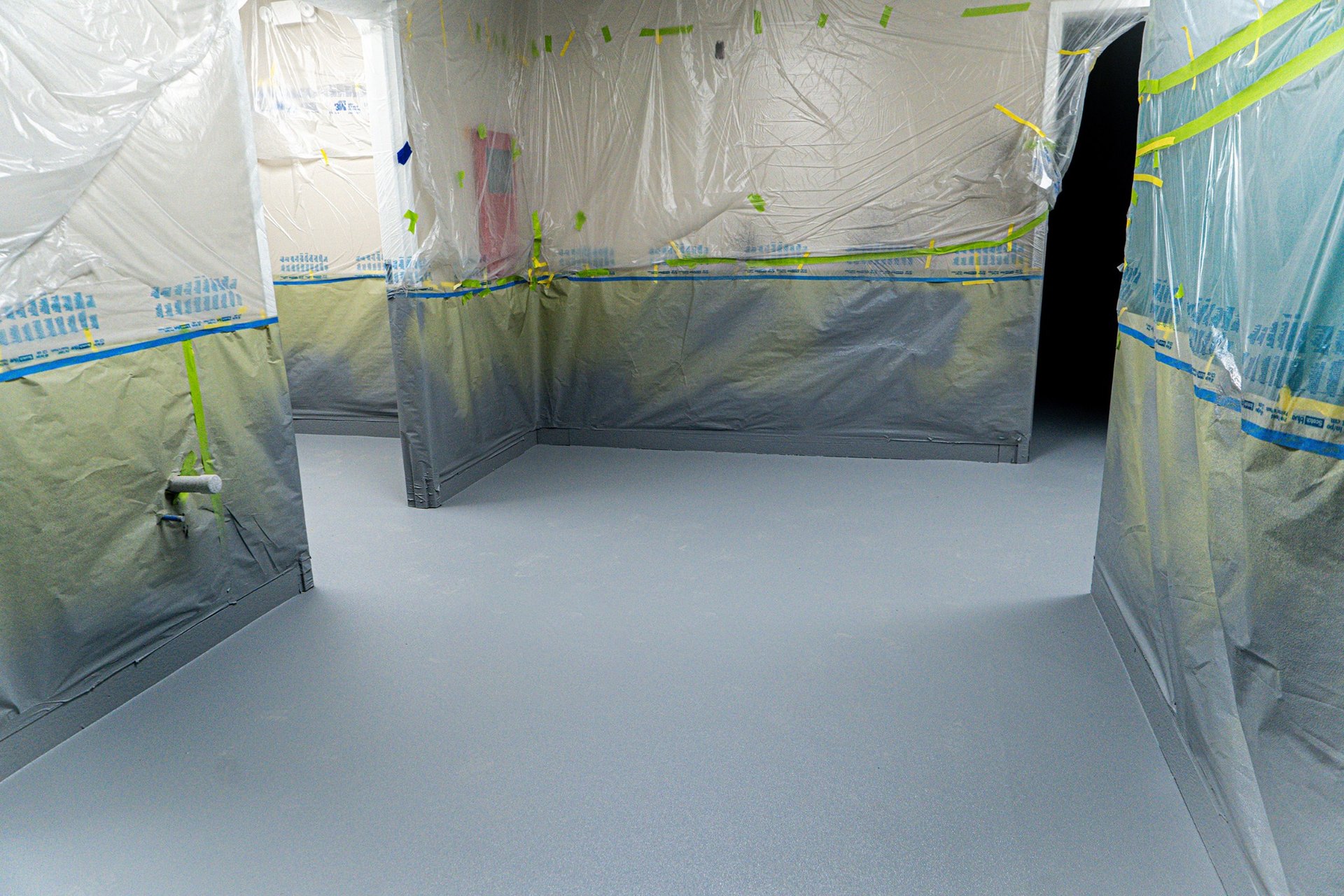
Mask, then coat the walls
Plastic goes up to the line, the wall base gets sprayed first and the coating is carried down onto the slab so the two become one film.
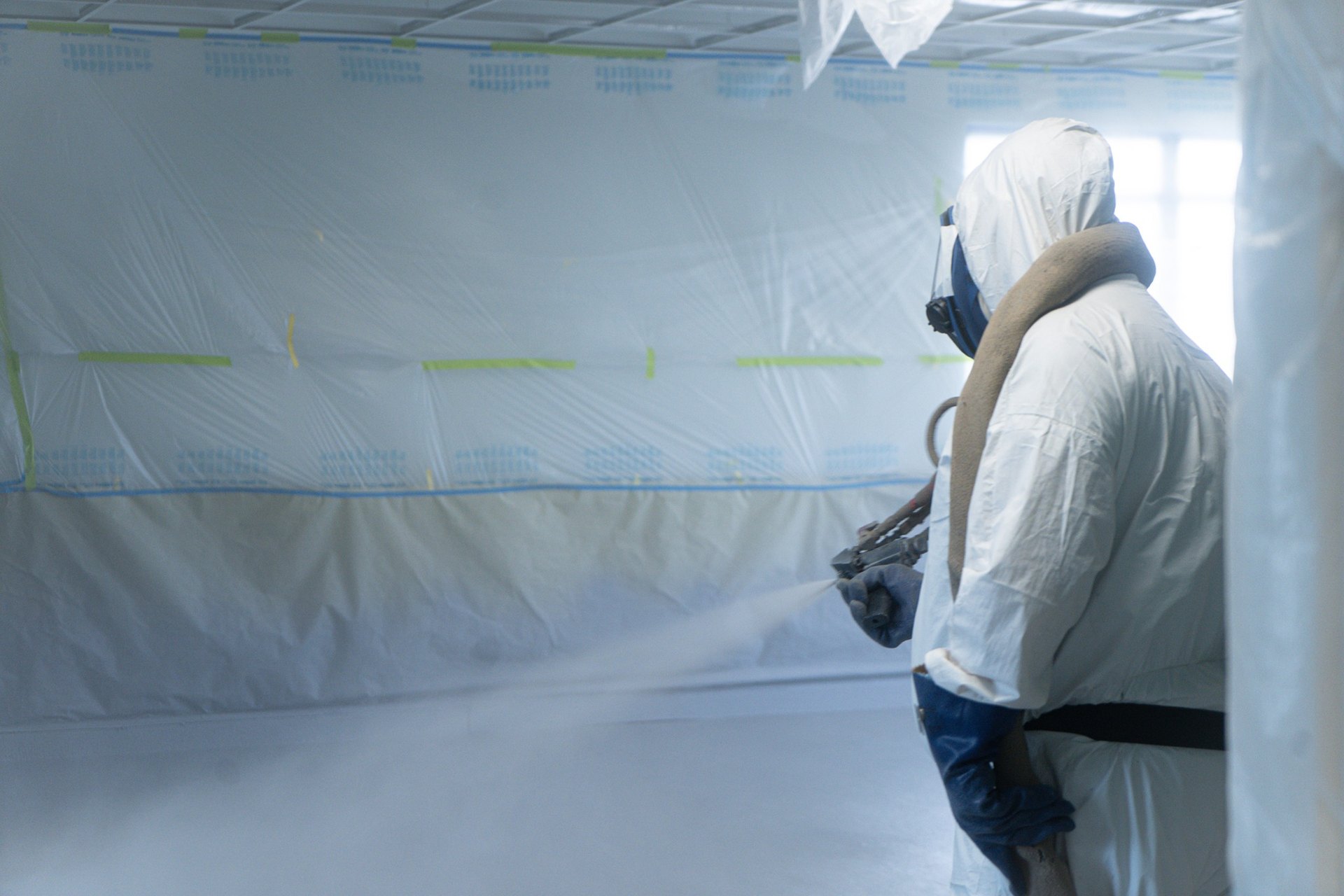
Lay the floor in one pass
The floor is sprayed wet-on-wet off the walls already coated. Because it skins over in under a minute, dust and site traffic have very little chance to spoil it.
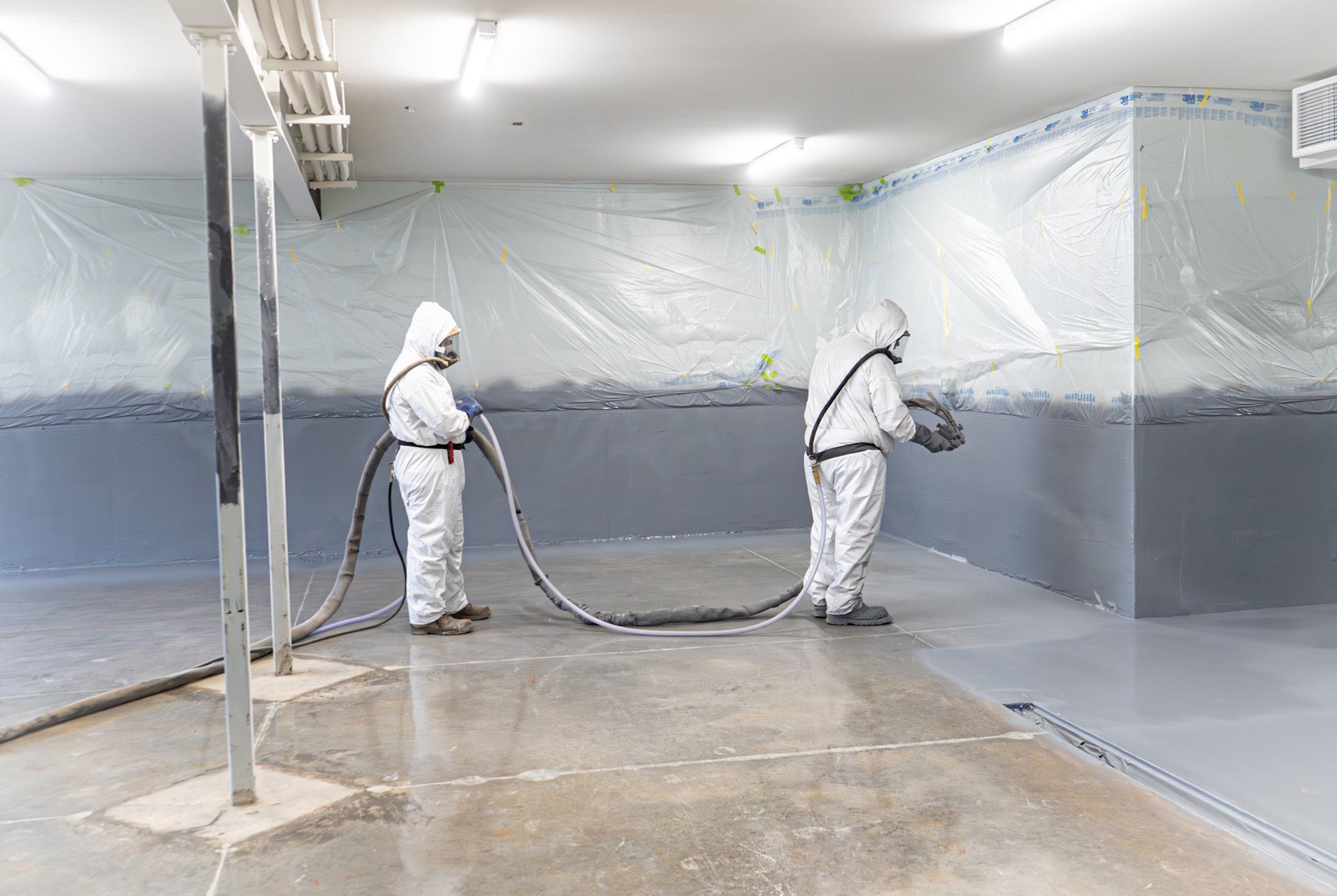
Two on the gun in bigger rooms
Open areas get worked by a pair so the whole floor stays inside the recoat window and there is no cold joint across the middle of the room.
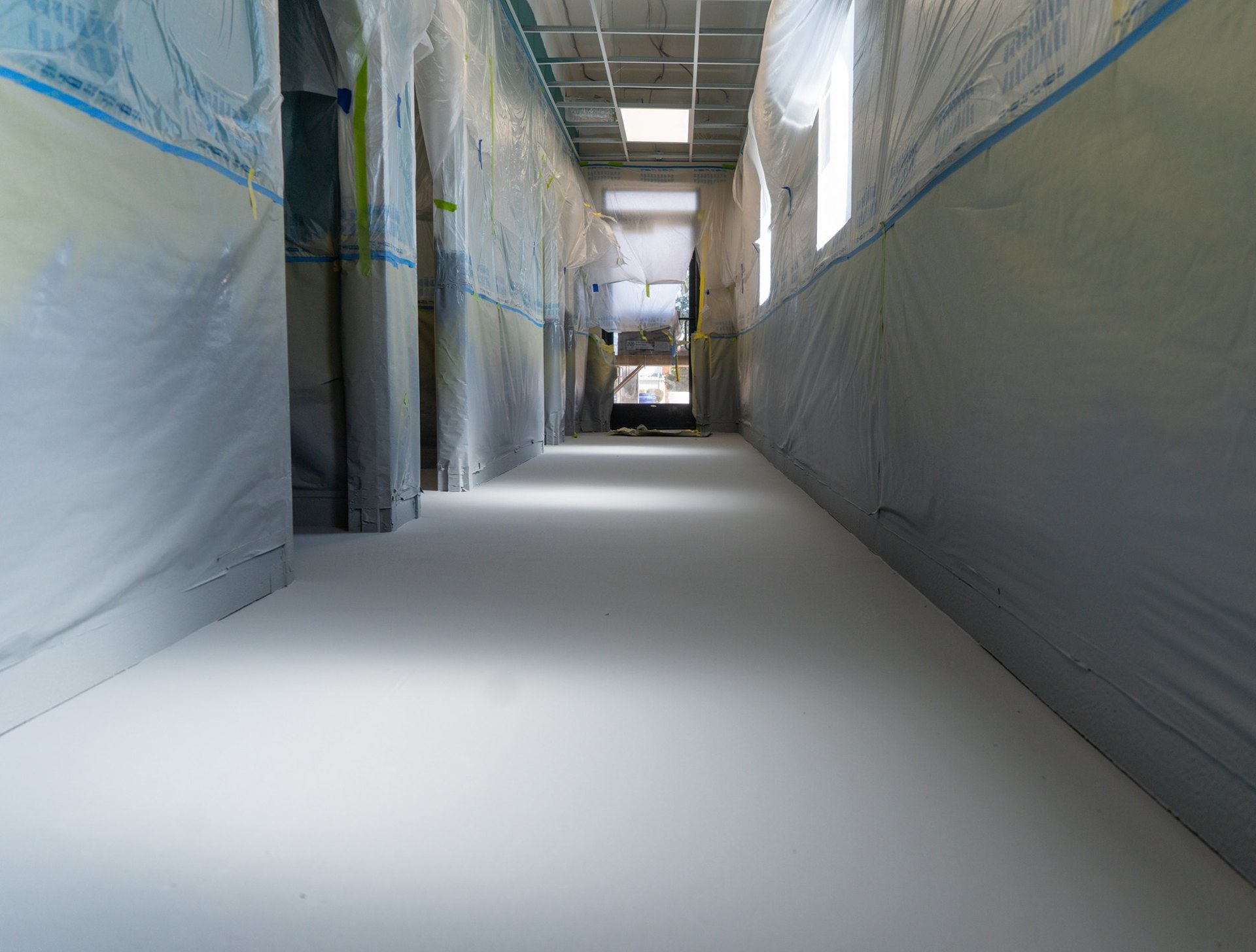
Corridors and coving
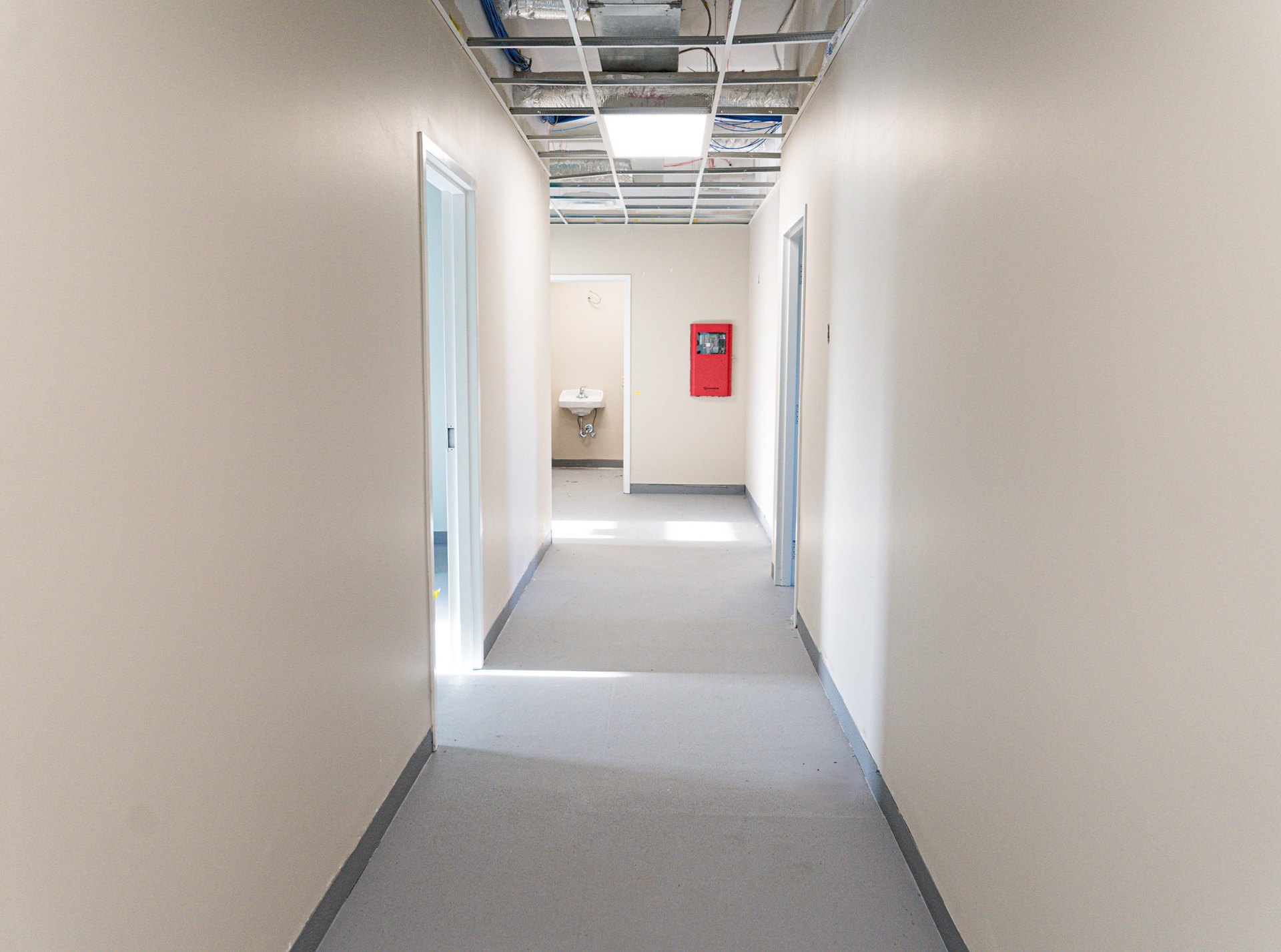
The coved base is the part a tile floor cannot do. Here it is sprayed continuous around every doorway and corner in the corridor.
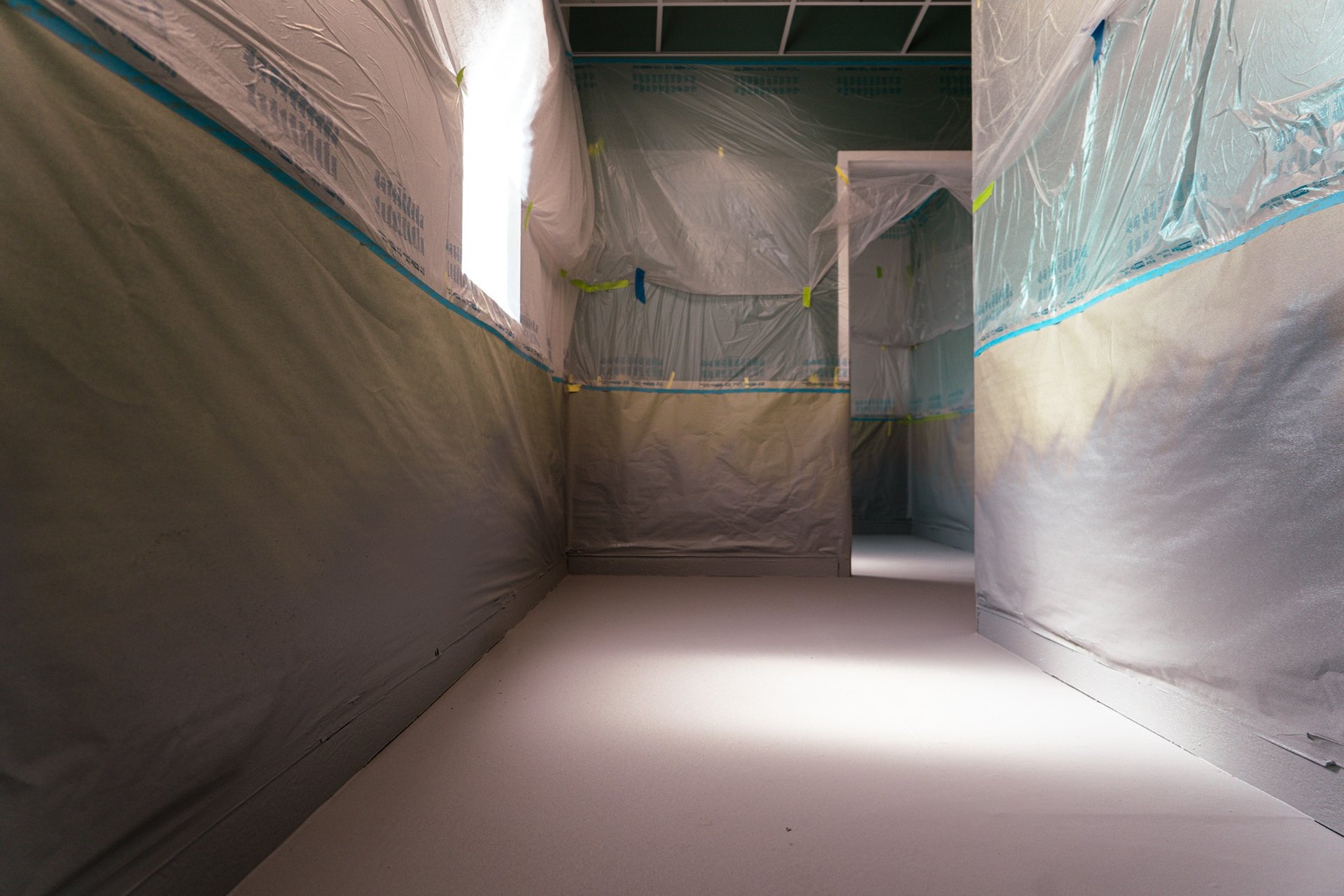
No joint at the floor line
Where the floor meets the wall there is a radius instead of a corner, so a mop or a hose actually reaches the dirt.
Handed over
The finished corridor: one monolithic grey film, floor to coved base, ready to be cleaned hard every day of its life.
See AquaSafe go down on a clinic floor.
The McClure Veterinary Clinic case study on film: the seamless floor system being sprayed on a working project.
What to expect from the film.
Typical values, rounded so you can size the product up quickly. Filter by what you care about, search for a property, or flip the sheet to metric.
No published property matches that search.
These are typical, rounded values obtained on ArmorThane equipment and parameters — they are here to give you a feel for the product, not to specify a job. Exact published figures, tolerances and test conditions are on the current AquaSafe technical data sheet; ask us and we will send it, along with the water-contact test documentation. A different spray machine or different parameters will change these numbers, so applicators should run their own testing for a given job. AquaSafe is for commercial use only and should only be applied by trained personnel.
How an AquaSafe job actually goes down.
The short version of the data sheet, in the order a crew does it.
- 01
Prepare the substrate properly
Coating performance and adhesion are directly proportional to surface preparation, and most coating failures trace back to it. Everything has to come off: dust, dirt, oil, grease, rust, corrosion. On a tank that has been in service, think about what the substrate has absorbed — that can defeat adhesion no matter how well it was prepped.
- 02
Precondition both drums and fit the desiccants
Bring Side A and Side B to around 70°F (21°C) before you spray, and fit a desiccant device to both containers while they are in use. Neither side may be diluted under any circumstances.
- 03
Power-agitate Side B and pigment it
Side B is a blend of many components and has to be agitated with air-driven power equipment until the color and the mixture are uniform — about a minute per gallon. Then add ArmorThane pigment at 100 grams per gallon. Side A needs no agitation.
- 04
Check the surface against the dew point
Surface temperature needs to be at least 5°F above the dew point. AquaSafe will spray onto a surface down around 30°F (−1°C), which opens up shutdown windows other coatings cannot take, but the dew point rule still holds.
- 05
Spray hot and hard
Around 2,800 psi minimum, material above about 150°F (66°C), through an ArmorThane HighLine 2511 or 4011 plural-component system. Hold pressure and temperature throughout, and work in smooth multidirectional passes for even thickness.
- 06
Recoat inside the window, or topcoat it
Inter-coat adhesion is excellent within the recoat window of roughly six hours. AquaSafe is aromatic, so it will yellow and darken under UV — anywhere sunlight and appearance both matter, finish it with ArmorThane UV Topcoat or UV ColorCoat.
The chemistry is only half of what you get.
ArmorThane makes the coating, builds the plural-component rig that sprays it, trains your crew hands-on and certifies them, and answers the technical line afterwards. No franchise fees, no royalties, no territory you have to buy. Applicators have come first here since 1989.
- Equipment package matched to the work you want to take on
- Hands-on training and applicator certification
- Technical support for the life of the business
- Applicators in more than 50 countries
AquaSafe, answered.
Is AquaSafe certified for potable water?
We say tested rather than certified, deliberately. Representative samples were evaluated by UL Solutions against NSF/ANSI/CAN 61 for drinking water health effects and NSF/ANSI/CAN 372 for lead content in June 2024, and AquaSafe separately passed AS/NZS 4020 testing at the Australian Water Quality Centre. UL's own document states that only product carrying the UL Mark counts as UL Certified, so we do not use that word. If your specification needs the mark or the full report, tell us and we will send what we hold.
What is the difference between AquaSafe and the HighLine products?
They are all ArmorLine pure polyureas, but they are aimed at different problems. HighLine 510H is the hard, abrasion-first industrial grade. AquaSafe is formulated for water contact and for surfaces that get cleaned constantly — softer at around 50 Shore D, stretchier at roughly 450% elongation, and with far lower Taber abrasion loss.
Why do both drums need a desiccant device?
Because this chemistry reacts with moisture. A desiccant device on each container keeps humid air out of the drum while you are drawing from it, which protects the material you have not sprayed yet. It is a step people skip and then cannot explain the foaming.
How cold can you spray it?
Onto a surface down around 30°F (−1°C). The very fast gel time is what makes that possible. The surface still has to be at least 5°F above the dew point, and both drums still need preconditioning to roughly 70°F before they go through the rig.
Can it go on a small tank, or inside pipe?
Pipe of nine inches in diameter and larger is in scope. Tank size is a different question — the minimum vessel size assumed in the water-contact testing is not the same as the minimum size you can physically spray, so check the current data sheet and the test documentation for the size you have in mind rather than assuming.
Does it need a primer?
Not on carbon or mild steel — it coats those without primer and still reads over 900 psi at a 75 to 100 micron blast profile. On concrete it performs over 500 psi both primed and on a shot-blasted profile, and in both cases the bond test fails the concrete rather than the coating.
Will it stay the color we sprayed?
Not in sunlight. AquaSafe is aromatic, so it yellows and darkens after UV exposure. The film keeps performing — a QUV exposure of about 3,000 hours shows no cracking or blistering — but color changes, gloss drops and it chalks. Inside a tank or a building this is irrelevant; outdoors, topcoat it with ArmorThane UV Topcoat or UV ColorCoat.
How long until the space can be used again?
Foot traffic within a few hours, full service after about a day. It is tack free in under a minute, which on an occupied or still-under-construction building is what keeps dust out of a fresh film.
What do we need to know before handling it?
This product contains isocyanate and curative material. Read the Safety Data Sheets for both sides before anyone touches a drum — regulations require that every employee be trained on the SDS for the chemicals they work around. Side A is suspected of causing cancer and can sensitize the airways; Side B causes serious eye damage and skin burns and is very toxic to aquatic life. Wear a fresh-air respirator, protective gloves and clothing, eye and face protection, and keep contaminated clothing out of circulation.
Tell us what you need to line.
Describe the tank, the building or the floor, and where you are. An ArmorThane specialist will come back with the right chemistry, the rig that sprays it, the test documentation you need for the spec, and what a startup actually costs.
- Equipment package matched to your applications
- Hands-on training and applicator certification
- Water-contact test documentation for your specification